Retirement Planning Template
Retirement Planning Template for Couples
One retirement planning template you set up around a household of two: combined savings, combined pension income and one shared expense figure, projected to the life expectancy you choose.
In Depth
Two Timelines, One Retirement Plan
Couples rarely retire at exactly the same time with exactly the same resources, which creates a planning challenge that single-person models cannot address. One partner may have a pension while the other has a 401(k). One may plan to work until 67 while the other wants to stop at 60. The years between the first and second retirement represent a transition period where income drops, healthcare coverage may change, and the financial plan needs to support one retired and one working partner simultaneously.
Social Security strategies for couples involve a set of decisions that interact with each other. A higher-earning spouse who delays claiming until 70 increases not only their own benefit but potentially the survivor benefit as well. The lower-earning spouse may benefit from claiming earlier if the household needs income during the gap years. These claiming decisions are interconnected - changing one partner's timing affects the other's options. Having both partners' full financial picture visible in one place makes it possible to compare scenarios meaningfully.
The surviving spouse scenario is a dimension of couples retirement planning that is uncomfortable but financially significant. When one partner passes, the household loses one Social Security benefit, potentially a pension, and moves to single-filer tax brackets - which are narrower than joint brackets. This can mean higher taxes on the same withdrawal amounts. Some couples find that Roth conversions during the joint retirement years help reduce this future tax burden for the surviving partner.
The Challenge
Why Couples Need Joint Retirement Planning
Retirement for two is more than double retirement for one. Different ages, different Social Security records, survivorship considerations, and shared spending create planning complexity that individual models miss.
Two Social Security records need coordination
When each partner claims Social Security dramatically affects household income. Spousal benefits, survivor benefits, and claiming age optimization require modeling both records together.
Different retirement ages complicate planning
If one partner retires at 58 and the other at 65, the plan needs to handle seven years of single-income coverage, healthcare bridge costs, and shifting income sources.
The surviving partner needs to be covered
When one partner passes, household income often drops more than expenses. Pension reductions, Social Security changes, and tax bracket shifts all affect the surviving partner.
Healthcare bridge is often needed before Medicare
If one partner retires before 65, COBRA or marketplace insurance creates a significant expense that lasts until Medicare eligibility.
Ready to see your couple finances in one place?
What You Get
Joint Retirement Planning Features for Couples
Household income in one set of inputs
Pension income and other income are entered as monthly household totals, so both partners are added together before the figures go in. The projection then runs on the combined numbers.
One pension start age you set
A single start age drives the projection, and the years before it are counted as a bridge period funded from the portfolio. Comparing claiming ages means running the projection once per age.
Cards for a drop in guaranteed income
There is no survivorship model. Two of the what-if cards remove the pension entirely or cut it by half, which is the closest the template gets to a large fall in household income.
Bridge years before pension starts
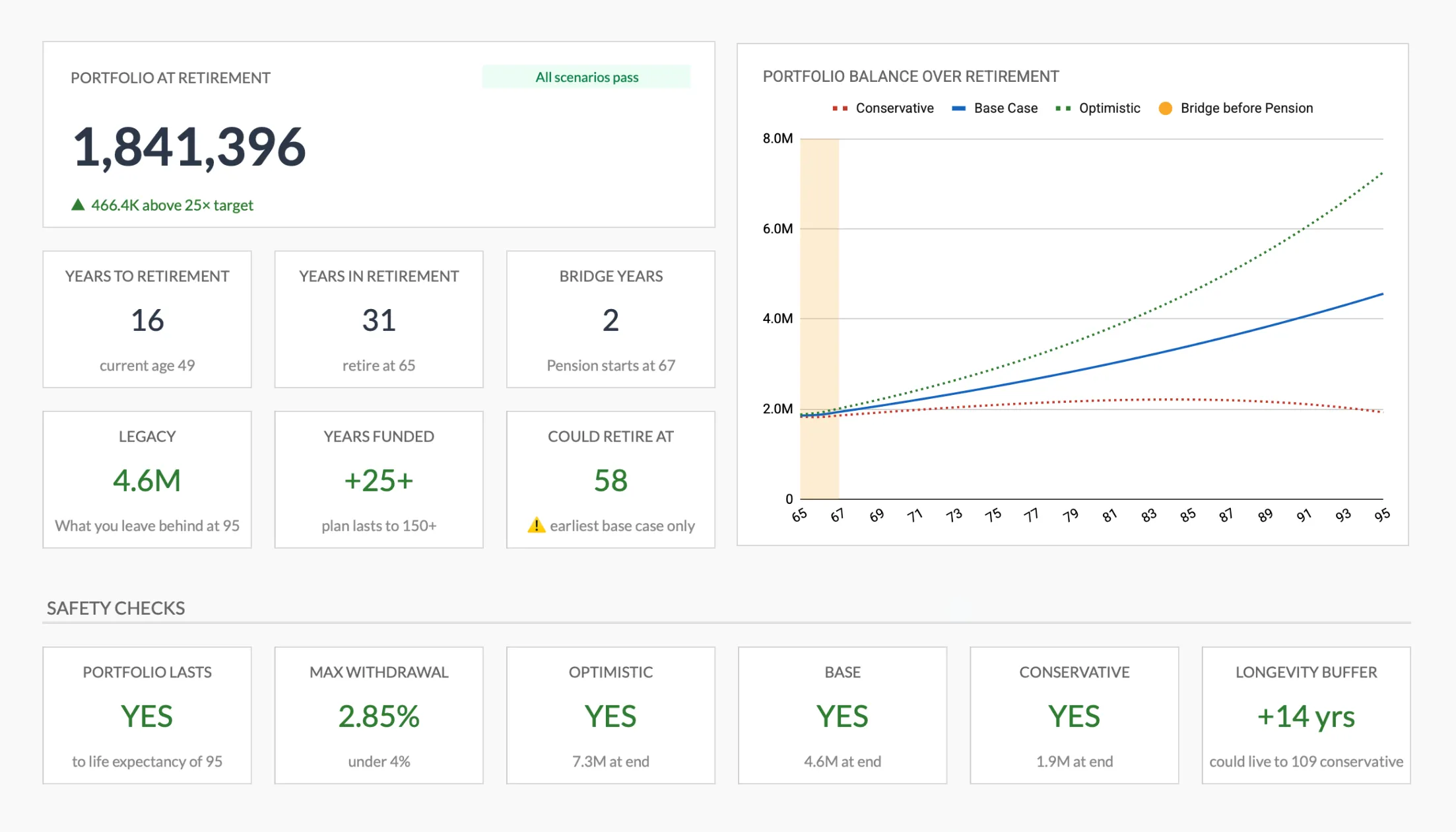
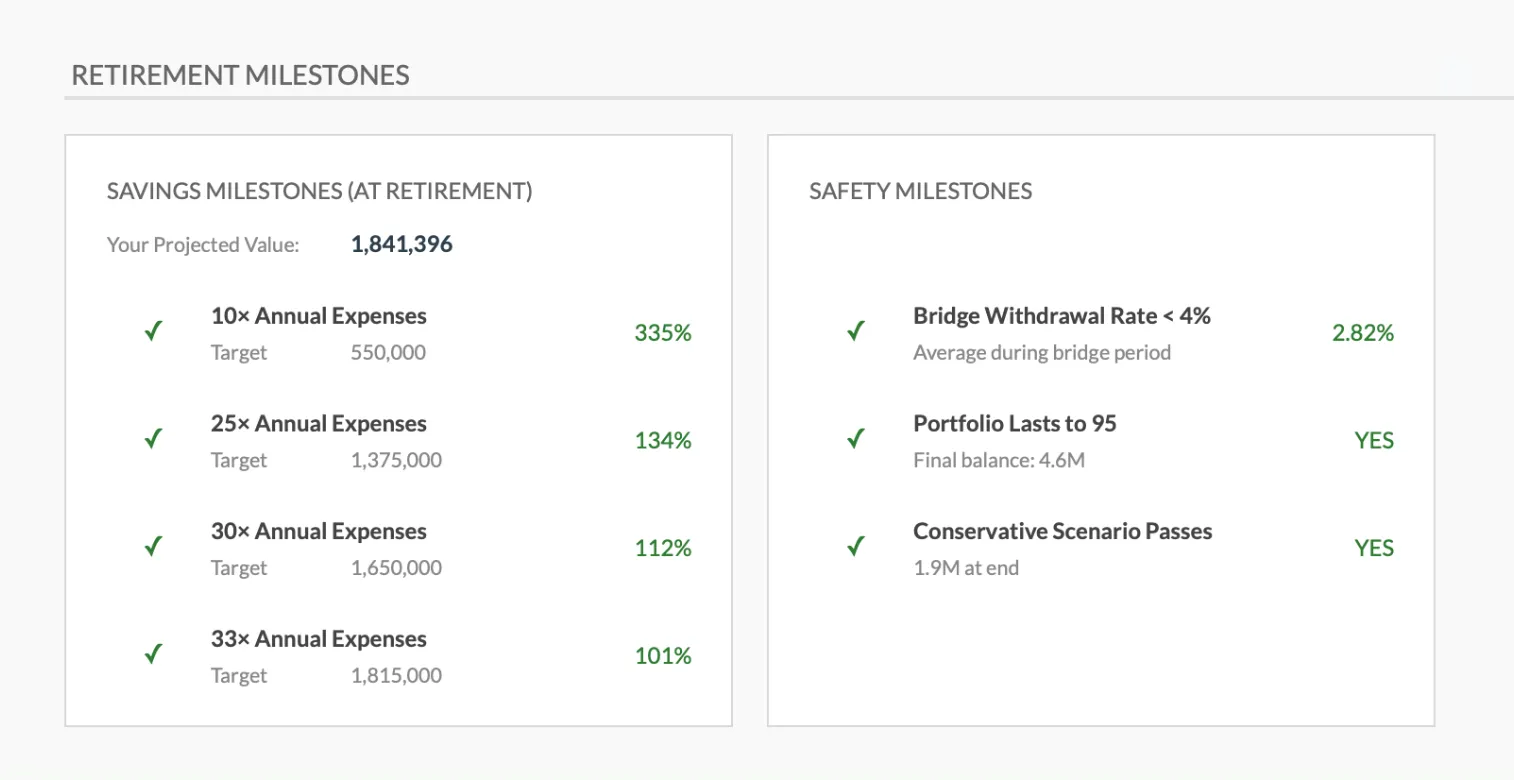
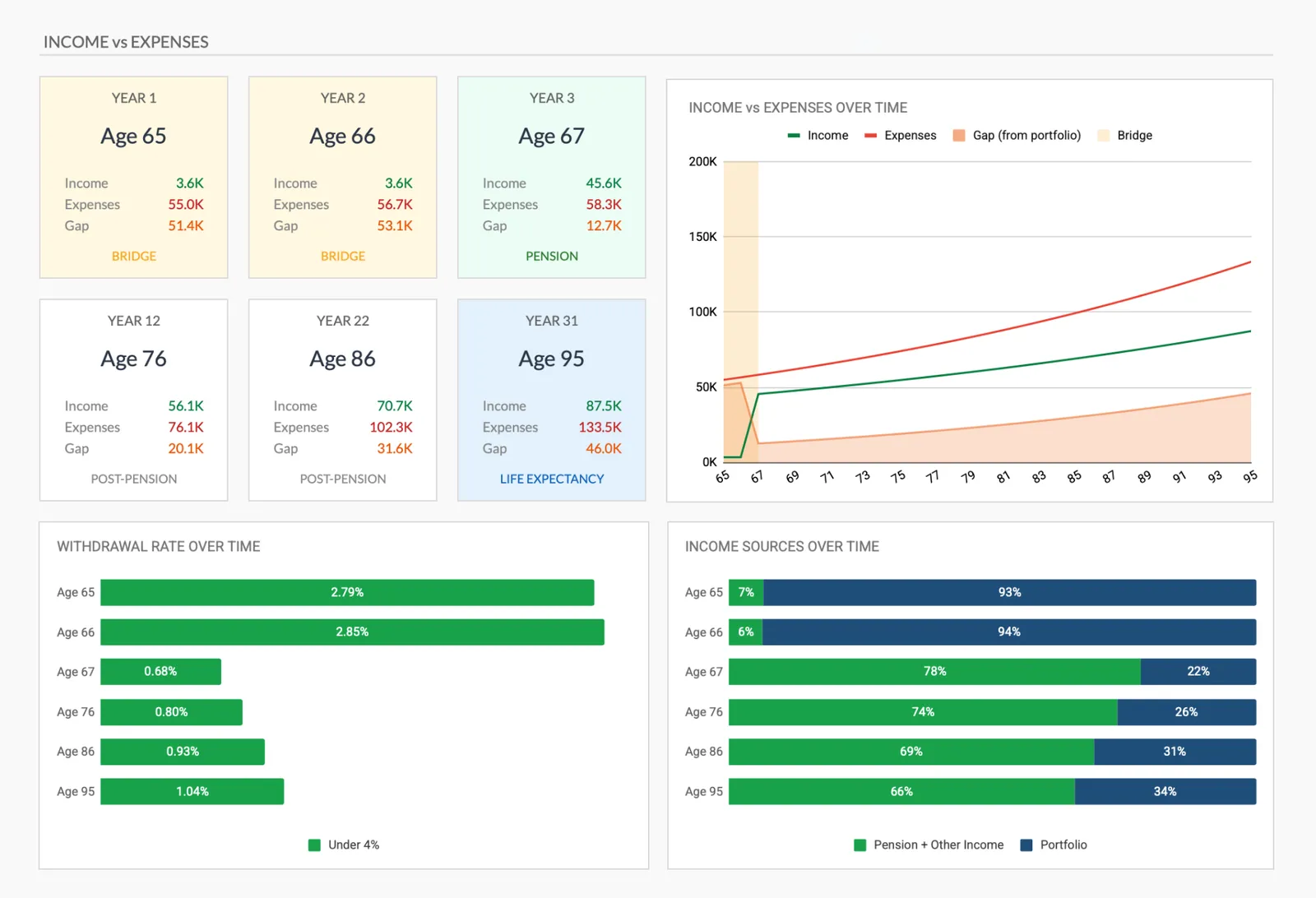
The gap between your retirement age and the pension start age is calculated, shaded on the charts, and its average withdrawal rate checked against 4%. Cover bought before Medicare folds into the annual expense figure.
One combined portfolio
Savings from both partners go in as a single balance. Whatever income does not cover is drawn from that one pot, and the withdrawal is reported as a percentage every year.
What-if scenario comparison
Twelve cards recalculate from your inputs, among them a one-year delay, retiring now, stopping saving, expenses 10% higher or lower, no pension and a 20% market drop.
See It In Action
What the template looks like
Browse through the template to see how it handles retirement projections, milestone tracking, and income planning.
- Retirement overview dashboard
- Savings growth projections
- Retirement milestone tracking
- Income vs expenses analysis
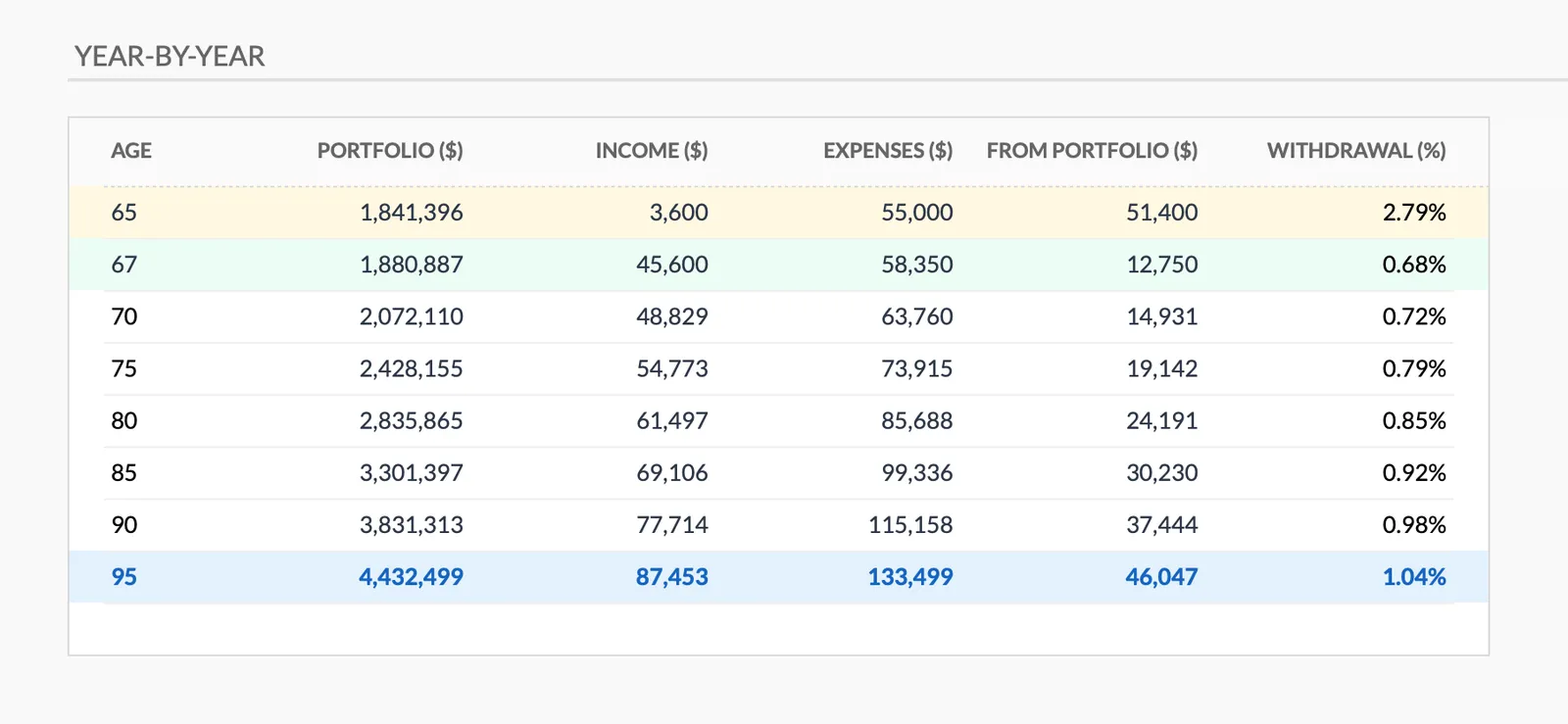
- Year-by-year projection
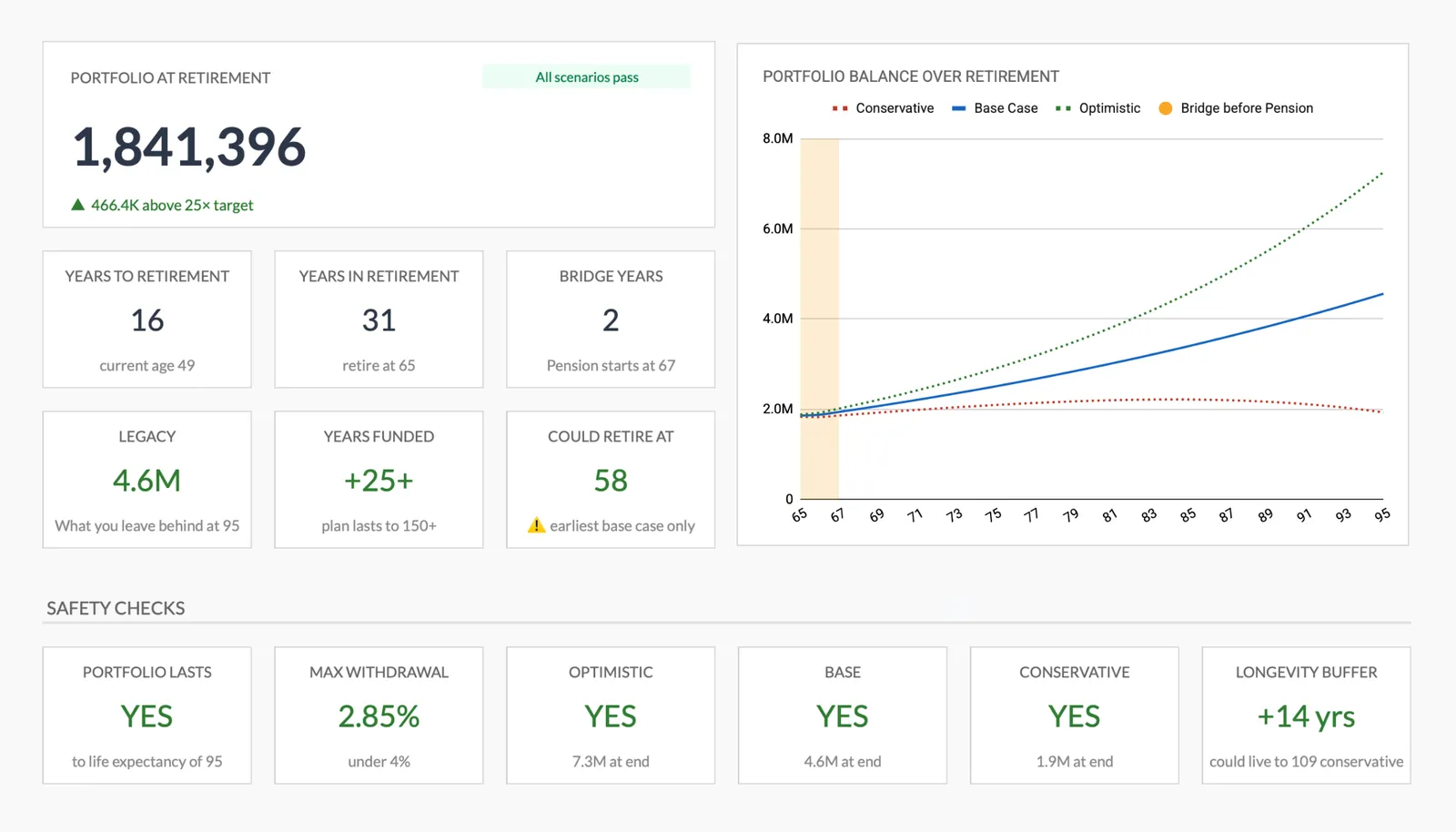
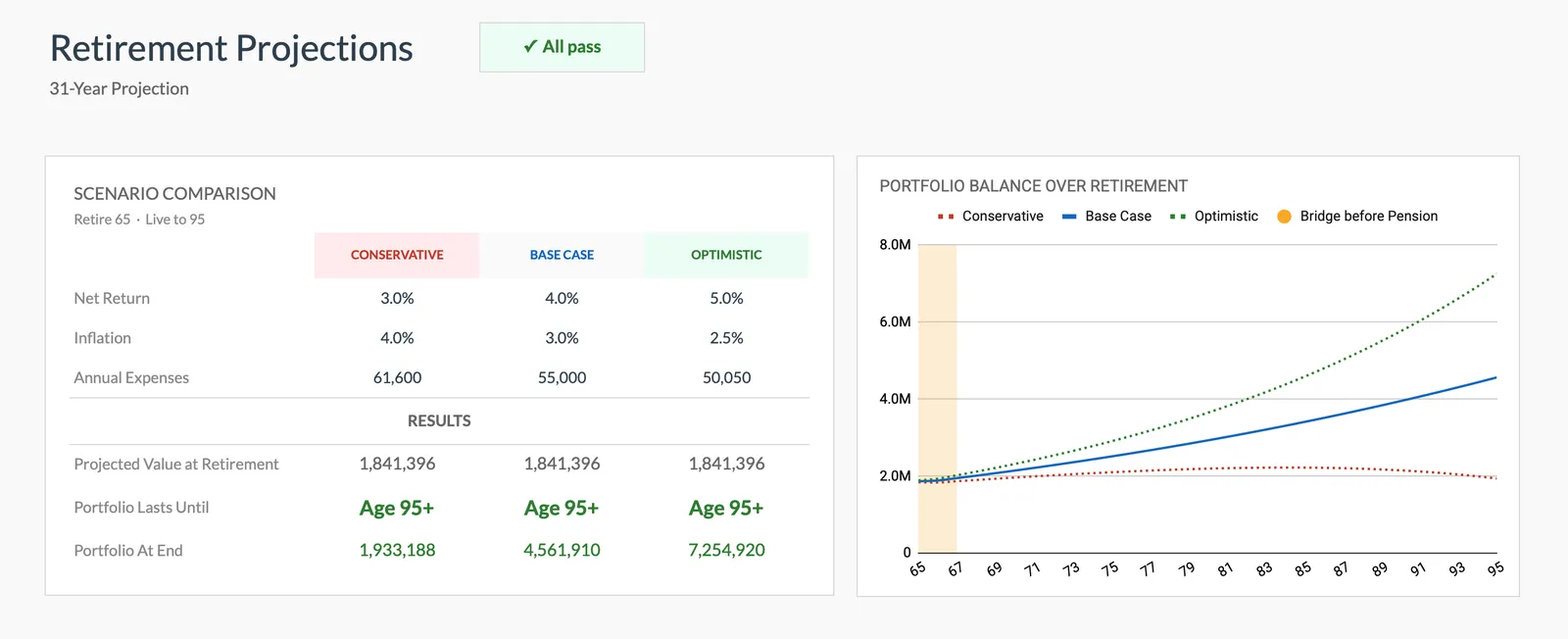
Complete retirement overview with projections
Project your retirement savings growth
Track progress toward retirement goals
Plan your retirement income against expenses
Detailed year-by-year retirement projection
Getting Started
Begin Planning Retirement as a Couple
Add both partners into one set of figures
Savings from every retirement account, both partners included, go in as one total. Pension income and other income go in as combined monthly amounts.
Set one target retirement age
The template takes a single current age, target retirement age, life expectancy and pension start age. Two different stop dates means running the projection once per set of ages.
Define household spending needs
Total annual expenses is one figure for the household in the first year of retirement. The inflation rate you set grows it every year after that.
Compare the three return scenarios
Conservative, base and optimistic run side by side with different net returns and inflation rates, and each reports the portfolio balance at the end of the horizon.
Test the pension cards
The no pension and 50% pension cut cards show the projection with guaranteed household income removed or halved, and report the age the portfolio would run out.
Common Questions
Retirement Planning for Couples- FAQ
Should we both claim Social Security at the same age?
That depends on age difference, earnings history, health and other income. The template does not model two claiming records: it takes one pension start age, so comparing combinations means running the projection once per scenario and noting the results.
What about spousal Social Security benefits?
There is no spousal benefit calculation. A lower-earning spouse may receive up to 50% of the benefit the higher earner receives, depending on claiming timing, and whatever the household expects to receive goes into the combined monthly pension figure.
How do we handle different retirement dates?
The template works from one retirement age, so different dates mean running it more than once. One option is a run for each partner stopping work, another is a single run using the later date, with the earnings of whoever retired first entered as other income.
What if one partner has a pension and the other does not?
Enter whatever pension the household expects as the combined monthly figure. A stacked chart then shows what share of each checkpoint year comes from pension and other income and what share comes from the portfolio.
Can we model downsizing?
There is no one-off event input. Sale proceeds can be added to total current savings and the lower housing cost reflected in the annual expenses figure, then compared against a run without either change.
How does this handle the surviving partner's tax situation?
After one partner passes, the surviving spouse moves to single filing status with different brackets. The template does not model that. There is no tax bracket logic anywhere in it, and the return fields are labeled net of tax, so the change would show up only in the figures you enter for expenses or net return.
Can't find the answer you're looking for? Contact our team
Start retirement planning as a couple
One-time purchase. No subscription. Your financial data stays in your Google Drive.