Best Value Complete Financial Planning Bundle
✓ Financial Planning✓ Net Worth Tracker✓ Monthly Budgeting✓ Travel Budget Planner✓ Annual Budgeting Planner✓ Monthly Expense Tracker✓ Annual Tax Planner✓ Retirement Planning
View Bundle →

Instant digital delivery · Terms & Conditions apply

Essentials Template - Excel & Google Sheets

Essentials Accounts Payable Tracker Spreadsheet Template for Google Sheets & Excel

Thirty bills, each carrying the vendor, the invoice number, the amount, the date it arrived and the date it is due. The Essentials Accounts Payable Tracker spreadsheet template marks each one paid, unpaid, partial, overdue or disputed, counts the days remaining on anything still open, and keeps the unpaid balance per bill. A dashboard separates what is outstanding from what is already past due. Three working sheets. Google Sheets and Excel. No macros, no VBA.

Instant digital delivery · Terms & Conditions apply

Essentials Accounts Payable Tracker spreadsheet template - Google Sheets and Excel preview

What's Included

  • A row per bill with vendor, invoice number and amount
  • The date a bill arrived as well as the date it is due
  • A status marking paid, unpaid, partial, overdue or disputed
  • Days until due, counted on anything still unpaid
  • The amount still unpaid, per bill
  • Derived columns that clear themselves once a bill is paid
  • Outstanding and overdue reported separately
  • A count of overdue bills, and what you have paid
  • The average time you actually take to pay
  • Works in Microsoft Excel and Google Sheets with no setup required

The FinancialAha Essentials Accounts Payable Tracker Spreadsheet Template is a two-sheet workbook for Google Sheets and Excel, with a How to Use guide on a third tab. It works as an Essentials Accounts Payable Tracker Excel template and an Essentials Accounts Payable Tracker Google Sheets template from the same download. A row per bill with the date each arrived and the date it is due, a status marking paid, unpaid, partial, overdue or disputed, a countdown on anything outstanding, and a dashboard separating what you have paid from what you still owe. No macros, no VBA.

Inside the workbook

What's inside the FinancialAha Essentials Accounts Payable Tracker spreadsheet template

The FinancialAha Essentials Accounts Payable Tracker Spreadsheet Template runs on two working sheets, with the instructions on a tab of their own. It works in both Microsoft Excel and Google Sheets and here is what the Essentials Accounts Payable Tracker spreadsheet holds.

  1. 01 of 02

    Payables

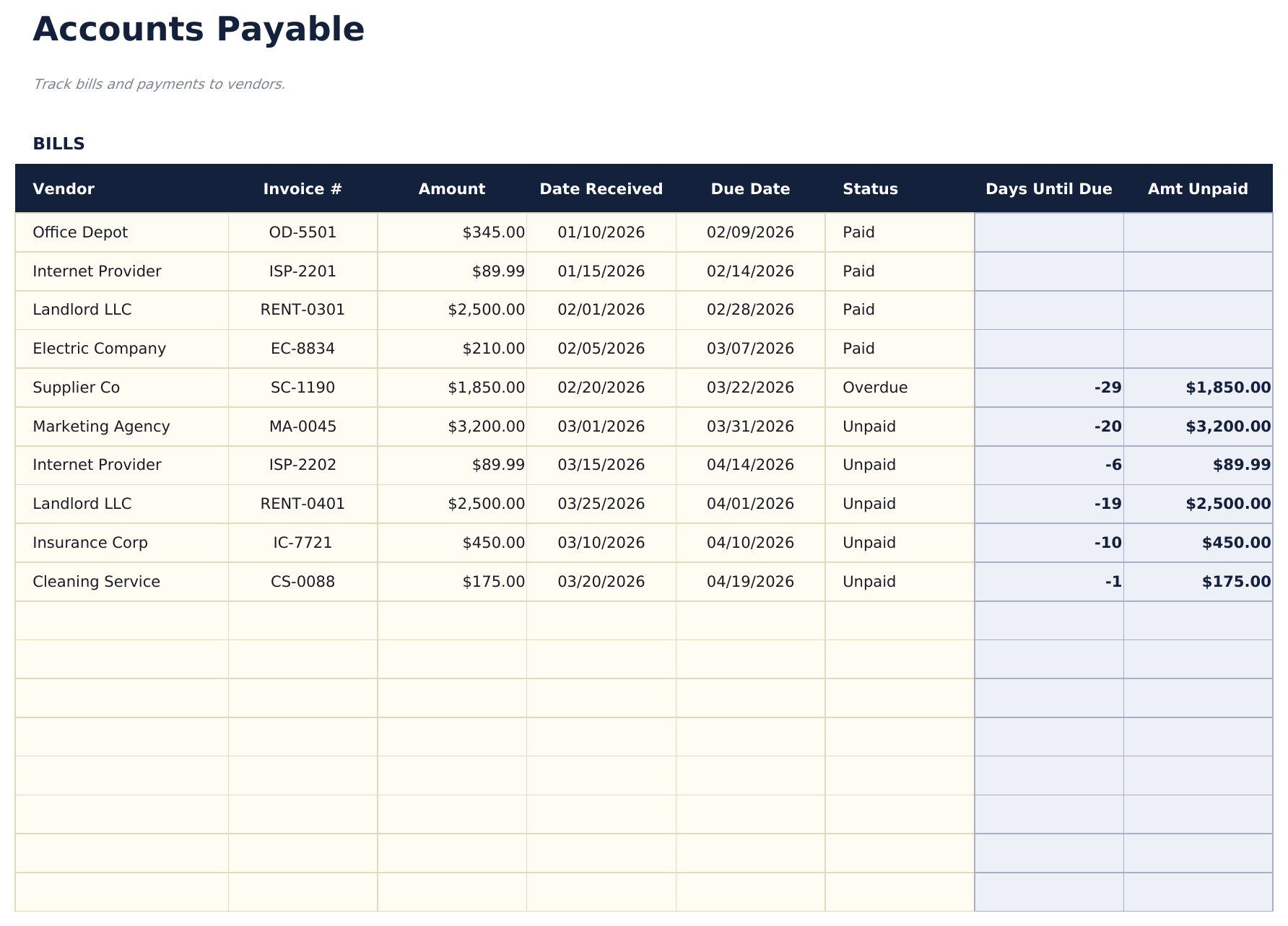
    A row per bill carrying the vendor, the invoice number, the amount, the date the bill arrived, the date it falls due and whether it has been paid. Beside them, two derived columns: how many days remain until an unpaid bill is due, and how much of the bill is still outstanding. Both derived columns go blank the moment a row is marked paid, which is what keeps the sheet readable as it fills up. A payables list that shows a countdown against every historic bill is a list nobody scans; one that only counts what is still live is a working document. Recording the date a bill arrived as well as the date it is due is what makes the payment window measurable - not how long a vendor gives you, but how long you actually take.

  2. 02 of 02

    Dashboard

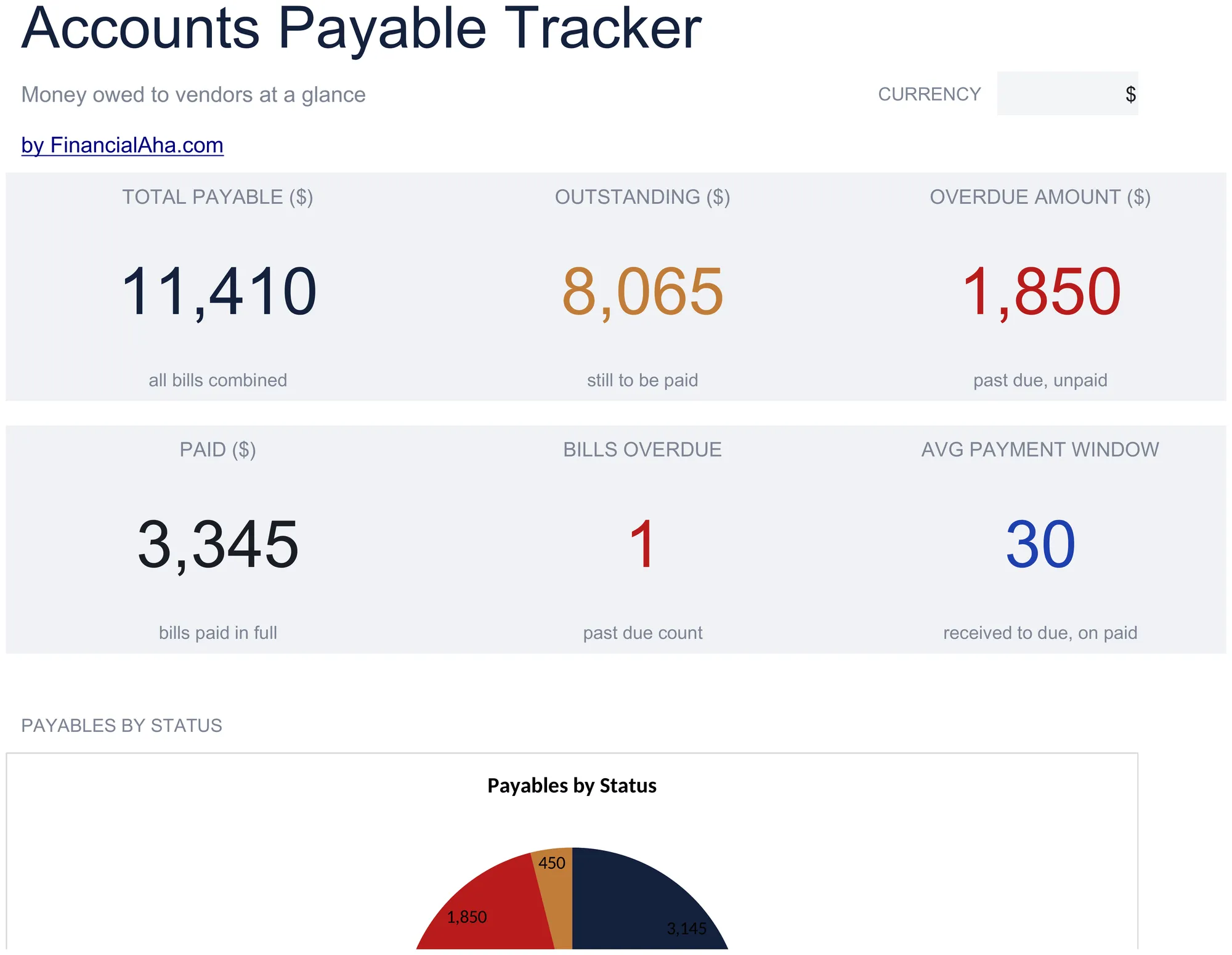
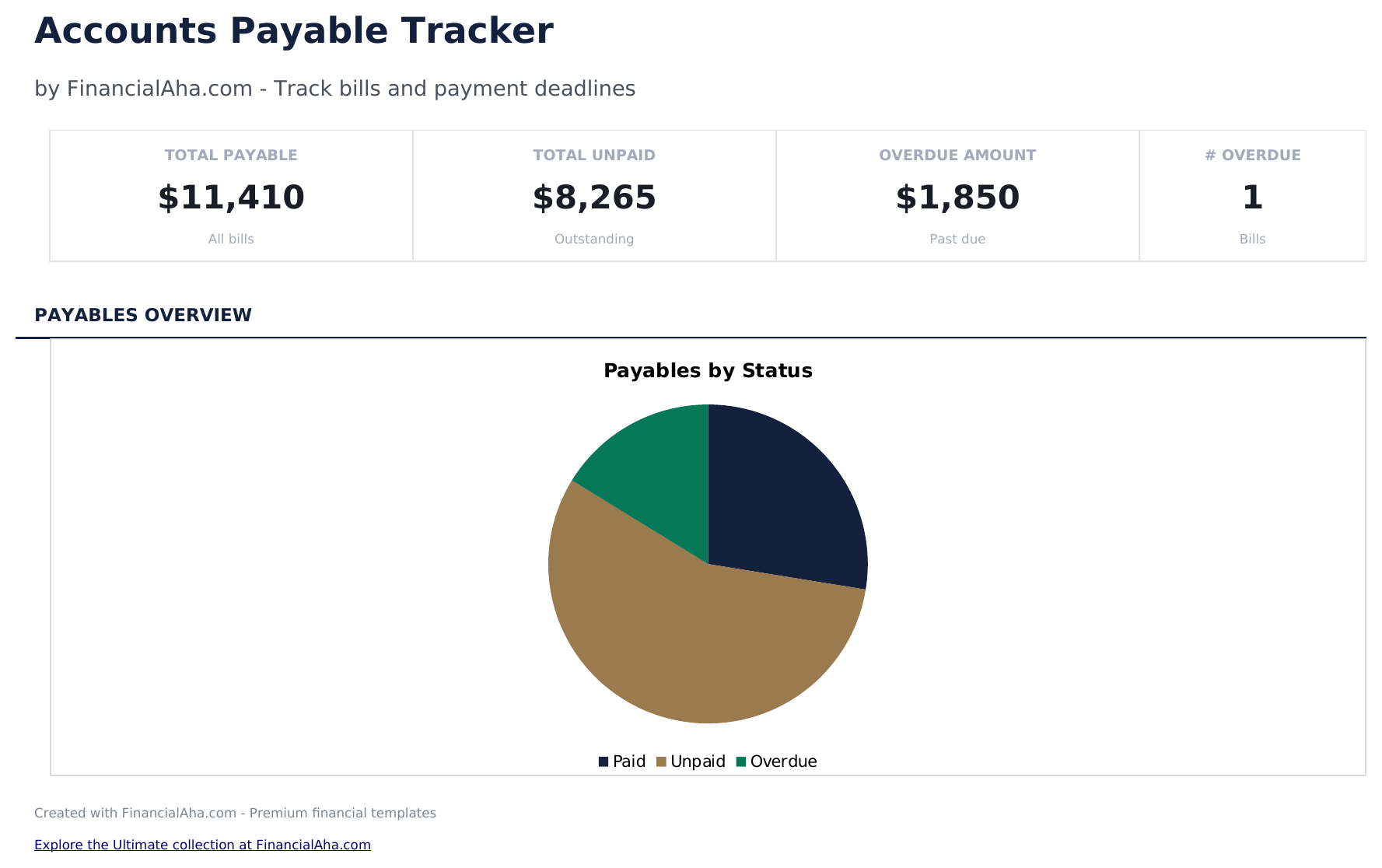
    Six figures and a chart. The top row carries every bill combined, what is still to be paid, and how much of that is already past due. The row beneath carries what has been paid, a count of the overdue bills and the average payment window across the ones you settled. Splitting outstanding from overdue is the split that matters. Outstanding is a plan; overdue is a relationship. A supplier who is two weeks late being paid remembers it at renewal, and one number that mixes the two hides which of your vendors is in that position. The average payment window is the figure a business rarely measures about itself. Most owners believe they pay on time, and the arithmetic is the only thing that settles it.

  3. Included guide

    How to Use

    A step-by-step guide on its own tab, covering what each column expects, how the derived columns behave once a bill is marked paid, and how to change the currency. Because it ships inside the file, the instructions travel with the template wherever it is opened.

Works in both Google Sheets and Excel

Essentials Accounts Payable Tracker Spreadsheet template for Google Sheets

Upload the Essentials Accounts Payable Tracker Spreadsheet Template to Drive, right-click it, and choose "Open with Google Sheets". This Essentials Accounts Payable Tracker Google Sheets template needs no conversion step, the chart comes across, and the countdown re-reads the date in Sheets exactly as it does in Excel.

Essentials Accounts Payable Tracker Google Sheets template setup

A shared copy of the Essentials Accounts Payable Tracker Google Sheets template suits a business where bills arrive to one person and get paid by another, which is where most missed due dates come from.

Running the Essentials Accounts Payable Tracker Google Sheet

The Essentials Accounts Payable Tracker Google Sheet takes a row when a bill arrives and a status change when it is paid. Everything else follows from those two habits.

Essentials Accounts Payable Tracker Spreadsheet template for Excel

The Essentials Accounts Payable Tracker spreadsheet Excel download is a plain .xlsx. Excel opens this Essentials Accounts Payable Tracker Excel template directly, with no import step, and the chart is a native Excel chart rather than a picture. There are no macros and no VBA in the file.

Essentials Accounts Payable Tracker Excel template setup

The same Essentials Accounts Payable Tracker Excel template opens in Excel on Windows, Excel on Mac, and Excel for the web. It is also the identical file you would upload to Drive, so there is no separate Essentials Accounts Payable Tracker spreadsheet download to choose between.

Essentials Accounts Payable Tracker spreadsheet Excel notes

The Essentials Accounts Payable Tracker spreadsheet Excel file carries no macros and no VBA, so Excel opens it without a trust prompt.

Opening the Essentials Accounts Payable Tracker spreadsheet Excel file

Nothing in the Essentials Accounts Payable Tracker Excel template is version-specific, so this Essentials Accounts Payable Tracker spreadsheet Excel workbook behaves identically in Excel on Windows, Excel on Mac, and older builds.

Spreadsheet template highlights

What the Essentials Accounts Payable Tracker spreadsheet template tracks

A row per bill. This is what the Essentials Accounts Payable Tracker Spreadsheet Template records for each one:

Vendor
who the bill is from
Invoice #
their reference
Amount
what is owed
Date Received
when the bill arrived, which is what makes the payment window measurable
Due Date
when it falls due
Status
paid, unpaid, partial, overdue or disputed, and the field the dashboard totals read
Days Until Due auto
derived, and blank once a bill is paid
Amt Unpaid auto
derived, and blank once a bill is paid

Compare builds

FinancialAha Accounts Payable Tracker spreadsheet template: Free and Essentials compared

Feature Free View Spreadsheet Template Essentials This page
Working sheets 1 2
Bill rows 16 30
Vendor and bill number Yes Yes
Due date Yes Yes
Status Derived from Paid and the due date Paid, unpaid, partial, overdue or disputed
Date the bill arrived Yes
Days until due Counted for unpaid bills
Amount still unpaid Per bill
Outstanding and overdue totals Yes
Average payment window Yes
Charts 1

The Free Accounts Payable Tracker Spreadsheet Template lists what you owe, carries a Paid column and works the urgency out from the due date itself. The FinancialAha Essentials Accounts Payable Tracker Spreadsheet Template keeps the history: a paid, unpaid, partial, overdue or disputed status on every bill, the date it arrived as well as the date it is due, a countdown and an unpaid amount that clear themselves when a bill is settled, and a dashboard separating outstanding from overdue with the average time you actually take to pay.

Good to know

Notes on working in the Essentials Accounts Payable Tracker spreadsheet template

  • Outstanding is a plan; overdue is a relationship. The dashboard keeps them apart for that reason.
  • The derived columns go blank once a bill is marked paid, which is what keeps the sheet readable as it fills.
  • Recording when a bill arrived is what makes the payment window measurable - not what the vendor allows, but what you take.
  • The status is typed here rather than derived, because payment is a fact a date cannot tell you.
  • Most owners believe they pay on time; the average payment window is the only thing that settles it.
  • The currency dropdown relabels the money columns across the workbook. It changes the label only and does not convert the numbers.

How to Use the Essentials Accounts Payable Tracker Spreadsheet Template

1

Log the bill

Vendor, invoice number and amount.

2

Record both dates

When it arrived, and when it is due.

3

Set the status

Paid, unpaid, partial, overdue or disputed.

4

Read the dashboard

Outstanding, past due, and your payment window.

Stress-tested with AI.

Every template starts with deep research into how people actually track the topic. We design the layout, build the formulas, and polish the design until it feels like something we would use ourselves. Along the way, we use AI to stress-test the calculations: unusual inputs, edge cases, and formula behavior, checked until the numbers hold.

Instant digital delivery · Terms & Conditions apply

Frequently Asked Questions

Is the FinancialAha Essentials Accounts Payable Tracker Spreadsheet Template a Google Sheets template?

Yes. Upload the file to Drive and choose "Open with Google Sheets". The chart comes across in the Essentials Accounts Payable Tracker Google Sheets template, and the countdown re-reads the date exactly as it does in Excel.

Is the FinancialAha Essentials Accounts Payable Tracker Spreadsheet Template an Excel template?

Yes. The download is a plain .xlsx, so the Essentials Accounts Payable Tracker Excel template opens directly in Excel with no import step. The chart is a native Excel chart rather than a picture, and there are no macros or VBA.

Will the FinancialAha Essentials Accounts Payable Tracker spreadsheet Excel file open in older versions of Excel?

Yes. The Essentials Accounts Payable Tracker spreadsheet Excel workbook ships as a plain .xlsx, so it opens identically in current Excel and in builds that predate dynamic arrays.

Why separate outstanding from overdue?

Because outstanding is a plan and overdue is a relationship. A supplier who waits two weeks past terms remembers it at renewal, and one figure mixing the two hides which vendors are in that position.

What happens when I mark a bill paid?

The countdown and the unpaid amount go blank on that row, so the sheet only counts what is still live. A list that shows a countdown against every historic bill is one nobody scans.

What is the average payment window?

The average time between a bill arriving and its due date across the ones you have paid. Most owners believe they pay on time; the arithmetic is the only thing that settles it.

Why is the status typed here rather than derived?

Because this build records payment, and whether a bill has been paid is a fact no date can tell you. The Free build has no payment state, so it derives urgency from the due date instead.

How do I open the Essentials Accounts Payable Tracker spreadsheet template in Google Sheets?

Upload the .xlsx file to Google Drive, then open it with Google Sheets. All formulas and formatting will be preserved.

More Essentials Business Finance Templates

Essentials

Instant digital delivery · Terms & Conditions apply

Highlights:

Dashboard with charts and KPIs
Pre-filled categories and sample data
No sign-up, no subscription
Lifetime free updates
Works in
Excel Google Sheets

Looking for premium spreadsheet templates?

Our paid templates include advanced multi-sheet dashboards, native Excel charts, and ongoing updates.

Private & secure

Your financial data stays on your device. We never see it.

Learn more →

Need help?

Check our guides or reach out with questions.

View FAQ →