
The average US wedding runs about $34,000, or $292 per guest, though real costs swing from under $15,000 to well past $50,000 depending on guest count, city, and season. This guide splits a wedding budget into standard category percentages, flags the service charges and tips that add 15-25% to quoted prices, and lays out a payment timeline so savings line up with vendor deposits.
The average US wedding costs about $34,000, or roughly $292 per guest, according to The Knot’s 2026 Real Weddings Study, which surveyed more than 10,000 couples married in 2025. Costs still range from $10,000 to $100,000+ depending on guest count, location, and season, so building a realistic budget matters more than matching any average. Your wedding’s right number depends on your specific circumstances, not national statistics.
The financial side of wedding planning can feel overwhelming, but breaking it into manageable pieces helps. Understanding cost drivers, tracking vendor payments, and planning for hidden expenses all reduce stress and prevent unpleasant surprises.
Track it in one sheet: The free Wedding Budget template covers the major categories with budgeted-versus-actual columns and a buffer line. The Essentials version ($19) adds a summary dashboard, and the Ultimate version ($29) adds a vendor tracker, a payment schedule, and a cost-per-guest breakdown.
Starting Your Budget
Determining total budget comes first - before vendors, venues, or Pinterest boards. Add up savings available, family contributions if any, and any amount you’re comfortable financing. This number becomes the constraint that shapes all other decisions.
Worth knowing: many couples who finance weddings later wish they’d scaled back instead. For some couples, starting married life without wedding debt matters more than the upgraded menu or extra flowers. The wedding is also the opening line of a shared financial life, and the guide to planning for major life changes covers the marriage-and-beyond transitions that follow.
Three factors drive most of the cost variation. Guest count affects nearly every category - more people means more catering, bigger venue, more invitations, more everything. Location creates dramatic differences: in The Knot’s 2026 study, New York City weddings average about $88,000 while Alaska, one of the least expensive states, averages about $19,000 for essentially the same celebration. Season matters too, with summer typically running $2,000 more than winter dates due to demand.
Budget Breakdown by Category
These percentages represent typical allocations, though individual priorities may shift the distribution:
| Category | Percentage | $30,000 Budget |
|---|---|---|
| Venue & Catering | 45-55% | $13,500-16,500 |
| Photography/Video | 10-12% | $3,000-3,600 |
| Entertainment | 8-10% | $2,400-3,000 |
| Flowers & Decor | 8-10% | $2,400-3,000 |
| Attire | 5-8% | $1,500-2,400 |
| Stationery | 2-3% | $600-900 |
| Transportation | 2-3% | $600-900 |
| Hair & Makeup | 2-3% | $600-900 |
| Contingency | 10-15% | $3,000-4,500 |
Cost per guest averages around $292 nationally, up $8 from the year before. This rough metric helps estimate budget changes when adding or removing guests:
| Guest Count | Estimated Cost |
|---|---|
| 50 guests | $14,600 |
| 100 guests | $29,200 |
| 150 guests | $43,800 |
Hidden Costs to Budget For
Service charges and gratuities surprise many couples. Venue service charges add 18-22% on top of quoted prices - a $10,000 catering bill becomes $12,000 with service charges included. Vendor tips range from $50-500+ depending on service quality and local customs. Overtime fees for photographers, DJs, and caterers add up quickly if the reception runs long.
Day-of expenses include the marriage license ($25-100 depending on location), wedding party gifts, welcome bags for out-of-town guests, and emergency supplies. Post-wedding costs like dress preservation, thank you cards, and photo albums often get forgotten during planning.
Adding 10-15% buffer for these hidden costs and unexpected overages prevents budget blow-ups. This contingency consistently proves useful - something almost always costs more than quoted.
Regional Cost Variations
Location dramatically affects wedding costs, even for similar weddings. These metro averages from The Knot’s 2026 study illustrate the range:
| Location | Average Cost |
|---|---|
| New York City | $88,000 |
| Chicago | $54,000 |
| San Francisco | $51,000 |
| Dallas | $32,000 |
| Oklahoma City | $21,000 |
Destination weddings can sometimes reduce costs by moving to a lower-cost region, though travel expenses for guests and the couple add complexity.
Wedding Budget Tracker
Tracking vendor payments prevents surprises and ensures deposits and final payments happen on schedule:
| Category | Vendor | Estimate | Deposit | Paid | Balance | Due |
|---|---|---|---|---|---|---|
| Venue | Oak Hall | $8,000 | $2,000 | $2,000 | $6,000 | May 1 |
| Catering | Fresh Foods | $4,500 | $1,000 | $1,000 | $3,500 | May 15 |
| Photo | Jane Photo | $3,200 | $800 | $800 | $2,400 | Jun 1 |
Track total estimated, total paid, and remaining balance. Seeing where you’re over or under by category helps make trade-off decisions as planning progresses.
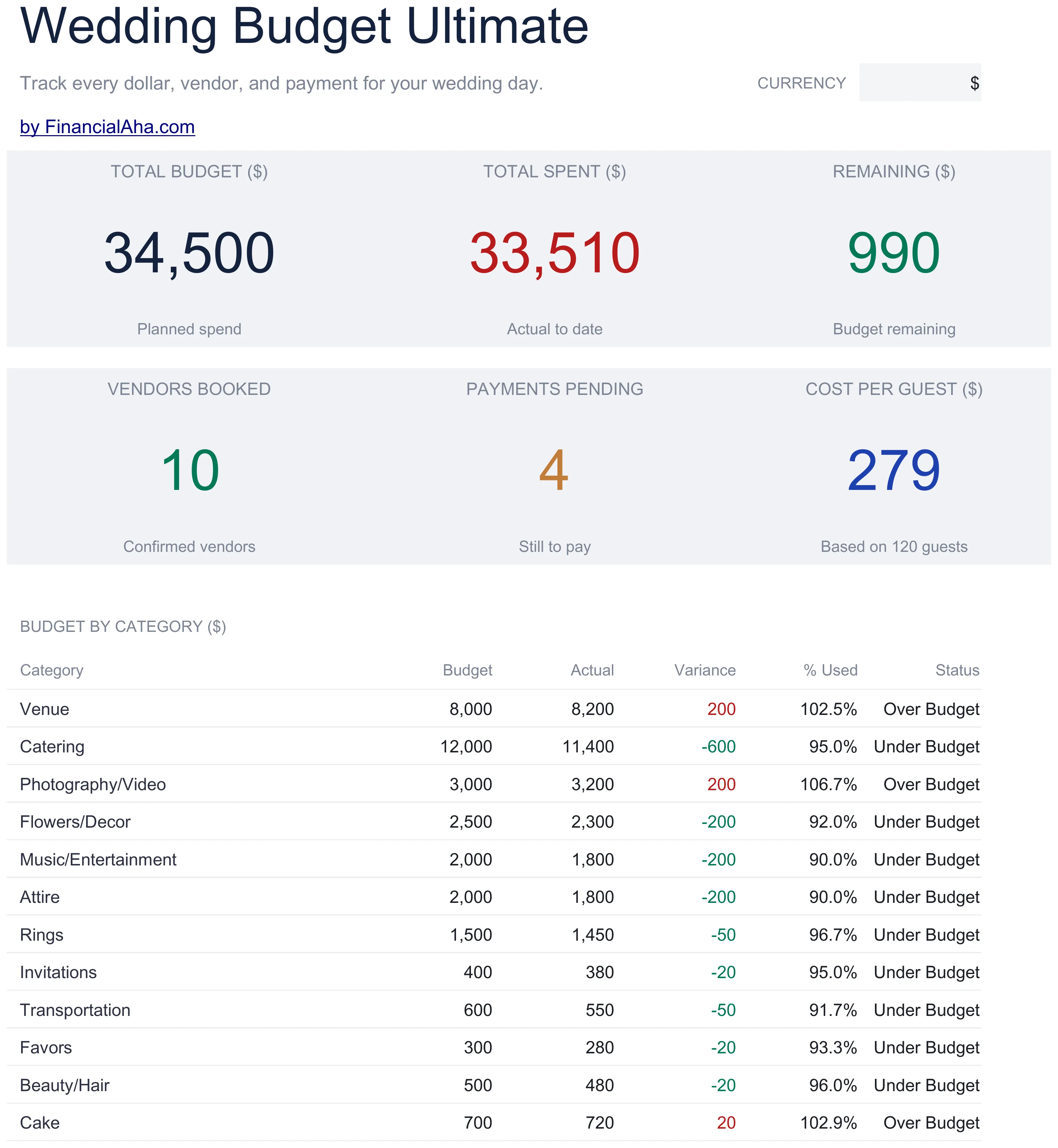
The Ultimate Wedding Budget template ($29) puts this on its own sheets: a vendor tracker with deposit paid and balance due per vendor, a payment schedule logging each payment as Paid, Scheduled, or Overdue, a guest cost analysis, and budget-versus-actual across 14 categories. The dashboard shown above reads from all of them, so it updates from the entries you type.
Cost-Saving Strategies
The highest-impact savings come from structural decisions. Reducing the guest list affects nearly every cost category. Off-peak timing, such as a Friday or Sunday instead of Saturday, can save 20-30% on venue costs. Off-season weddings (January-March in most regions) similarly reduce vendor rates.
Moderate savings opportunities include non-traditional venues like restaurants, parks, or family properties. In-season, locally-sourced flowers cost less than exotic imports. DIY invitations, favors, and some decor can reduce costs for couples with time and skills.
Smaller savings that add up: limiting bar to beer, wine, and a signature cocktail rather than full open bar; choosing buffet over plated service; sending digital save-the-dates. No single item transforms the budget, but together they create meaningful differences.
Payment Timeline
Wedding payments follow a general timeline that helps with planning savings. Venue deposits typically come at 12+ months out. Photographer and caterer deposits follow at 8-12 months. DJ and florist deposits land around 6-8 months before the wedding. Final payments begin 2-4 months out.
Aligning savings timeline with payment due dates prevents cash crunches. Knowing when large payments come due helps structure monthly savings contributions. The Savings Calculator can model how much to set aside each month to reach a deposit by its due date, and a savings goal tracker keeps each deadline visible as the balance grows.
Common Mistakes
Not accounting for hidden costs is perhaps the most common budget-buster. Service charges and tips add 15-25% to quoted prices. When comparing vendors, these additions are easy to miss until the final invoice arrives.
Prioritizing everything equally leads to frustration. You can’t have the best of everything within a budget. Deciding early what matters most, whether photography, food, venue, or flowers, allows strategic allocation of limited resources.
Skipping the contingency causes problems when something inevitably costs more than expected. Most couples who plan without a buffer regret it when reality exceeds estimates.
A working budget doesn’t have to be elaborate to catch these. Dropping your own numbers into the free Wedding Budget template turns the category percentages above into a live budget-versus-actual view, so an overrun in one category surfaces before it derails the rest.
Related
- Wedding Budget template (free) - budget-versus-actual across the major wedding categories
- Monthly Budget Template - track wedding savings alongside regular monthly expenses
- Savings Goal Tracker - line each vendor deposit up with its own savings deadline
- Spreadsheet Budgets for Couples - the shared household budget once the big day is done
- Budget-Friendly Date Night Ideas - keeping connection affordable after the wedding spend
- Sinking Funds Explained - the method behind saving toward a dated future cost
Frequently asked questions
When should I start building a wedding budget?
Starting 12-18 months out gives more room to save and to compare vendors. Shorter timelines mean working with what you already have rather than what you could accumulate over a longer stretch.
Does the $34,000 average include the engagement ring and honeymoon?
No. The Knot's national average covers the ceremony and reception and excludes the engagement ring and the honeymoon. Couples who count those separately usually see a total outlay well above the headline figure.
Why did my final invoice come in higher than the vendor's quote?
Most catering and venue quotes leave out the service charge, which commonly adds 18-22%, and gratuities land on top of that. A number that looks affordable at the quote stage can end up 15-25% higher once those lines are added.
Is the $34,000 average the number to plan around?
Not necessarily. The national average blends small courthouse ceremonies with six-figure celebrations, so it says little about any single wedding. Guest count, city, and season move the figure far more than the average does, which is why a budget built from your own numbers tends to be more useful than a benchmark.
Sources
- The Knot Worldwide Unveils 2026 Real Weddings Study - The Knot Worldwide
- The Average Wedding Cost - The Knot
About this article
Average wedding cost, cost-per-guest, seasonal, state and metro figures checked on 2026-09-10 against The Knot Worldwide 2026 Real Weddings Study, which analyzed 10,474 US weddings held in 2025. Wedding Budget template features checked on 2026-09-10 against the shipped workbooks: Free (Wedding Budget, How to Use), Essentials (Dashboard, Wedding Budget, How to Use) and Ultimate (Dashboard, Budget Overview, Vendor Tracker, Payment Schedule, Guest Cost Analysis, Budget vs Actual, How to Use). Last reviewed September 2026.