
Nearly every major transition - marriage, a baby, a home, a career change, divorce, retirement, or a new business - runs on the same four moves: map what will change, build a cash buffer before it hits, rebuild the budget for the new reality, then update beneficiaries and documents. Below are cost ranges, timelines, and the hidden costs for each change.
Major life changes create financial turbulence. Marriage, children, buying a home, career shifts - all of them.
Without planning, transitions become crises. With preparation, they’re just milestones you can handle.
Planning tools: The Financial Planning Template projects your assets and debt forward to an end year you pick, using six assumptions you set: income, expenses, assets growth, assets yield, debt change and inflation. The Net Worth Tracker shows your starting point, and the Monthly Budget Template handles the month-to-month adjustments.
Here’s what to know for life’s biggest transitions.
The Pattern That Works for Any Change
Most major transitions follow a similar financial pattern. Understanding what changes, building a buffer, adjusting your budget, and updating documents.
What Will Actually Change
Look at the full picture:
- Income (up, down, or staying the same?)
- Expenses (what’s new, what goes away?)
- Assets (buying something, selling something?)
- Liabilities (taking on debt, paying off debt?)
- Timeline (happening now or gradually?)
The Buffer You Need
Financial cushion matters more during transitions. Worth building up your emergency fund before the change happens. Reducing other obligations helps too.
If something goes wrong during the transition, you want room to handle it. The buffer that shows up in nearly every section below is the same idea each time, sized to your own expenses:
Budget Adjustment
Your old budget won’t match your new reality. New income, new expenses, new priorities.
The Monthly Budget Template lets you plan the new budget before the change, then adjust as reality unfolds.
Document Updates
Life changes mean paperwork changes:
- Beneficiaries on accounts
- Insurance policies
- Estate documents
- Account ownership
Easy to forget these. Worth making a checklist.
Marriage / Combining Finances
The Conversations Worth Having First
Talk about the money stuff before the wedding:
- What debts each person has
- Current savings and assets
- Income and what you each expect to earn
- How you each tend to spend
- What financial goals matter to you
Awkward conversations, but better before than after. The cost side of the wedding itself is its own project, and the wedding budget planning guide breaks it into category percentages and a payment timeline.
What Needs Handling Right Away
- Decide on combined vs. separate finances
- Open joint accounts (if combining)
- Update beneficiaries
- Review insurance needs
- Create combined budget
The Monthly Budget Template works whether you’re fully combining or keeping some separation, and the spreadsheet setup for couples covers the three account structures behind that choice.
How Budgets Usually Change
| Category | Before (Each) | After (Combined) |
|---|---|---|
| Housing | $1,500 each | $2,000 (shared) |
| Utilities | $150 each | $180 (shared) |
| Food | $400 each | $600 (shared) |
Marriage typically cuts per-person costs. Two people sharing one place.
How This Usually Unfolds
- Pre-wedding: The big financial talks
- Post-wedding: Update accounts and beneficiaries
- First 6 months: Figure out what system actually works for you both
Having a Child
What to Do During Pregnancy
Nine months gives you time to prepare:
- Build a baby fund ($5,000-10,000 for immediate costs)
- Review health insurance (maternity coverage, adding the child)
- Research what childcare actually costs in your area
- Build up your emergency fund beyond the normal amount
Babies are expensive. The more buffer you have, the less stressed you’ll be.
The First-Year Costs
| Item | Estimated Cost |
|---|---|
| Hospital bills (with insurance) | $1,000-5,000 |
| Nursery setup | $1,500-5,000 |
| Initial supplies | $500-1,000 |
| First year total | $10,000-25,000 |
Wide ranges because it depends on your choices and location. But plan for the higher end.
What Changes in Your Monthly Budget
| New Expenses | Monthly Estimate |
|---|---|
| Diapers/formula | $150-300 |
| Childcare | $800-2,500 |
| Health insurance increase | $100-400 |
| Baby supplies | $100-200 |
How This Usually Unfolds
- Pregnancy: Build savings, research costs, adjust budget projections
- Birth: Handle immediate expenses
- Months 1-6: Figure out what things actually cost (usually more than you planned)
- Year 1: Settle into the new normal
The Monthly Budget Template helps track how actual costs compare to what you expected.
Buying a Home
What to Do 6-12 Months Before
Give yourself time to save and prepare:
- Figure out what you can actually afford (3x annual income is one common approach)
- Save for down payment (20% is the threshold that avoids PMI, but lower is possible)
- Save for closing costs (2-5% of the purchase price)
- Build a home emergency fund ($5,000-10,000 for the things that will break)
- Work on credit score if it needs improving
The Net Worth Tracker totals assets and liabilities by type month by month, with liquid assets broken out separately from the rest, which is the figure a down payment comes out of.
What You Pay Upfront
| Cost | Typical Amount |
|---|---|
| Down payment | 3-20% of price |
| Closing costs | 2-5% of price |
| Moving costs | $1,000-5,000 |
| Initial repairs/supplies | $2,000-5,000 |
For a $300,000 home, the down payment and closing costs alone come to $15,000-75,000 depending on your down payment percentage, before moving and repairs.
How Monthly Costs Change
| Category | Renting | Owning |
|---|---|---|
| Rent/Mortgage | $1,500 | $1,800 |
| Utilities | $150 | $250 |
| Insurance | $20 | $150 |
| Maintenance | $0 | $200 |
| Property taxes | $0 | $300 |
| Total | $1,670 | $2,700 |
Owning usually costs more per month than renting a similar place. But you’re building equity instead of paying someone else’s mortgage. Our rent vs buy calculator walkthrough puts real numbers on that trade-off before you commit.
How This Usually Unfolds
- 6-12 months out: Build savings, get finances ready
- 3-6 months out: Get pre-approved, start looking
- Purchase: Handle all the transaction costs
- First year: Adjust to actual costs, build up maintenance fund for when things break
They will break.
Career Change / Job Loss
If You’re Choosing to Leave
Planning a career change gives you time to prepare:
Before you quit:
- Build 6-12 months of expenses in emergency fund
- Understand how benefits transfer (health insurance especially, also 401k)
- Pay down debt where you can
- Reduce fixed expenses if possible
Budget reality: There will likely be an income gap. Plan for it.
If You Lose Your Job
No time to prepare, but steps to take immediately:
First week:
- File for unemployment benefits
- Review any severance package
- Compare COBRA vs. marketplace health insurance costs
- Contact creditors if you can’t make payments
Emergency mode: Cut budget to essentials until income stabilizes. The Monthly Budget Template helps identify what’s truly essential vs. what can wait.
What Career Changes Cost
| Item | Estimated Cost |
|---|---|
| Training/education | $500-10,000 |
| Certifications | $200-2,000 |
| Interview expenses | $100-500 |
| Income gap (per month) | Variable |
The income gap is usually the biggest cost. Everything else is secondary. To see how long your savings actually cover that gap, our financial runway calculator turns your cash and monthly burn into a number of months.
How This Usually Unfolds
- Pre-change (if planned): 3-6 months getting ready
- Transition: Living on emergency budget
- New role: Rebuild savings, adjust to whatever your new income is
Divorce
What You Need to Know Financially
- Get the complete picture of all assets and debts
- Document everything (seriously, everything)
- Legal costs run $3,000-30,000+ depending on how complicated it gets
- You’ll need a single-income budget
The Net Worth Tracker helps establish what the full financial picture actually is.
How Budgets Change
Everything that was shared becomes individual expense:
- Full rent/mortgage instead of half
- Full utilities instead of half
- Your own health insurance
- Child support (paying or receiving)
Going from dual income to single income while expenses go up. Financially difficult.
How This Usually Unfolds
- Decision phase: Gather all financial documents, understand the full picture
- Process: Pay legal costs, start adjusting to new lifestyle
- Post-divorce: Rebuild entire budget as single person with single income
Retirement
What to Do 5-10 Years Before
Retirement needs more preparation time than most other changes:
- Calculate what you’ll actually need
- Maximize contributions to retirement accounts
- Figure out Social Security timing
- Plan where income will come from
- Plan healthcare costs (especially if retiring before Medicare eligibility at 65)
The Financial Planning Template runs a single projection of assets and debt out to the end year you set, and changing one of the six assumptions, income or expenses for instance, redraws it. The Net Worth Tracker records assets and liabilities month by month and marks milestone targets off as they are reached. For a quick standalone estimate first, our retirement calculator walkthrough covers the inputs that move the number most.
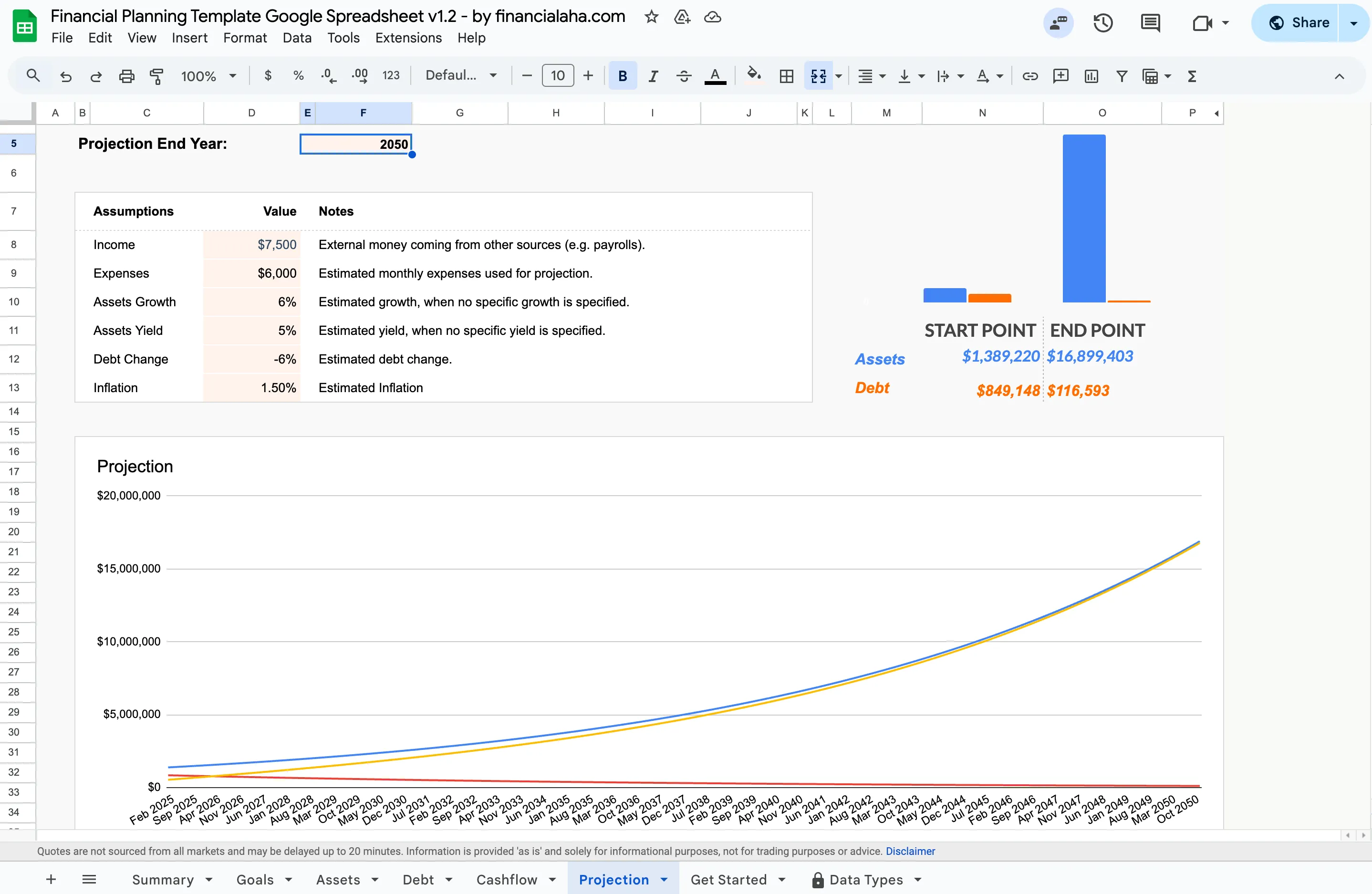
The Financial Planning Template (Premium) projects assets and debt forward from six assumptions to the end year you choose, so editing one of them redraws the whole curve.
How Budgets Typically Change
| Category | Working | Retired |
|---|---|---|
| Income | $6,000/mo | $4,500/mo |
| Commute | $300 | $0 |
| Work clothes | $100 | $50 |
| Healthcare | $200 | $500 |
| Travel | $200 | $400 |
Income usually drops. Some expenses disappear, others increase.
Where Retirement Income Comes From
- Social Security
- Retirement account withdrawals
- Pension (if you have one)
- Part-time work (if you want to)
- Investment income
How This Usually Unfolds
- 10 years out: Maximize savings, pay off debt
- 5 years out: Detailed budget planning for retirement
- 1 year out: Healthcare decisions, Social Security timing decisions
- Retirement: Adjust spending to match fixed income reality
Starting a Business
Financial Preparation Before Launch
Starting a business is financially risky. Prepare accordingly:
- Build 6-12 months of personal expenses in emergency fund
- Save initial capital for the business itself
- Cut personal expenses where you can
- Understand that income will be irregular. For years.
That unpredictable, patternless income is the exact problem we built FinancialAha to tame after leaving a startup of our own.
Keep Everything Separate
Business and personal finances need complete separation:
- Separate business bank account
- Separate business credit card
- Separate tracking (use different spreadsheets)
The Monthly Budget Template for personal, and the Cash Flow Forecast Template for projecting business income and expenses across 12 months with scenario planning.
Budget Reality Check
What to expect financially:
- Zero business income for 6-12 months minimum
- Irregular, unpredictable income for 1-3 years
- Business expenses coming before any revenue appears
Most businesses fail in the first few years. Plan like yours might.
Tools That Help With Any Transition
Net Worth Tracker
The Net Worth Tracker gives you the complete picture:
- See where you stand before the change
- Monitor how the transition affects your finances
- Track recovery and adjustment after
Worth knowing your baseline before any major change.
Monthly Budget Template
The Monthly Budget Template handles the details:
- Plan new budget before change happens
- Adjust as reality differs from plan
- Track actual spending through the transition
Most transitions cost more than expected. Tracking shows where.
What Usually Goes Wrong
Waiting Until It Happens
Addressing finances after the change instead of before. By then you’re reacting under stress instead of planning with clarity.
Underestimating What It Costs
Major changes cost more than expected. Almost always. Building in a 20% buffer helps, but even that might not be enough.
Missing the Hidden Costs
Some changes have costs that aren’t obvious. Career change might slow long-term growth. Early retirement might mean higher healthcare costs for years.
Forgetting the Paperwork
Beneficiaries, insurance policies, estate documents - all need updating after major changes. Easy to forget when dealing with everything else.
Related
- Financial Planning Template - Long-term projections for life changes
- Net Worth Tracker - Track your financial baseline
- Monthly Budget Template - Manage monthly adjustments
- Emergency Fund Calculator
- Budgeting for New Baby Costs
Major life changes need financial preparation. Understand what will actually change, build a buffer before it happens, create budgets for the new reality, and update the paperwork.
Marriage, children, home purchase, career change, retirement - they all follow similar patterns. Plan ahead and transitions become manageable instead of crises.
Frequently asked questions
How much cash buffer do people keep for a major change?
A common benchmark is three months of expenses. For career-related changes, where an income gap can run longer than expected, many people target six to twelve months instead.
Should I delay a change until finances are ready?
It depends on the change. Some, like buying a home or starting a business, can wait until savings are in place. Others, like a job loss or divorce, don't offer that choice, which is why a standing buffer matters.
What if several changes happen at once?
Overlapping changes draw on the same savings, so the risk compounds. Some people handle it by sequencing the optional changes and carrying a larger buffer through the overlap.
Is 20% down actually required to buy a home?
No. 20% is the threshold that lets you avoid private mortgage insurance, but many conventional and government-backed loans allow far less down, with PMI added to the monthly payment until you build enough equity.
When does it make sense to see a financial advisor?
Complex situations - several simultaneous changes, significant assets, or complicated tax implications - are where some people find professional input worth paying for.
Sources
- What is private mortgage insurance? - Consumer Financial Protection Bureau
- What fees or charges are paid when closing on a mortgage and who pays them? - Consumer Financial Protection Bureau
- Get started with Medicare - Medicare.gov (Centers for Medicare & Medicaid Services)
- Continuation of Health Coverage (COBRA) - U.S. Department of Labor
- Unemployment Insurance - U.S. Department of Labor
About this article
Program rules cited here - the 20% threshold for avoiding PMI, typical closing costs, COBRA, unemployment insurance, and Medicare eligibility at 65 - are checked against the CFPB, the U.S. Department of Labor, and Medicare.gov. Dollar amounts in the tables are illustrative planning ranges to size a budget against, not sourced national averages. Template claims checked on 2026-09-10 against the shipped Financial Planning Google Sheet (Projection tab: end year plus the Income, Expenses, Assets Growth, Assets Yield, Debt Change and Inflation assumptions), the Net Worth Tracker (Summary, Assets, Liabilities, Milestones tabs), the Monthly Budgeting sheet (Budget Plan, Transactions tabs) and the Cash Flow Forecast (Forecast, Scenarios tabs). Last reviewed September 2026.