
Your emergency fund target is your essential monthly expenses times the months of coverage your situation calls for: about 3 months for stable dual incomes, 6 for most single earners, and 9 to 12 for variable or self-employed income. Add up the bare-bones costs (housing, utilities, groceries, insurance, minimum debt payments) and multiply. On a $3,000 monthly floor that works out to $9,000, $18,000, or $27,000.
“Three to six months of expenses” is standard advice. But what’s your actual number? It depends on income stability, obligations, and risk tolerance, and calculating it takes just a few minutes. The Consumer Financial Protection Bureau frames it the same way: the right amount depends on your situation, which is exactly what a short calculation pins down.
The stakes are concrete. In the Federal Reserve’s 2025 survey of household finances, 63% of adults said they could cover a $400 emergency with cash or its equivalent, a share that has barely moved in years. A funded emergency account is what puts you in that group.
The Emergency Fund Calculator runs these numbers automatically. No signup required.
The Formula
The calculation is straightforward: Emergency Fund equals Essential Monthly Expenses multiplied by Months of Coverage. Two questions determine the answer: what counts as essential, and how many months of coverage do you need?
Getting both right matters. Overestimate essential expenses and the target feels impossibly high. Underestimate months needed and the fund won’t cover a real emergency. The good news is that reasonable estimates work fine - precision isn’t critical here.
Calculate Essential Expenses
Essential expenses are what you’d need if income stopped - not normal spending, but survival mode. This is a stripped-down budget for getting by, not living comfortably.
Include: Housing (rent or mortgage, taxes, insurance), utilities (electric, gas, water, basic internet, phone), groceries (modest estimate, no dining out), transportation (car payment, insurance, basic gas), health insurance and medications, minimum debt payments.
Exclude: Dining out, entertainment, subscriptions, shopping, savings contributions. These can be paused during an emergency.
An example calculation might look like: Housing $1,500, Utilities $200, Groceries $400, Transportation $350, Health Insurance $300, Debt Minimums $250. Total essential expenses: $3,000 per month.
How Many Months?
The right number of months depends on your situation. 3 months works for very stable income (government jobs, tenured positions), dual income households, no dependents, and fields where finding work happens quickly.
6 months fits typical job stability, sole or primary earners, homeowners, and people with dependents. This is the most common target. 9-12 months makes sense for irregular income (freelance, commission), self-employment, industries with frequent layoffs, or single income families with children.
This table lines up common situations with a starting target. Your specific circumstances may shift you up or down from these.
| Situation | Target months |
|---|---|
| Dual-income household, both stable W-2 jobs, low debt | 3 months |
| Single-income household, stable W-2, low debt | 4 to 6 months |
| Single-income household, stable W-2, significant debt | 6 months |
| Self-employed or freelance, predictable client base | 6 months |
| Self-employed or freelance, variable income | 9 to 12 months |
| Single income, sole earner with dependents | 9 to 12 months |
| Approaching retirement (within 5 years) | 12 plus months |
| Industry with long unemployment durations | 9 plus months |
Using the $3,000 monthly essential expenses example: 3 months equals $9,000, 6 months equals $18,000, 9 months equals $27,000.
A Worked Example
Sam is a freelance designer with variable income, averaging about $85,000 over the past year. Single, no dependents, living in a mid-cost city. Adding up the floor, essential monthly expenses come to $2,975.
| Category | Monthly |
|---|---|
| Rent | $1,650 |
| Utilities (electric, internet, phone) | $190 |
| Groceries (basic) | $360 |
| Health insurance | $480 |
| Health expense allowance (out of pocket) | $150 |
| Transportation (insurance, transit, no car payment) | $145 |
| Minimum debt payments | $0 |
| Total essential | $2,975 |
Because the income is self-employed and variable, the table points to 9 to 12 months. Sam picks 9, since the client base is reasonably stable and spending can scale down further if needed. That puts the target at $2,975 times 9, or $26,775, rounded to $27,000 for a clean number.
The fund currently sits at $14,000, leaving a gap of about $13,000. Saving $1,200 a month toward emergency, that gap closes in roughly 11 months.
To keep those numbers in one place rather than recomputing them each visit, the Emergency Fund Calculator spreadsheet ($19, Essentials tier) tracks the target, current balance, monthly contribution, and months to goal on a single dashboard.
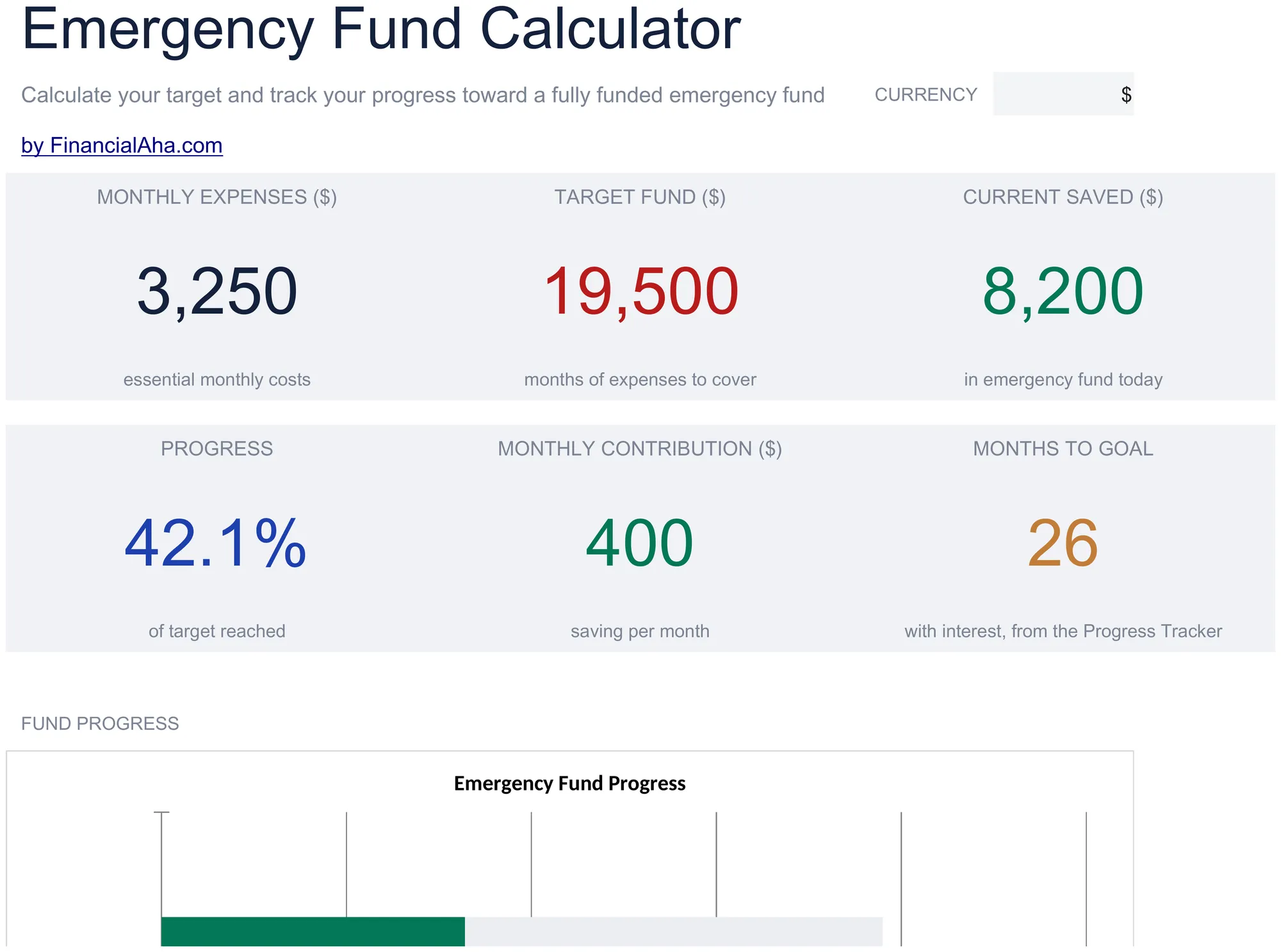 The Emergency Fund Calculator spreadsheet (Essentials tier) shipped with its own sample figures: essential monthly costs, the target fund, current saved, and progress toward it in one view.
The $1,000 Starter Fund
If 3-6 months feels overwhelming, a common first milestone is $1,000. This smaller target covers most minor emergencies, keeps a surprise off a credit card, is achievable quickly, and builds the saving habit.
One common approach: $1,000 first, then attack high-interest debt, then build the full emergency fund. The logic is that high-interest debt costs more than the safety of a larger emergency fund would save. But having something in reserve prevents debt from growing during small emergencies.
Where to Keep It
The right account balances accessibility with separation from everyday spending. Good options include high-yield savings accounts (FDIC insured up to the standard limit, and earning interest), money market accounts, and regular savings accounts.
Avoid keeping it in checking (too easy to spend), investments (can lose value exactly when you need it), or CDs (penalties defeat the purpose of emergency access). The money needs to be accessible within 1-2 days, but separate enough that you don’t dip into it casually.
Building Strategies
Working backward from the goal shows the monthly number. For an $18,000 target: divide by 24 months for $750/month, or by 36 months for $500/month. A timeline that is ambitious but still realistic tends to be the one people actually stick with.
Speed it up by automating transfers on payday (money you never see is money you don’t miss), directing all windfalls to the emergency fund, temporarily pausing other savings goals, or cutting discretionary spending temporarily. These accelerators can significantly compress the timeline.
What Counts as an Emergency?
Defining emergencies before they happen prevents rationalization. Yes: Job loss, major medical expense, essential car repair (needed for work), urgent home repair, emergency travel for family situations.
No: Vacation opportunity, sale on something you want, holiday gifts, regular car maintenance, anything you could have predicted. If you knew it was coming, it’s not an emergency - it’s a budgeting category. Blurring this line depletes the fund for non-emergencies.
Predictable annual expenses like insurance premiums, holiday gifts, and vehicle registration sit in the same category. Repeatedly drawing on the emergency fund for them is usually a sign that a separate sinking fund alongside it fits better. Different bucket, different purpose.
Once you have a target, the useful next move is a single number: your essential monthly expenses times your months of coverage. Run it in the calculator above, and to see how a set monthly contribution grows the balance over time, Savings Calculator: How Your Money Grows walks through the projection.
More on Savings
- Savings Calculator: How Your Money Grows - Growth projections for regular contributions
- When to Recalculate Your Emergency Fund - Life changes that shift the target
- Multiple Savings Accounts Strategy - Organizing by purpose
- Savings Goal Tracker - Track progress in a spreadsheet
- Financial Runway Calculator - How many months your savings would cover if income stopped
Related
Frequently asked questions
Should I pay off debt or build emergency fund first?
One common approach is a $1,000 starter fund, then attack high-interest debt, then complete the emergency fund.
Is $10,000 enough for everyone?
Not necessarily, because the target follows your essential expenses and months of coverage rather than a round number. $10,000 covers about nine months of an $1,100 bare-bones budget, but only three months at $3,300 a month.
Should the target be based on my income or my expenses?
The calculation uses essential expenses, not income. Two people earning the same amount can have very different bare-bones budgets, and it is the spending floor that a fund has to cover during a gap in income.
Does a credit card or line of credit count as an emergency fund?
Available credit is borrowing rather than savings. Limits can be cut when a lender tightens, and interest accrues from the first day, so cash reserves and credit lines are usually treated as separate things.
What if I can't save much right now?
Even $25 a week adds up to $1,300 in a year. Some people find that automating a small, fixed transfer builds the habit faster than waiting for a large amount to spare.
How often is it worth recalculating?
Once a year is a common cadence, plus after major life changes like a new job, a child, or a home purchase that shifts your essential expenses.
Sources
- An essential guide to building an emergency fund - Consumer Financial Protection Bureau
- Report on the Economic Well-Being of U.S. Households in 2025 - Federal Reserve
- Deposit Insurance - Federal Deposit Insurance Corporation
About this article
Fund targets and the essential-expense list follow the Consumer Financial Protection Bureau's emergency fund guide; the account-safety note reflects FDIC deposit insurance rules. The share of adults who could cover a $400 emergency is from the Federal Reserve's Economic Well-Being of U.S. Households report. Spreadsheet claims checked on 2026-09-10 against the shipped Essentials Emergency Fund Calculator workbook (Dashboard, Emergency Fund Setup, Progress Tracker, How to Use sheets) and the on-site Emergency Fund Calculator component. Last reviewed September 2026.