
Splitting savings into separate accounts, or in-account "buckets", gives each goal its own balance so progress is visible at a glance instead of buried in one pooled number. Most people settle on 3-4 accounts: checking, emergency fund, short-term goals, and long-term goals. Banks like Ally (up to 30 buckets) and SoFi (up to 20 Vaults) let you split one account instead of juggling several logins.
One savings account with $15,000 tells you nothing about progress. Could be a full emergency fund. Or halfway to three different goals. Separate accounts remove the guesswork by giving each goal its own dedicated balance.
Whether using multiple accounts, bank buckets, or spreadsheet tracking, the underlying principle is the same: knowing exactly where you stand on each goal provides clarity that a single pooled balance cannot.
Track everything: The Monthly Budget Template lets you track savings allocations even with one pooled account. The Net Worth Tracker shows how all accounts contribute to total wealth.
The Problem with One Account
A single balance doesn’t show how much is designated for emergencies versus vacation versus other goals. This lack of clarity makes it difficult to know if you’re on track or behind. Progress becomes mental math rather than glancing at a number.
Pooled savings also gets tempting to raid. A separate vacation fund feels more protected than vacation money mixed in with everything else. Psychological barriers matter - money with a name is harder to spend on something else.
Account Structure Options
The minimalist approach uses 1-2 accounts: checking for expenses and one high-yield savings for all goals. This works well when tracking allocations in a spreadsheet like the Monthly Budget Template. The simplicity has value if you’re disciplined about mental accounting.
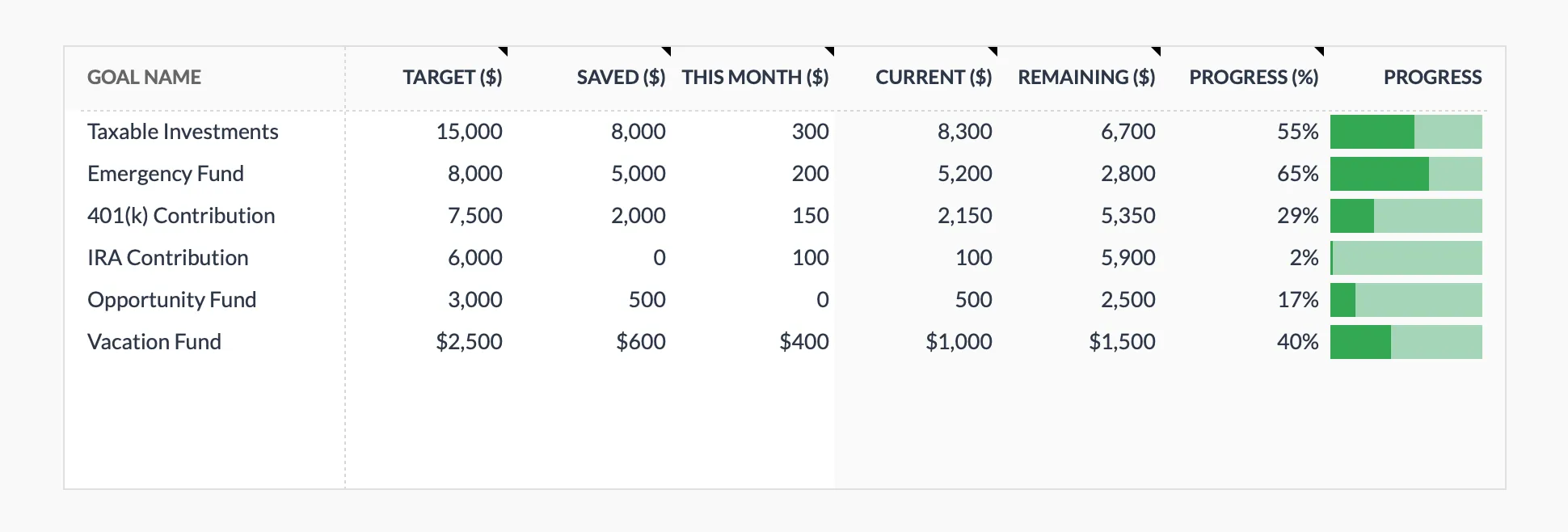
The Goals tab in the Monthly Budget Template (Premium tier) gives each goal a separate line, so one pooled savings account still shows exactly where every dollar is designated.
A standard structure uses 3-4 accounts: checking for daily expenses, emergency fund, short-term savings (vacation, purchases), and long-term goals (down payment). Many people find this level of separation provides clarity without excessive complexity.
The detailed approach uses 5+ accounts: separate accounts for emergency fund, vacation, holiday gifts, car replacement, home maintenance, and each major goal. Some people prefer this level of visual separation where each account’s balance represents exactly one thing.
Savings Buckets: Modern Alternative
Many banks now offer “buckets” within a single account. These digital envelopes divide one balance into labeled portions, providing the organizational benefits of multiple accounts without the complexity of managing separate logins and statements.
| Bank | Bucket Limit | Notes |
|---|---|---|
| Ally Bank | Up to 30 | Boosters for extra interest |
| SoFi | Up to 20 | Called “Vaults” |
| Wealthfront | No set limit | Categories earn the full-balance rate |
| Capital One 360 | No set limit | Separate labeled accounts, not in-account buckets |
Buckets provide visual separation while keeping all your money in one high-yield account earning the same rate. This can be simpler than managing multiple accounts at different institutions, and you can mirror the same split in a sheet by tracking multiple savings goals as named buckets.
Setting Up Your System
Start with your goals. List what you’re saving for: emergency fund, short-term goals (under a year), medium-term (1-3 years), and long-term (3+ years). This inventory determines how many buckets or accounts you’ll need.
For each goal, calculate the total needed, target date, and monthly contribution required. The free Savings Goal Tracker gives each goal a row for its target amount, the amount saved, and the target date, then works out what is remaining on each one and totals all three columns. The Monthly Budget Template helps figure out how much you can allocate to each based on your income and expenses.
Pick your structure based on personal preference. Separate accounts, buckets within one account, or spreadsheet tracking with pooled funds all work. No single right answer exists - the approach that you’ll actually maintain is the right one for you.
Automating transfers for each goal on payday removes friction. One less thing to remember each month, and the money goes where it belongs before you can spend it.
Sample Setup
Here’s what a practical multiple-account structure might look like:
Checking at your primary bank handles daily expenses and bills. High-Yield Account #1 serves as the emergency fund with a target of $15,000 and current balance of $8,000, reserved only for true emergencies. (Not sure what that target should be? Our emergency fund guide and calculator works it out from your monthly costs.)
High-Yield Account #2 covers short-term goals with buckets for vacation ($1,200), holiday gifts ($400), and car repairs ($600). High-Yield Account #3 at a different bank holds down payment savings. The different bank adds friction against casual withdrawals, which can be helpful for long-term goals.
Benefits of Separation
FDIC insurance covers $250,000 per depositor, per insured bank. Because that limit is per bank, spreading balances across separate institutions raises total coverage, whereas several accounts (or buckets) at the same bank still share one $250,000 limit. This matters mainly for those approaching that threshold.
Watching each goal grow independently provides different motivation than tracking one big number. Seeing your vacation fund climb from $800 to $1,200 feels more tangible than watching a pooled balance increase by the same amount.
Money labeled “emergency fund” in its own account tends to feel more protected. This psychological barrier against spending works for many people - the friction of moving money between accounts creates a pause that prevents impulsive raids.
Potential Drawbacks
Multiple accounts mean multiple logins, multiple statements, and potential fees to watch. The administrative burden grows with each additional account.
Some accounts require minimum balances to avoid fees or earn full interest rates. Small amounts spread across many accounts might not meet thresholds, resulting in fees or reduced earnings that offset the organizational benefits.
More complexity means more to track and more transfer setups to maintain. If the system becomes overwhelming, it’s less likely to be maintained consistently.
Making the Decision
Multiple accounts might work well if you struggle with spending pooled savings, have several distinct goals with different timelines, or find visual separation motivating. The key question: would seeing separate balances help you save more effectively?
One account might work better if you’re comfortable tracking allocations in a spreadsheet (like the Monthly Budget Template), prefer simplicity over organization, or have strong spending discipline. The system matters less than consistently using it.
Whichever structure you land on, the next step is the same: write down each goal with its target, current balance, and monthly contribution. The Goals tab shown above does exactly that for a pooled account, and if you’re mapping several accounts, the Net Worth Tracker rolls every balance into one running total so the split accounts still add up to a single number.
Related
Frequently asked questions
How many savings accounts is too many?
Most people find 5-6 accounts manageable. Beyond that, complexity tends to outweigh benefits. Buckets within a single account offer more categories without more accounts.
Do multiple savings accounts affect my credit score?
No. Savings accounts don't appear on credit reports the way loans and credit cards do, so opening several has no credit impact.
Should my emergency fund be at a different bank?
It's a matter of preference. Some people prefer the added friction of a separate bank to prevent impulsive withdrawals. Others prefer having all funds accessible immediately. Both approaches work.
Do savings buckets earn more interest than one plain account?
No. Buckets are labels inside a single account, so every bucket earns that account's rate. Interest differs between accounts only when you spread money across banks with different APYs.
Are funds in savings buckets FDIC insured separately?
Buckets sit inside one account, so they share that bank's coverage rather than adding to it. FDIC insurance is $250,000 per depositor, per bank, so several accounts at the same bank also share one limit; only spreading money across different banks raises total coverage.
Sources
- Savings Buckets: Alternative to Multiple Accounts? - Ally Bank
- SoFi Savings Vaults - SoFi
- Wealthfront Cash Account - Wealthfront
- 360 Performance Savings - Capital One
- Deposit Insurance - FDIC
About this article
Bank bucket and account limits checked against Ally, SoFi, Wealthfront, and Capital One's own account pages The $250,000 coverage figure checked against FDIC.gov Template claims checked on 2026-09-10 against the shipped Savings Goal Tracker (free) workbook, the Monthly Budgeting Goals and Budget Plan sheets, and the Net Worth Tracker Assets sheet Last reviewed September 2026.