
Savings grow from two forces working together, your contributions and compound interest on the balance. Over a few years the interest rate barely moves the total, but over decades it dominates. Saving $400 a month reaches about $155,000 in 20 years at 4.5% versus about $118,000 at 2%, the same habit roughly $37,000 apart.
Here is something counterintuitive about savings: for the first few years, the interest rate barely matters. Someone saving $400 a month at 4.5% has about $21,000 after four years. At 2%, they have about $20,000. Roughly $1,000 apart after four years of effort. The rate feels almost irrelevant.
But stretch that to twenty years and the gap explodes. The 4.5% saver has roughly $155,000. The 2% saver has about $118,000. Same monthly habit, $37,000 apart. The rate did not change. Time just gave it room to work.
That tension, between what matters now and what matters later, is the most useful thing a savings calculator reveals. The Savings Calculator lets you test your own numbers. No signup required.
What the Formula Actually Does
The future value formula with regular contributions:
FV = P(1 + r)^n + PMT x [((1 + r)^n - 1) / r]
P is starting balance, r is the periodic rate, n is periods, PMT is the contribution. In plain language: your existing money grows, your new deposits grow, and the growth itself grows. That third piece, growth on growth, is barely noticeable at first and dominant later.
The Myth of the Perfect Amount
There is a lot of advice about how much to save each month. The 20% rule. The pay-yourself-first crowd. The “save until it hurts” people. Most of it misses the point.
Consistency matters more than amount. Someone saving $200 every month for ten years has more than someone who saves $800 for three months, gets overwhelmed, and stops. The calculator makes this clear when you run the numbers - even modest amounts, left alone, become meaningful.
That said, small increases compound in surprising ways. Here is what happens when you bump a $300/month savings habit by $50:
| Monthly Amount | After 5 Years (4.5%) | After 10 Years | After 20 Years |
|---|---|---|---|
| $300 | $20,150 | $45,360 | $116,400 |
| $350 | $23,500 | $52,920 | $135,800 |
| $400 | $26,860 | $60,480 | $155,200 |
Each extra $50/month adds about $19,400 over twenty years. That includes roughly $7,400 in interest earned on just the additional contributions. The money works harder the longer it sits.
Working Backward From a Goal
Projecting forward is interesting. Working backward is useful.
If you need $20,000 for a down payment in three years and have $2,000 saved, you need roughly $460/month at 4.5% interest (the $2,000 keeps growing while you add to it). The savings calculator projects forward in whole years rather than solving for a monthly figure, so working backward means trying an amount and reading the future value. At $400/month, that same $2,000 start is still short at the three year mark and passes $20,000 around month 41.
Some common goals and what they require starting from zero:
- $15,000 emergency fund - $400/month reaches it in about 36 months at 4.5% (the Emergency Fund Calculator sizes the target itself)
- $8,000 car fund - $350/month gets there in roughly 22 months
- $40,000 home down payment - $600/month takes about 60 months
These are estimates. The point is not precision - it is seeing whether a goal is three years away or five, and adjusting expectations or contributions accordingly.
Where You Park It Changes the Math
The interest rate in a savings calculator is not hypothetical. It depends on where the money actually sits, and the range is wide:
A standard savings account at a large bank often pays a fraction of a percent; the FDIC national average for savings deposits sits well under half a percent. A high-yield savings account currently pays closer to 4-5%. On $20,000 over three years, the difference between 0.5% and 4.5% is roughly $2,500 in earned interest. That is free money left on the table for no reason other than inertia.
CDs lock money for a fixed period and sometimes offer slightly better rates. Money market accounts behave like high-yield savings with check-writing features. For anything over a year, shopping the rate is worth the fifteen minutes it takes.
What the Balance Is Actually Worth
A future value of $155,000 in twenty years is a headline number, not a spending number. Prices rise over the same two decades, so the money buys less than the figure suggests. That is why the Savings Calculator shows a second result alongside the nominal balance: a real value that discounts the total by an inflation rate you set.
The gap is larger than most people expect. At 3% inflation, prices roughly double over about 24 years, so a balance that grows to $155,000 might have the purchasing power of closer to $85,000 in today’s terms. The nominal number still went up, and it still beat leaving the cash in a checking account, but the real figure is the honest one to plan around. When a savings rate lands below the inflation rate, the real value can even drift down while the nominal balance climbs, which is the quiet cost of parking long-term money at 0.5%.
The Boundary Between Saving and Investing
A savings calculator assumes a fixed, reliable rate. That works well for actual savings accounts where the principal is protected and the rate is relatively stable. It stops being the right tool when the goal is ten or twenty years out and the money could go into investments with variable returns.
The rough guideline: savings accounts for money needed within a few years. Investments for money not needed for a decade or more. The zone between three and seven years is where people make different choices depending on their comfort with volatility.
Neither of these two calculators models variable returns. The Compound Interest Calculator also runs on a single fixed rate, and it starts from a lump sum rather than a monthly habit, with a compounding frequency you set to annual, quarterly, monthly or daily and an effective annual rate reported alongside the future value. For straightforward “I am putting $X per month into a savings account,” the savings calculator is the one that adds the contributions, compounding monthly at a twelfth of the annual rate.
Why Tracking Changes Behavior
There is an interesting pattern in behavioral research: people who track their savings tend to save more. The visibility creates a feedback loop. You see the number go up, which reinforces the habit, which makes the number go up.
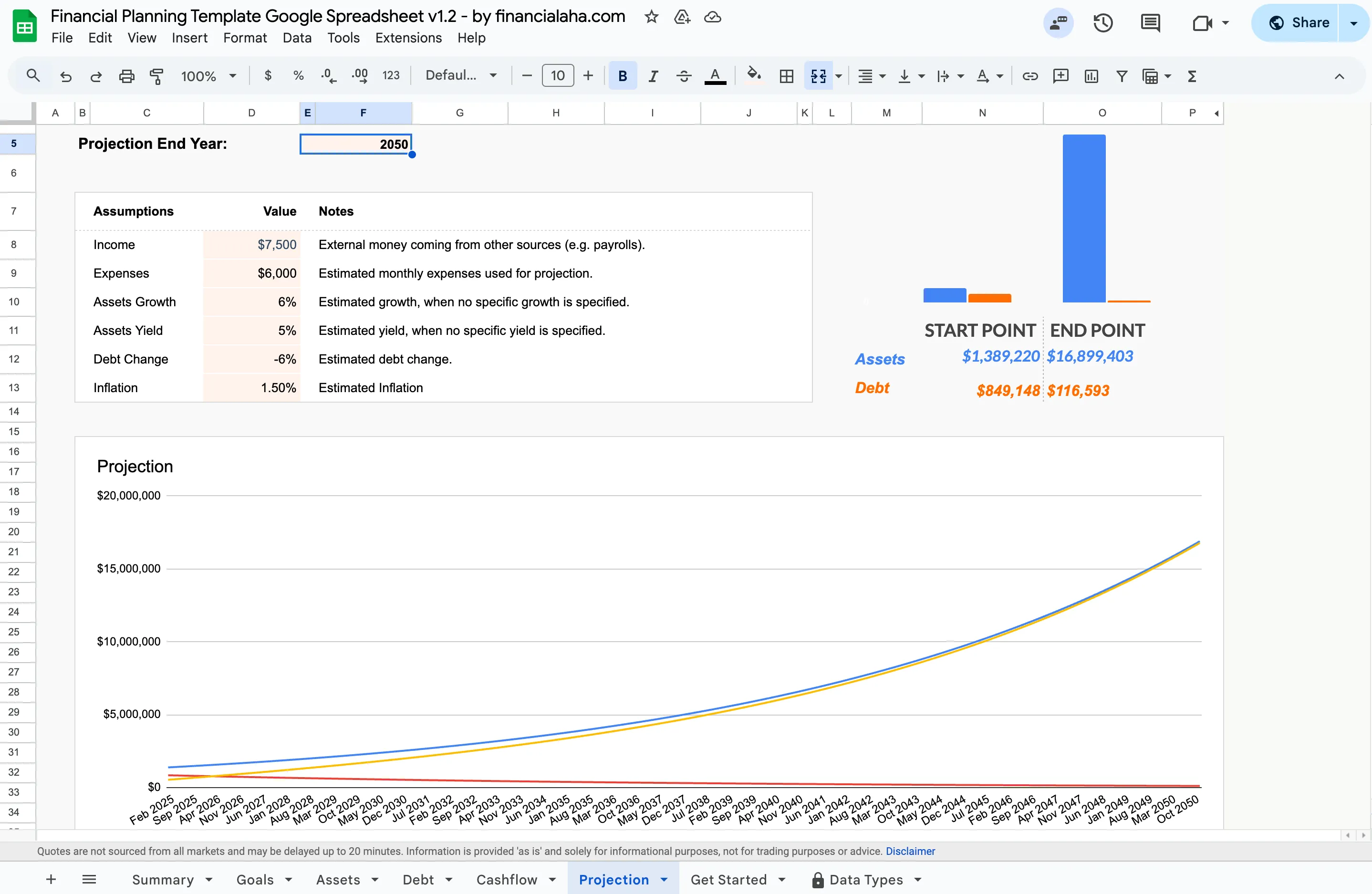
Running a savings calculator once gives you a number. Checking actual progress against that projection monthly turns a plan into a habit. Whether that tracking happens in a spreadsheet, an app, or a notebook matters less than doing it at all. The Financial Planning Template is one structured option: its Cashflow tab takes one row per month of income and spending, the Summary shows average savings per month against a goal you set on the Goals tab, and the Projection tab runs assets and debt forward to an end year you choose.
More on Savings
- Emergency Fund Calculator - How much to set aside for unexpected expenses
- Compound Interest: The Math Behind Growth - Why starting earlier matters more than starting bigger
- Multiple Savings Accounts Strategy - Organizing savings by purpose
- College Savings Calculator - Working a long-term education goal back to a monthly amount
Related
Frequently asked questions
How much should I save each month?
There's no universal number. One common starting point is 20% of after-tax income, but any consistent amount builds over time. Even small amounts benefit from compounding.
Does the interest rate really matter that much?
Over short periods, not dramatically. Over decades, enormously. A 1% difference on $500/month over 30 years can mean $50,000+ more or less.
How often is interest compounded?
Most savings accounts compound daily or monthly. The difference between daily and monthly compounding is small - what matters more is the rate itself and consistent contributions.
Should I save or invest?
Short-term goals (under 3-5 years) are typically better in savings accounts. Longer-term goals may benefit from investment returns, though with more risk.
Does the savings calculator account for inflation?
Yes. Alongside the nominal future value, it shows a real value that discounts the balance by an inflation rate you set, so you can see roughly what the money would buy in today's terms rather than just its headline size.
Do I pay tax on the interest a savings account earns?
Interest earned in a standard taxable savings account is generally reported as income each year, so the after-tax growth can be a little lower than the calculator's pre-tax figure. Rates and rules vary by country and account type.
Sources
- National Rates and Rate Caps - FDIC
About this article
Growth figures computed with the site's Savings Calculator model: monthly compounding with contributions credited at month end. Savings-account rate ranges checked against the FDIC national deposit rate averages. Calculator inputs, outputs and template claims checked on 2026-09-10 against the site's Savings Calculator component and the shipped Financial Planning Google Sheet (Summary, Goals, Cashflow, Projection tabs). Last reviewed September 2026.