
Four years at an in-state public university could approach $268,000 for a child born today if costs keep rising at 5% a year. Starting a 529 at birth, roughly $310 a month covers half of that projected cost at a 7% return; waiting until age 10 pushes the same target past $1,000 a month. Started at birth, compounding does close to half the work.
Nobody looks at a newborn and thinks “I need $268,000 in 18 years.” But that is roughly what four years at an in-state public university could cost across the years a child born today would spend there, if costs keep climbing at 5% a year.
The number sounds absurd. It follows from decades of college prices outrunning general inflation. The last ten years have run differently: College Board figures put average published tuition, fees, housing and food at public four-year colleges $740 lower in inflation-adjusted terms than in 2015-16. Which of those two trends holds for the next eighteen years is the open question, and it is the assumption that drives everything below.
The College Savings Calculator projects what you’ll need and how much to save monthly based on your timeline. No signup required.
What College Costs Right Now
Average published charges for 2025-2026 (tuition, fees, housing and food):
| Type | Per Year | Four Years | |------|----------|------------| | Public, in-state | ~$25,850 | ~$103,000 | | Public, out-of-state | ~$45,780 | ~$183,000 | | Private nonprofit | ~$60,920 | ~$244,000 |
These are national averages from the College Board’s Trends in College Pricing and Student Aid 2025, and the four-year column holds today’s prices flat rather than projecting them forward. Individual schools range from well below to well above. Starting at a public two-year college costs less per year, with average in-district tuition and fees of $4,150 against $11,950 in-state at public four-year institutions. And these are sticker prices: they don’t account for grant aid, scholarships, or other offsets that many students receive.
What Tuition Inflation Does to the Target
At 5% annual cost inflation, the calculator’s default assumption, the $25,850 in-state figure projects forward like this. Each of the four college years is inflated separately, so the fourth year costs more than the first:
| Child’s Current Age | Years Until College | Projected 4-Year Cost | |--------------------|--------------------|-----------------------| | Newborn | 18 | ~$268,000 | | 5 years old | 13 | ~$210,000 | | 10 years old | 8 | ~$165,000 | | 14 years old | 4 | ~$135,000 |
These projections assume 5% cost inflation runs uninterrupted for the whole horizon. That’s not guaranteed. There has been public and political pressure on tuition costs, some states have implemented caps, and published prices have grown more slowly than 5% in recent years. The projections are still useful for setting a savings target, even if the actual number lands somewhat differently.
The Monthly Math
Most families aren’t aiming to cover 100% of projected costs. Covering half is a strong position - it meaningfully reduces future borrowing while keeping the monthly savings commitment manageable.
For a newborn, targeting 50% of projected in-state costs ($134,000), starting from a zero balance and assuming 7% returns in a 529 account:
Monthly savings needed: approximately $310.
Over 18 years, that’s about $67,200 in contributions. Investment growth adds roughly $66,800. Compound returns do close to half the work at that horizon, and less of it the later saving starts.
Here’s how that same $134,000 target changes based on when saving begins:
| Start When Child Is | Monthly Savings Needed | |--------------------|----------------------| | Newborn | $310 | | 3 years old | $425 | | 5 years old | $530 | | 8 years old | $775 | | 10 years old | $1,045 | | 13 years old | $1,870 |
The dollar target is held constant here to isolate the cost of delay. The calculator works differently: it recalculates the goal from the child’s age, so a later start also shows a smaller projected bill, because fewer years of inflation land before the first tuition payment.
Each year of delay adds roughly 11% to the required monthly amount over the early stretch, rising to about 16% a year around age 10 and past 20% a year in the last five. Starting at birth gives compounding the most room to work. Starting at 13 means contributions have to carry almost all of it.
Plug in your own child’s age, target percentage, and expected return to see the monthly figure for your situation:
The 529 Plan: Why Most People Use It
The 529 is the dominant college savings vehicle for good reason - its tax structure is purpose-built for this.
Tax-free growth. Investment gains are never taxed when used for qualified education expenses. Over 18 years of compounding, avoiding the annual tax drag on dividends and capital gains makes a real difference.
State tax benefits. Many states offer income tax deductions or credits for 529 contributions. The exact benefit varies by state, but it’s essentially a discount on every dollar contributed.
Flexible qualified expenses. Tuition, fees, books, room and board, and computer technology all qualify under the IRS rules for 529 plans, which also allow a capped annual amount for tuition at elementary and secondary schools. That K-12 cap has changed recently, so it is worth reading the current IRS figure rather than a remembered one.
High contribution capacity. Annual contributions up to the gift tax exclusion ($19,000 per parent per child in 2026) don’t require a gift tax return. There’s also a “superfunding” option that allows up to $95,000 in a single year by using five years of gift tax exclusions at once.
A new escape hatch. Starting in 2024, up to $35,000 in unused 529 funds can be rolled into a Roth IRA for the beneficiary (subject to the account being open 15+ years and annual Roth contribution limits). This addresses the longstanding worry about what happens if the child doesn’t need the full amount.
How 529 Investment Strategy Shifts Over Time
Most 529 plans offer age-based portfolios that automatically adjust their stock-to-bond mix as the child approaches college. The logic is straightforward:
Ages 0-8: Heavily invested in stocks (80-100%). The time horizon is long enough to ride out market downturns.
Ages 9-14: Shifting toward balanced (50-70% stocks). Still growing, but with less exposure to sharp declines.
Ages 15-17: Mostly conservative (20-40% stocks). Protecting what’s been accumulated as the tuition bills get closer.
Age 18+: Cash equivalents or stable value funds. The money needs to be there when the bill arrives, not subject to market risk.
This glide path reduces the chance of a poorly timed market drop wiping out years of growth right when the money is needed.
When 100% Isn’t the Goal
Aiming for full funding is one approach. But it’s not the only reasonable one, and for many families it’s not realistic. A few things that help close whatever gap remains:
Partial funding still matters. Covering 50% of costs means 50% less in loans. Even 25% changes the debt picture after graduation.
Community college as a starting point. Two years at a community college followed by two years at a four-year school is one of the most cost-effective paths to a bachelor’s degree.
Student contributions. Part-time work, co-ops, internships, and summer jobs can cover $5,000-$10,000 per year, depending on the situation.
Grandparent contributions. Grandparents can contribute to 529 plans, and recent FAFSA changes have made grandparent-owned 529 accounts more favorable for financial aid calculations.
Merit and need-based aid. Scholarships and grants are uncertain and shouldn’t be the plan, but they’re a real factor for many students.
The point isn’t to have everything figured out 18 years in advance. It’s to start, even at a modest amount, and let time and compounding narrow the gap.
The Financial Planning Template takes the wider view. Each holding goes on its Assets tab as its own row with a type, a name, a value, an annual yield and an annual growth rate, so an education account sits in the same list as the 401k, the brokerage account and the house rather than in a spreadsheet of its own. The Projection tab then carries assets and debt forward to a chosen end year from six assumptions: income, expenses, assets growth, assets yield, debt change and inflation.
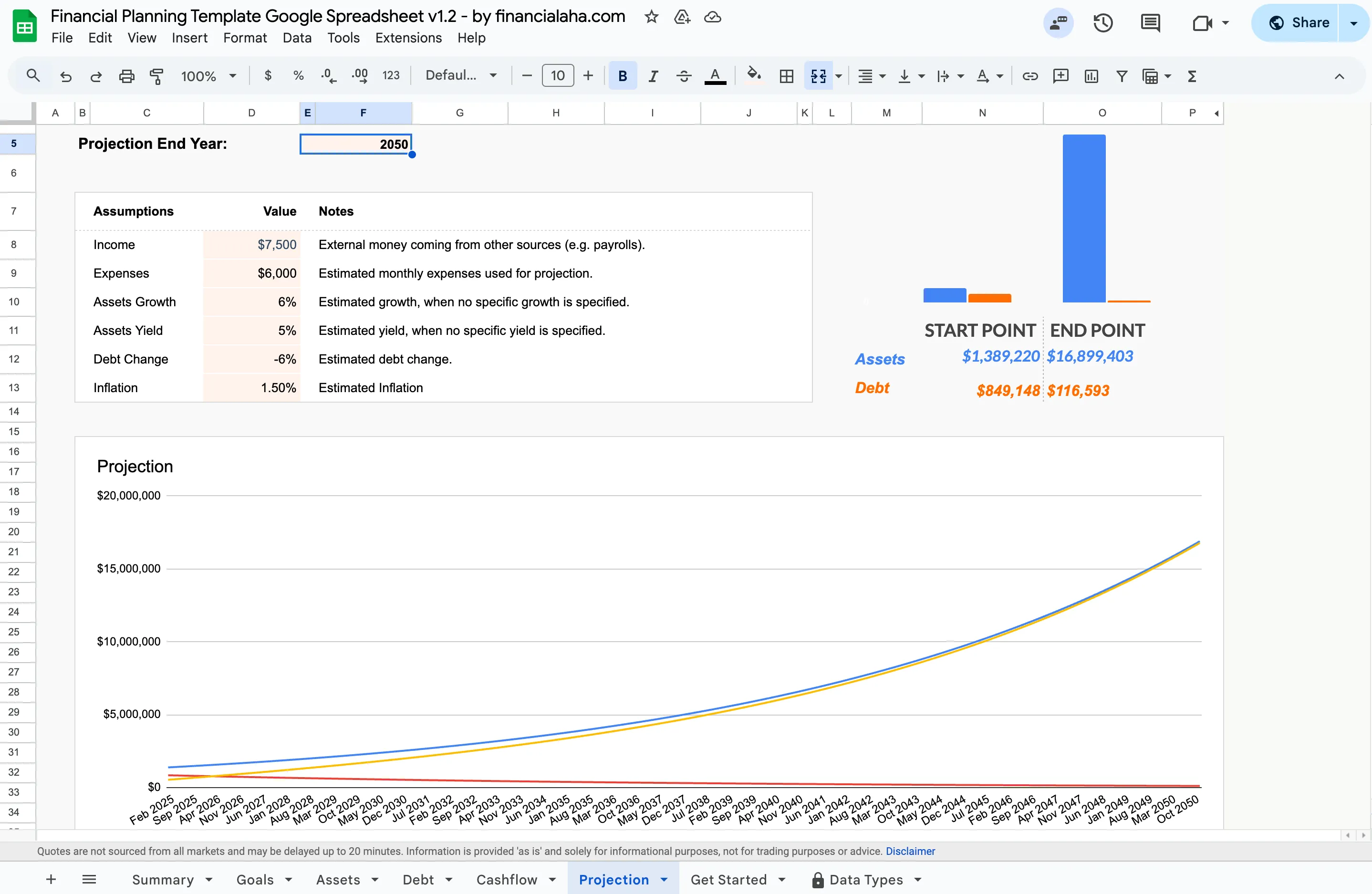
The Financial Planning Template (Premium) projects assets and debt to a chosen end year from six assumptions, with a start point and end point for each.
More on Savings & Growth
- Compound Interest: The Math Behind Growth - Why starting earlier matters most for college savings
- Savings Calculator: How Your Money Grows - Model regular contributions over time
- Student Loan Payoff Calculator - For when loans become part of the picture
Related
Frequently asked questions
How much does college actually cost?
For 2025-2026, the College Board puts average published tuition, fees, housing and food at about $25,850 a year for in-state students at public four-year universities and about $60,920 at private nonprofit four-year colleges. At today's prices, four-year totals run from roughly $103,000 to $244,000. Those are sticker prices before grant aid.
What is a 529 plan?
A tax-advantaged savings account specifically for education expenses. Contributions grow tax-free, and withdrawals for qualified education expenses are also tax-free. Many states offer a state tax deduction for contributions.
Should I save for college or retirement first?
Most financial planners prioritize retirement savings. Children can borrow for college or earn scholarships; you can't borrow for retirement. That said, saving something for education reduces future debt burden.
What if my child doesn't go to college?
529 funds can be transferred to another family member, used for vocational training, or up to $35,000 can be rolled to a Roth IRA (with conditions). Non-qualified withdrawals face taxes and a 10% penalty on earnings.
Does a parent-owned 529 reduce financial aid?
It counts as a parental asset on the FAFSA, which is assessed at a maximum of 5.64% of its value, so the impact on aid eligibility is usually small. Distributions from a parent-owned 529 are not counted as student income. Grandparent-owned accounts are treated differently, and recent FAFSA changes made them more favorable.
What return should I assume when projecting a 529?
The projections here use 7% as an illustration. Actual returns depend on the funds you hold and on the markets, and age-based portfolios deliberately lower the expected return as college nears to protect the balance. Running a few different rates through a calculator shows how sensitive the monthly figure is to the assumption.
Sources
- Trends in College Pricing and Student Aid 2025 - College Board
- 529 plans: Questions and answers - Internal Revenue Service
About this article
College cost figures were checked on 2026-09-10 against the College Board Trends in College Pricing and Student Aid 2025 published charges for 2025-26. 529 qualified expenses and the gift tax exclusion were checked on 2026-09-10 against the IRS 529 plan questions and answers and the IRS gift tax FAQ. Projected costs and monthly figures were recomputed on 2026-09-10 with the model in the on-site College Savings Calculator, which inflates each college year separately and solves for a monthly contribution at monthly compounding. Financial Planning Template claims were checked on 2026-09-10 against the shipped Google Sheet (Summary, Goals, Assets, Debt, Cashflow, Projection tabs). Last reviewed September 2026.