
Compound interest means earning returns on your returns, captured by the formula A = P(1 + r/n)^(nt). At a 7% annual return a lump sum roughly doubles every decade, so $10,000 grows to about $76,000 over 30 years, while simple interest would reach only $31,000. Time matters more than the rate or the size of each deposit, which is why starting ten years earlier can beat contributing for far longer.
Two people each invest $300 a month at a 7% annual return. Person A starts at 25 and stops after ten years, contributing $36,000 in total. Person B starts at 35 and keeps going for thirty years straight, contributing $108,000. By age 65, Person A has grown to roughly $421,000. Person B, despite putting in three times as much, has about $366,000.
Read that again. Person A contributed a third of the money and still finished ahead, by around $55,000. The only difference was ten years of earlier compounding. That head start, worth more than the $72,000 gap in contributions, is the entire case for understanding how compound interest works.
The Compound Interest Calculator projects how a lump sum grows at a rate and time horizon you choose. No signup required.
The Part Nobody Finds Exciting (But Matters)
Here is the formula, the same one the SEC’s Investor.gov calculator runs on:
A = P(1 + r/n)^(nt)
A is the final amount. P is what you start with. r is the annual rate. n is how many times interest compounds per year. t is years.
For regular contributions, the formula expands, but the idea stays the same: old money earns returns, and those returns earn their own returns. That feedback loop is the whole game.
A quick shortcut worth knowing - the Rule of 72. Divide 72 by the interest rate to estimate doubling time. At 7%, money roughly doubles every 10.3 years. At 4%, about 18 years. It is surprisingly accurate between 4% and 12%, and it is useful for back-of-napkin math when someone throws a rate at you.
Where the Acceleration Hides
Compound interest is boring for a long time and then suddenly is not. Here is $10,000 at 7% compounded annually, with no contributions:
| Years | Value | Growth That Decade |
|---|---|---|
| 0 | $10,000 | - |
| 10 | $19,672 | $9,672 |
| 20 | $38,697 | $19,025 |
| 30 | $76,123 | $37,426 |
| 40 | $149,745 | $73,622 |
The money nearly doubles each decade, but look at the actual dollar growth per decade. It almost doubles too. From roughly $9,700 in the first decade to $73,600 in the fourth. Nothing changed about the rate or the effort. Time did all the work.
This is what trips people up. The first five or ten years feel underwhelming. You save diligently, check the balance, and it has not moved much beyond what you put in. Then somewhere around year fifteen, the compounding starts producing numbers that look like they belong to someone else’s account.
Adding Regular Contributions Changes Everything
Starting balance of $10,000 with $500 added every month, compounding monthly at 7%:
| Years | You Put In | Portfolio Value | Interest Earned |
|---|---|---|---|
| 5 | $40,000 | $49,973 | $9,973 |
| 10 | $70,000 | $106,639 | $36,639 |
| 20 | $130,000 | $300,851 | $170,851 |
| 30 | $190,000 | $691,150 | $501,150 |
After twenty years, the interest earned exceeds the total money you contributed. After thirty, the interest is more than double your contributions. At that point, your money is doing most of the work. The compound interest formula covers a single lump sum, so to model this pattern of steady deposits the Savings Calculator is the tool built around regular contributions.
This is where compound interest stops being an abstract formula and starts being a practical argument for starting earlier, even with small amounts. $200 a month starting at 25 beats $500 a month starting at 40, in most scenarios, simply because of the extra fifteen years of compounding.
Simple vs. Compound: The $45,000 Difference
The distinction is worth seeing in raw numbers.
$10,000 at 7% for 30 years with simple interest: $10,000 + ($10,000 x 0.07 x 30) = $31,000. Interest earned: $21,000.
Same inputs with compound interest: $10,000 x (1.07)^30 = $76,123. Interest earned: $66,123.
Compound interest produced over three times the interest. The entire $45,000 gap comes from one thing: returns earning their own returns. In the simple case, only the original $10,000 ever generates interest. In the compound case, last year’s interest generates this year’s interest, and that cycle repeats for decades.
When Compounding Works Against You
Every dollar of credit card debt compounds against you, and the average rate charged on balances that carry interest sits around 22%. A $5,000 balance at that rate, paid down with only the minimum, can generate more than $5,000 in interest charges over time. The same exponential curve that grows investments also grows debt.
This is worth remembering when weighing whether to invest or pay down high-interest debt first. Clearing a 22% balance locks in a return equal to that rate, which is hard to match with any investment. The Credit Card Payoff Calculator shows the math on the debt side.
What the Calculator Cannot Tell You
The formula assumes a steady rate of return. Real investments do not work that way. A 7% average might include a year of +25% followed by a year of -18%. Over long periods, the compounding principle still holds, but the ride is bumpier than any table suggests.
Inflation is the one it does handle. An inflation field sits next to the rate, and the Real Value result and the Real line on the chart restate the same balance in today’s money. A 7% nominal return with 3% inflation is roughly a 4% real return. Taxes stay outside the model, and they take a cut in taxable accounts. Tax-advantaged accounts like 401(k)s and Roth IRAs let compounding work more efficiently by keeping more of the growth in play.
None of this changes the core insight: time is the most powerful variable in the compound interest formula. Rate matters. Contribution size matters. But time is the one you cannot buy back.
For running the same forward math on your own numbers, the Financial Planning Template lists each asset with its value, annual yield and annual growth rate, then projects assets and debt out to an end year you set.
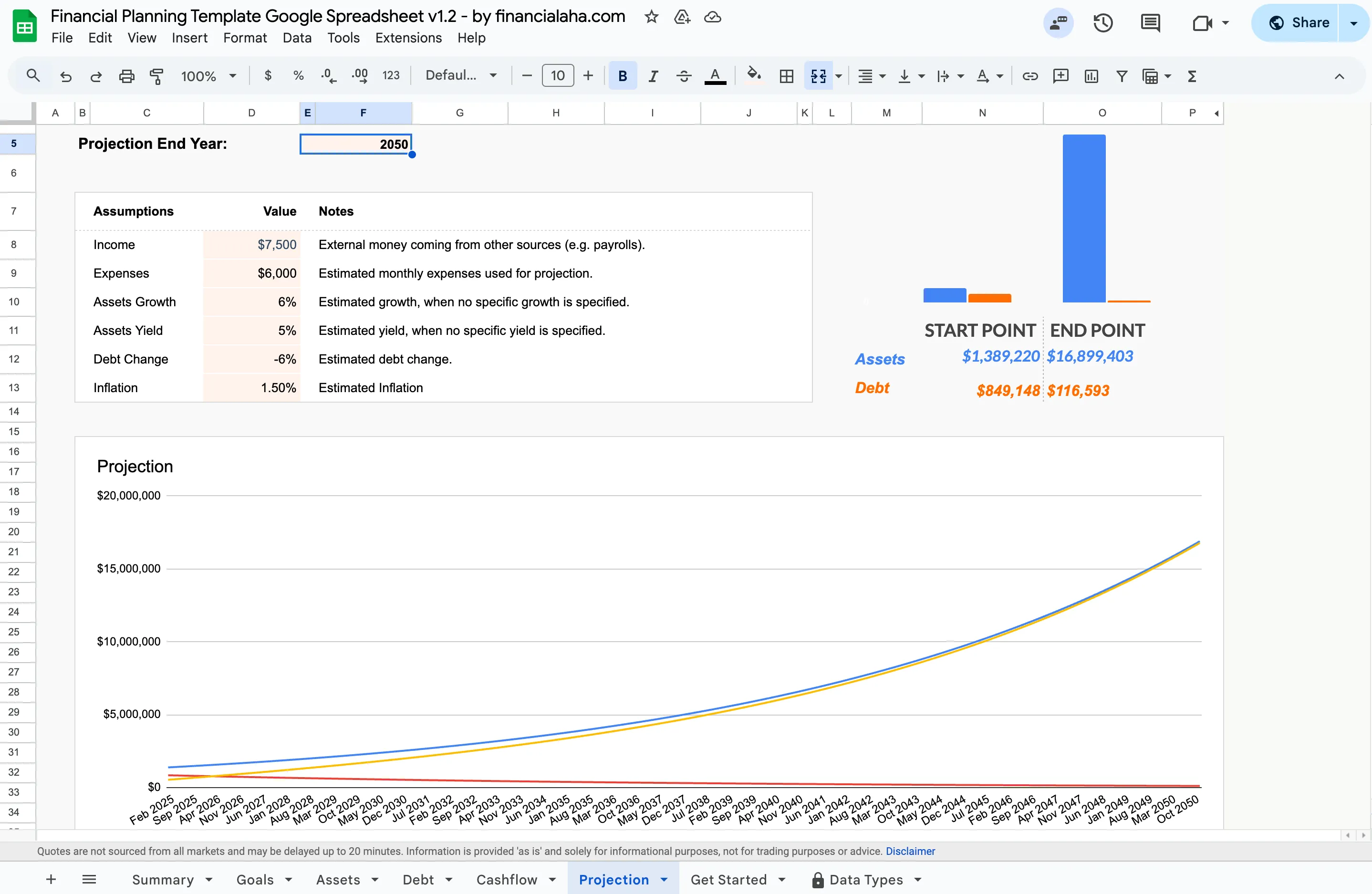
The Projection tab in the Premium Financial Planning Template applies your growth, yield, and inflation assumptions and draws the same compounding curve out to a year you choose.
More on Savings & Growth
- Savings Calculator: How Your Money Grows - How regular contributions add up over time with interest
- Compound Interest Calculator in Google Sheets (Step-by-Step) - Building the same formula and FV projection yourself in a spreadsheet
- Financial Independence Data: FIRE and Wealth - What long-run compounding looks like when the goal is financial independence
Related
Frequently asked questions
What's the difference between simple and compound interest?
Simple interest is calculated only on the original principal. Compound interest is calculated on principal plus accumulated interest - meaning you earn interest on your interest.
How often should interest compound?
More frequent compounding produces slightly higher returns. Daily vs. monthly makes a small difference. What matters far more is the rate itself and how long the money compounds.
Is 7% a realistic long-term return?
The US stock market has historically averaged about 10% nominal (7% after inflation) over long periods. Individual results vary significantly by time period and investment choices.
Does compound interest work against me with debt?
Yes. Credit cards and loans compound interest on your balance, which is why debt can grow quickly when only minimum payments are made.
Can the Compound Interest Calculator handle monthly contributions?
The Compound Interest Calculator projects a single lump sum growing at a rate, compounding frequency, and time horizon you set. For ongoing deposits, the Savings Calculator is built around regular contributions and shows how they add up alongside interest.
Why does starting ten years earlier beat contributing for longer?
The earliest dollars pass through the most compounding periods, so each one doubles more times. An extra decade at the front can outweigh a much larger amount added later, which is what the two-investor example at the top shows.
Sources
- Compound Interest Calculator - U.S. Securities and Exchange Commission (Investor.gov)
- Consumer Credit - G.19 (credit card interest rates) - Federal Reserve
About this article
Growth tables recomputed with the standard compound interest formula A = P(1 + r/n)^(nt) at a 7% return, using monthly compounding for the contribution examples. The credit card APR figure was checked against the Federal Reserve's G.19 Consumer Credit release. Calculator and template claims checked on 2026-09-10 against the shipped Compound Interest Calculator (principal, rate, inflation, compounding frequency, years; future value, real value, total interest, effective rate, nominal/real/principal chart) and the Financial Planning Google Sheet (Assets and Projection tabs). Last reviewed September 2026.