
A spreadsheet budget for couples is one shared sheet both partners can edit, with categories matched to how the household actually spends and a standing monthly review. The account structure underneath (full pool, three-account 'his/hers/ours', or separate accounts with monthly reconciliation) is a couple-level decision the sheet supports either way. Most couples start with a monthly planned-vs-actual layout; couples with seasonal income use the year-long version.
Two people, one budget. A solo budget tracks one person’s income against one person’s spending. A couples budget has two income streams, two sets of habits, two ways of thinking about money, and shared expenses sitting in the middle.
About 34 percent of partnered Americans say money is a source of conflict in their relationship, according to a 2024 Ipsos survey. The same survey found 36 percent admit to being untruthful about money with their partner. The numbers make the case for a shared system over two private ones: visibility is what closes the gap.
Why a shared bank account is not a shared system
Combining accounts is a banking choice. Knowing what comes in and where it goes is a tracking choice. The two are independent. Many couples have a joint checking account and still cannot answer “what did we spend on groceries last month?” without scrolling through a statement.
A shared budget spreadsheet does three things a joint account does not:
- Groups transactions by category, so “how much on groceries?” is one cell.
- Shows planned vs actual, so you know if last month was normal or notable.
- Surfaces patterns over time, because one bad month is noise and three bad months is a signal.
The three common money structures
Couples land in one of three patterns. None is the right one; each fits different relationships, different incomes, and different histories with money.
| Structure | How it works | Often fits |
|---|---|---|
| Full pool | All income flows to joint accounts; all spending comes from joint accounts. | Couples married long enough that “mine and yours” stopped feeling useful. |
| Three-account (“his/hers/ours”) | Each partner keeps a personal account; a joint account covers shared expenses funded by proportional transfers. | Couples with different incomes, different spending styles, or one prior solo-budget habit each. |
| Separate with reconciliation | Each partner pays for things from their own account; one monthly settle-up rebalances the load. | Newly cohabiting, second marriages with separate prior finances, or couples who prefer high autonomy. |
The Pew Research Center found that 29 percent of US marriages now have both spouses earning about the same, up from 11 percent in 1972. The structure that fits a 50/50 income couple is not the structure that fits a couple where one partner earns three times more. The spreadsheet adjusts; the conversation about which structure to use is upstream.
The three-account model in detail
Three accounts, one rule.
- Partner A’s personal account: A’s paycheck lands here, A’s personal spending comes from here.
- Partner B’s personal account: same, for B.
- Joint account: a fixed monthly transfer from each personal account covers shared expenses - rent or mortgage, utilities, groceries, joint subscriptions, savings.
The transfer amount is where the income conversation lives. Two common patterns:
- Equal contribution. Each partner transfers half of joint expenses, regardless of income. Works when incomes are similar.
- Proportional contribution. Each partner transfers their share of joint expenses based on share of combined income. If A earns 60 percent of combined income, A transfers 60 percent of joint expenses.
For a couple with $9,000 combined monthly take-home and $5,400 in joint expenses, proportional split looks like this:
| Partner | Monthly take-home | Share of income | Joint contribution |
|---|---|---|---|
| A | $5,400 | 60% | $3,240 |
| B | $3,600 | 40% | $2,160 |
| Total | $9,000 | 100% | $5,400 |
After the transfer, each partner has the remainder of their income for personal spending and personal goals. The joint account funds shared life. No one has to ask permission to buy a book.
The shared spreadsheet setup
Whichever structure you use, the spreadsheet sits in one place and both partners can edit it.
Storage. Google Sheets is the default for most couples because sharing is built in and changes sync live. Excel via OneDrive or a shared drive works for couples who prefer Microsoft, with the caveat that simultaneous editing is less smooth.
Permissions. Both partners as editors, not one editor and one viewer. The Ipsos data found 51 percent of couples designate one partner for credit card bills and 59 percent for utilities; the partner who is not designated often loses track of what is being paid. Shared editing rights tend to keep that gap from forming in the first place.
Structure. Three tabs cover most setups:
- Income. Each paycheck, each partner, each date. A small table; numbers do not move much.
- Expenses. Date, description, category, amount, who paid (if relevant), notes. The biggest tab.
- Dashboard. Planned vs actual by category, monthly totals, savings rate. The screen you look at most.
Editing convention. Some couples take turns by month; others split by account (A enters everything from A’s card, B enters everything from B’s card); others have one partner who does most of the entry and the other reviewing the dashboard monthly. Any of these works as long as the dashboard is the shared reference.
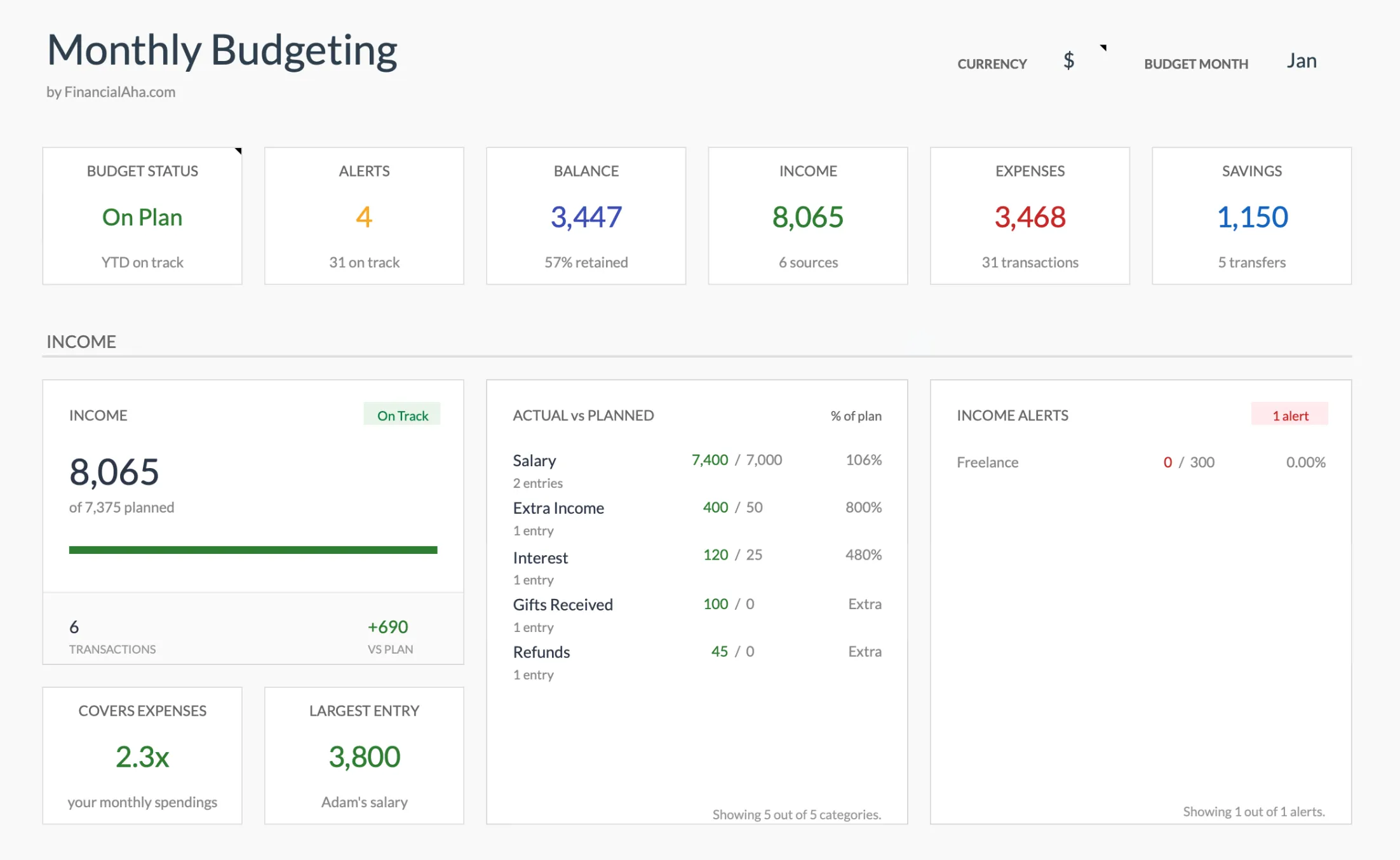
The Summary tab is the shared reference both partners look at: actual vs planned by category, plus income, expenses, and savings totals for the month, all calculated from the Transactions sheet.
Joint vs personal categories
The category list is where the spreadsheet starts to reflect a particular couple’s life. Some categories are unambiguously joint (rent, utilities, shared groceries). Some are unambiguously personal (one partner’s hobby, the other’s clothes). The middle is where conversation happens.
A working starting split:
Joint categories (paid from the joint account, tracked in the shared sheet):
- Housing - rent or mortgage, property tax, insurance
- Utilities - electric, gas, water, internet, shared streaming
- Groceries and household supplies
- Transportation - car payment, insurance, gas, transit passes (if used jointly); a shared car is also where the lease-versus-buy decision gets made together
- Insurance - health, life, disability where joint
- Savings and joint goals - emergency fund, vacation fund, down payment
- Childcare and child-related expenses (if applicable)
- Pets
Personal categories (paid from each partner’s own account, optionally tracked in the shared sheet):
- Clothing and personal items
- Hobbies and personal entertainment
- Restaurants and outings with friends (when not joint)
- Gifts for each other
- Personal subscriptions
Restaurants is the category most couples have to decide on. Dinner together is joint; lunch alone at work is personal. A rule written in a notes cell saves re-deciding every month. Giving the dinners-out a small date-night line is one way couples keep that spending visible instead of scattered across the month.
When incomes are different
The 60/40 split table above is one approach. Several others exist:
- Income-proportional with a personal floor. Same proportional contribution, but each partner keeps a minimum personal stipend regardless. Useful when one income is much lower and a strict proportional split leaves the lower earner with too little personal money.
- Fixed contribution plus topup. Each partner contributes a fixed dollar amount to joint expenses; the higher earner covers any monthly overage. Simpler in months when joint expenses bounce around.
- Phased convergence. Start with proportional, move toward equal over time as part of a longer financial integration. Common for newly cohabiting couples.
A couple deciding which to use is not arguing about percentages; they are deciding what feels fair given their specific history and values. The numbers fall out of the framing. The Net Worth Tracking for Couples piece covers the broader separate-vs-combined question for couples at a longer financial horizon.
The monthly review
Fifteen minutes, two cups of coffee, the spreadsheet open. This is the underrated half of couples budgeting.
A working agenda:
- Open the dashboard. Five minutes looking at the numbers without commentary.
- Categories that landed near or over plan. What happened? Was it a one-time thing or a pattern?
- Categories that came in under. Did we underspend or underestimate?
- One thing for next month. Not a resolution; a small adjustment. Examples some couples land on: move the grocery target up by $40, drop a streaming service neither partner used, nudge the vacation transfer by $50.
- Anything coming up. Annual insurance renewal, kid’s summer camp, a friend’s wedding. Future-tense items that should be on the radar.
The format matters less than the cadence. Monthly is enough; weekly is too often for most couples; quarterly is too far apart to catch drift. A repeating calendar event with both partners’ names on it is the part most couples skip and then wonder why the budget never works.
The conversations that come out of this are often less about numbers than they look. “We spent $640 on restaurants” is a number. “Do we want to be spending this much on restaurants” is a values question. The spreadsheet surfaces the first; the conversation answers the second.
When disagreement is about values, not numbers
A category overrun is not always a planning failure. Sometimes one partner’s idea of what should be in that category is different from the other’s. Gifts is a classic one: what counts as a reasonable amount to spend on a parent’s birthday gift varies enormously across families of origin.
One pattern some couples land on: name the values gap directly rather than negotiating the dollar amount. “I grew up where birthday gifts were $20 and you grew up where they were $100” is a more honest starting point than “you spend too much on your mom’s birthday.” The spreadsheet does not adjudicate; it shows what is happening so the right conversation can start.
Pre-marriage assets, inheritance, and what gets tracked separately
Most couples keep certain things outside the joint tracker:
- Pre-marriage assets and accounts already separate when the relationship started.
- Inheritance, especially if clearly designated to one partner.
- Retirement accounts in some couples (others include them).
- Substantial earmarked gifts from family.
These usually live in their own labeled tabs. Mixing them into joint columns creates confusion about what is shared and what the joint budget looks like month to month. State law varies on what is and is not separate property; this is a tracking choice, not a legal one. A couple where the legal status matters is at a stage to ask a lawyer, not a spreadsheet.
When the DIY sheet runs out
A hand-rolled shared sheet works well for couples with regular income and familiar expense patterns. It tends to strain around variable income, seasonal swings, sinking funds for irregular expenses, and dashboards that need more than manual SUMIFs every month. That same complexity creep, as a home spreadsheet outgrew itself, is what led us to build FinancialAha. It is also the point where a template with the formulas already built, such as the Monthly Budget Template, saves more time than rolling your own.
For couples planning a specific trip together rather than ongoing finances, the Vacation Budget Spreadsheet for Couples piece walks through trip-specific structure with contribution splits and settle-up math. For couples in the middle of wedding planning, the Wedding Budget Spreadsheet piece covers the 80-row vendor structure and deposit timing.
Get the template
Two options, framed by how the couple plans:
- For couples who plan together each month: the Monthly Budget Template ($29). Planned vs actual by category, a monthly dashboard, room for the 15-minute review.
- For couples who plan annually: the Annual Budget Template ($29). A plan column and an actual column for every category in each of the 12 months, plus an Annual Financial Goals sheet with year-end targets. Figures go in month by month rather than transaction by transaction, and it is a separate file from the monthly one.
Both are Google Sheets files you own outright. Sharing and editor access come from Google Drive rather than from anything built into the templates. No subscription, no account linking, no data leaving your own Drive. Either works for any of the three account structures above; the spreadsheet does not know or care whether the money came from a joint account, a personal account, or a settle-up transfer.
Related
Frequently asked questions
Should we combine all our money?
Couples handle this differently. The three common structures are full pool, his/hers/ours (three accounts), and separate with monthly reconciliation. Each works for different relationships. The spreadsheet can support any of them.
Who 'owns' the spreadsheet?
A shared Google Sheet with both partners as editors usually beats one partner being the keeper. Even if one partner does most of the entry, joint visibility prevents the financial-information-asymmetry that strains relationships.
What if we disagree on a category?
A monthly 15-minute review is the underrated half of couples budgeting. The disagreement is often about values, not numbers. The spreadsheet surfaces the question; the conversation answers it.
How do we handle inheritance or pre-marriage assets?
Most couples keep those separate in the tracker, with their own labeled tabs or sections. Mixing them into joint columns creates confusion. State law varies; this is a tracking choice, not a legal one.
What if one partner has irregular or freelance income?
Variable income is where a fixed proportional split gets awkward. Some couples base each month's contribution on a trailing average of the irregular earner's income; others have the steadier earner cover a fixed base while the variable earner tops up in stronger months. The spreadsheet holds either arrangement; it just needs the contribution figure entered per month rather than set once.
What if one of us brought debt into the relationship?
Pre-relationship debt is usually tracked as a personal line rather than a joint one, the same way pre-marriage assets are kept separate. Keeping it labeled and visible in the shared sheet closes the information gap without forcing it into the joint columns. Whether repayment is shared is a couple-level decision, not one the tracker makes for you.
Sources
About this article
Couples-money statistics checked against an Ipsos survey of partnered Americans and Pew Research Center's analysis of U.S. Census earnings data. Template prices and structure checked on 2026-09-10 against the shipped Monthly Budgeting Google Sheet (Summary, Budget Plan, Transactions, Goals, Categories tabs) and the Annual Budgeting Planner (Summary, Annual Plan, Annual Financial Goals tabs). Last reviewed September 2026.