
Couples track net worth three ways. Fully combined puts every account in one household number and suits partners whose finances and goals are already shared. Fully separate keeps each partner's own sheet and fits independent finances or very different histories. Hybrid, where most couples land, keeps individual visibility while rolling shared assets into one household total. The structure that works follows how you already think about money, not the reverse.
Money is one of the most common things couples argue about, and how you track it together is a decision that looks purely practical but is actually deeply personal. The spreadsheet structure you choose says something about how you see the partnership. There’s no right answer, only real trade-offs worth thinking through. The Net Worth Tracker is one file that lists every account as its own row inside a fixed asset type, so a couple can run one shared copy or a copy each; the choice is about which of the three structures below matches how you and your partner already think about money.
Why This Decision Matters More Than It Seems
The way you track net worth shapes how you talk about money. A couple with a single combined number naturally thinks in terms of “we’re at $218,000,” where the household is the unit. A couple with separate tracking thinks in terms of “I’m at $75,000 and you’re at $62,000,” where the individuals are the unit. Neither framing is wrong, but they lead to very different conversations when it’s time to decide whether to buy a house, change careers, or take a year off.
For long-term planning as a couple, the Financial Planning Template projects one set of assets, debt and cashflow forward to an end year you choose, and measures it against goals you enter for net worth, liquid money, asset value and maximum debt.
Fully Combined: The “What’s Mine Is Ours” Approach
Picture this: one spreadsheet, every account listed together, one net worth number at the bottom. Partner A’s 401(k), Partner B’s student loans, the joint checking account, the mortgage - it all goes in one place. The question “how are we doing?” has a single, clear answer.
This approach works when both people genuinely think of their finances as shared. It tends to emerge naturally in marriages where incomes are similar and financial goals are aligned. The mental shift from “mine” and “yours” to “ours” usually precedes the spreadsheet decision, not the other way around.
The simplicity is real. One number to track, one sheet to update, one conversation to have. And there’s something psychologically powerful about seeing a shared number grow, reinforcing the sense of building something together.
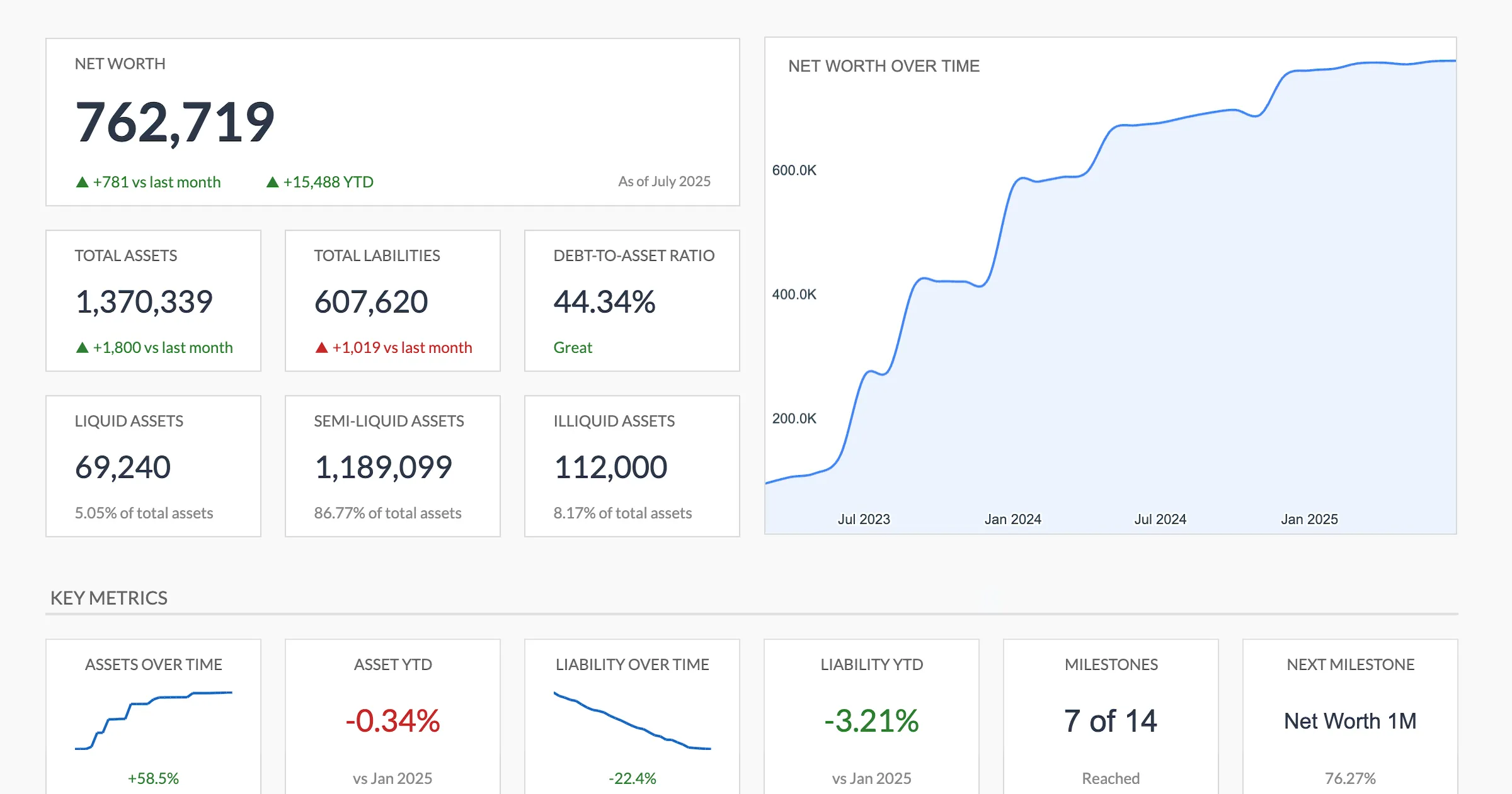
The Summary tab in the Premium Net Worth Tracker rolls every account in the file into one net worth figure, alongside total assets, total liabilities and a Net Worth Over Time chart. That is the view a fully combined couple works from.
But combined tracking papers over things that might matter. When one partner earns significantly more, or when one brought substantial debt into the relationship, a single number can hide dynamics that deserve attention. If Partner A contributed $150,000 and Partner B contributed $30,000, the combined total of $180,000 doesn’t tell you that story. For some couples, that’s fine - they genuinely don’t care. For others, the imbalance creates quiet resentment that a spreadsheet can’t fix.
And if the relationship ends, there’s no clean individual baseline to return to. Something worth acknowledging, even if it feels uncomfortable.
Fully Separate: The “Respectful Distance” Approach
Now imagine two people, each with their own spreadsheet, tracking their own accounts independently. They might share the totals with each other, or they might not - that’s a separate conversation about transparency.
This approach gets unfairly maligned as a lack of commitment, but that’s not what it is for most couples who choose it. It’s often about respecting different financial histories and habits. One partner might be a meticulous tracker who updates weekly. The other might check their accounts quarterly and prefer not to think about it in between. Separate tracking lets each person manage money in the way that works for them, without imposing one style on both.
Where separate tracking gets complicated is joint planning. If you want to buy a house together, you need to know the combined picture - and if you’ve been tracking separately, assembling that picture requires a conversation that combined trackers never need to have. It can also lead to a quiet divergence where two people in the same household are heading in different financial directions without realizing it.
Separate tracking tends to make sense for unmarried couples, for relationships where financial independence is important to one or both partners, and for situations where financial histories are very different - like when one partner has a high income and no debt while the other is working through $80,000 in student loans.
Hybrid: The “Both And” Approach
The hybrid is what many couples actually end up with, even if they don’t call it that. Each person maintains some awareness of their individual finances (retirement accounts, personal savings, debts they brought into the relationship) while also tracking shared assets and liabilities together. A household summary sheet pulls it all into one view when needed.
| Category | Amount |
|---|---|
| Partner A net worth | $75,000 |
| Partner B net worth | $62,000 |
| Joint assets | $93,000 |
| Joint liabilities | -$12,000 |
| Total Household | $218,000 |
To get a first combined figure before building any of this out, the Net Worth Calculator adds up the assets and liabilities you enter, individual and joint together, and returns total assets, total liabilities and one net worth figure.
The hybrid approach requires one thing the others don’t: agreement on what counts as “joint” versus “individual.” The joint checking account is obvious. But what about a 401(k) that’s legally individual but represents household retirement savings? What about a car that’s in one person’s name but both people use? These classification decisions are small negotiations, and they reveal how the couple actually thinks about ownership and partnership.
The added complexity is the trade-off. There’s more to track and more to maintain. But the flexibility is real - a hybrid system can evolve as the relationship does. Couples who start hybrid often gradually shift toward combined as their lives become more intertwined.
The Scenarios That Complicate Things
When incomes are very different. A household where one partner earns $200,000 and the other earns $45,000 faces a tracking question that’s really a fairness question. Combined tracking focuses on household progress and sidesteps the “who contributed what” discussion - which can reduce friction. Separate tracking with agreed-upon contributions to joint expenses (often proportional to income) maintains individual accountability. There’s no formula for this; it depends on whether both people feel the arrangement is fair.
When one partner brings debt. Student loans from before the relationship, a car loan, credit card debt - these belong to one person, but they affect both. Some couples track the debt separately as an individual responsibility. Others absorb it into the combined picture and tackle it as a team. The hybrid approach lets you do both: the debt stays on one person’s individual sheet, but the payments come from joint resources. What matters more than the tracking structure is whether both people agree on the plan.
When one partner owns a business. Business value is volatile and hard to pin down. Including it in household net worth means the number swings with the business - up $50,000 one quarter, down $30,000 the next. Some couples track business value separately and only count distributions (actual money paid out) in the household finances. Others accept the volatility as part of their financial picture. Either way, it helps to be explicit about the choice rather than inconsistently including or excluding business assets depending on whether the number looks good that month.
Blended families. When children from previous relationships are in the picture, protecting inheritance becomes a priority for many people. Fully separate tracking keeps assets clearly delineated for estate purposes. A hybrid approach with documentation establishes what’s joint versus individual. Whatever the tracking method, legal documentation (wills, trusts, beneficiary designations) matters more than spreadsheet organization.
The Conversations That Matter More Than the Spreadsheet
Before you set up any tracking system, a few conversations are worth having. What are the financial goals you share? What level of detail are you both comfortable seeing? How do you think about debt one person brought to the relationship - as theirs or as something you’re both dealing with?
These aren’t spreadsheet questions. They’re relationship questions. If one partner wants full combined tracking and the other wants fully separate, the interesting thing isn’t the tracking preference - it’s what each person is really saying about how they see the partnership.
Ongoing, it helps to check in periodically. How often do you review together? What spending requires a conversation versus individual discretion? These agreements can evolve, and the tracking system can evolve with them.
Moving Between Approaches
Transitioning from separate to combined usually happens gradually. If either partner is new to this, the mechanics of tracking net worth from scratch are the same whoever owns the accounts. Start with a household summary that simply adds up two individual net worths, giving visibility without changing anything. Then as joint accounts grow, combine those. Eventually, some couples merge tracking entirely.
Going the other way, from combined to separate, is less common but sometimes necessary. Document the current joint net worth, divide assets by ownership, and set up individual systems. Neither direction is a sign that something is wrong. The tracking system is a tool that serves you - not the other way around.
Legal Reality vs. Spreadsheet Reality
One important note: in most jurisdictions, marriage creates financial entanglements regardless of how you organize your spreadsheet. In community property states, for instance, income and most property acquired during marriage are generally treated as owned equally by both spouses, as the IRS explains in Publication 555. Debt during marriage may be joint responsibility, and retirement accounts may carry spousal rights. Your tracking method doesn’t change the legal reality. If keeping finances legally separate matters to you, documentation like prenuptial agreements carries weight in ways that spreadsheet tabs do not.
For significant assets or complex situations, financial and legal professionals can advise on both structure and strategy. The spreadsheet tracks numbers; professionals help you understand what those numbers mean in the real world.
Related
- Financial Planning Template - Goals and a projection to an end year you set
- Net Worth Tracker - Accounts by asset type, with a Summary dashboard
- Net Worth Tracking for Beginners
- How Often to Calculate Net Worth
- Psychology of Net Worth Tracking
Frequently asked questions
How do we decide whether to combine net worth before marriage?
That's a personal decision without a universal answer. Tracking together builds financial partnership; tracking separately maintains independence. Choose what fits your relationship stage and comfort level.
What if one partner doesn't want to share their numbers?
Reluctance to share limits joint planning. Worth exploring why there's hesitation and whether some middle ground exists, like sharing totals without detailed breakdowns.
How do we handle different tracking styles?
One partner can serve as the family CFO who maintains the household spreadsheet, while the other contributes data or reviews together. Find a division of labor both partners accept.
Are retirement accounts considered joint?
Legally they're individual, but for household planning purposes, including them in combined net worth often makes sense since retirement planning requires knowing what both partners have saved.
Should we count the home as joint if only one name is on the title or mortgage?
Ownership on paper and how a couple actually uses an asset can differ. Many couples treat a shared home as joint regardless of whose name is on the title or loan, and note the legal owner separately. A tracker holds the value wherever you place it, so the classification is the couple's call, not the spreadsheet's.
Do we each need a separate copy of the template?
Some couples keep one shared copy and label each account row with whose it is, since rows sit inside fixed asset types like Real Estate or Retirement Account rather than inside per-person sections. Others keep a copy each and add the two totals up themselves. The Net Worth Tracker is a Google Sheets file you can copy as many times as needed.
Sources
- Publication 555, Community Property - Internal Revenue Service
About this article
Legal points about community property and marital assets are checked against IRS Publication 555. Template sheets, inputs and outputs checked on 2026-09-10 against the shipped Net Worth Tracker Google Sheet (Summary, Assets, Liabilities, Milestones, Setup tabs) and the Financial Planning Google Sheet (Goals, Projection tabs). Example figures in the household table are illustrative and are not taken from either template. Last reviewed September 2026.