
Tracking net worth changes financial behavior because awareness disrupts autopilot, the same mechanism that makes food logging work. Monthly updates suit most people: frequent enough to catch problems like subscription creep, rare enough to ignore market noise. The common traps are anxiety over daily swings and comparison to others, both eased by watching your 12-month trend instead of the daily number.
There is a reason tracking comes up in almost every conversation about money, and it is not just that “responsible people track things.” The act of tracking itself appears to change behavior.
Tracking tool: The Net Worth Tracker provides structured monthly tracking designed to support healthy financial habits.
Why Tracking Changes Behavior
Food logging shows the pattern clearly. In a Kaiser Permanente weight-loss maintenance trial of nearly 1,700 adults, those who kept daily food records lost twice as much weight as those who kept none. Logging burns no calories. What it does is interrupt autopilot, and the same principle applies to money.
Before you track net worth, financial decisions happen in a fog. You have a vague sense of whether things are “fine” or “not fine.” Maybe you check your bank balance occasionally. But the complete picture, assets minus debts and the trajectory over time, stays invisible.
Once you start tracking monthly, that fog lifts. You see that the $200/month subscription creep actually costs $2,400/year. You notice that your net worth grew $15,000 last year even though it didn’t feel like you were saving much. You realize your student loans have barely moved despite two years of payments because you’re only covering interest.
This isn’t about judgment. It’s about information. And information changes decisions.
The Upside
Watching net worth increase over time turns an abstract concept into something concrete. “Building wealth” stops being a vague aspiration and becomes a visible line trending upward on a chart.
This matters because most financial progress is invisible. You don’t feel richer when your 401(k) grows by $500 this month. You can’t touch index fund shares. But a net worth tracker makes that growth tangible - you can see that you’re $12,000 ahead of where you were last January.
The compound effect becomes real too. Early on, investment returns barely register. After a few years of tracking, you start noticing months where your investments grew more than you contributed. That’s when the math clicks emotionally, not just intellectually.
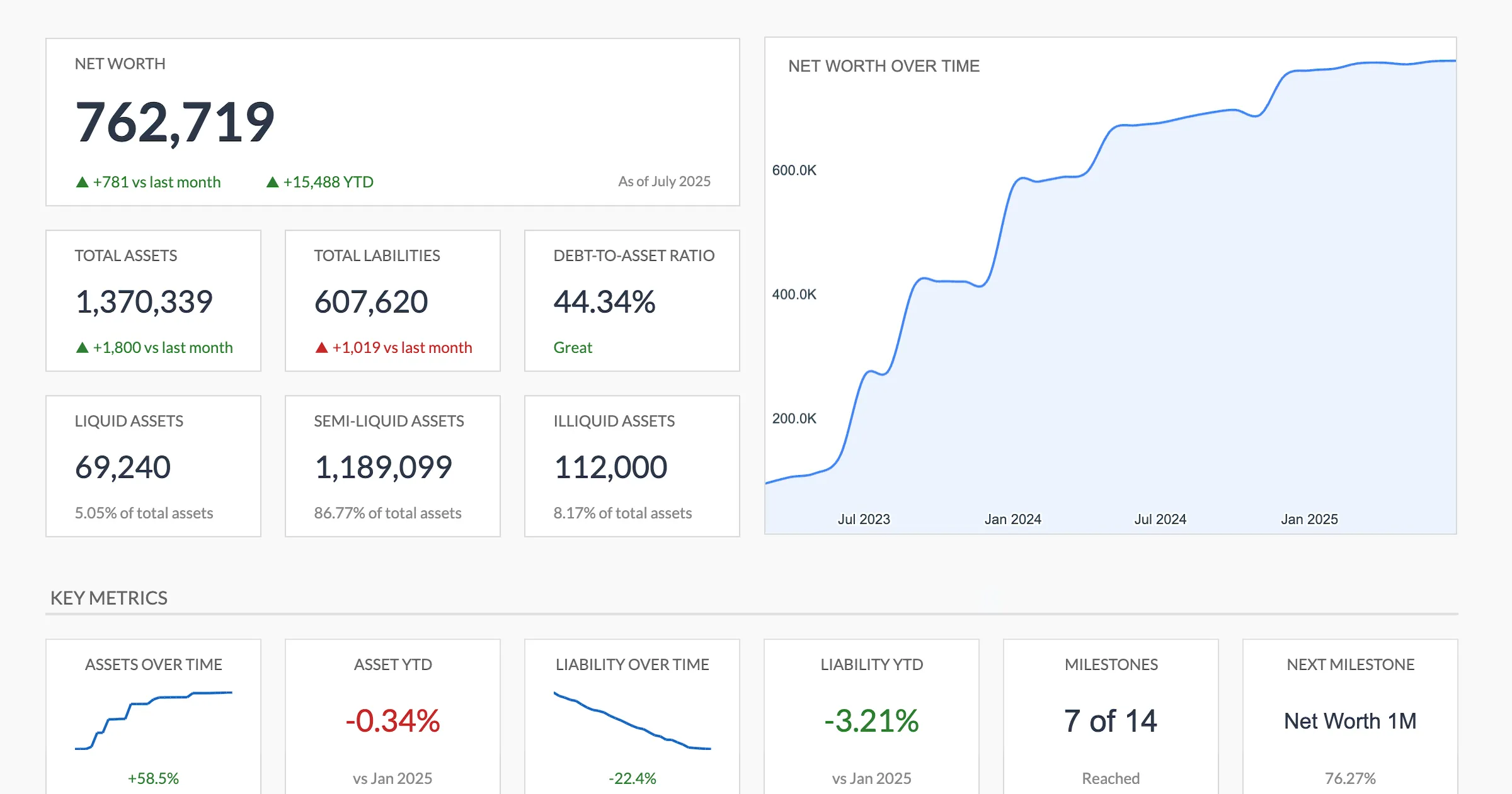
The Net Worth Tracker (Premium) puts the trend line front and center: the year-to-date figure and the net-worth-over-time chart are what turn invisible progress into something you can actually see.
The Downside
Tracking has a dark side. Some people check their net worth daily and stress over normal market fluctuations. Others obsess over the number to the point where a bad month ruins their week.
If your net worth is heavily invested in stocks, it will fluctuate. A 10% market drop means your net worth drops 10% (on paper). This is normal and temporary if you don’t sell - but it doesn’t always feel that way when you’re staring at the number.
Comparison creates problems too. Reading about someone your age with twice your net worth can spiral into feelings of inadequacy - even though you know nothing about their circumstances (inheritance, location, career, luck).
And there’s the risk of number fixation. Net worth is one metric. It doesn’t capture cash flow health, life satisfaction, or whether you’re actually enjoying the money you have. Someone with $500,000 in home equity but no emergency fund has a different situation than someone with $300,000 in liquid investments.
Finding the Right Frequency
Daily or weekly tracking creates noise. Your net worth didn’t meaningfully change since yesterday. Market fluctuations dominate, and you’re just watching randomness. This frequency tends to increase anxiety without providing useful information.
Monthly tracking works for most people. It’s frequent enough to catch problems (spending creep, forgotten subscriptions, accounts going sideways) but rare enough that real change has time to happen between updates. A month is long enough for a paycheck cycle, a credit card statement, and meaningful investment movement.
Quarterly or annual tracking works if monthly creates anxiety or if your finances are stable and automated. The downside is that problems compound longer before you notice them.
The right answer depends on your personality. If tracking motivates you, monthly is probably right. If it stresses you out, try quarterly and see if the distance helps. There is a fuller breakdown of the trade-offs in how often to calculate net worth.
Managing Emotional Reactions
Net worth will drop sometimes. Markets decline. You’ll have expensive months - car repairs, medical bills, taxes. A single bad month doesn’t define your trajectory.
When this happens, looking at 12-month change instead of single-month change usually restores perspective. Yes, you’re down $3,000 from last month. But you’re up $18,000 from last year. The longer view matters more.
The same applies when net worth jumps unexpectedly. A hot stock market or a bonus can inflate the number temporarily. Appreciation is fine, though one good quarter is a thin basis for raising fixed spending, which is the lifestyle inflation that quietly cancels out the gain.
When Tracking Helps Most
Tracking is most valuable during transitions: paying off debt, building an emergency fund, early career growth. These are phases where progress happens relatively quickly and visibility matters.
It’s less critical once finances stabilize. Someone with a paid-off house, fully-funded retirement accounts, and automated investments might not need monthly tracking - an annual check-in confirms everything is still working.
Tracking also helps when you suspect something is wrong but can’t pinpoint it. “I make good money but never seem to get ahead” becomes clearer when you see exactly where the money goes and how net worth has (or hasn’t) changed over three years.
Beyond the Number
Net worth is useful but incomplete. A few other questions matter:
Cash flow: Are you spending less than you earn? Positive net worth with negative monthly cash flow is a slow-motion problem.
Liquidity: How much of your net worth can you actually access? Home equity doesn’t help with an emergency, which is the distinction between net worth and liquid net worth.
Trajectory: Is net worth growing, flat, or declining? Direction matters more than current position.
Sustainability: Are you building wealth in a way you can maintain, or are you white-knuckling an extreme savings rate?
And some important things don’t show up in any number: stress level around money, confidence in your decisions, whether your spending aligns with your values.
The Identity Shift
Something subtle happens after a year or two of consistent tracking. Your relationship with money changes.
Spending decisions start feeling different. Not because you’re forcing discipline, but because you’ve internalized the tradeoffs. That $50 dinner out registers as “$50 that won’t compound for 30 years” without conscious effort. This isn’t deprivation - it’s just awareness.
Some people describe this as shifting from “spender” to “wealth builder.” The identity change affects decisions automatically. You’re not fighting impulses anymore; you genuinely want different things.
This doesn’t happen overnight, and it doesn’t happen to everyone. But for people who stick with tracking long enough, it’s a common experience.
What Healthy Tracking Looks Like
Monthly tracking, focusing on trends rather than single data points, celebrating milestones without inflating lifestyle, using the data for decisions rather than anxiety - this is roughly the healthy version.
The Net Worth Tracker provides structured monthly tracking with historical comparison. The Financial Planning Template works from the other end: a Goals tab holds targets for net worth, liquid money, assets and debt, and a Projection tab carries your current assets and debt forward to an end year you choose.
Related
- Financial Planning Template - Set targets and project them forward
- Net Worth Tracker - Structured monthly tracking
- How Often to Calculate Net Worth
- Net Worth Tracking for Beginners
- Lifestyle Inflation Protection
Frequently asked questions
Is it normal to feel bad when net worth drops?
Yes. The response matters more than the feeling. A temporary emotional reaction is fine; making poor financial decisions based on that reaction is the problem.
How do I stop comparing to others?
Your own trajectory tends to be the more useful reference. Comparison to yourself last year says something; comparison to strangers online, whose inheritance, location, and career you can't see, rarely does.
What if tracking creates anxiety?
Try less frequent tracking (quarterly), focus on controllable metrics like savings rate, or consider whether the anxiety points to a real problem that needs addressing.
Should my house and car count in net worth tracking?
Net worth is everything you own minus everything you owe, so a home or car belongs in the total. Because that equity is hard to spend, many trackers separate liquid from illiquid assets so a large but frozen number doesn't get mistaken for available cash.
Is a net worth tracker the same as a budget?
No. A budget plans monthly income and spending, while a net worth tracker records what you own minus what you owe at a point in time. The two answer different questions, which is why some people keep both.
About this article
Template sheets, inputs and outputs checked on 2026-09-10 against the shipped Net Worth Tracking Google Sheet (Summary, Assets, Liabilities, Milestones, Setup tabs) and the Financial Planning Google Sheet (Goals, Projection tabs). Last reviewed September 2026.