
Net worth counts every asset minus every debt; liquid net worth counts only assets you can turn into cash quickly, minus your debts. Total net worth tracks long-term wealth, while liquid net worth shows what you could actually access in an emergency. The two often diverge, so tracking both gives the fuller picture.
Someone with $500,000 net worth might have only $10,000 accessible. Someone with $150,000 net worth might have $100,000 available immediately.
Both numbers matter, but they answer different questions. Understanding the distinction helps with both long-term planning and short-term financial decisions.
The Basic Difference
Net worth counts everything. All assets minus all liabilities. Real estate equity, retirement accounts, vehicles, collectibles - everything you own of value, minus everything you owe. This number captures your total financial position and tracks wealth accumulation over time.
Liquid net worth is more selective. It counts only assets you can convert to cash quickly, within days to weeks, without significant penalty or hassle. It answers a different question: how much money could you actually access if you needed it tomorrow?
What Counts as Liquid?
The distinction matters for practical planning. Here’s how different assets typically categorize.
Liquid assets include cash in checking and savings accounts, money market accounts, taxable brokerage accounts, and savings bonds. These can convert to spendable cash within days. You might lose some value if markets are down, but the conversion process is straightforward.
Illiquid assets include home equity, retirement accounts (accessible but with penalties), business ownership stakes, vehicles, real estate investments, and collectibles. Converting these to cash requires selling, and selling takes time, effort, and sometimes significant costs.
Gray areas exist. Retirement accounts are technically accessible: you can withdraw before age 59 1/2, but the IRS generally applies a 10% additional tax on early distributions on top of ordinary income tax. Some people include retirement accounts in liquid net worth at a reduced value (say, 70-80% of balance) to account for this. Others exclude them entirely since accessing the money has real costs.
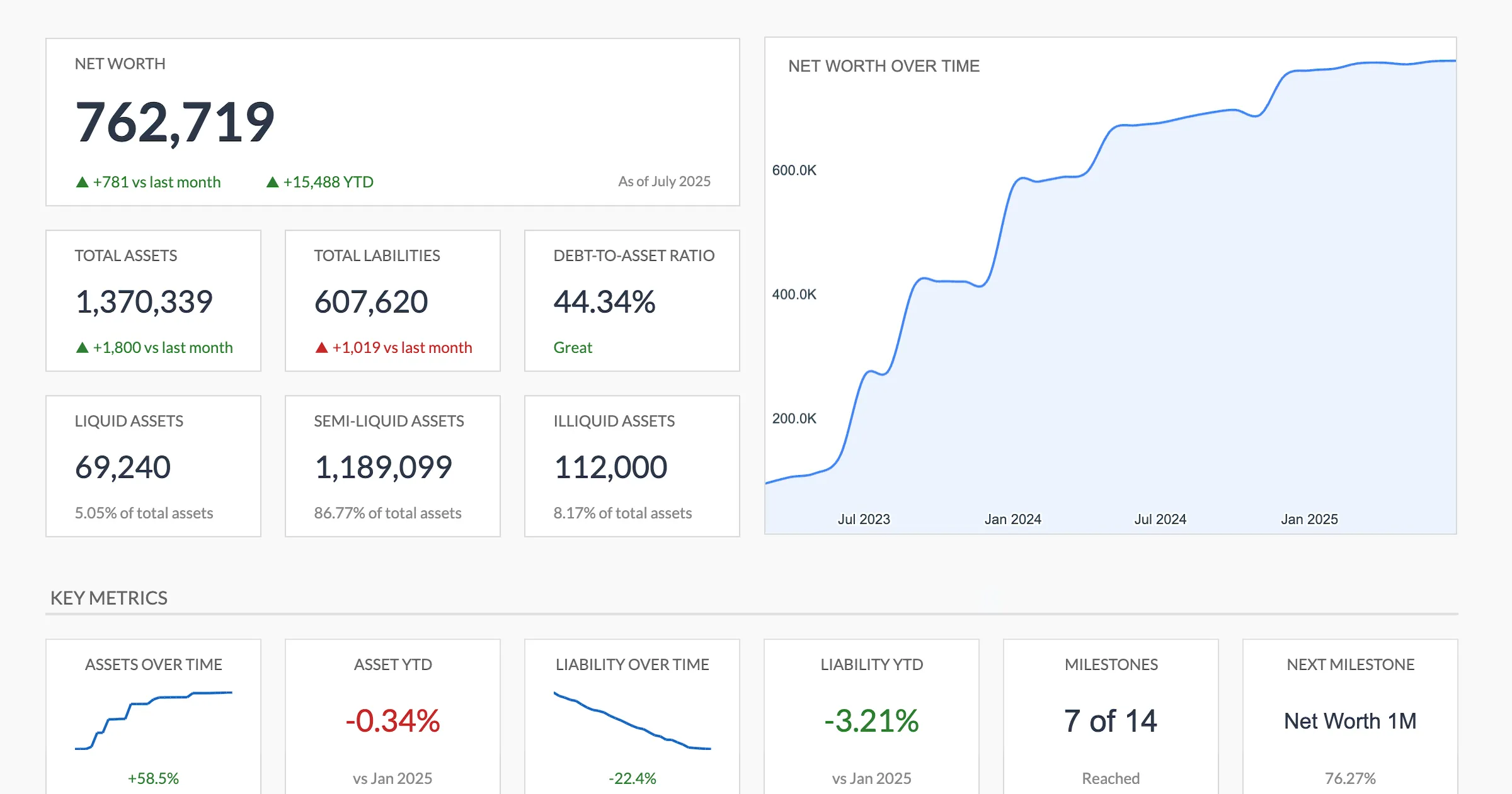
The Premium Net Worth Tracker breaks total assets into liquid, semi-liquid, and illiquid tiers, so the gap between what you own and what you can quickly reach is visible at a glance.
Example: Same Person, Two Numbers
The contrast becomes clear with a concrete example. Consider someone with the following financial picture.
Total Net Worth:
| Assets | Value |
|---|---|
| Home | $350,000 |
| 401(k) | $120,000 |
| Taxable investments | $30,000 |
| Savings | $15,000 |
| Checking | $5,000 |
| Vehicle | $25,000 |
| Total Assets | $545,000 |
| Mortgage | $280,000 |
| Auto loan | $12,000 |
| Total Liabilities | $292,000 |
| Net Worth | $253,000 |
Liquid Net Worth:
| Liquid Assets | Value |
|---|---|
| Taxable investments | $30,000 |
| Savings | $15,000 |
| Checking | $5,000 |
| Total Liquid | $50,000 |
With liabilities at $292,000, the liquid net worth is -$242,000. This isn’t necessarily a problem, since it reflects assets tied up in home equity and retirement savings. But it does mean accessible cash is limited to $50,000, regardless of the healthy total net worth.
To run your own numbers, the net worth calculator below totals assets minus liabilities the same way the example does. It takes Cash & Savings, Investments, Retirement Accounts, Real Estate, Vehicles and Other Assets on one side, Mortgage, Car Loans, Student Loans, Credit Card Debt and Other Debts on the other, and returns total assets, total liabilities and net worth. There is no separate liquid subtotal, so the liquid slice is whatever you entered under Cash & Savings and Investments, while the remaining asset fields cover what takes longer to reach.
For a formula-by-formula version you can build yourself, see how to calculate your net worth in Google Sheets.
When Each Metric Matters
Total net worth answers long-term questions. Is retirement on track? How has wealth grown over the past decade? What’s available for estate planning? What’s the overall financial picture for major life decisions like career changes or relocations? This number provides the big picture view of financial health.
Liquid net worth answers short-term questions. Could you survive six months of unemployment? Could you cover a major emergency without debt? Do you have capital available for investment opportunities that require quick action? This number measures financial flexibility and resilience to unexpected setbacks.
The Common Imbalance
Many people have acceptable total net worth but dangerously low liquid net worth. This pattern is more common than you might expect, especially among homeowners and diligent retirement savers.
Warning signs include high home equity but minimal savings, maxed retirement contributions but no emergency fund, or needing to take on debt for a $5,000 emergency. Any of these suggests the balance between long-term wealth building and short-term financial resilience may be off.
This imbalance happens for understandable reasons. Retirement contributions get emphasized in workplace financial education. Home equity accumulates automatically with each mortgage payment. Cash sitting in savings feels idle compared to investments generating returns. The result: strong total net worth, weak liquid net worth.
Building More Liquidity
If the imbalance resonates, some approaches are worth considering to shift resources toward accessible savings.
One approach some people take is building an emergency fund before maxing retirement contributions. The employer 401(k) match is often captured regardless, since it is money left on the table otherwise, while contributions beyond the match wait until accessible savings reach a comfortable level.
After securing the employer match, taxable brokerage accounts offer an alternative to additional retirement contributions. The money grows and compounds, but remains accessible without penalties. This provides both growth and liquidity.
Cash reserves matter even if they’re not “optimized.” Not everything needs to generate maximum returns. The purpose of accessible savings is peace of mind and flexibility, not maximizing growth.
Tracking Both
A comprehensive approach tracks both metrics side by side. This doesn’t require separate spreadsheets - just organizing your net worth tracker to show both views.
One approach: create two sections. The first includes all assets, all liabilities, and calculates total net worth. The second includes only liquid assets, the same liabilities, and calculates liquid net worth. Watching both numbers over time reveals whether the balance is shifting toward or away from liquidity.
In the Net Worth Tracker, the split is a setting rather than a second block of rows. The Setup tab lists eleven asset types with a Liquid, Semi-Liquid or Illiquid dropdown beside each one, so Retirement Account or Real Estate can sit in whichever tier matches how you read it. The Summary then reports Liquid, Semi-Liquid and Illiquid asset totals with each tier’s share of total assets, next to net worth and the debt-to-asset ratio. Liabilities are not classified, so subtracting them from the liquid tier stays a manual step.
Related
Frequently asked questions
Do you subtract all debts or only short-term debts for liquid net worth?
There is no single rule. The common approach subtracts all liabilities from liquid assets, which is why a homeowner with a large mortgage can show a deeply negative liquid net worth. Some people subtract only short-term debts, such as credit card balances, to isolate near-term cash pressure. Whichever method you pick, applying it the same way each period is what makes the trend readable.
Should retirement accounts count as liquid?
Most calculations treat them as illiquid because reaching the money before age 59 1/2 usually triggers a 10% early-withdrawal penalty plus income tax. Some people include them at a reduced value, often 70 to 80% of the balance, to reflect that they are reachable but costly. Excluding them entirely is the more conservative reading.
Is negative liquid net worth a problem?
Not necessarily. Young homeowners often have negative liquid net worth because so much sits in home equity and retirement accounts. The more telling question is whether the liquid assets on their own cover several months of expenses.
Which metric deserves more attention?
Both track something the other misses. Total net worth measures long-term progress; liquid net worth measures short-term flexibility. Watching them side by side is what reveals whether wealth is becoming more or less accessible over time.
Sources
- Retirement topics - Tax on early distributions - Internal Revenue Service
About this article
Early-withdrawal penalty and the age 59 1/2 threshold checked against IRS guidance on tax on early distributions. Worked example figures are internally reconciled: assets minus liabilities for both total and liquid net worth. Net Worth Tracker sheets, Setup liquidity dropdown and Summary liquidity tiles checked on 2026-09-10 against the shipped Net Worth Tracking Google Sheet (Summary, Assets, Liabilities, Milestones, Setup tabs). Last reviewed September 2026.