
A Roth conversion pays income tax now so future growth and withdrawals come out tax-free. It pays off when your rate today is lower than the rate you expect in retirement, and the classic windows are gap years, early retirement before Social Security starts, and down markets. Partial "bracket-filling" conversions usually beat converting everything at once, and paying the tax from a separate account rather than the IRA is what makes the math work.
A Roth conversion is a bet. You’re betting that the tax rate you pay today is lower than the rate you’d pay in retirement. If you’re right, you come out ahead - sometimes significantly. If you’re wrong, you’ve paid more tax than necessary.
The interesting part: there are specific windows in life when this bet is almost certainly favorable. Knowing when those windows open, and how much to convert, is where the math gets useful.
The Roth Conversion Calculator models both outcomes with your numbers. No signup required.
Pay Now or Pay Later: What the Math Looks Like
Take $100,000 sitting in a traditional IRA. Current marginal rate: 22%. Expected retirement rate: 24%. Twenty years until withdrawal. 7% average annual growth.
Leave it in the traditional IRA:
- Grows to $386,968
- Withdraw at 24%: $386,968 x 0.76 = $294,096 after tax
Convert to Roth, pay tax from a separate account:
- Pay $22,000 in tax now (22% of $100,000)
- $100,000 in Roth grows to $386,968
- Withdraw tax-free: $386,968
But that $22,000 used for taxes could have been invested too. Left in a taxable account at the same 7%, with long-term capital gains tax taking 15% of the return, the effective rate is about 5.95%, and over 20 years it grows to roughly $69,900.
Net comparison:
- Traditional path: $294,096
- Roth path: $386,968 minus $69,900 opportunity cost = $317,068
The Roth conversion wins by about $23,000. The margin isn’t enormous, but it’s real - and it widens if the tax rate gap is larger or the time horizon is longer.
One critical detail: if the tax is paid from the IRA itself rather than outside money, only $78,000 goes into the Roth. That grows to $301,835 - barely beating the traditional path. Paying the tax from a separate account is what makes conversions work.
The Windows That Open and Close
Roth conversions aren’t equally good every year. Certain life situations create temporarily low tax rates that make conversions unusually attractive:
Between jobs. A few months with no salary can drop your annual income into a lower bracket. Converting enough to fill that bracket captures the low rate.
Early retirement, before Social Security. The years between stopping work and claiming Social Security or Required Minimum Distributions often produce the lowest taxable income of your adult life. This is prime conversion territory.
A down year in the market. If a $200,000 traditional IRA drops to $150,000, converting at the lower value means paying tax on $150,000. When it recovers, with that recovery happening inside the Roth, the growth is tax-free.
Years with unusual deductions. Large medical expenses, charitable contributions, or business losses can push taxable income down, creating conversion room.
Bracket-Filling: The Strategy That Usually Beats Going All In
Converting an entire traditional IRA in one year often creates a massive tax bill by pushing income into the higher brackets. The more effective approach for most people is partial conversion - converting just enough to fill the current bracket.
Here’s what that looks like:
Single filer with $42,000 in taxable income. For 2026, the 22% bracket starts at $50,401, so there’s $8,400 of room left in the 12% bracket. Converting exactly that amount costs $1,008 in tax.
Do this for several years, converting $20,000 to $30,000 annually at favorable rates, and over a decade you can move a substantial portion of a traditional balance to Roth without ever triggering a painful tax bill.
The calculator takes a conversion amount you enter, along with your current rate, the rate you expect in retirement, the years to withdrawal, the return and whether the tax comes from outside funds, so amounts can be compared one at a time. It does not hold a bracket table or work out how much room a bracket has left.
When Conversions Don’t Make Sense
Not every situation favors a Roth conversion. Some scenarios where standing pat is likely the better call:
You’re in a peak earning year. Converting at 32% or 37% only helps if retirement income will be even higher - and for most people, it won’t be.
Retirement income will be modest. If Social Security and modest withdrawals keep you in the 10-12% bracket during retirement, paying 22%+ now to avoid 12% later is a losing trade.
The tax has to come from the IRA. Converting $100,000 and paying $22,000 from the same account means only $78,000 makes it to the Roth. The tax-free compounding advantage shrinks dramatically.
The time horizon is short. A conversion at age 72 has far less time for tax-free growth to overcome the upfront tax cost than a conversion at age 52.
The Ripple Effects
A Roth conversion adds to your adjusted gross income for the year, which can trigger secondary costs:
- Medicare premiums: Higher income can trigger IRMAA surcharges. Social Security sets those surcharges from the tax return two years earlier, so the higher Part B and Part D premiums arrive two years after the conversion.
- Social Security taxation: More income can push the taxable share of Social Security benefits from 50% up to 85%.
- ACA subsidies: For those on marketplace health insurance, a large conversion can reduce or eliminate premium subsidies.
A conversion that saves $3,000 in future taxes but costs $4,000 in Medicare surcharges isn’t a win. The total picture matters.
The 5-Year Rule (Briefly)
Converted amounts have a five-year waiting period before they can be withdrawn penalty-free if you’re under 59.5. Each conversion starts its own clock.
After 59.5, the rule doesn’t apply. Converted funds are immediately available. This makes conversions in the years just before or during early retirement especially practical - by the time you might need the money, the waiting period has likely passed.
Putting It Together
The Retirement Financial Planning Template projects a single combined retirement balance year by year, listing income, expenses, the amount drawn from the portfolio and the withdrawal rate at each age, and it marks the bridge period between the retirement age you enter and the age pension income starts. It works from one savings figure covering all retirement accounts, so it does not separate Roth from traditional money or model a conversion. The Annual Tax Planner Template covers one tax year at a time: income is logged by type on the Income sheet, each type carries a tax rate you enter on the Dashboard, and a conversion would sit there as an income line at the rate you set.
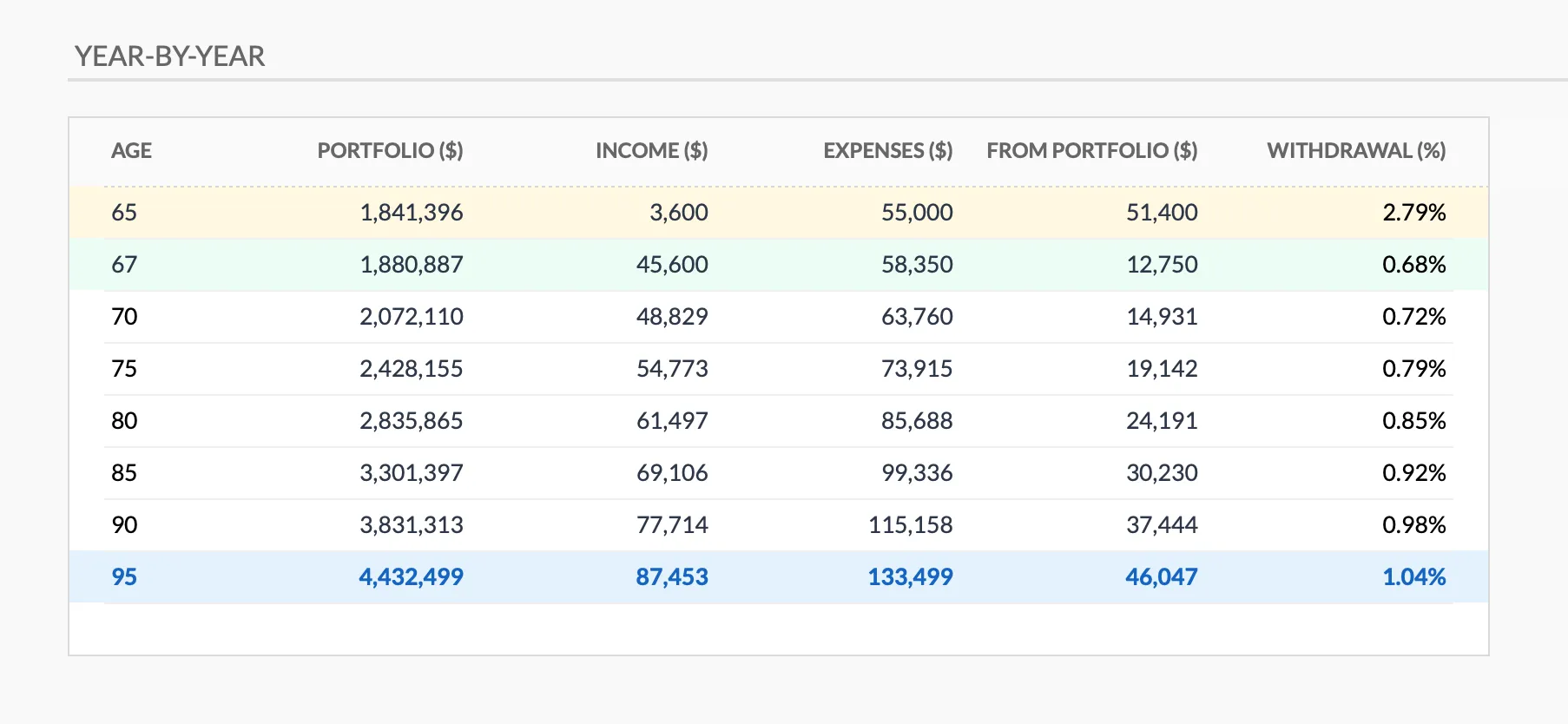
The year-by-year projection view in the Retirement Financial Planning Template (Premium tier) shows how portfolio balance and withdrawal rate move across each retirement year, the same low-income years where conversions often fit.
Roth & 401(k) Deep Dives
- Backdoor Roth Calculator: The High-Earner Strategy Explained - How the backdoor Roth works, including the pro-rata rule and who benefits most
- 401(k) vs. Roth 401(k) Calculator: Which One Wins? - Comparing traditional and Roth 401(k) contributions based on current and future tax rates
- Roth IRA Growth Calculator: See Your Tax-Free Future - How tax-free compounding works and why starting early matters
- Mega Backdoor Roth Calculator: Supercharge Your Roth Contributions - After-tax 401(k) contributions converted to Roth, beyond the standard limit
Related
Frequently asked questions
What is a Roth conversion?
Moving money from a traditional IRA or 401(k) to a Roth IRA. You pay income tax on the converted amount now, but future growth and withdrawals are tax-free.
When is a Roth conversion most advantageous?
When your current tax rate is lower than your expected future rate - such as during a gap year between jobs, early retirement before Social Security starts, or years with unusually low income.
Can I convert just part of my traditional IRA?
Yes. Partial conversions are common and often preferred - they let you control the tax impact by converting only enough to fill up your current tax bracket.
Is there a deadline for Roth conversions?
Conversions must be completed by December 31 of the tax year. Unlike IRA contributions, there's no extension to April 15.
Can I undo a Roth conversion once it's done?
No. The option to recharacterize (reverse) a conversion was eliminated for tax years after 2017, so a conversion is permanent. That is one reason many people convert only enough to fill a target bracket rather than a large amount at once.
Does a Roth conversion affect Medicare premiums right away?
There's usually a delay. IRMAA surcharges use your income from two years earlier, so a conversion at 63 can raise Part B and Part D premiums at 65. The higher premium generally applies for one year per year of higher income.
Sources
- Rev. Proc. 2025-32: 2026 inflation-adjusted tax brackets - Internal Revenue Service
- Medicare costs and IRMAA income-related premium adjustments - Medicare.gov (Centers for Medicare & Medicaid Services)
- Topic no. 423, Social Security and equivalent railroad retirement benefits - Internal Revenue Service
- Publication 590-B, Distributions from Individual Retirement Arrangements (IRAs) - Internal Revenue Service
About this article
Bracket-filling example uses the 2026 single-filer federal income tax brackets from IRS Rev. Proc. 2025-32. The pay-now-versus-later comparison is worked at 7% annual growth over 20 years, with the tax paid from a separate account, and it follows the same convention as the on-site calculator: the tax money left invested in a taxable account earns the return less a 15% long-term capital gains drag. Template sheets, inputs and outputs checked on 2026-09-10 against the shipped Retirement Financial Planning Projections Google Sheet (Summary, Inputs, Projections, Helpers, Instructions tabs) and the Annual Tax Planner workbook (Dashboard, Income, Deductions, Quarterly tabs). Last reviewed September 2026.