
Traditional 401(k) saves tax at today's rate and taxes withdrawals in retirement; Roth 401(k) taxes contributions now and pays out tax-free. When your tax rate is the same now and later the two end up mathematically identical, so the decision hinges on the direction your rate moves: traditional wins if you expect a lower rate in retirement, Roth wins if you expect a higher one, and splitting between both hedges the uncertainty. Employer matches land in the pre-tax bucket in most plans, so most people hold a mix either way.
Do you want to pay taxes now or later? That is the entire 401(k) vs. Roth 401(k) question, stripped of jargon. The answer depends on one thing you can estimate but never know for certain: whether your tax rate will be higher or lower in retirement than it is today.
The 401(k) vs. Roth 401(k) Calculator compares both options using your specific numbers. No signup required.
A Decision Tree
Before diving into the math, here is a quick framework:
If your tax rate is clearly higher now than it will be in retirement - traditional likely wins. You avoid taxes at a high rate now and pay at a lower rate later.
If your tax rate is clearly lower now than it will be in retirement - Roth likely wins. You pay taxes at today’s low rate and withdraw tax-free later.
If you genuinely do not know - splitting between both is a reasonable hedge.
Most of this article is about figuring out which scenario applies to you. The calculator handles the math once you have a guess.
Why the Math Is Symmetric
When tax rates stay the same, both options produce identical after-tax income. This surprises people, but the math is straightforward.
Traditional path: $10,000 pre-tax contribution in the 22% bracket. Grows to about $54,300 over 25 years at 7%. Withdraw and pay 22% tax: about $42,300 after tax.
Roth path: Same $10,000 income. Pay 22% tax first, leaving $7,800 to contribute. Grows to about $42,300 over 25 years at 7%. Withdraw tax-free: about $42,300.
Identical. The order of operations, taxing before or after growth, does not change the result when the rate is the same. This means the entire decision hinges on the difference between your current and future rate.
Scenarios Where Traditional Wins
High earner approaching retirement. Someone in the 32% bracket with 5-10 years left before retiring at a lower spending level gets an immediate tax break at a high rate and pays at a lower rate. The spread is wide and the time horizon is short, which limits Roth’s growth advantage.
Large income drop expected in retirement. A household spending $150,000 during working years but planning to live on $60,000 in retirement will likely drop several tax brackets. Traditional contributions saved at 32% and withdrawn at 12% or 22% create significant tax savings.
Moving from a high-tax state to a no-tax state. Contributing in California (up to 13.3% state tax) and withdrawing in Texas or Florida (0%) adds state tax savings on top of any federal advantage.
Scenarios Where Roth Wins
Early career in a low bracket. Someone earning $45,000 in the 12% bracket who expects income growth over the next twenty years is locking in a low tax rate. If they eventually reach the 24% or 32% bracket, paying 12% now looks like a bargain in hindsight.
Concern about future tax rates. If you believe rates will rise generally, given long-term government debt trends, paying today’s known rate removes that uncertainty. Nobody knows what rates will look like in 2050, but current rates are historically moderate.
Large traditional balances already. Required minimum distributions from big traditional accounts can push retirees into higher brackets unexpectedly. Roth money does not count as taxable income when withdrawn, which keeps other tax-sensitive calculations (Social Security taxation, Medicare premiums) lower. Roth balances also avoid RMDs: the Roth IRA never had them, and starting in 2024 SECURE 2.0 removed lifetime RMDs from designated Roth accounts in 401(k) and 403(b) plans, so a Roth 401(k) is no longer forced to distribute on a schedule during your lifetime.
Running the Comparison
Here is a concrete example for someone trying to decide:
Profile: Age 35, $90,000 salary, 24% marginal federal rate, plans to retire at 65, expects a 22% rate in retirement.
Contributing $9,000/year (10% of salary) at 7% return for 30 years:
Traditional path: Tax savings of $2,160/year now. Balance at 65: ~$850,000. After 22% tax on withdrawals: ~$663,000 in spending power.
Roth path: No tax break now, costing $2,160 more annually. Balance at 65: ~$850,000. All tax-free: $850,000 in spending power.
The Roth produces $187,000 more in after-tax dollars. But to make this comparison fair, you have to ask: what happens with the $2,160/year the traditional path freed up? If invested at 5.5% after-tax return for 30 years, it grows to about $156,000.
Net Roth advantage: roughly $31,000 in this scenario. The gap is modest because the rate difference (24% now vs. 22% later) is small. If the future rate were 15%, traditional wins. If 32%, Roth wins by a much larger margin.
The calculator above handles the same trade-off in one step rather than two. It assumes the same pre-tax paycheck funds both columns, so the Roth column invests the contribution reduced by your current tax rate instead of tracking a separate side fund, and the employer match is treated as pre-tax in both columns. That effectively reinvests the traditional path’s tax saving at the full 7% return, which is why the calculator puts the traditional side ahead on these same inputs while the 5.5% side fund above favors the Roth.
The Case for Doing Both
Here is a detail that simplifies the decision: you can split.
Many plans allow directing some percentage to traditional and some to Roth. The combined total still cannot exceed the 2026 employee deferral limit of $24,500, or $32,500 with the $8,000 catch-up at 50+ (the catch-up is $11,250 for ages 60 to 63). This provides:
Tax diversification. In retirement, you can pull from whichever account makes that year’s tax situation more favorable. Low-income year? Draw from the traditional side at a low rate. High-income year? Use Roth.
Protection against uncertainty. Nobody knows what tax policy will look like in twenty or thirty years. Having both account types means you benefit either way.
RMD management. Smaller traditional balances mean smaller required minimum distributions, keeping taxable income more controllable in later years.
A common approach: contribute enough to the traditional side to reduce AGI below key thresholds (for deductions or credits), and put the rest in Roth.
One Thing People Forget
Regardless of whether you choose traditional or Roth for your own contributions, in most plans the employer match goes into the traditional (pre-tax) side. Even someone contributing 100% Roth typically ends up with both account types.
This means most people will have a mix anyway. The question is just the ratio, and the ratio can change year to year as income and circumstances shift. Modeling a full career, including how the employer match compounds on the pre-tax side, is what the 401(k) Calculator walks through.
The Retirement Financial Planning Template works one level above the account-type question. It takes a single savings figure covering all retirement accounts combined, plus an annual savings amount and a return entered net of taxes, then projects the balance to your retirement age and runs it out against your expenses under conservative, base case and optimistic scenarios. The traditional and Roth split is not something it models.
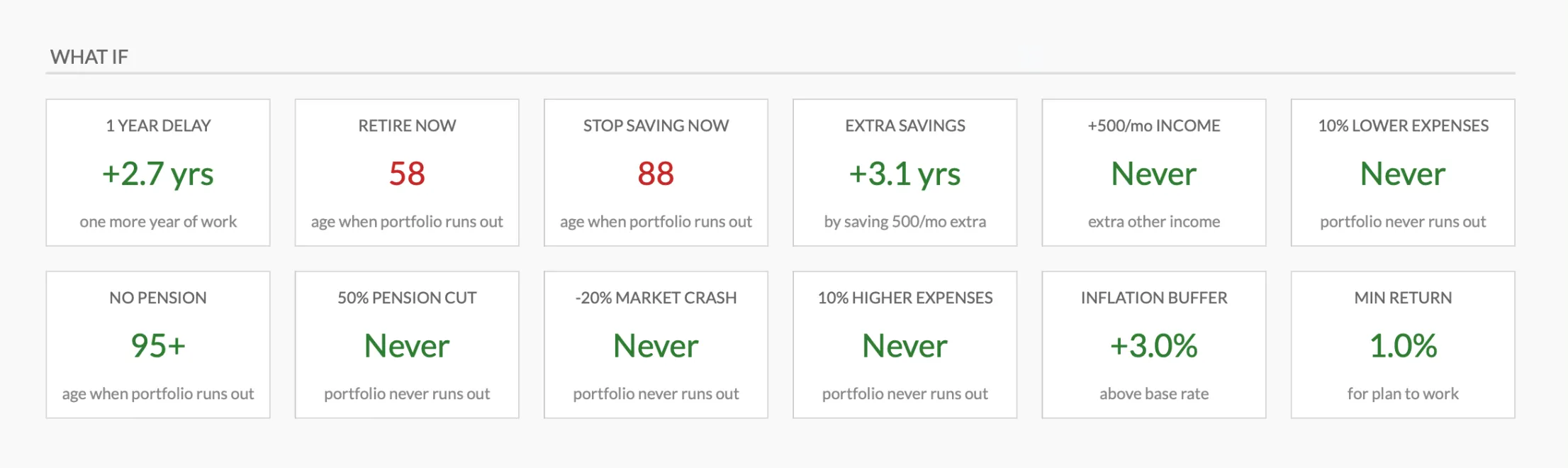 The Retirement Financial Planning Template (Premium) runs twelve what-if cards, from a one-year delay and extra savings to a 20% market crash, each reporting the age when the portfolio runs out or the extra years the change buys.
Roth & 401(k) Deep Dives
- Roth Conversion Calculator: When Converting Makes Sense - When a Roth conversion is advantageous and how to find the optimal conversion amount
- Roth IRA Growth Calculator: See Your Tax-Free Future - How tax-free compounding works and why starting early matters
- 401(k) Calculator: How Contributions Grow Over a Career - Modeling 401(k) growth with employer matching over a full career
- Mega Backdoor Roth Calculator: Supercharge Your Roth Contributions - After-tax 401(k) contributions converted to Roth, beyond the standard limit
Related
- 401(k) vs. Roth 401(k) Calculator
- 401(k) Calculator
- Roth Conversion Calculator
- Roth vs Traditional IRA Spreadsheet - The same tax-timing decision on the IRA side
- Retirement Financial Planning Template
Frequently asked questions
What's the main difference?
Traditional 401(k) contributions reduce your taxable income now but withdrawals are taxed in retirement. Roth 401(k) contributions are taxed now but withdrawals are tax-free. Same contribution limits apply to both.
Does the employer match go into the Roth?
In most plans, employer matching contributions go into the traditional (pre-tax) side regardless of your own contribution type, and they'll be taxed as income when withdrawn. That is why even a 100% Roth contributor usually ends up with both account types.
Can I split between both?
Yes. Many plans allow you to direct a percentage to traditional and a percentage to Roth. The combined total can't exceed the annual limit ($24,500 in 2026).
If the math is equal, which is better?
When tax rates are the same now and later, the outcome is mathematically identical. In a tie, some planners lean Roth because tax-free withdrawals provide more flexibility and there's no exposure to future rate increases.
Does a Roth 401(k) have income limits like a Roth IRA?
No. Unlike the Roth IRA, the Roth 401(k) has no income limit to participate, so high earners who are phased out of Roth IRA contributions can still contribute the full amount to a Roth 401(k).
Do Roth 401(k)s require minimum distributions?
Not during the owner's lifetime. Starting in 2024, SECURE 2.0 removed lifetime required minimum distributions from designated Roth accounts in 401(k) and 403(b) plans, bringing them in line with the Roth IRA.
Sources
- 401(k) limit increases to $24,500 for 2026, IRA limit increases to $7,500 - Internal Revenue Service
- Roth comparison chart (designated Roth 401(k), Roth IRA, pre-tax 401(k)) - Internal Revenue Service
- Retirement topics - Required minimum distributions (RMDs) - Internal Revenue Service
About this article
Contribution limits are the 2026 IRS figures ($24,500 employee deferral, $8,000 catch-up at 50-plus) from IRS Notice 2025-67. Worked comparisons use 7% annual growth and reinvest the traditional path's up-front tax savings at a 5.5% after-tax return. Calculator inputs, outputs and the like-for-like assumption were checked on 2026-09-10 against the component that powers the embed (src/components/calculators/calculators/Traditional401kVsRothCalculator.astro). Template claims checked on 2026-09-10 against the shipped Retirement Financial Planning Projections workbook (Summary, Inputs, Projections tabs) and the what-if screenshot. Last reviewed September 2026.