
The mega backdoor Roth lets you add after-tax 401(k) money and then convert it to Roth, on top of the standard $24,500 employee limit. In 2026 the total 401(k) cap is $72,000, so the strategy can move up to roughly $47,500 more per year into tax-free Roth space - but only if your plan allows after-tax contributions plus in-plan conversions or in-service withdrawals.
Most people hear “$72,000 annual 401(k) limit” and assume it is a typo. The employee contribution limit is $24,500 in 2026, that is the number people know. But the total 401(k) limit, including employer contributions and after-tax money, is $72,000. The gap between those two numbers is where the mega backdoor Roth lives.
The Mega Backdoor Roth Calculator shows how that gap translates into real money over time. No signup required.
The Gap Nobody Talks About
Here is how a typical 401(k) breaks down for someone earning $150,000 with a 5% employer match:
- Employee contribution (Roth or traditional): $24,500
- Employer match (5% of salary): $7,500
- Used so far: $32,000 of the $72,000 limit
- Remaining capacity: $40,000
That $40,000 of unused space is not wasted capacity for everyone. If your plan allows after-tax contributions, you can fill it. And if your plan also allows in-plan Roth conversions, you can convert that after-tax money into Roth dollars - where it grows and gets withdrawn tax-free.
This is the mega backdoor Roth. It is not a loophole. It is not obscure tax law only accountants know about. It is a feature some 401(k) plans offer, and many eligible employees never use it because they have never heard of it.
Enter an after-tax contribution alongside your regular 401(k) contribution, then set an expected return, a tax rate and the years you have left. The calculator totals the two contributions against the $72,000 limit and projects what each side is worth:
Why the Conversion Step Matters
After-tax contributions sitting in a 401(k) are not the same as Roth contributions. The money itself was already taxed (you contributed after-tax dollars), but the growth on those contributions gets taxed when you withdraw it. That is the worst of both worlds - no upfront deduction and taxable growth.
The conversion fixes this. Move the after-tax dollars to Roth (either within the plan or to an external Roth IRA), and the growth becomes tax-free. The timing of a Roth conversion matters here too, since any earnings that build up before you convert are taxable in the year of the conversion. The sooner you convert after contributing, the less growth has accumulated, and the less tax you owe on the conversion itself.
Plans that offer automatic conversion every pay period are ideal. Each paycheck, the after-tax contribution converts to Roth immediately - zero growth between contribution and conversion, zero tax on the conversion. If your plan requires manual conversion, doing it monthly or quarterly keeps the taxable growth small.
What $40,000 a Year in Roth Space Actually Means
The dollar amounts get large quickly. Here is $40,000 per year in mega backdoor Roth contributions at an assumed 8% return:
| After 5 years | After 10 years | After 15 years | After 20 years | |---|---|---|---| | $253,400 | $625,800 | $1,173,000 | $1,976,900 |
The contributions themselves total $800,000 over 20 years. The remaining $1,176,900 is growth - all of it tax-free on qualified withdrawal. Compare that to a taxable account earning the same return with even modest annual tax drag, and the difference over two decades is hundreds of thousands of dollars.
For married couples where both spouses have access to this strategy, the household numbers double.
The Three Things Your Plan Needs
Not every 401(k) supports this. Three requirements must all be met:
After-tax contributions must be allowed. This is different from Roth contributions. “After-tax” is a distinct contribution type that goes into the plan on a post-tax basis but does not automatically get Roth treatment. Many plans skip this option entirely.
In-plan Roth conversion or in-service withdrawals. Getting the money into after-tax is only half the strategy. It needs a path to Roth. Either the plan converts it internally (in-plan Roth conversion) or lets you roll it out to a Roth IRA while still employed (in-service withdrawal).
Enough room under the $72,000 cap. Your employee contributions plus employer match determine how much space remains. A generous employer match actually reduces your mega backdoor capacity, which is an unusual situation where a bigger match means less room for this strategy.
The HR department or plan administrator can confirm whether all three conditions are met. If even one is missing, the strategy is not available through that plan.
Who Actually Does This
This is not a starter strategy. Someone contributing $40,000 per year beyond their regular 401(k) max has already covered the basics - emergency fund, no high-interest debt, regular retirement contributions maxed out. At that savings rate, we are typically talking about households earning $200,000 or more with expenses well under control.
There is also a practical question of cash flow. Even someone earning $250,000 may find $40,000 in extra annual savings difficult after taxes, mortgage, childcare, and other obligations. The mega backdoor Roth works for people who have both the plan features and the financial capacity.
For anyone not yet maxing out their standard 401(k) and getting the full employer match, those steps come first. The mega backdoor is an optimization layer - powerful, but only relevant after the foundation is solid.
Stacking All the Roth Channels
For someone who has access to everything, the annual Roth contribution picture looks like this:
| Channel | 2026 Amount | |---|---| | Roth 401(k) employee contributions | $24,500 | | Backdoor Roth IRA | $7,500 | | Mega backdoor Roth (varies by match) | Up to ~$40,000 | | Total Roth per year | Up to ~$72,000 |
That is $72,000 per person flowing into accounts where every dollar of future growth is tax-free. For a couple, $144,000 per year. Over a 15 to 20 year career, the tax-free retirement pool can grow very large.
A Note on Future Legislation
Congress has proposed restricting or eliminating the mega backdoor Roth strategy multiple times. As of 2026, it remains available. But the political interest in closing it has been consistent enough that the window could narrow, which is worth keeping in mind for anyone weighing the strategy.
If it does, existing Roth money stays Roth. Nothing gets clawed back. The strategy just becomes unavailable going forward. This is not a reason to rush into something inappropriate - but for people who already qualify and have the cash flow, delaying has a cost that may not be recoverable.
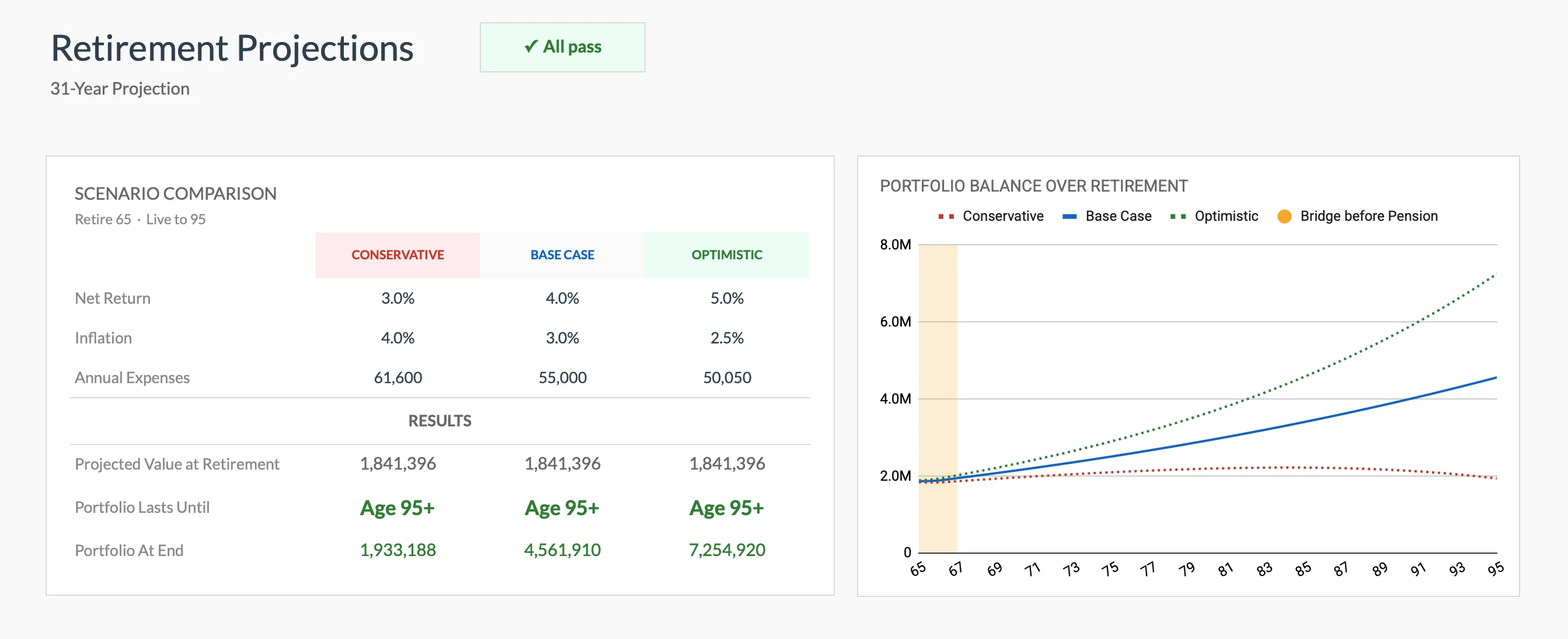 Scenario comparison in the Premium Retirement Financial Planning Template, with the same projected value at retirement carried through conservative, base case and optimistic net returns.
The Retirement Financial Planning Template works one level up from this. It takes a single combined balance for all retirement accounts plus one annual savings figure, projects what that reaches by your target retirement age, then runs the balance year by year to life expectancy under conservative, base case and optimistic assumptions. It does not split savings by account type or model the conversion itself, so a figure from the calculator above enters there as part of the annual savings number rather than as its own line.
Roth & 401(k) Deep Dives
- Backdoor Roth Calculator: The High-Earner Strategy Explained - How the backdoor Roth works, including the pro-rata rule and who benefits most
- 401(k) vs. Roth 401(k) Calculator: Which One Wins? - Comparing traditional and Roth 401(k) contributions based on current and future tax rates
- Roth IRA Growth Calculator: See Your Tax-Free Future - How tax-free compounding works and why starting early matters
Related
Frequently asked questions
What is a mega backdoor Roth?
Making after-tax (not Roth) contributions to a 401(k) beyond the employee limit, then converting those to Roth. This allows up to $47,500 in additional Roth contributions per year beyond the standard $24,500 limit in 2026.
Does my employer's plan need to support this?
Yes. The plan must allow after-tax contributions AND either in-plan Roth conversions or in-service withdrawals to a Roth IRA. Not all plans offer this.
How is this different from a regular backdoor Roth?
A regular backdoor Roth uses an IRA and is limited to $7,500/year in 2026. The mega backdoor uses a 401(k) and can add up to $47,500/year in Roth contributions.
What's the combined total I can put into retirement accounts?
In 2026: $24,500 (employee 401k) + employer match + up to $47,500 in after-tax contributions = $72,000 total 401(k) limit. Plus $7,500 in IRA contributions.
Is there an income limit for the mega backdoor Roth?
No. Unlike direct Roth IRA contributions, which phase out at higher incomes, the mega backdoor Roth has no income cap. The limit is your plan's features and the $72,000 total 401(k) ceiling, not what you earn.
Does the after-tax money count against my Roth IRA contribution limit?
No. After-tax 401(k) contributions live under the $72,000 total 401(k) limit, which is separate from the $7,500 IRA limit. You can use both channels in the same year if you qualify for each.
Sources
- 401(k) limit increases to $24,500 for 2026, IRA limit increases to $7,500 - Internal Revenue Service
- Notice 2025-67: 2026 Cost-of-Living Adjustments (section 415(c) defined contribution limit) - Internal Revenue Service
About this article
Contribution limits verified against IRS Notice 2025-67 and the IRS 2026 limits announcement (employee deferral $24,500, total 401(k) limit $72,000, IRA $7,500). Calculator inputs and outputs checked on 2026-09-10 against the shipped Mega Backdoor Roth Calculator (after-tax contribution, regular 401(k) contribution, expected return, tax rate, years); template claims checked the same day against the shipped Retirement Planning Google Sheet (Summary, Inputs, Projections, Helpers, Instructions tabs). Last reviewed September 2026.