
A backdoor Roth lets high earners fund a Roth IRA despite the income limit. You contribute the $7,500 IRA maximum to a traditional IRA (non-deductible) in 2026, then convert it to a Roth. The catch is the pro-rata rule, which can make the conversion partly taxable if you hold any pre-tax IRA money. Over 30 years at an assumed 8%, $7,500 a year compounds to roughly $850,000, all tax-free.
There is an income limit for contributing directly to a Roth IRA. In 2026, it starts phasing out at $153,000 for single filers and $242,000 for married filing jointly, and closes entirely at $168,000 and $252,000 respectively, per the IRS. Earn above those thresholds and the direct door closes.
But there is a back door. And it has been open for years.
The Backdoor Roth Calculator shows the long-term value of using it. No signup required.
Two Steps, One Outcome
The strategy is straightforward. First, contribute to a traditional IRA. There is no income limit for making contributions - only for deducting them. A high earner cannot deduct a traditional IRA contribution, but they can still make one.
Second, convert that traditional IRA to a Roth IRA. There is no income limit for conversions either. Since the money was contributed with after-tax dollars (non-deductible), converting it triggers little or no tax - the IRS already got its cut.
The end result: up to $7,500 lands in a Roth IRA where it grows tax-free, just as if you had contributed directly. The income limit becomes irrelevant.
The Pro-Rata Trap
This is where many people trip up, and it is worth understanding before doing anything.
The IRS does not let you cherry-pick which IRA dollars you convert. If you have any pre-tax money in any traditional, SEP, or SIMPLE IRA anywhere, the conversion gets taxed proportionally across all of it.
Picture it this way. You have $67,500 in a traditional IRA from old 401(k) rollovers. You contribute $7,500 non-deductible for a backdoor Roth. Your total IRA balance is now $75,000, and only 10% of it ($7,500) is non-deductible. When you convert $7,500, only 10%, or $750, converts tax-free. The other $6,750 counts as taxable income.
That is a big deal. Instead of a clean, nearly tax-free conversion, you owe income tax on $6,750. The strategy still works mathematically, but the tax bill in the conversion year takes a significant bite.
The workaround: rolling any existing pre-tax IRA money into an employer 401(k) before the backdoor Roth. Once the pre-tax IRA balance is zero, the conversion is clean. Not every 401(k) accepts incoming rollovers, though, so that is worth confirming first.
$7,500 a Year Adds Up
The annual limit is not huge compared to a 401(k). But give it time and the numbers become meaningful.
At an assumed 8% return, here is what $7,500 per year looks like growing inside a Roth:
- After 10 years: $108,600 (contributed $75,000)
- After 20 years: $343,200 (contributed $150,000)
- After 30 years: $849,600 (contributed $225,000)
At 30 years, the growth is $624,600. None of it is ever taxed. For someone in the 15-20% capital gains bracket, that is roughly $94,000 to $125,000 in taxes that simply do not exist.
The same money in a taxable account would face annual tax drag on dividends and eventual capital gains on sale. After 30 years, the Roth advantage runs into six figures, depending on tax bracket and investment mix. Plug your own return, time horizon, and bracket into the calculator below to see the gap for your situation.
Timing and Mechanics
Some people do the entire backdoor Roth in January: contribute $7,500 to the traditional IRA, let it settle in cash or a money market fund for a few days, then convert. This maximizes the time the money spends growing inside the Roth during the year.
Others contribute monthly and convert periodically. Both approaches work. The key detail is converting quickly after contributing. The longer the money sits in the traditional IRA, the more it grows, and that growth is taxable on conversion. Converting within days keeps the taxable amount negligible.
One more administrative piece: Form 8606 is filed with your tax return. This form documents the non-deductible contribution and prevents the IRS from treating it as pre-tax money. Missing it does not disqualify the strategy, but it creates headaches later.
Backdoor Roth vs. Taxable Investing
The alternative to a backdoor Roth is simply investing the $7,500 in a regular taxable brokerage account. The money grows, you pay taxes on dividends each year, and you pay capital gains when you sell. Straightforward, no extra steps.
Over 30 years at 8% gross return, the comparison on $7,500 per year:
The Roth grows to roughly $849,600, all tax-free. The taxable account, after annual tax drag on dividends and an eventual capital gains bill on sale, ends up somewhere around $610,000 to $720,000 depending on turnover, dividend yield, and tax bracket. The gap, on the order of $130,000 to $240,000, is the value of the extra step.
That is the core question behind the backdoor Roth: is the administrative hassle of a two-step contribution and an annual Form 8606 worth six figures over a career? For most eligible people with clean IRA situations (no pre-tax balances), the answer tends to be yes.
Who This Is (and Is Not) For
The backdoor Roth fits a specific profile. You earn too much to contribute to a Roth IRA directly. You have no pre-tax IRA balances (or can roll them into a 401(k)). You have already maxed your 401(k) and want one more tax-advantaged account.
It offers little for someone who can already contribute to a Roth directly, since that path skips the paperwork entirely. And for someone with a large traditional IRA they cannot move into a 401(k), the pro-rata tax hit may outweigh the benefit. Running the numbers for your specific situation is the only way to know.
Congress has discussed eliminating the backdoor Roth multiple times. As of 2026, it remains available, but the possibility of future legislation is worth noting. If the door closes, the strategy ends for everyone. In the meantime, it remains one of the few ways high earners can access Roth-style tax-free growth beyond what the 401(k) provides.
The Retirement Financial Planning Template sits one level up from a single contribution. It takes one combined savings balance covering all retirement accounts plus an annual savings figure, then projects that portfolio to retirement and through it across conservative, base, and optimistic scenarios. It does not split Roth from pre-tax money or model a conversion, so a backdoor Roth contribution enters as part of the annual savings figure.
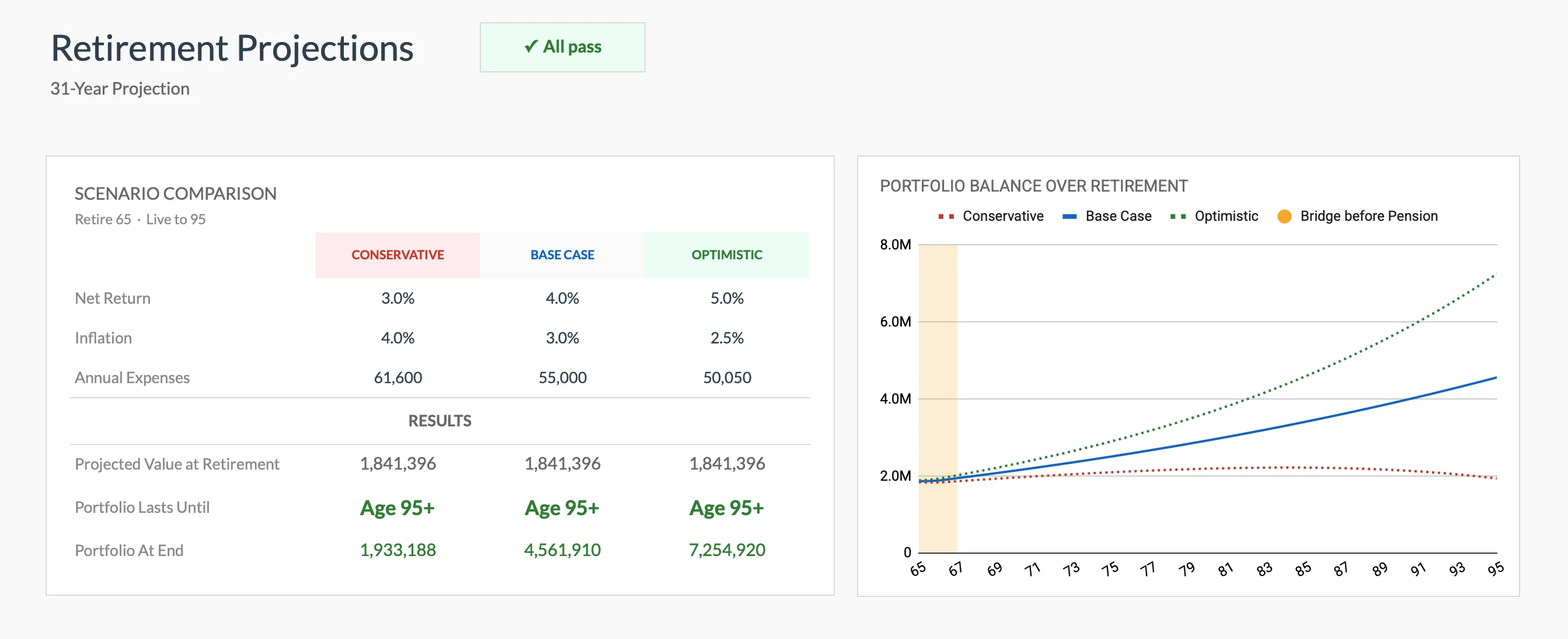
The Retirement Financial Planning Projections template (Premium tier) models portfolio balance across conservative, base, and optimistic scenarios over a 31-year projection. It works from one combined savings balance rather than per-account balances.
Roth & 401(k) Deep Dives
- Mega Backdoor Roth Calculator - How after-tax 401(k) contributions converted to Roth can add tens of thousands extra per year, well beyond the standard IRA limit
- Roth Conversion Calculator: When Converting Makes Sense - When a Roth conversion is advantageous and how to find the optimal conversion amount
- Roth IRA Growth Calculator: See Your Tax-Free Future - How tax-free compounding works and why starting early matters
Related
Frequently asked questions
What is a backdoor Roth IRA?
A two-step strategy: contribute to a traditional IRA (non-deductible), then convert to a Roth IRA. This bypasses the Roth IRA income limits, allowing high earners to fund a Roth.
Is the backdoor Roth legal?
Yes. The IRS has acknowledged this strategy, and it has been used widely for years. Congress has discussed restricting it but has not done so as of 2026.
What is the pro-rata rule?
If you have existing pre-tax IRA balances, conversions are taxed proportionally across all IRA money, not just the non-deductible portion. This can make backdoor Roth conversions partially taxable.
How much can I contribute through a backdoor Roth?
The standard IRA contribution limit, which is $7,500 in 2026 ($8,600 if 50 or older). The backdoor doesn't increase the limit; it just provides a path around the income restriction.
Is there a waiting period between the contribution and the conversion?
The IRS has no stated holding period, and many people convert within days. Some prefer to let the contribution show as a settled balance before converting so the paper trail is clean. Any growth that occurs while the money sits in the traditional IRA becomes taxable on conversion.
Can both spouses do a backdoor Roth?
Each spouse can do it in their own IRAs, up to the annual limit each, even on a single income via a spousal IRA. Conversions have no income limit, so a high household income does not block either partner.
Does the conversion count as taxable income for anything else?
Any taxable portion of the conversion adds to your modified adjusted gross income for that year, which can touch things tied to MAGI such as Medicare IRMAA surcharges or ACA subsidies. A clean conversion with no pre-tax balances adds little or nothing.
Sources
- 401(k) limit increases to $24,500 for 2026, IRA limit increases to $7,500 - Internal Revenue Service
- About Form 8606, Nondeductible IRAs - Internal Revenue Service
About this article
IRA contribution limit and Roth IRA income phase-out ranges checked against the IRS 2026 figures (IR-2025-111). Growth figures are illustrative projections of the $7,500 annual limit compounding at an assumed 8% return, not guaranteed outcomes. Retirement Financial Planning Projections claims checked on 2026-09-10 against the shipped Google Sheet (Summary, Inputs, Projections, Helpers, Instructions tabs): one combined Total Current Savings input, an Annual Savings input, and three scenarios, with no Roth or pre-tax split and no conversion modelling. Last reviewed September 2026.