
Roth IRA growth is fully tax-free: at an assumed 8% return, $7,500 contributed at the start of each year for 40 years grows to roughly $2.1 million, with nothing owed on qualified withdrawals. The 2026 contribution limit is $7,500 ($8,600 at age 50 or older), and because compounding rewards time, starting a decade earlier can outweigh contributing three times as long. The calculator below projects your own numbers.
Two people retire at 65 with $1 million each. One has it in a traditional IRA, the other in a Roth. They look identical on paper - but they’re not. The traditional IRA holder still owes income tax on every dollar withdrawn. The Roth holder keeps every cent.
That gap between a pre-tax million and a post-tax million is what makes the Roth IRA worth understanding. The Roth IRA Growth Calculator projects what yours could look like over time. No signup required.
What “Tax-Free Growth” Actually Means in Dollar Terms
Tax-free sounds good in the abstract. It’s more interesting in concrete numbers.
In a regular taxable brokerage account earning 8%, you don’t actually keep 8%. Dividends get taxed each year. When you sell, capital gains get taxed. Depending on your bracket and turnover, the effective return drops to something like 6.5-7%.
In a Roth IRA, 8% stays 8%. Every year. For decades.
Here’s what that looks like with $7,500 contributed at the start of each year (the 2026 limit), starting from nothing, on the same timing the calculator above uses:
| Years | Total Contributed | Taxable Account (6.5%) | Roth IRA (8%) | Tax-Free Advantage |
|---|---|---|---|---|
| 10 | $75,000 | $107,800 | $117,300 | $9,500 |
| 20 | $150,000 | $310,100 | $370,700 | $60,600 |
| 30 | $225,000 | $689,900 | $917,600 | $227,700 |
| 40 | $300,000 | $1,402,900 | $2,098,400 | $695,500 |
At 40 years, the tax-free advantage alone is roughly $695,000. And when the Roth holder withdraws in retirement, no additional tax is owed. The taxable account holder would face capital gains tax on top of the drag they already absorbed.
The Classic Early-Start Illustration
This comparison gets cited a lot because the numbers are genuinely surprising.
Person A starts contributing $7,500/year at age 22, keeps it up for just 10 years, then stops entirely. Total invested: $75,000. By age 65, assuming 8% returns, the Roth holds roughly $1,487,000.
Person B starts at 32, contributes $7,500/year for 33 consecutive years, never misses one. Total invested: $247,500. By age 65, the Roth holds roughly $1,182,000.
Person A put in less than a third of the money. Person B invested for more than three times as long. Person A still finishes ahead, because those ten early contributions spent an extra three decades compounding.
The math doesn’t care whether this feels fair. Time is the single largest variable in compound growth.
Contribution Limits and Catch-Up Rules
The Roth IRA limit for 2026 is $7,500 per year, with an extra $1,100 catch-up (a total of $8,600) for those 50 and older. Here’s what maximum contributions look like across different starting ages:
| Starting Age | Annual Limit | Years to 65 | Total Contributions |
|---|---|---|---|
| 22 | $7,500 | 43 | $339,000* |
| 25 | $7,500 | 40 | $316,500* |
| 30 | $7,500 | 35 | $279,000* |
| 35 | $7,500 | 30 | $241,500* |
| 40 | $7,500 | 25 | $204,000* |
*Ages 50 to 64 use the $8,600 catch-up limit (15 years).
Contribution limits tend to rise with inflation over time, so future limits will likely be higher than today’s numbers.
Income Limits (And the Backdoor Workaround)
Not everyone can contribute directly to a Roth IRA. For 2026, the ability to contribute phases out based on modified adjusted gross income:
- Single and head of household: Full contribution under $153,000, partial between $153,000-$168,000, nothing above $168,000
- Married filing jointly: Phase-out range of $242,000-$252,000
For people above these limits, the backdoor Roth strategy remains available: contribute to a non-deductible traditional IRA, then convert to Roth. There’s no income limit on conversions. The Backdoor Roth Calculator walks through the numbers on this.
Roth vs. Traditional: A Tax-Timing Question
The choice between Roth and traditional comes down to when you’d rather pay taxes.
With a Roth, contributions are taxed now. All future growth and withdrawals are tax-free. With a traditional IRA, contributions reduce your taxable income today, but every dollar withdrawn in retirement gets taxed as ordinary income.
For someone in the 12% or 22% bracket today who expects to be in a similar or higher bracket later, the Roth math tends to look favorable - pay a known lower rate now rather than an unknown potentially higher rate later.
For someone at peak earnings in the 32% or 37% bracket who expects to drop to 22-24% in retirement, the traditional IRA’s upfront deduction provides more value.
Plenty of people contribute to both types at different stages of their careers. That creates tax diversification in retirement - the option to pull from whichever account is more tax-efficient in a given year.
Three Structural Advantages Beyond Tax-Free Growth
No required minimum distributions. Traditional IRAs force withdrawals starting at age 73. Roth IRAs don’t. The money can sit and grow for an entire lifetime, which also makes Roths useful for estate planning - inherited Roth IRAs pass to beneficiaries tax-free.
Access to contributions at any time. Contributions (not earnings) can be pulled out without penalty or tax, at any age, for any reason. This gives the Roth an unusual dual purpose as both a retirement account and a last-resort emergency fund. Most people are better served leaving the money invested, but having the option provides flexibility that other retirement accounts don’t.
No tax surprises in retirement. Roth withdrawals don’t count as taxable income. That matters for things like Medicare premium surcharges (IRMAA), Social Security taxation thresholds, and overall tax bracket management.
For a whole-portfolio view, the Retirement Financial Planning Template works from one combined savings figure covering all retirement accounts, plus an annual savings amount, and projects that portfolio out to life expectancy under conservative, base case and optimistic return assumptions. It treats retirement savings as a single pot rather than splitting Roth from traditional balances. The Financial Planning Template takes the other cut: a Roth IRA can sit as its own row on the Assets tab with a value, an annual yield and an annual growth rate, beside cash, bonds, stocks, real estate and a 401k row under Long-Term Saving.
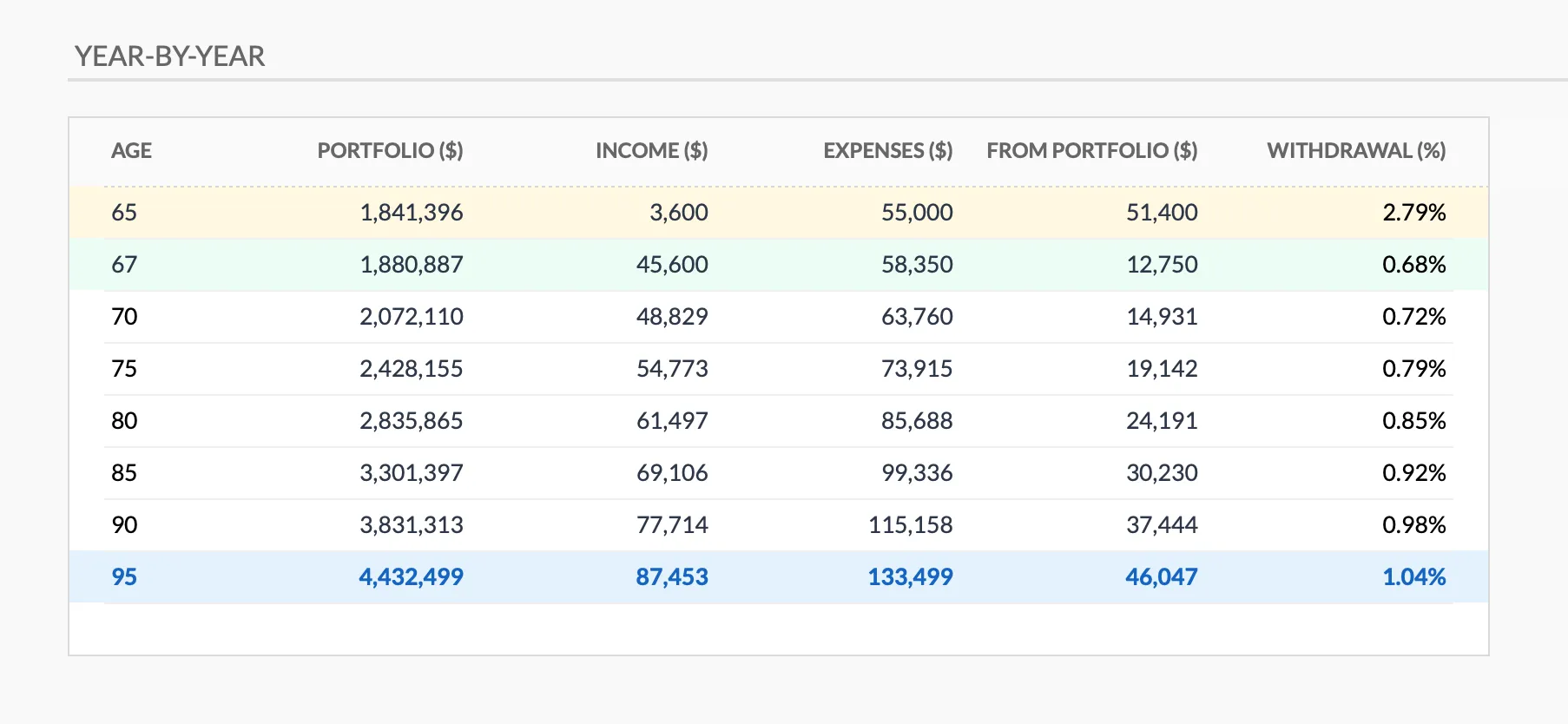 The Retirement Financial Planning Template (Premium tier) projects one portfolio year by year from age 65 to 95, showing income, expenses, the amount drawn from the portfolio and the withdrawal rate at each age.
Roth & 401(k) Deep Dives
- Roth Conversion Calculator: When Converting Makes Sense - When a Roth conversion is advantageous and how to find the optimal conversion amount
- 401(k) vs. Roth 401(k) Calculator: Which One Wins? - Comparing traditional and Roth 401(k) contributions based on current and future tax rates
- Backdoor Roth Calculator: The High-Earner Strategy Explained - How the backdoor Roth works, including the pro-rata rule and who benefits most
Related
Frequently asked questions
What's the Roth IRA contribution limit?
For 2026, the limit is $7,500 per year ($8,600 if age 50 or older). Income limits apply - the ability to contribute phases out at higher incomes.
What makes Roth IRA growth special?
All growth is tax-free. Unlike taxable accounts (where dividends and gains are taxed) or traditional IRAs (where withdrawals are taxed), qualified Roth distributions owe nothing in taxes.
Can I withdraw Roth contributions anytime?
Yes. Contributions (not earnings) can be withdrawn at any time, for any reason, with no tax or penalty. This makes the Roth IRA more flexible than most retirement accounts.
What if I earn too much for a Roth IRA?
The backdoor Roth strategy - contributing to a traditional IRA and then converting to Roth - is an option for high earners. Income limits don't apply to conversions.
Do these projections account for inflation?
No. A fixed nominal return leaves the ending balance in future dollars, not today's buying power - a balance projected 40 years out buys less than the same figure does now. Running the numbers again with a lower 'real' return shows an inflation-adjusted view.
Is an 8% return realistic?
8% is a common illustration figure loosely based on long-run stock market averages before inflation. Actual returns vary year to year and can be negative for long stretches, so any single projection is a rough guide rather than a promise. Trying a lower rate shows a more conservative picture.
Sources
- 401(k) limit increases to $24,500 for 2026; IRA limit increases to $7,500 - Internal Revenue Service
- Retirement topics - IRA contribution limits - Internal Revenue Service
- Roth IRAs - Internal Revenue Service
- Retirement plan and IRA required minimum distributions FAQs - Internal Revenue Service
About this article
Contribution limits and Roth IRA MAGI phase-out ranges verified against the IRS 2026 cost-of-living adjustment announcement. Growth projections apply a fixed annual return to level contributions made at the start of each year, the same timing the on-site Roth IRA Growth Calculator uses; the figures are illustrative, not a forecast. Template claims checked on 2026-09-10 against the shipped Retirement Financial Planning Projections Google Sheet (Inputs, Projections tabs) and the Financial Planning Google Sheet (Assets, Projection tabs). Last reviewed September 2026.