The 2026 401(k) employee contribution limit is $24,500, with an extra $8,000 catch-up at age 50 and older. Capturing the full employer match matters most - a typical 50%-of-6% match turns a 6% contribution into an effective 9%. Over a 35-year career, compounding on your contributions plus the match usually dwarfs what you actually put in. This guide walks the math with worked examples.
Most people’s first interaction with a 401(k) happens during the blur of a new job orientation. Someone mentions “matching” and “contribution percentage,” you pick a number, and then you don’t think about it again for a while.
That initial choice, a number you probably picked somewhat arbitrarily, ends up being one of the most consequential financial decisions of your career. A few percentage points in either direction, compounded over decades, creates a gap of hundreds of thousands of dollars.
The 401(k) Calculator shows what your contribution rate actually produces over time. No signup required. Plug in your own salary, contribution rate, match, and expected return below:
The Three Engines of 401(k) Growth
A 401(k) isn’t just a savings account. It has three forces working simultaneously:
Your contributions come from each paycheck before taxes (traditional) or after taxes (Roth). Either way, you’re setting aside money consistently - and consistency is what compound growth feeds on.
Employer matching adds money on top of your contribution. A typical match, 50% of the first 6% of salary, turns your 6% contribution into an effective 9%. This is often described as “free money,” and while that phrase gets overused in finance, here it’s accurate.
Investment returns compound on the total balance: your contributions plus the match. Over 30+ years, this third engine generates more wealth than the first two combined. Often much more.
What a Career of Contributions Actually Looks Like
Here’s someone earning $80,000, contributing 6%, with a 50% employer match on the first 6%, earning 7% average annual returns, starting at age 30:
Annual contribution: $4,800 from employee + $2,400 from employer = $7,200/year.
| Age | Years In | You’ve Put In | Employer Added | Account Balance | |-----|---------|--------------|---------------|----------------| | 35 | 5 | $24,000 | $12,000 | $44,300 | | 40 | 10 | $48,000 | $24,000 | $106,400 | | 50 | 20 | $96,000 | $48,000 | $315,800 | | 60 | 30 | $144,000 | $72,000 | $727,700 | | 65 | 35 | $168,000 | $84,000 | $1,065,000 |
Read that last row again. Total money put in from all sources: $252,000. Account value: over $1 million. The other $813,000? That’s investment returns doing what they do given enough time.
The Price of Leaving Match Money on the Table
Here’s the math most people never see. Same scenario as above, but this employee contributes 3% instead of 6%.
At 3%, the employer match is only $1,200/year instead of $2,400. That’s $1,200 in missed free money annually.
$1,200 per year, compounded at 7% over 35 years, grows to roughly $177,000.
Put differently, the difference between 3% and 6%, about $4.80/day in reduced take-home pay, turns into roughly $177,000 in missed employer contributions plus their growth. Every day below the full match threshold is an expensive day, even if it doesn’t feel like one.
What Bump Would Do the Most Good?
The paycheck impact of contribution increases is softer than people expect, because pre-tax contributions reduce taxable income:
| Contribution Rate | Monthly Paycheck Reduction* | Balance at 65 | |------------------|---------------------------|---------------| | 3% | baseline | $532,500 | | 6% | -$146 | $1,065,000 | | 10% | -$341 | $1,538,300 | | 15% | -$584 | $2,130,000 |
*Estimated after tax savings at 22% federal + 5% state. The paycheck shrinks by less than the contribution because of the tax benefit.
The jump from 6% to 10% costs about $195/month in take-home pay and adds roughly $473,000 to the final balance over 35 years. The monthly figure is small next to the balance figure, which is what three and a half decades of compounding does to a steady deposit.
2026 Contribution Limits
The IRS sets these limits each year and they rose for 2026:
| Category | Annual Limit | |----------|-------------| | Employee contribution (under 50) | $24,500 | | Catch-up contribution (50+) | $8,000 | | Total employee (50+) | $32,500 | | Super catch-up (ages 60-63) | $11,250 | | Combined employee + employer | $72,000 |
The employee limit covers only what you defer from your own paycheck. Employer matching sits on top of it, under the higher $72,000 combined cap. The super catch-up for ages 60 to 63 comes from the SECURE 2.0 Act and replaces the standard 50+ catch-up in those four years.
Maxing out at $24,500 on an $80,000 salary means contributing 30.6%, aggressive but doable for some. The tax savings on a traditional contribution that large are substantial enough to meaningfully soften the paycheck impact.
Traditional vs. Roth: The Tax Timing Question
Traditional 401(k): Tax break now. Contributions reduce this year’s taxable income. Withdrawals in retirement are taxed as ordinary income.
Roth 401(k): Tax break later. Contributions come from after-tax income (no immediate benefit). Withdrawals in retirement are completely tax-free - including all the growth.
The core question: is your tax rate higher now or will it be higher in retirement?
Early in a career, when income is lower, Roth contributions often look favorable - locking in today’s low rate on money that might compound for decades. During peak earning years, traditional contributions provide more immediate relief.
Many people end up doing some of each, building what’s sometimes called “tax diversification,” the ability to pull from either bucket depending on what’s most efficient in any given retirement year. The 401(k) vs. Roth 401(k) Calculator puts the two side by side for your own numbers.
The Escalation Trick
Increasing contributions by 1% per year, ideally timed with annual raises, is one of the more painless ways to build toward a higher rate. A 3% raise combined with a 1% contribution increase means take-home pay still grows by 2%. You never feel the increase because you never had the money.
Many employer plans offer this as an automatic setting. If yours does, turning it on takes about two minutes and might be the most productive two minutes of your financial year.
The Retirement Financial Planning Template works one level up from a single account. You enter a combined savings balance and an annual savings figure, and it projects the value at retirement, then runs that pot year by year against pension income and expenses to show how long it lasts.
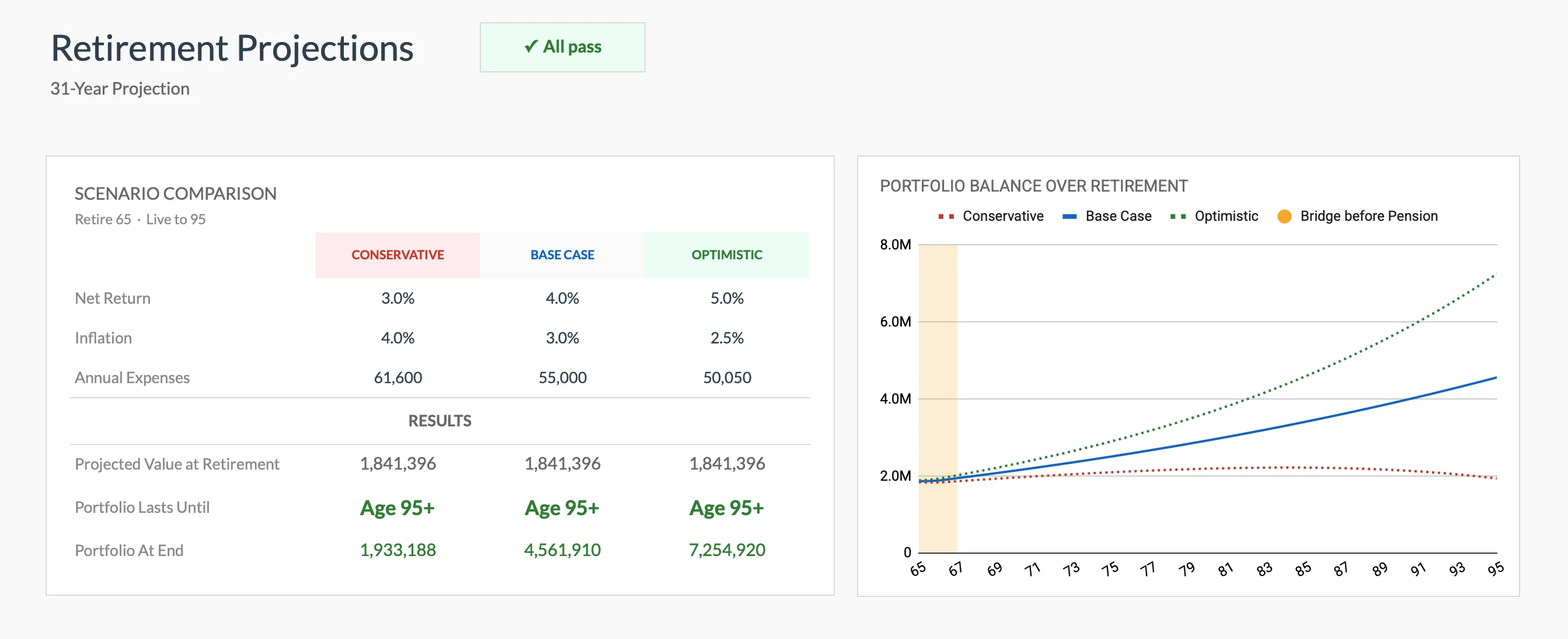
The Retirement Financial Planning Template (Premium tier) runs one combined balance through conservative, base-case and optimistic net returns, next to pension income and inflation-adjusted expenses. It does not split the total by account, so a 401(k) sits inside the same figure as everything else.
More on Retirement Planning
- Retirement Calculator: Planning for the Future - Estimate how much you need overall and whether your savings rate gets you there
- 401(k) vs. Roth 401(k) Calculator - Compare the tax tradeoffs between traditional and Roth contributions
- Solo 401(k) vs SEP IRA Spreadsheet - The self-employed version of the contribution decision
Related
Frequently asked questions
How much can I contribute to capture the full match?
It depends on the plan's formula. A common one matches 50% of the first 6% of salary, so contributing at least 6% captures the full match. Below that threshold, part of the match goes unclaimed. Beyond capturing the match, a rule of thumb some planners cite is 10-15% of gross income toward retirement in total.
What's the 2026 contribution limit?
The employee contribution limit is $24,500 for 2026. Workers age 50 and older can add an $8,000 catch-up for a total of $32,500. Under SECURE 2.0, those aged 60 to 63 get a larger catch-up of $11,250 instead.
Does the employer match count toward my $24,500 limit?
No. The $24,500 employee limit applies only to money you defer from your own paycheck. Employer matching and profit-sharing fall under a separate combined limit, which is $72,000 for 2026, not counting any age 50+ catch-up.
What return assumption do the examples use?
The worked examples assume a 7% average annual return, a common long-run figure for a diversified, stock-heavy portfolio. Real returns vary year to year and are never guaranteed, so the balances shown are illustrations rather than predictions.
Traditional or Roth 401(k)?
Traditional contributions reduce taxable income now; Roth contributions are taxed now but grow tax-free. Someone expecting a higher tax bracket in retirement may find Roth more efficient, and someone expecting a lower one may prefer traditional. Many people split contributions across both for tax diversification.
What happens to my 401(k) if I leave my job?
The money is yours. Options include leaving it with the former employer, rolling it to a new employer's plan, rolling it to an IRA, or cashing out (which triggers taxes and penalties before age 59.5).
Sources
- 401(k) limit increases to $24,500 for 2026, IRA limit increases to $7,500 - Internal Revenue Service
About this article
Contribution limits re-verified on 2026-09-10 against the live IRS 2026 limit announcement and the IRS 401(k) contribution limits page (Notice 2025-67). Growth figures are illustrative and recomputed on 2026-09-10 with the same method as the on-site 401(k) Calculator: contributions added at the start of each year, 7% annual return, 50%-of-first-6% employer match. Template claims checked on 2026-09-10 against the shipped Retirement Financial Planning Projections Google Sheet (Summary, Inputs, Projections, Helpers, Instructions tabs). Last reviewed September 2026.