
Both plans shelter self-employment income, but the Solo 401k adds an employee deferral (up to $24,500 in 2026) on top of the 25 percent employer contribution, so it usually allows more at moderate incomes. SEP IRA is employer-side only and simpler to run, with no annual filing. At $80,000 of net self-employment income the Solo 401k gap is about $24,500. The formulas below calculate the maximum contribution for each at any income.
Self-employed retirement planning has no default. Nobody enrolls you, picks an investment menu, or sets up payroll deferrals. The choice between Solo 401k and SEP IRA is one of the first forks in the road, and the answer is not the same at $80,000 of net self-employment income as it is at $250,000.
From a distance the two plans look similar: tax-deferred, contribution capacity well above an IRA, simple custody at the major brokerages. Up close, they treat compensation differently, allow different account features, and require different annual paperwork. The Retirement Financial Planning Projections template does not run the contribution math, but it takes the annual figure you land on as its Annual Savings input and projects it forward. Every formula below works in any spreadsheet.
2026 limits up front
Numbers below come from IRS Notice 2025-67 for plan year 2026. The IRS adjusts most figures yearly for inflation; the structure of the rules stays the same, only the caps move.
| Limit (2026) | Solo 401k | SEP IRA |
|---|---|---|
| Employee elective deferral | $24,500 | Not allowed |
| Employer / profit-sharing share | Up to 25% of compensation* | Up to 25% of compensation* |
| Combined annual addition cap | $72,000 | $72,000 |
| Catch-up, age 50+ | +$8,000 | Not allowed |
| Super catch-up, age 60-63 | +$11,250 | Not allowed |
| Compensation cap considered | $360,000 | $360,000 |
*For unincorporated self-employed people, “25% of compensation” effectively becomes about 20% of net self-employment earnings after the half-of-SE-tax adjustment and the contribution itself is backed out. The math section below shows why.
Both plans share the overall cap, but Solo 401k has a second contribution channel (the employee deferral) that SEP IRA does not.
How the Solo 401k is structured
A one-participant 401k is a regular 401k where the only participants are the business owner (and optionally a spouse who works in the business). The IRS treats it as a qualified plan, just without discrimination testing because there are no rank-and-file employees.
The contribution structure has two sides:
- Employee deferral. The owner can defer up to the annual elective deferral limit ($24,500 in 2026) from their own compensation. This applies per person, not per plan - anyone with a day-job 401k counts deferrals across both plans against the same cap.
- Employer profit-sharing. The business can contribute up to 25% of compensation on top of the deferral, subject to the combined cap.
Combined, the two sides top out at $72,000 in 2026 (higher with catch-up).
The structural cost: a written plan document is required, and once plan assets cross $250,000, the plan owes an annual Form 5500-EZ filing. Many Solo 401k holders cross the threshold without realizing the filing obligation kicks in; the penalty for missing it can run into thousands per year.
How the SEP IRA is structured
A Simplified Employee Pension is what it sounds like - the simple option. The IRS describes setup as “easily established by adopting Form 5305-SEP” or a prototype, with no annual filing requirement in most cases.
Mechanically, a SEP IRA is an IRA owned by the participant, into which the employer contributes. For self-employed people, the employer and participant are the same person.
The contribution structure has only one side: employer profit-sharing, up to 25% of compensation, with the same $72,000 cap in 2026. No employee deferral channel. No catch-up provision for older participants. SECURE 2.0 added a Roth SEP option, but provider adoption has been uneven.
The trade for the missing deferral channel is administrative simplicity. No plan document. No Form 5500. No fidelity bond. Setup is roughly the same as opening any IRA.
The contribution-limit math at three income levels
The 25% employer side looks identical on paper but produces different totals at different incomes, because Solo 401k bolts a flat $24,500 deferral on top.
For unincorporated self-employed filers (sole proprietors and single-member LLCs on Schedule C), the contribution formula uses net earnings from self-employment:
Net SE income = Schedule C profit - (one-half of self-employment tax)The half-of-SE-tax figure is the same one a self-employment tax calculator produces, and it feeds directly into this contribution math. The 25% employer contribution is then calculated on net SE income minus the contribution itself, which mathematically reduces to about 20% of net SE income for the employer side. IRS Publication 560 has the rate table and worksheet; spreadsheets handle it cleanly.
Example 1: $80,000 net SE income
| Component | Solo 401k | SEP IRA |
|---|---|---|
| Net SE income | $80,000 | $80,000 |
| Half of SE tax (approx.) | -$5,652 | -$5,652 |
| Adjusted net SE income | $74,348 | $74,348 |
| Employer / profit-sharing (~20%) | $14,870 | $14,870 |
| Employee deferral | $24,500 | $0 |
| Total contribution | $39,370 | $14,870 |
| Percent of net SE income sheltered | 49% | 19% |
Solo 401k shelters 2.6x as much. The gap is almost entirely the employee deferral, which SEP IRA does not allow.
Example 2: $150,000 net SE income
| Component | Solo 401k | SEP IRA |
|---|---|---|
| Net SE income | $150,000 | $150,000 |
| Half of SE tax (approx.) | -$10,597 | -$10,597 |
| Adjusted net SE income | $139,403 | $139,403 |
| Employer / profit-sharing (~20%) | $27,881 | $27,881 |
| Employee deferral | $24,500 | $0 |
| Total contribution | $52,381 | $27,881 |
| Percent of net SE income sheltered | 35% | 19% |
The dollar gap stays roughly constant ($24,500-ish) because the deferral piece is flat. The percentage gap narrows as income grows.
Example 3: $250,000 net SE income
| Component | Solo 401k | SEP IRA |
|---|---|---|
| Net SE income | $250,000 | $250,000 |
| Half of SE tax (approx.) | -$14,266 | -$14,266 |
| Adjusted net SE income | $235,734 | $235,734 |
| Employer / profit-sharing (~20%) | $47,147 | $47,147 |
| Employee deferral | $24,500 | $0 |
| Total contribution | $71,647 | $47,147 |
| Percent of net SE income sheltered | 29% | 19% |
At this income, Solo 401k sits about $350 below the $72,000 combined cap; the cap binds at roughly $252,000 of net SE income. SEP IRA is well below either cap. The structural gap holds - $24,500 of additional sheltered income on the Solo 401k side.
Across all three, Solo 401k allows more contribution at every income level, and the dollar gap tracks the employee deferral. SEP IRA closes that gap only when the deferral channel is already used by a day-job 401k.
Roth treatment
One of the cleaner differentiators.
Solo 401k. The employee deferral side can be made as Roth in most plan documents. The employer side is pre-tax (SECURE 2.0 allows Roth employer contributions in theory, but provider adoption has been slow). Solo 401k offers a clear Roth path on at least the $24,500 deferral.
SEP IRA. Historically pre-tax only. SECURE 2.0 added a Roth SEP option in 2023, but most major custodians still do not offer it. In practice, SEP IRA functions as pre-tax unless the custodian explicitly confirms Roth support.
The Roth vs Traditional IRA Spreadsheet walks through the breakeven math; the same logic applies to the deferral side of the Solo 401k decision.
Loans, hardship withdrawals, in-service rollovers
A Solo 401k can include a loan provision. The owner can borrow up to the lesser of $50,000 or 50% of the vested balance, repay over 5 years, and pay interest back to themselves. Not every plan document offers this, since support varies by custodian, but the option exists.
A SEP IRA does not allow loans. It is, structurally, an IRA, and IRAs do not permit loans. The closest workaround is the 60-day rollover rule, which is narrow and risky.
Both plans allow rollovers in and out. Solo 401k plans can also be designed to allow in-service rollovers after age 59 1/2, which adds some flexibility without a triggering event.
Administrative burden
| Task | Solo 401k | SEP IRA |
|---|---|---|
| Setup form | Adopt a plan document (custodian template or paid prototype) | Form 5305-SEP, one page |
| IRS filing at setup | None | None |
| Annual filing | Form 5500-EZ once assets exceed $250,000 | None for most |
| Contribution deadline | Tax filing deadline including extensions | Tax filing deadline including extensions |
| Plan document review | Required periodically (provider handles for most) | Not applicable |
| Fidelity bond | Sometimes required, varies | Not required |
SEP IRA is materially less work. Solo 401k needs more attention, particularly at the $250,000 asset threshold where the Form 5500-EZ obligation begins. The filing itself is not complex (one page, plus schedules), but missing it is expensive: the IRS penalty starts at $250 per day, capped at $150,000 per return for late filers. One-participant plans file Form 5500-EZ rather than the Title I Form 5500, so they are not eligible for the Department of Labor’s Delinquent Filer program; the IRS instead runs its own penalty relief program for late Form 5500-EZ filers that can substantially reduce the penalty for self-corrected filings.
The admin gap is the price of the higher contribution capacity.
Spouse participation
Both plans allow a spouse who earns from the business to participate. For Solo 401k, the spouse can defer up to the same $24,500 (or $32,500 with the age-50 catch-up) plus receive employer contributions. For SEP IRA, the spouse can receive an employer contribution up to the same 25% cap on their compensation. A two-person spouse arrangement doubles household contribution capacity at the same business income level, and the Solo 401k advantage doubles too, since two $24,500 deferrals stack.
Putting both plans in a spreadsheet
Both contribution paths fit in one sheet with an Inputs block, calculations per plan, and a Comparison Dashboard.
Inputs:
| Cell | Label | Example |
|---|---|---|
| B1 | Net Schedule C profit | $150,000 |
| B2 | Half of SE tax | $10,597 |
| B3 | Employee deferral limit (year) | $24,500 |
| B4 | Combined limit (year) | $72,000 |
Solo 401k calculations:
Adjusted net SE = B1 - B2
Employer side = MIN(Adjusted net SE * 0.20, B4 - B3)
Employee side = MIN(B3, Adjusted net SE)
Total Solo 401k = MIN(Employer side + Employee side, B4)
SEP IRA calculations:
Adjusted net SE = B1 - B2
Total SEP IRA = MIN(Adjusted net SE * 0.20, B4)
The Dashboard reports both totals, the gap, and the first-year tax deferral at your marginal rate. Adding a spouse column doubles the household totals when both participate.
How the variables map to the math
The variables below change what the contribution formula returns and what the paperwork looks like. The matrix describes what shifts for each variable; the decision sits with the reader (or their CPA, who will know facts the spreadsheet does not).
| Variable | What changes |
|---|---|
| Net SE income under ~$50k | The 25% employer side is small either way; the $24,500 deferral channel is the only way to shelter much more. |
| Net SE income $50k-$250k | The $24,500 deferral is the largest single moving piece; SEP IRA loses ground on the math here. |
| Income above $250k | Solo 401k approaches the combined cap; SEP IRA’s lower paperwork burden becomes a larger relative factor. |
| Roth contribution wanted | Solo 401k supports Roth on the deferral side broadly; Roth SEP exists but custodian support is uneven. |
| Loan access wanted | Solo 401k can include a loan provision; SEP IRA cannot (IRAs do not permit loans). |
| Plan to hire non-spouse employees within 2-3 years | SEP IRA extends to employees with a contribution to each; Solo 401k must convert. |
| Day-job 401k already maxed | The $24,500 deferral channel is already used up by the day-job plan, narrowing the gap. |
| Annual-filing tolerance is low | Form 5500-EZ kicks in for Solo 401k once plan assets pass $250,000. |
The Form 5500-EZ threshold is the row most often overlooked. Some Solo 401k owners shift to SEP IRA once their plan assets cross $250,000 to avoid the filing.
Picking a provider
The mainstream brokerages (Fidelity, Schwab, Vanguard, E*TRADE) offer both Solo 401k and SEP IRA accounts. Solo 401k plan documents differ in what features they include, such as loans, after-tax contributions, and the mega backdoor Roth, so the differences are not just about expense ratios. Specialist providers offer “self-directed” Solo 401k plans that allow alternative assets (real estate, private notes); these are more expensive and add complexity. The plan document is where the feature set actually lives; a no-fee setup at one custodian and another can differ on what the plan allows.
What the spreadsheet does not cover
The math is clean. A few real-world inputs sit outside it. Whether current cash flow supports maxing the contribution every year. How the contribution interacts with the QBI deduction and the rest of Schedule C. The Form 5500-EZ filing once Solo 401k assets cross $250,000. The first two often need an accountant; the third is paperwork.
Templates that fit this question
- 401k Calculator - Projects a balance from a salary, a contribution percentage, an employer match capped at a share of salary, an expected return and a salary growth rate, with a year-by-year table running to retirement age. It does not check contribution limits and has no SEP IRA side.
- Retirement Financial Planning Projections - The wider picture once the contribution figure is settled. One combined savings balance and one annual savings figure project forward to a target retirement age, then a year-by-year drawdown runs to life expectancy against expenses and pension income, in conservative, base-case and optimistic scenarios. There are no account types in it, so Solo 401k and SEP IRA balances go in as a single combined number.
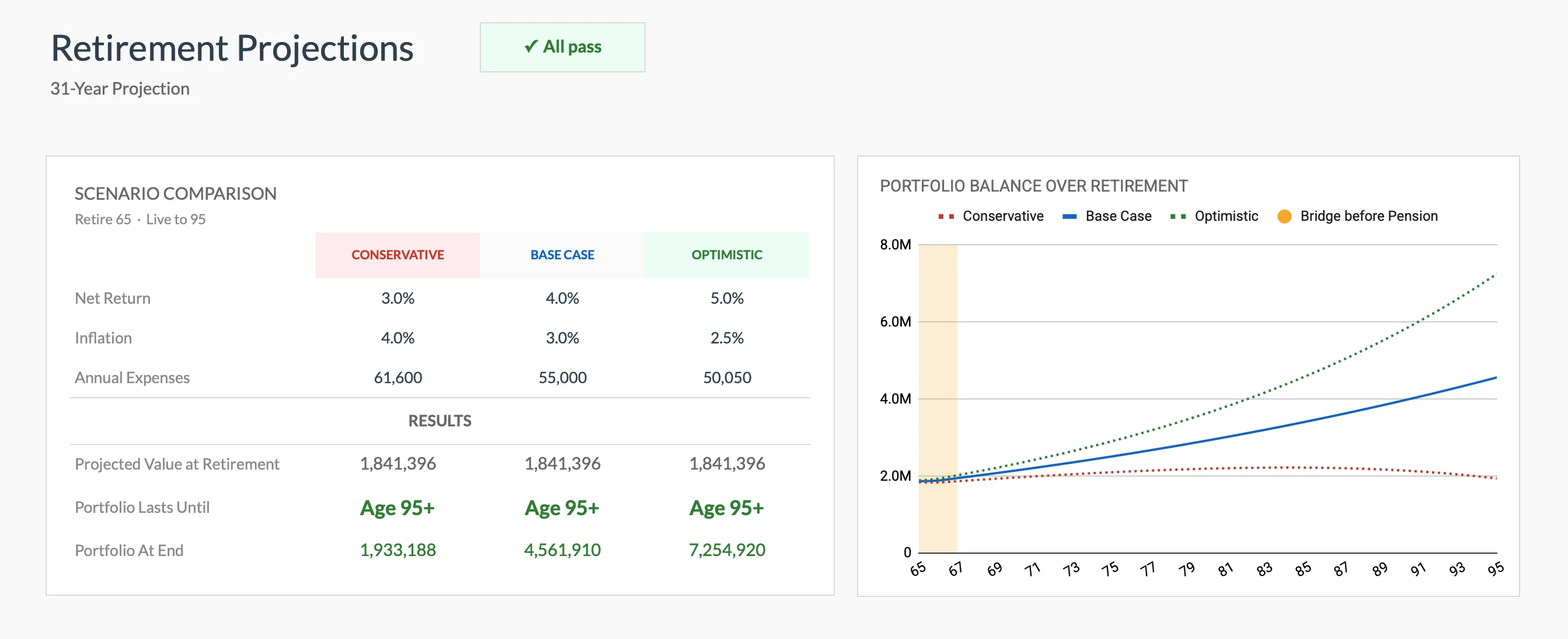
The 401k Calculator works in Excel, Google Sheets, and LibreOffice Calc. The Retirement Financial Planning Projections template is a Google Sheet. No setup, no subscription, one-time purchase.
Related
- Roth vs Traditional IRA Spreadsheet - The Roth-versus-pre-tax math that applies to the Solo 401k deferral side.
- Retirement Account Tracker: 401(k) and IRA in One Sheet - Tracking multiple accounts (including SEP IRA and Solo 401k) in one place.
- Self-Employment Tax Calculator - Where the half-of-SE-tax adjustment used in the contribution math comes from.
- Quarterly Estimated Tax Spreadsheet - The other side of self-employed tax planning, for the payments that run alongside these contributions.
Frequently asked questions
Which one has higher contribution limits?
Solo 401k allows both employee deferral (up to $24,500 in 2026) and employer profit-sharing (up to 25 percent of net self-employment income), with a combined cap of $72,000. SEP IRA allows only the employer side. For most self-employed earners under ~$200k, Solo 401k allows more total contribution.
Can my spouse contribute?
Both plans support a participating spouse who earns from the business. The spouse's contribution doubles the household capacity at the same income range.
Does either offer Roth?
Solo 401k offers Roth treatment for the employee deferral portion (the employer portion is always pre-tax). SEP IRA is historically pre-tax only; SECURE 2.0 added a Roth SEP provision, but provider adoption has been uneven through 2026. Check with your provider.
How much admin does each take?
SEP IRA is simpler, with one form (Form 5305-SEP) to set up and no annual filing. Solo 401k requires a written plan document and a Form 5500-EZ annual filing once plan assets exceed $250,000. The admin gap is the trade for the higher limits.
Can I contribute to both a Solo 401k and a SEP IRA in the same year?
For the same business, contributions to a SEP IRA and a Solo 401k count against one shared annual limit ($72,000 in 2026), so running both does not raise the ceiling. The reason to hold a Solo 401k over a SEP is the employee deferral channel, not stacking two plans.
What happens to a SEP IRA if I hire employees?
A SEP requires the employer to contribute the same percentage of pay for every eligible employee, so adding staff means funding their accounts on the same terms. A Solo 401k is limited to the owner and a working spouse; once a non-spouse employee becomes eligible, the plan has to convert to one that allows other participants.
Sources
- Notice 2025-67: 2026 Cost-of-Living Adjustments for Retirement Plans - Internal Revenue Service
- 401(k) limit increases to $24,500 for 2026, IRA limit increases to $7,500 - Internal Revenue Service
- One-Participant 401(k) Plans - Internal Revenue Service
- Simplified Employee Pension Plan (SEP) - Internal Revenue Service
- Publication 560: Retirement Plans for Small Business - Internal Revenue Service
- About Form 5500-EZ, Annual Return of a One-Participant Retirement Plan - Internal Revenue Service
- Penalty Relief Program for Form 5500-EZ Late Filers - Internal Revenue Service
About this article
Contribution limits, deferrals, and catch-ups verified against IRS Notice 2025-67 and the IRS 2026 cost-of-living release for plan year 2026. Plan structure, the Form 5500-EZ threshold, and the 25-percent employer figure checked against IRS Publication 560 and the IRS one-participant 401(k) and SEP pages. Template claims checked on 2026-09-10 against the shipped Retirement Financial Planning Projections Google Sheet (Summary, Inputs, Projections, Helpers, Instructions tabs) and the Essentials 401k Calculator workbook (Dashboard, 401k Setup, Projection Table, How to Use tabs). Last reviewed September 2026.