
Retirement savings scatter across 401(k)s, traditional and Roth IRAs, a 403(b), a SEP-IRA and an HSA. This walks through a per-account layout for balance, year-to-date contributions and employer match, lists the 2026 IRS limits ($24,500 for a 401(k) and $7,500 for an IRA) so remaining room is easy to work out, and covers allocation views, consolidating old accounts, and folding the balances into net worth.
Retirement savings often scatter across multiple accounts - 401(k)s from different employers, IRAs, Roth accounts, maybe a pension. Tracking them together provides the complete picture.
Built-in tracking: The Net Worth Tracker includes space for multiple retirement accounts with historical tracking.
What to Track Per Account
| Field | Description |
|---|---|
| Account type | 401(k), IRA, Roth, etc. |
| Provider | Fidelity, Vanguard, employer name |
| Balance | Current value |
| Contributions YTD | Amount added this year |
| Employer match YTD | Matching contributions received |
Example Tracker
| Account | Type | Provider | Balance | YTD Contributions |
|---|---|---|---|---|
| Current 401(k) | 401(k) | Fidelity | $85,000 | $7,500 |
| Old employer 401(k) | 401(k) | Vanguard | $42,000 | $0 |
| Roth IRA | Roth IRA | Schwab | $35,000 | $3,500 |
| Traditional IRA | IRA | Vanguard | $18,000 | $0 |
| Total | $180,000 | $11,000 |
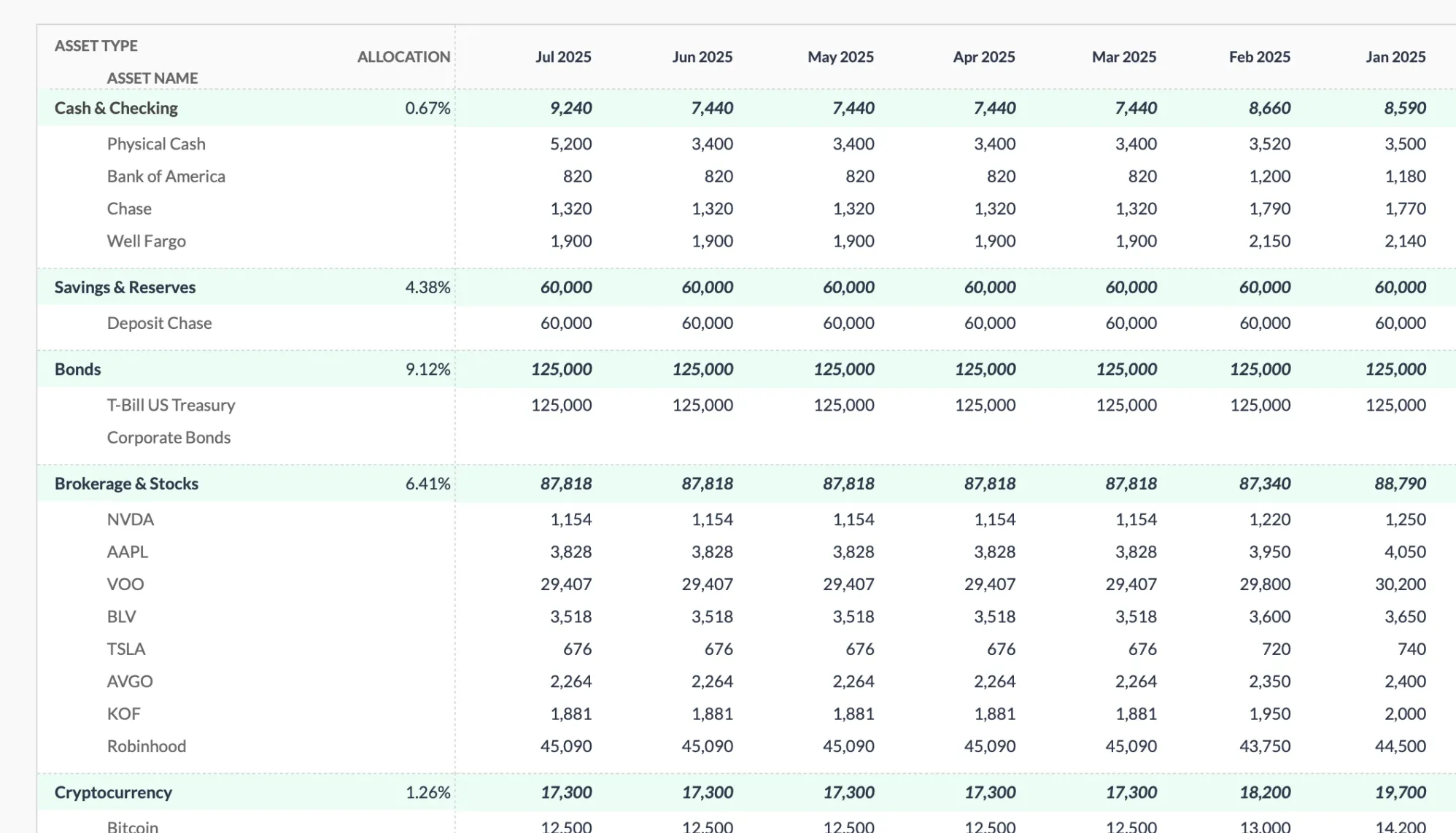 One row per account with monthly columns, from the Net Worth Tracker (Premium tier).
A monthly update takes about 10 minutes once you establish the rhythm. In the Net Worth Tracker each new month is a column you insert on the Assets tab, so the row keeps its own balance history, and the Summary tab charts assets over time alongside the year-to-date change against January.
Contribution Limit Tracking
2026 Contribution Limits
| Account | Annual Limit | Over 50 Catch-up |
|---|---|---|
| 401(k) / 403(b) | $24,500 | +$8,000 |
| IRA (Traditional/Roth) | $7,500 | +$1,100 |
| SEP-IRA | $72,000 | N/A |
| HSA (self-only) | $4,400 | +$1,000 (age 55+) |
These are the 2026 figures announced by the IRS; the HSA numbers come from IRS Publication 969. Limits are adjusted for inflation most years, so a tracker built this way benefits from a single editable cell per limit rather than a number hard-coded into a formula.
Track Against Limits
| Account | Limit | YTD Contributed | Remaining |
|---|---|---|---|
| 401(k) | $24,500 | $7,500 | $17,000 |
| Roth IRA | $7,500 | $3,500 | $4,000 |
Employer Match Tracking
| Employer Match | Amount |
|---|---|
| Match formula | 100% up to 6% |
| Your salary | $75,000 |
| Max match | $4,500 |
| Match received YTD | $1,875 |
| Remaining match to earn | $2,625 |
Consolidating Old Accounts
Multiple 401(k)s from past employers mean harder tracking, potentially higher fees, and different investment options. One approach is rolling old 401(k)s to your current employer plan (if allowed) or a Traditional IRA (more investment options).
Rolling over might not make sense when the current plan has great low-cost options, you need access to the age-55 rule, or company stock has favorable treatment.
Investment Allocation View
Across All Accounts
| Asset Class | Account 1 | Account 2 | Account 3 | Total | % |
|---|---|---|---|---|---|
| US Stocks | $50,000 | $30,000 | $20,000 | $100,000 | 55% |
| Int’l Stocks | $20,000 | $12,000 | $10,000 | $42,000 | 23% |
| Bonds | $15,000 | $0 | $5,000 | $20,000 | 11% |
| Other | $0 | $0 | $0 | $20,000 | 11% |
| Total | $85,000 | $42,000 | $35,000 | $182,000 | 100% |
Compare Actual to Target
| Asset Class | Target | Actual | Difference |
|---|---|---|---|
| US Stocks | 50% | 55% | +5% |
| Int’l Stocks | 25% | 23% | -2% |
| Bonds | 20% | 11% | -9% |
| Cash | 5% | 0% | -5% |
Some people rebalance when drift exceeds 5-10%.
Retirement Projections
Once the balances are aggregated, the same total can drive a growth projection. The Financial Planning Template projects the Assets and Debt tabs forward to a chosen end year from six assumptions: income, expenses, assets growth, assets yield, debt change and inflation. The Retirement Financial Planning & Projections template takes one combined savings balance plus an annual savings figure, then runs conservative, base, and optimistic scenarios side by side.
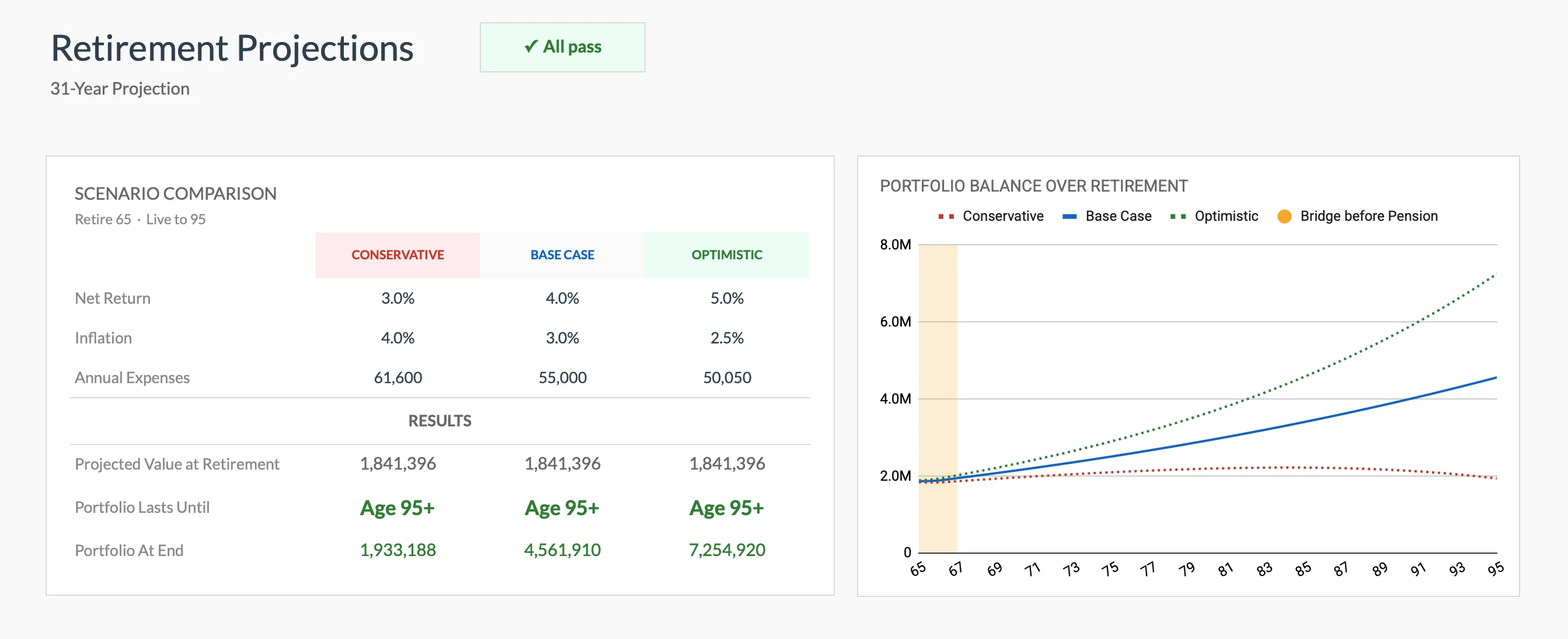 Scenario comparison from the Retirement Financial Planning & Projections template (Premium tier).
Quick Estimate
Future Value = Current Balance x (1 + return)^years + Annual Contributions x ((1 + return)^years - 1) / returnCurrent balance: $180,000 | Annual additions: $20,000 | Return: 7%
| Years | Projected Value |
|---|---|
| 10 | $635,000 |
| 15 | $985,000 |
| 20 | $1,470,000 |
| 25 | $2,145,000 |
One common rule of thumb suggests 25x annual expenses. Not gospel, but a starting point.
To run your own numbers with adjustable return and timeline, the retirement calculator does the same math interactively:
Integration with Net Worth
Include retirement accounts as assets in your net worth, but some people also track a separate “accessible net worth” view:
| Metric | Amount |
|---|---|
| Total net worth | $340,000 |
| Retirement accounts | -$180,000 |
| Accessible net worth | $160,000 |
Common Tracking Mistakes
- Forgetting old accounts. 401(k)s from past employers often get lost in transitions. Worth checking the National Registry of Unclaimed Retirement Benefits.
- Tracking balances but ignoring allocation. Without monitoring allocation, you might end up with unintentional risk.
- Missing employer match tracking. Worth tracking whether you’re getting the full match available.
Related
- Retirement Financial Planning & Projections - Scenario-based retirement modelling
- Net Worth Tracker - Retirement account tracking built-in
- Retirement Calculator: Planning for the Future
- Tracking Investments in a Net Worth Spreadsheet
- Net Worth Projections: Forecasting Your Financial Future
- Solo 401(k) vs SEP IRA Spreadsheet - Comparing the two self-employed retirement accounts you would track here
Frequently asked questions
Do employer matching contributions count toward my $24,500 401(k) limit?
No. The $24,500 limit for 2026 applies to your own salary deferrals. Employer match sits under a separate, larger combined cap ($72,000 for 2026), so the match does not eat into your personal contribution room. Worth tracking the two in separate columns so neither gets confused.
Can I contribute to both a 401(k) and an IRA in the same year?
Yes. The 401(k) limit and the IRA limit are separate buckets, so someone can put up to $24,500 in a 401(k) and up to $7,500 in an IRA in 2026. Whether the IRA contribution is deductible can phase out at higher incomes, which is worth checking against the IRS phase-out ranges.
Should I track pension value?
If you have a pension, one approach is estimating current value based on years of service and the payout formula, then including it as an asset. Some people keep it in a separate line since it is not a balance you can move.
How do I track an HSA as retirement savings?
Some people include the HSA balance in retirement tracking when they are treating it as long-term savings rather than spending it on current medical costs. The 2026 HSA limits are $4,400 for self-only and $8,750 for family coverage.
What about Social Security?
Social Security is not a balance, so it does not belong in net worth. It is still useful to factor an estimated benefit into retirement income projections separately.
Should I track by account or by type?
Both views are useful. Individual accounts help with day-to-day management, while aggregating by type (all 401(k)s, all IRAs) helps with contribution-limit and allocation planning.
Sources
- 401(k) limit increases to $24,500 for 2026, IRA limit increases to $7,500 - Internal Revenue Service
- Publication 969: Health Savings Accounts and Other Tax-Favored Health Plans - Internal Revenue Service
About this article
Contribution and catch-up limits checked against the IRS 2026 cost-of-living adjustment announcement (IR-2025-111 / Notice 2025-67). Template claims checked on 2026-09-10 against the shipped Net Worth Tracker Google Sheet (Summary, Assets, Liabilities, Milestones, Setup, Instructions tabs), the shipped Financial Planning Google Sheet (Summary, Goals, Assets, Debt, Cashflow, Projection tabs) and the shipped Retirement Financial Planning Projections Google Sheet (Summary, Inputs, Projections, Helpers, Instructions tabs). Last reviewed September 2026.