
A quarterly estimated tax spreadsheet takes your year-to-date income, subtracts deductions, applies your effective tax rate, and subtracts what you have already paid to show each quarter's payment. The safe harbor rule removes the underpayment penalty entirely if you pay 100 percent of last year's federal tax (110 percent when prior-year AGI topped $150,000) or 90 percent of this year's, whichever is smaller. For variable income, paying 25 percent of last year's tax each quarter is the simplest way to stay penalty-free. This guide covers the 2026 due dates, the safe harbor math, and a worked freelancer example.
Estimated tax payments fall due four times a year, and the IRS payment periods are not calendar quarters, which is where most missed-payment emails start. If you are self-employed and skipped an earlier deadline, a small penalty is already accruing. This post covers what to enter in a quarterly estimated tax spreadsheet, the safe harbor calculation that lets you ignore variable income, and a worked example you can adjust to your own numbers.
The 2026 due dates
| Quarter | Income period | Due date |
|---|---|---|
| Q1 | Jan 1 - Mar 31 | April 15, 2026 |
| Q2 | Apr 1 - May 31 | June 15, 2026 |
| Q3 | Jun 1 - Aug 31 | September 15, 2026 |
| Q4 | Sep 1 - Dec 31 | January 15, 2027 |
Notice Q2 covers two months, not three. The IRS due dates aren’t on calendar quarters. This is the single most common source of “I missed it” emails.
What you owe each quarter
Two ways to figure it.
Method 1: Safe harbor. Pay 25 percent of last year’s total federal tax liability per quarter (or 27.5 percent per quarter if your prior-year AGI was over $150,000). If you do this, you owe no underpayment penalty regardless of what you actually earn this year. Simple.
Method 2: Actual income. Calculate year-to-date income, subtract deductions, apply tax brackets, and pay the projected liability minus what you’ve already paid. More accurate but more work, especially for variable income.
Most people use a hybrid: safe harbor as the floor (so you’re guaranteed no penalty), then top up with method 2 if the year is going much better than last year.
The safe harbor formula
Safe harbor quarterly payment = (Prior year total federal tax) / 4Or if AGI was over $150,000:
Safe harbor quarterly payment = (Prior year total federal tax * 1.10) / 4The 110 percent figure applies only when prior-year AGI was over $150,000 ($75,000 if married filing separately). If you paid $24,000 in federal tax in 2025 and your AGI was under $150,000, you owe $6,000 per quarter in 2026 estimates. Pay that on time, your underpayment penalty is zero, even if your 2026 income spikes.
This is the easiest path for variable-income earners. You ignore current-year income noise and pay a predictable amount.
The actual-income calculation
When you’d rather pay closer to your real liability (because last year was unusually high or low), the calculation is:
Q estimate = (YTD net income * effective tax rate) - YTD paymentsWhere:
- YTD net income = year-to-date gross minus year-to-date deductions
- Effective tax rate = your projected average federal tax rate for the year (not your marginal)
- YTD payments = what you’ve already sent the IRS plus any W-2 withholding
The honest tricky part is the effective rate. For a single filer in 2026:
| Taxable income | Effective federal rate (approx) |
|---|---|
| $50,000 | 10.3 percent |
| $80,000 | 14.0 percent |
| $120,000 | 17.5 percent |
| $200,000 | 22.0 percent |
| $300,000 | 25.5 percent |
Add 15.3 percent for self-employment tax. The 12.4 percent Social Security portion applies to net earnings up to the $184,500 wage base for 2026, and the 2.9 percent Medicare portion applies to everything above it with no cap. Subtract the deduction for half of SE tax, then add state tax on top.
For most freelancers, the combined federal plus SE plus state effective rate lands between 25 percent and 35 percent of net business income. The Annual Tax Planner does not carry those tables. Its Dashboard gives you a rate cell next to each income type, so whichever effective rate you settle on for self-employment is the one it applies to the self-employment income logged on the Income tab.
The self-employment slice is the part that catches new freelancers off guard, since it stacks on top of income tax. If you want to see it in isolation before dropping the number into either method above, the calculator below runs it from your net profit.
A worked example
Lina is a freelance illustrator. 2025 federal tax liability was $14,400. AGI was $112,000 (under $150,000). 2026 is going about the same.
Safe harbor approach (easy): $14,400 / 4 = $3,600 per quarter. She pays $3,600 on April 15, June 15, September 15, and January 15. Total $14,400. If 2026 actual liability ends up higher (say $16,800), she owes the difference at filing in April 2027 with no underpayment penalty because she met safe harbor.
Actual-income approach (more accurate):
Q1 (Jan to Mar 2026): $24,000 gross, $6,500 deductions = $17,500 net. Estimated annual income: $70,000. Effective combined rate: 28 percent. Projected annual tax: $19,600. Q1 payment: $19,600 / 4 = $4,900.
Q2 (Apr to May 2026): YTD gross $42,000, YTD deductions $11,000 = $31,000 net. Annualized to $74,400. Projected annual tax: $20,830. Total to have paid by Q2: $20,830 / 12 * 5 = $8,680. Less Q1 paid ($4,900). Q2 payment: $3,780.
The actual-income approach is more accurate but requires running the calculation each quarter, and then somewhere to record the figure you arrived at against what you actually sent.
Where the spreadsheet helps
The Annual Tax Planner has a Quarterly tab that lays out all four quarters with their income periods and IRS due dates already filled in, with Q4 shown as Jan 15 and footnoted as falling in the next tax year. It does not work the estimate out for you. The four rows are yours to fill in, one per quarter:
- Estimated income for the period
- Estimated tax
- Amount paid, which a totals row at the foot of the table adds up for the year
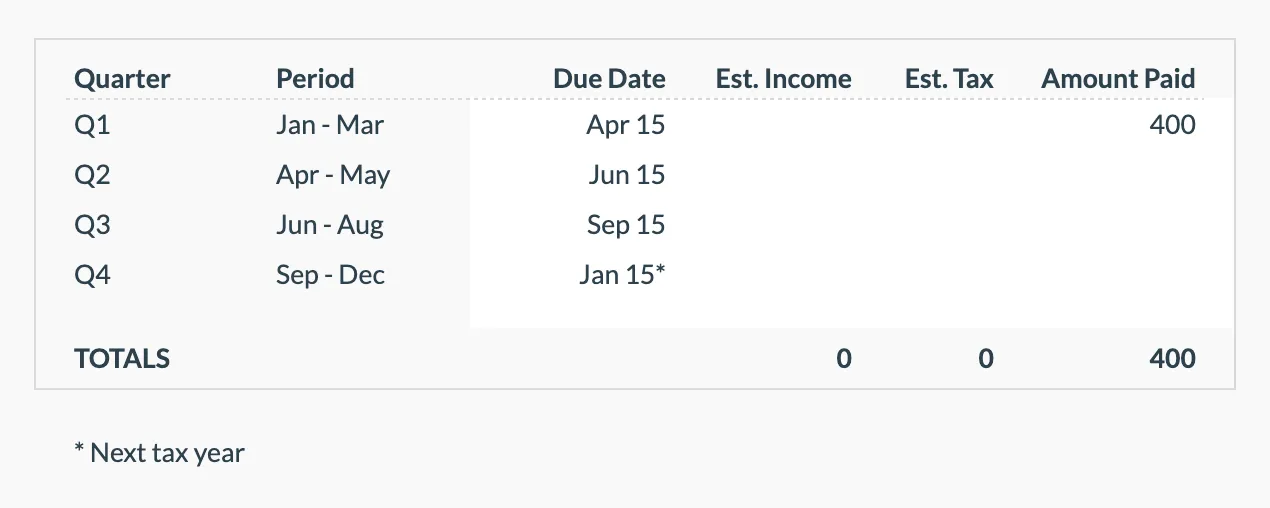
Income and deductions live on their own tabs, where they feed the Dashboard rather than the quarterly rows. The Dashboard totals income by type, applies the rate you set against each type, subtracts the deduction benefit and any credits, and lands on a net tax liability. The quarterly amount-paid total carries into that same Dashboard, sitting with tax withheld and other payments in a Total Paid figure, next to a balance-due card that shows the liability less what has gone in. You decide each quarter which number to actually pay, and the sheet keeps the record in one place so nothing is miscredited at filing.
Common mistakes
Forgetting Q1. April 15 is also Tax Day for the prior year. Many first-time filers focus on the prior-year return and miss the new-year Q1 estimate. Set a calendar reminder a week before each due date.
Using calendar quarters instead of IRS quarters. Q2 ends May 31, not June 30. Don’t ask why; the IRS just decided.
Not accounting for state estimates. Most states with income tax also require quarterly estimates with similar (but not identical) due dates. Track them separately.
Paying online but forgetting to record. IRS Direct Pay and EFTPS confirm but don’t mail receipts by default. Save the confirmation number in your spreadsheet so you don’t double-pay or miss-credit at filing.
Treating estimates as optional. Underpayment penalties are small but accumulate. The 2026 individual underpayment rate ran 7 percent in the first quarter and 6 percent in the second, so a $5,000 underpayment left outstanding for a year works out to roughly $350. Avoidable.
How to actually pay
Three options:
- IRS Direct Pay. directpay.irs.gov. Free, takes a checking account routing number, no signup required. The simplest option for occasional users.
- EFTPS. eftps.gov. Free, requires enrollment (which takes 7 to 10 days the first time, so set up early). Better for recurring quarterly use because you can schedule all four payments at once.
- IRS2Go app. Mobile version of Direct Pay. Works fine.
Avoid paying by debit or credit card; the processing fees (around 2 percent for credit) cost more than the brief float.
Running this in a spreadsheet
The Annual Tax Planner (Premium) carries the 2026 due dates on a four-row quarterly log, plus Income and Deductions tabs that drive a Dashboard net tax liability and a balance-due figure once the quarterly payments are in. The safe harbor floor and the actual-income figure are still yours to work out; the template is where they get recorded and set against what you have paid. If you only need to track each quarter’s federal and state amounts against their due dates, the free Quarterly Tax Payment Tracker does that on its own, with a paid column that zeroes a row’s still-due amount once it is marked Yes and a still-due total at the foot. And to pin down the self-employment tax slice before it goes into either method, the self-employment tax calculator gives you the 15.3 percent figure from your net profit.
Related
- Self-Employment Tax Calculator for Freelancers
- Income Tax Calculator: Understanding Your Tax Bill
- Tax Deduction Tracker in Google Sheets: Schedule A Categories Row by Row
- 25 Self-Employed Tax Deductions for 2026
- Q3 Estimated Tax Prep 2026 (Sept 15 Deadline Worksheet) - The September deadline run through year-to-date numbers
- Mid-Year Tax Checkup: 8 Things Worth Reviewing in June - The broader review that surfaces which estimate to pay
Frequently asked questions
Do I need to pay quarterly estimates if I have a W-2 job and a side business?
Maybe. If your W-2 withholding covers at least 90 percent of your projected total tax (or 100 percent of last year's), you're at safe harbor. If your side business income pushes total liability higher, you may need estimates or you can increase W-2 withholding via a new W-4 to cover the gap.
What's the underpayment penalty?
Roughly the federal short-term rate plus 3 percent, applied to the underpaid amount for the period it was unpaid. The IRS set the individual underpayment rate at 7 percent for the first quarter of 2026 and 6 percent for the second. On a small underpayment it's a few dollars; on a $20,000 underpayment it's a few hundred.
Most of my income landed in Q4. Do I owe penalties for the earlier quarters?
Not necessarily. The IRS annualized income installment method (Form 2210, Schedule AI) lets you match each quarter's payment to the income you actually earned in that period, so a slow first half followed by a heavy fourth quarter does not get penalized as if the money arrived evenly. It's more paperwork, which is why some people prefer the flat safe harbor amount instead.
Can I skip a quarter and catch up later?
You can, but the safe harbor calculation is per quarter, so skipping Q2 and paying double in Q3 still triggers a penalty for the Q2 period. Better to pay on time, even if the amount is approximate.
What if I overpay?
You get a refund at filing in April. The IRS doesn't pay interest on the overpayment unless they hold it past the refund processing window, which is rare.
Does the safe harbor work if last year I owed nothing?
Yes. If your prior-year tax liability was zero (because you had no income or all income was offset), you owe no estimates this year regardless. The safe harbor calculation produces zero. You'll still owe at filing if 2026 generates tax, but no penalty for not pre-paying.
Sources
- Estimated Taxes - Internal Revenue Service
- Topic no. 306, Penalty for underpayment of estimated tax - Internal Revenue Service
- Quarterly interest rates - Internal Revenue Service
- Contribution and Benefit Base - Social Security Administration
About this article
Due dates, the safe harbor thresholds, and the underpayment rate are checked against the IRS estimated-taxes page, Topic 306, and the IRS quarterly interest rates table. The 2026 Social Security wage base is checked against the SSA contribution and benefit base. Template sheets, inputs and outputs checked on 2026-09-10 against the shipped Annual Tax Planner workbook (Dashboard, Income, Deductions, Quarterly tabs) and the free Quarterly Tax Payment Tracker workbook (Quarterly Taxes tab). Last reviewed September 2026.