
Self-employed filers can claim 25 deductions in 2026, from the home office and vehicle write-offs to retirement contributions, the QBI deduction, and above-the-line health insurance premiums. This guide maps each deduction to its Schedule C line, works through the big four that move the most money, and shows where to log them. Every figure is checked against the 2026 IRS limits.
Self-employment turns almost every business cost into a potential deduction, and the ones filers leave on the table are rarely exotic. They are the home office, the mileage log nobody kept, the retirement account never opened, and the health premiums that belong above the line. Below are 25 deductions to know for 2026, each mapped to its Schedule C line, with extra detail on the four that move the most money and a worked example showing how they stack up. Each one has a home in the Annual Tax Planner.
In this article
- The 25 deductions, with what each covers, the Schedule C line, and where it lands in the tracker
- The big four (home office, vehicle, health insurance, retirement) get extra detail because they account for most missed dollars
- A worked example for a freelance consultant earning $95,000 net
- Common mistakes and what triggers an audit
- Where to track each one
The 25 deductions
| # | Deduction | Schedule C line | Notes |
|---|---|---|---|
| 1 | Home office | Line 30 (or Form 8829) | Simplified $5/sq ft up to 300 sq ft, or actual expense method |
| 2 | Vehicle | Line 9 | Standard mileage 72.5 cents/mile (Jan-Jun 2026), 76 cents/mile (Jul-Dec 2026), or actual expense |
| 3 | Health insurance premiums | Schedule 1, Line 17 | Above the line, not Schedule C |
| 4 | SEP IRA contribution | Schedule 1, Line 16 | Up to 25 percent of net SE income, max $72,000 (2026) |
| 5 | Solo 401(k) contribution | Schedule 1, Line 16 | Employee + employer up to $72,000, plus $8,000 catch-up at 50+ |
| 6 | SIMPLE IRA contribution | Schedule 1, Line 16 | Lower limit ($17,000 in 2026), simpler admin |
| 7 | Half of self-employment tax | Schedule 1, Line 15 | Automatic, just file Schedule SE |
| 8 | QBI deduction | Form 8995 | 20 percent of qualified business income, with phase-outs |
| 9 | Business meals | Line 24b | 50 percent deductible, actual amount logged |
| 10 | Supplies | Line 22 | Anything under $2,500 typically goes here |
| 11 | Software subscriptions | Line 18 or 22 | Adobe, Notion, project management, etc. |
| 12 | Internet | Line 25 | Business-use percentage of home internet |
| 13 | Cell phone | Line 25 | Business-use percentage |
| 14 | Legal and professional services | Line 17 | Lawyer, accountant, bookkeeper |
| 15 | Education | Line 27a (other) | Courses that maintain or improve current business skills |
| 16 | Advertising | Line 8 | Ads, business cards, website costs |
| 17 | Contract labor | Line 11 | Payments to contractors, send 1099-NEC if over $600 |
| 18 | Business travel | Line 24a | Lodging, transportation, 50 percent of meals |
| 19 | Equipment (Section 179) | Form 4562 | Up to $2,560,000 expensed in 2026 |
| 20 | Depreciation | Form 4562 | For assets not Section 179’d |
| 21 | Business insurance | Line 15 | E&O, general liability, cyber, business property |
| 22 | Bank and merchant fees | Line 17 or 27a | Stripe fees, business bank fees |
| 23 | Startup costs | Form 4562 | Up to $5,000 in year 1, rest amortized over 15 years |
| 24 | Retirement plan setup credit | Form 8881 | Up to $5,000/yr for first three years of a new plan |
| 25 | Small business health insurance credit | Form 8941 | If you cover employee premiums and meet conditions |
That’s the list. Now let’s look at the four that move the most money.
The big four (where most dollars are missed)
1. Home office
The home office deduction is real and underused, especially since the 2017 rule changes left it intact for self-employed filers (W-2 employees lost it).
Two methods:
Simplified method. $5 per square foot, up to 300 square feet, for a maximum of $1,500. No allocation of utilities, mortgage interest, depreciation, or insurance. Simple, but caps your deduction.
Actual expense method. Allocate a percentage of your home costs (utilities, insurance, mortgage interest, property tax, depreciation, repairs) by the percentage of your home used exclusively and regularly for business. A 200 square foot office in a 2,000 square foot home = 10 percent.
Worked example: Home with $24,000 in annual costs (utilities, insurance, mortgage interest, depreciation). Home office is 10 percent of square footage. Deduction = $2,400. Compared to simplified ($1,000 for 200 sq ft), actual wins by $1,400.
Audit risk: Lower than people think. The “exclusive and regular use” test is the key. A spare bedroom that doubles as a guest room fails. A converted garage office with a desk, chair, and file cabinet (and no other use) passes.
Track it: log the calculated deduction as a Business Expenses entry in the Annual Tax Planner’s deductions tab, described as “Home office”. Keep a folder of supporting docs (utility bills, insurance, mortgage statements) for the actual method.
2. Vehicle
For most self-employed people, the vehicle deduction is the second largest after the home office.
Standard mileage rate. The IRS raised the 2026 business rate mid-year: 72.5 cents per mile for trips from January through June, then 76 cents per mile from July through December. Multiply the business miles in each period by the matching rate and add them together.
Actual expense method. Track total vehicle expenses (gas, maintenance, insurance, depreciation, lease payments) and multiply by business-use percentage. Generally favorable for expensive vehicles or low-MPG vehicles; standard mileage favors fuel-efficient cars and high-mileage drivers.
Worked example: 6,000 business miles in the first half of 2026 at 72.5 cents ($4,350) plus 6,000 in the second half at 76 cents ($4,560) comes to $8,910 (standard mileage). The same vehicle, with $9,000 in actual expenses at 60 percent business use, gives $5,400. Standard mileage wins by $3,510 here.
The catch: the standard mileage rate has to be chosen in the vehicle’s first business year to stay available later. Starting with actual expenses locks that vehicle out of standard mileage.
Track it: log every business trip with date, destination, purpose, and miles, since the IRS requires a contemporaneous record. The date matters in 2026 because it decides which rate applies. Enter the resulting deduction under Business Expenses in the Annual Tax Planner’s deductions tab.
3. Health insurance premiums
If you’re self-employed and pay your own health insurance (or coverage for your spouse, dependents, or children under 27), the premiums are deductible above the line on Schedule 1, Line 17.
This means the deduction reduces your AGI directly, which has downstream effects on every other AGI-tied calculation (medical expense floor, IRA contribution phase-outs, ACA subsidies, etc.).
Limits:
- Can’t exceed your net self-employment income.
- Can’t include any month where you (or your spouse) were eligible for an employer-subsidized plan.
- Long-term care premiums included up to age-based limits.
Worked example: $850/month family premium = $10,200 annual deduction. At a 24 percent marginal bracket, that’s $2,448 in federal tax savings, plus state.
Track it: log the annual total under the Medical/Health deduction category, described as “Health insurance premiums”.
4. Retirement contributions
The self-employed have access to retirement vehicles a W-2 employee can only dream about. Three to know.
SEP IRA. Up to 25 percent of net self-employment income, capped at $72,000 in 2026. Quick to set up at any major brokerage. A common fit for high earners with no plans to add employees.
Solo 401(k). You contribute as both employee ($24,500 in 2026 elective deferrals, plus $8,000 catch-up at 50 plus) and employer (up to 25 percent of compensation, combined cap $72,000 plus catch-up). Roth contributions are allowed on the employee side, which is why moderate-to-high earners who want Roth flexibility tend to choose it.
SIMPLE IRA. Lower limits ($17,000 employee in 2026, plus $4,000 catch-up at 50 plus, plus an employer match), but simpler admin if you have employees.
Worked example: net self-employment income of $120,000, with a Solo 401(k) funded at roughly $46,800 ($24,500 employee plus about $22,300 on the employer side). At a 24 percent federal bracket, that is around $11,200 in current-year federal tax savings, with the money still yours, growing tax-deferred (or tax-free if Roth).
Track it: log the contribution under the Retirement Contributions category, using the receipt or notes field for the plan type and custodian.
The other 21, briefly
The rest move less money individually but add up, and the ones that are logged expenses land in one of the Annual Tax Planner’s deduction categories.
Half of self-employment tax (Line 15 Sched 1): Automatic once you file Schedule SE. SE tax is 15.3 percent of 92.35 percent of net SE income, and half of it comes off above the line.
QBI deduction (Form 8995): 20 percent of qualified business income, with phase-outs starting at $201,750 single / $403,500 MFJ in 2026. For most self-employed people under the threshold, this works out to a 20 percent deduction off the top, which makes it one of the largest single items on the list.
Business meals: 50 percent deductible. Track each meal with date, attendees, business purpose, and amount, then log the deductible half under Business Expenses.
Supplies: Office supplies, small tools, anything consumable under $2,500.
Software: Annual or monthly subscriptions (Adobe, QuickBooks, Notion, Zoom Pro, etc.). Increasingly significant; track it.
Internet: Business-use percentage. If you use home internet 60 percent for work, deduct 60 percent of the bill.
Cell phone: Same logic. If you have a dedicated business line, 100 percent. If shared, deduct the business-use percentage.
Legal and professional services: Lawyer fees for business contracts, accountant for tax prep (the portion attributable to the business), bookkeeping services.
Education: Courses, conferences, books, subscriptions that maintain or improve your current business skills. New career skills don’t qualify.
Advertising: Google Ads, Facebook Ads, business cards, website hosting, domain registration, SEO contractors.
Contract labor: Payments to other contractors. Issue 1099-NEC for any contractor paid $600 or more in the year.
Business travel: Out of town travel for business. Lodging, transportation, 50 percent of meals. The trip must have a business purpose; mixed business-leisure trips require allocation.
Equipment (Section 179): Computers, cameras, vehicles over 6,000 lbs GVWR, machinery. Deduct up to $2,560,000 in 2026. Most self-employed people will never approach the limit.
Depreciation: For assets not Section 179’d, depreciate over their useful life. Form 4562 handles it. Tax software (or your accountant) does the math.
Business insurance: Errors and omissions, general liability, cyber, business property, business auto. All deductible.
Bank and merchant fees: Business bank account fees, Stripe fees, PayPal fees, Square fees. They add up; track them.
Startup costs: First $5,000 deductible in year 1, rest amortized over 15 years. Includes legal fees to incorporate, market research, initial advertising before opening.
Retirement plan setup credit (Form 8881): Up to $5,000 per year for the first three years of a new retirement plan. New for many freelancers post-SECURE Act.
Small business health insurance credit (Form 8941): If you have employees and pay at least 50 percent of their health insurance premiums, you may qualify for a credit up to 50 percent of premiums paid.
A worked example: $95k freelance consultant
Anna is a freelance UX consultant. 2026 numbers:
| Line item | Amount |
|---|---|
| Gross income | $95,000 |
| Less: expenses | ($24,500) |
| Net SE income | $70,500 |
| SE tax (15.3 percent of 92.35 percent) | $9,962 |
| Half of SE tax (above the line) | ($4,981) |
| Health insurance premiums | ($8,400) |
| Solo 401(k) contribution | ($23,500) |
| Adjusted gross income | $33,619 |
| QBI deduction (20 percent of qualified business income, capped) | ($6,724) |
| Standard deduction (MFJ, 2026) | ($32,200) |
| Taxable income | $0 |
| Federal income tax | $0 |
| SE tax (full) | $9,962 |
| Total federal tax | $9,962 |
Without aggressive deduction tracking and retirement contributions, Anna would have paid roughly $13,000 to $15,000 more in federal tax. The retirement contribution alone (Solo 401(k) at $23,500) saved her around $5,400 in current-year tax while the money stays hers.
Common mistakes
- Mixing personal and business expenses. A separate business bank account and credit card eliminates 90 percent of audit risk and end-of-year reconciliation pain.
- No documentation for vehicle mileage. The IRS requires a contemporaneous log. “I drove a lot” doesn’t qualify. Apps (MileIQ, Everlance) or a simple spreadsheet log work.
- Deducting commuting. Driving from your home to your regular workplace isn’t deductible. Driving from your home office to a client site is.
- Home office that fails the exclusive use test. A kitchen table, a corner of the bedroom, a couch with a laptop don’t qualify. A defined space used only for business does.
- Overlooking the retirement deduction entirely. Often the single largest deduction self-employed filers leave unused. A SEP IRA can be opened and funded up to the tax filing deadline (including extensions), so the window stays open well after the calendar year closes.
Where to track all 25
The expense deductions on this list land in one of eight categories on the deductions tab of the Annual Tax Planner: Business Expenses, Medical/Health, Retirement Contributions, Charitable, Education, Housing/Mortgage, Insurance, and Other. Each entry carries a description, amount, date, and a receipt or notes field, so a mileage total, a home-office allocation, and a software subscription all sit in the same log, and the dashboard totals each category. The last two items on the list are credits rather than deductions, and the dashboard has its own tax credits field for those.
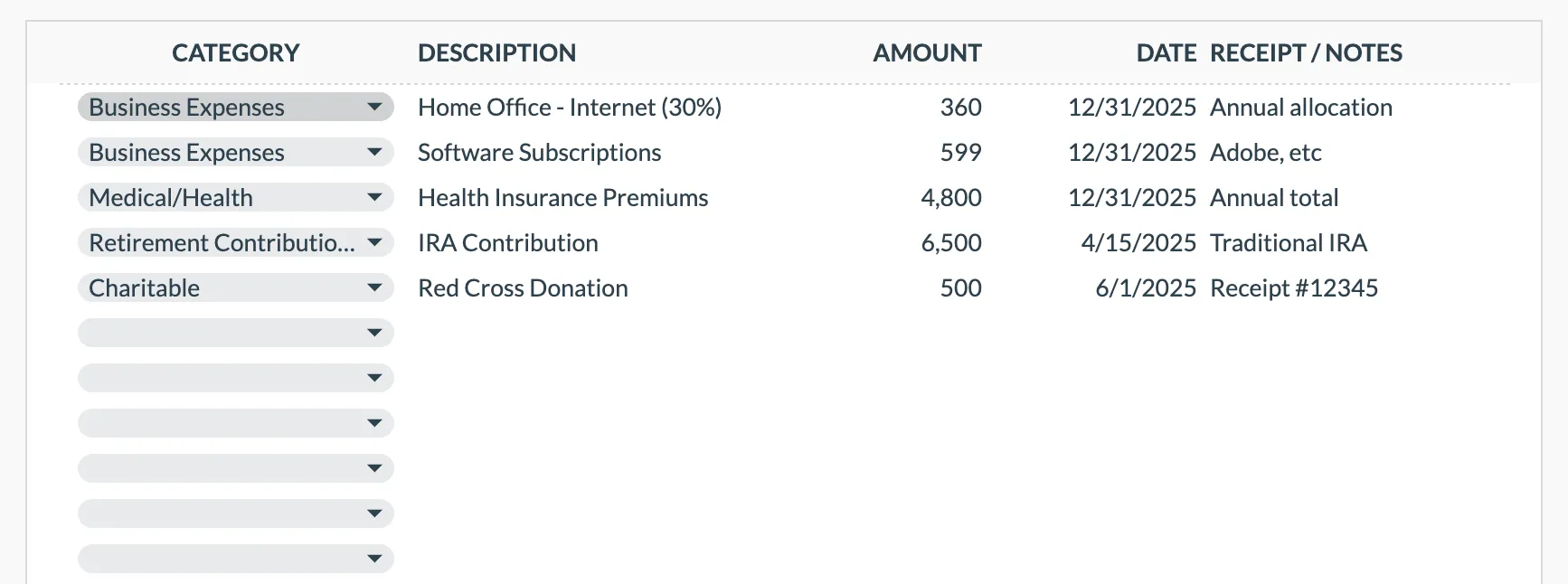 The deductions tab in the Annual Tax Planner (Premium tier), logging each expense to a category with its own notes.
Alongside the deduction log, the planner tracks income across eight source types, logs the four quarterly payments against their due dates, keeps a 14-item document checklist for W-2s, 1099s and the rest, and works out a net tax liability from the tax rate you set for each income type, less the deduction benefit and any credits. It runs in Google Sheets or Excel, and it is a one-time purchase at $29.
If you’d rather build a tracker yourself, the companion post walks through the row schema: see Tax Deduction Tracker in Google Sheets.
Next step
Pick the vehicle method (standard mileage or actual) and the retirement account before year end, since both decisions are harder to change afterward. From there, the Annual Tax Planner gives every deduction on this list a home, and the self-employment tax breakdown covers the 15.3 percent side of the return that these deductions do not touch.
Related
- Annual Tax Planner - Income, deductions, quarterly payments, and a document checklist in one sheet
- Announcing the Annual Tax Planner Spreadsheet Template - Why we built the planner and what lives on each tab
- Tax Deduction Tracker in Google Sheets - Build your own deduction log from scratch
- Self-Employment Tax Calculator - How the 15.3 percent SE tax is figured and what to set aside
- Side Hustle Calculator: Your Real Profit After Taxes - What side income nets once these deductions and taxes come out
Frequently asked questions
Do I need an LLC to claim these deductions?
No. Self-employed sole proprietors file Schedule C and claim every deduction on this list. An LLC adds liability protection and some flexibility but doesn't change the deduction picture for a single-member LLC taxed as a sole proprietor.
What if I have a day job and a side business?
You file Schedule C for the side business and deduct business expenses against business income. Some deductions (health insurance) only apply if your day job doesn't offer subsidized coverage. Retirement contributions to a solo 401(k) for the side business are separate from your day-job 401(k), with combined limits.
Are estimated taxes required?
Yes, if you'll owe more than $1,000 in tax for the year and your W-2 withholding doesn't cover at least 90 percent of current-year tax or 100 percent of prior-year tax (110 percent if AGI over $150,000). See the quarterly estimated tax post for the safe harbor walkthrough.
Can I deduct expenses from before my business started?
Yes, as startup costs. First $5,000 deductible in your first year of operation, rest amortized over 15 years. Form 4562 handles the calculation.
What's the audit risk on home office and vehicle?
Lower than most people assume, and documentation is what carries the day. A clearly defined home office (photos help), a contemporaneous mileage log, and consistent year-over-year deduction patterns tend to hold up. The deductions that draw scrutiny are the ones backed by gut-check estimates and no records.
Which mileage rate applies for 2026?
Both, split by date. The IRS set the 2026 business standard mileage rate at 72.5 cents per mile for January through June, then raised it to 76 cents per mile for July through December. Miles are priced by the period the trip fell in, so a year-round log needs the trip date, not just the total.
Can I switch between standard mileage and actual expense later?
It depends on which one you started with. Choosing the standard mileage rate in the vehicle's first business year keeps both options open in later years. Starting with the actual expense method on that vehicle locks you out of standard mileage for as long as you own it.
Sources
- 401(k) limit increases to $24,500 for 2026, IRA limit increases to $7,500 - Internal Revenue Service
- Standard mileage rates - Internal Revenue Service
- Rev. Proc. 2025-32 (2026 inflation adjustments: QBI thresholds, Section 179) - Internal Revenue Service
About this article
2026 contribution limits, QBI thresholds, the Section 179 cap, and the mid-year mileage rates checked against IRS Notice 2025-67, Rev. Proc. 2025-32, and the IRS standard mileage rates page. Tracker features checked on 2026-09-10 against the shipped Annual Tax Planner workbook (Dashboard, Income, Deductions, Quarterly, Documents Checklist, Exchange Rates, Instructions sheets). Last reviewed September 2026.