
Self-employment tax is 15.3% (12.4% Social Security plus 2.9% Medicare) charged on 92.35% of your net freelance income. Half of what you pay is deductible against income tax, and the total is settled in four quarterly estimated payments rather than one April bill. On $70,000 of net income the self-employment tax alone comes to about $9,891.
The first freelance paycheck is exciting. The first tax bill is a shock. When you are employed, your employer quietly pays half of your Social Security and Medicare taxes - you never see that money and never think about it. Go self-employed and suddenly the full 15.3% is yours to deal with, on top of income tax.
The Self-Employment Tax Calculator takes gross income, business expenses and your income and state tax rates, then splits the result into self-employment tax, federal tax, state tax and take-home pay. No signup required.
Where the 15.3% Comes From
When you work for an employer, FICA taxes get split. You pay 6.2% for Social Security and 1.45% for Medicare. Your employer matches that with another 6.2% and 1.45%. You never see the employer’s half on your paycheck - it is invisible.
Self-employed? You are both the employee and the employer. Both halves are your responsibility, which is how the 15.3% self-employment tax rate is built:
- Social Security: 12.4% (on net earnings up to the $184,500 wage base in 2026)
- Medicare: 2.9% (on all net earnings, no cap)
- Additional Medicare: 0.9% on earnings above $200,000 single / $250,000 married
The 15.3% applies to 92.35% of net self-employment income - not the full amount. This adjustment exists because employees do not pay FICA on the employer’s share, so the IRS gives self-employed people comparable treatment. It is a small discount, but on $70,000 in net income it knocks the taxable base down to about $64,645.
What It Actually Costs
Here is a concrete example. A freelance designer earns $85,000 in revenue, spends $15,000 on legitimate business expenses, and has $70,000 in net self-employment income.
The SE tax calculation: $70,000 times 92.35% equals $64,645. Social Security portion: $64,645 times 12.4% equals $8,016. Medicare portion: $64,645 times 2.9% equals $1,875. Total self-employment tax: $9,891.
That is $9,891 before a dollar of income tax. The effective SE tax rate on the original $70,000 is about 14.1%.
Now add income tax. After the self-employment tax deduction (half of $9,891, which is $4,946) and the 2026 standard deduction of $16,100 for a single filer, federal income tax on the remaining taxable income is roughly $5,630. State income tax at 5% adds about $3,250.
Total tax bill: approximately $18,770. That is about 27% of $70,000 in net income. This is why experienced freelancers set aside 25-30% of every dollar that comes in.
The Quarterly Payment Trap
Self-employed individuals do not have an employer withholding taxes from each paycheck. The IRS still wants its money throughout the year, though, not as a lump sum in April. The solution is quarterly estimated payments.
The deadlines for the 2026 tax year: April 15, June 15 and September 15 of 2026, then January 15 of 2027. Each payment covers roughly 25% of the expected annual tax. Miss them or underpay, and penalties accumulate.
The safe harbor rules offer some protection. Pay at least 100% of last year’s tax liability (110% if AGI was over $150,000) through estimated payments, and penalties are avoided even if you owe more when filing. This is particularly useful for freelancers with unpredictable income - base quarterly payments on last year’s numbers and settle up at filing time.
The most common mistake is not making estimated payments at all during the first year of self-employment. Someone who earned $60,000 freelancing and owes $17,000 in combined taxes discovers the entire amount is due at once - with penalties added on top. The IRS is not sympathetic to “I did not know” - the system assumes you will figure it out, and the penalties apply regardless.
What Reduces the Bill
Self-employment tax has fewer escape routes than income tax, but several strategies help.
Business deductions lower both taxes. Every legitimate business expense reduces net self-employment income, which reduces both income tax and self-employment tax. Home office, equipment, software, professional development, mileage, health insurance premiums (deductible for self-employed individuals as an adjustment to income) - tracking these carefully pays for itself.
The S-Corp election. Past a certain income level, typically $50,000 to $60,000 in net earnings, forming an S-Corporation and paying yourself a “reasonable salary” can reduce SE tax. The salary is subject to payroll taxes, but remaining profits distributed as dividends are not. On $100,000 in business income, paying yourself a $60,000 salary and taking $40,000 in distributions saves roughly $4,950 in SE tax. The trade-off is added accounting complexity, payroll processing, and the requirement to actually pay a reasonable salary - the IRS watches for artificially low salaries.
Retirement contributions. A SEP-IRA (up to 25% of net SE income, max $72,000 in 2026) or a Solo 401(k) reduces income tax, though not self-employment tax directly. Still, sheltering $15,000 or $20,000 from income tax makes a material difference in the total bill.
The Separate Account Rule
Freelance income arrives looking like it is all yours. It is not. Roughly a quarter to a third of every payment is spoken for before you touch it.
The most reliable approach: open a separate savings account dedicated to taxes. When a client payment hits your account, immediately transfer 25-30% to the tax account. When quarterly payments are due, the money is already there. This removes the discipline problem - you cannot accidentally spend money that is not in your checking account.
Some freelancers go further and open a separate checking account for business income, keeping the tax savings account fed from that business account. The separation adds clarity - personal money and business money never mix, tax money is always set aside, and the checking account balance reflects spendable income rather than gross revenue.
The first year of self-employment taxes is the hardest because the numbers are unfamiliar and the quarterly rhythm is new. By year two, the pattern becomes routine. By year three, most people have a system that runs without much thought.
For anyone managing irregular freelance income alongside personal expenses, the Annual Tax Planner Template tracks income, deductions, and estimated payments as they happen, and the Monthly Budget Template helps structure personal spending around variable income.
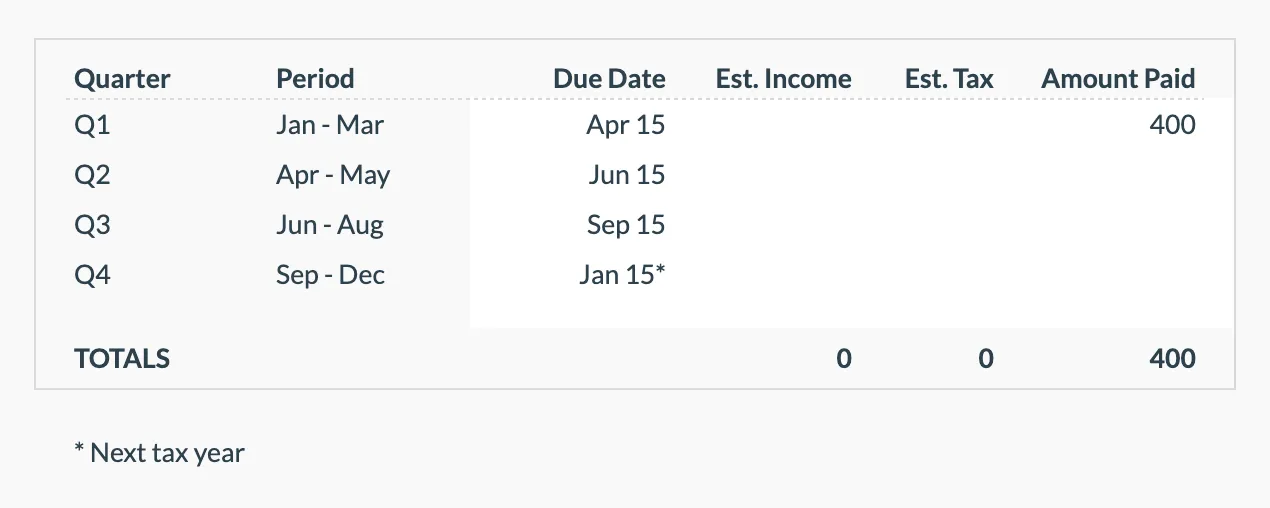
The quarterly payment tracker in the Annual Tax Planner Template (Premium tier) lays out all four deadlines and totals what you have paid so far against what you owe.
Related
- Income Tax Calculator: Understanding Your Tax Bill - how federal income taxes stack on top of self-employment tax
- How to Budget for Irregular Income - smoothing variable freelance pay so the tax set-aside is always covered
- Side Hustle Calculator - what side income actually nets after taxes and expenses
- Annual Tax Planner Template - track income, deductions, and estimated payments in one workbook
Frequently asked questions
What is the self-employment tax rate?
15.3% on net self-employment income - consisting of 12.4% for Social Security (on income up to $184,500 in 2026) and 2.9% for Medicare (on all income). This covers both the employer and employee portions.
Can I deduct the employer half?
Yes. Half of the self-employment tax (7.65%) is deductible on your income tax return as an above-the-line deduction, reducing your adjusted gross income.
When are quarterly estimated payments due?
April 15, June 15, September 15, and January 15 (of the following year). Missing deadlines incurs penalties.
Do I owe self-employment tax on all side income?
If net earnings from self-employment are $400 or more in a year, self-employment tax applies. This includes freelance work, gig economy earnings, and business profits.
Do I still owe self-employment tax if I also have a W-2 job?
Yes. Freelance and business profits are taxed separately from wages, so self-employment tax applies to the net side income even when a day job already withholds FICA. One overlap worth knowing: Social Security tax stops once your combined wages and net self-employment earnings reach the annual wage base ($184,500 in 2026), while the 2.9% Medicare portion keeps applying with no cap.
Does forming an LLC reduce self-employment tax?
Not on its own. A single-member LLC is taxed the same as a sole proprietor by default, so the full 15.3% still applies to net earnings. What can change the math is electing S-Corporation treatment, where a reasonable salary is subject to payroll tax and remaining profits are not - a structure that adds payroll and accounting work in exchange for the potential saving.
Sources
- Self-Employment Tax (Social Security and Medicare Taxes) - Internal Revenue Service
- Estimated Taxes - Internal Revenue Service
- Retirement Plans for Self-Employed People - Internal Revenue Service
- Contribution and Benefit Base - Social Security Administration
About this article
Rate, wage base, the 92.35% adjustment, and the $400 threshold checked on 2026-09-10 against the IRS self-employment tax and estimated taxes pages, IRS Rev. Proc. 2025-32 for the 2026 brackets and standard deduction, IRS Notice 2025-67 for the 2026 SEP-IRA limit, and the SSA contribution and benefit base. Calculator inputs and outputs checked on 2026-09-10 against src/components/calculators/calculators/SelfEmploymentTaxCalculator.astro; Annual Tax Planner claims checked against the shipped workbook (Dashboard, Income, Deductions, Quarterly sheets). Last reviewed September 2026.