
Budget from your leanest month, not your average. Set a baseline from the lowest income month of the past year, fund a strict priority order as money arrives, and run every payment through a buffer account that pays you a steady amount each month. Set aside 25-30% of each payment for taxes, and because income can disappear, many freelancers hold a larger emergency fund of 6 to 9 months of expenses.
Budgeting advice assumes predictable paychecks. But what if you’re a freelancer earning $8,000 one month and $2,000 the next?
Irregular income needs different strategies. Our Monthly Budget Template works for variable income because you can adjust allocations as each payment arrives, and the Freelancer Finance Suite adds invoice tracking and a tax reserve for anyone billing clients directly.
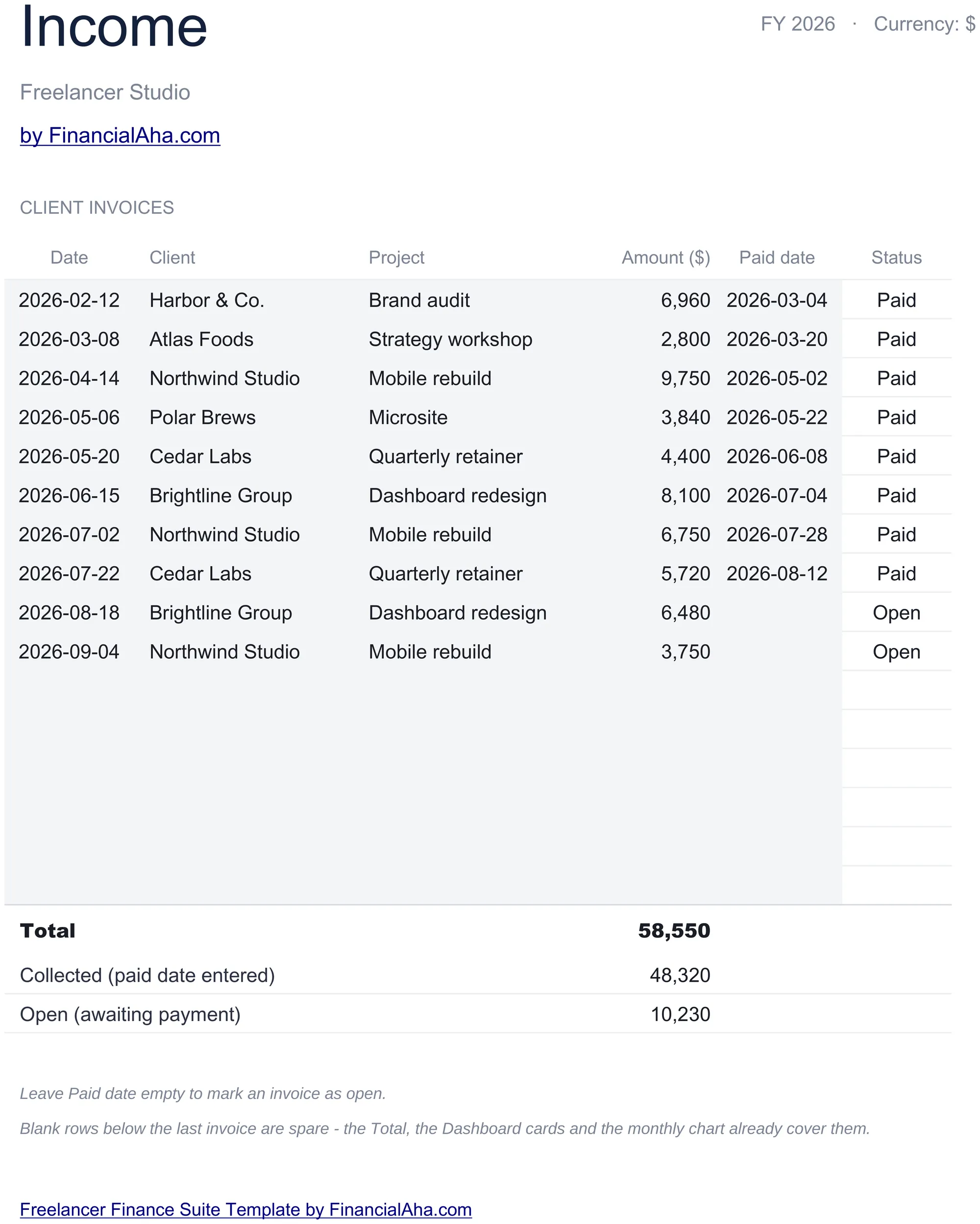 The income tab of the Freelancer Finance Suite (Premium) captures the reality of irregular pay: invoices swing from $2,800 to $12,500 month to month, and some sit open until a client pays.
Why Traditional Budgeting Fails
The standard approach is: know monthly income, allocate to categories, spend accordingly. With variable income, step one breaks. You can’t allocate what you don’t know you’ll have.
This doesn’t mean budgeting is impossible - it means the strategy needs to adapt. Several approaches work, and finding the right fit depends on how your income varies and your tolerance for complexity.
Budget Your Baseline
Look at your last 12 months. What was your lowest month? That’s your baseline. If income ranged $3,000 to $9,000, budget as if you’ll earn $3,000 every month.
The advantage is that you can always meet the budget. Months above baseline create surplus that can go to savings, debt, or a buffer for lean months. The challenge is discipline - resisting lifestyle inflation when money feels abundant.
Priority-Based Allocation
Create a spending hierarchy that determines what gets funded first. Tier 1 - Survival (must pay) includes housing, utilities, basic food, essential transportation, health insurance. Tier 2 - Obligations (should pay) covers debt minimums, phone/internet, childcare, insurance.
Tier 3 - Important (want to pay) includes savings goals, extra debt payments, valued subscriptions. Tier 4 - Flexible (if available) covers entertainment, dining out, shopping, extra savings. When income arrives, fund tiers in order. Tier 1 always gets funded. Tier 4 only happens in good months.
Income Smoothing
Build a buffer account between income and spending. All income goes to the buffer first. Transfer a fixed amount to checking monthly. The buffer absorbs the highs and lows.
For example: average income is $5,000/month but varies from $2,000 to $9,000. Build a buffer holding 2-3 months of expenses. Pay yourself $5,000/month from the buffer. High months refill it. Low months draw from it. This creates artificial paycheck regularity even when income is unpredictable.
Zero-Based with Actual Money
Budget only money currently in your account. Look at what’s available now, assign every dollar to categories, and when new income arrives, assign those dollars too. This is the core of zero-based budgeting, applied to money you already hold.
You’re always budgeting real money rather than projected money. The approach pairs well with priority-based allocation: assign available money to the highest priorities first, then work down the list.
Handling Feast and Famine
How the income swings get handled tends to determine long-term stability. High-income months are where the surplus gets built: emergency savings, refilling the buffer for lean months, extra debt payments. The pull to spend more is strong, and having a plan for the extra money makes it easier to route somewhere deliberate before it drifts into lifestyle.
Low-income months are where the buffer earns its keep. Spending shifts toward essentials, non-critical subscriptions can pause, and the plan aims to avoid adding new debt. A low month is far easier to navigate when it was planned for during a high one.
Tax Considerations
Self-employment income means paying your own taxes, and this trips up many freelancers. Many people with irregular income set aside 25-30% of every payment as soon as it lands. That range is not arbitrary: it has to cover federal income tax plus self-employment tax, which runs 15.3% of net earnings (12.4% for Social Security and 2.9% for Medicare). A W-2 employee splits that payroll tax with an employer; the self-employed pay the whole share, on top of income tax, which is why the set-aside is higher than most people expect.
The IRS collects this money in four estimated tax payments rather than all at once. For a given tax year, they are generally due April 15, June 15, September 15, and January 15 of the following year, shifting to the next business day when a date falls on a weekend or holiday.
Keeping tax money in a dedicated separate account helps. That money is already spoken for, so treating it as gone the moment it arrives avoids the trap of spending funds that were never really available.
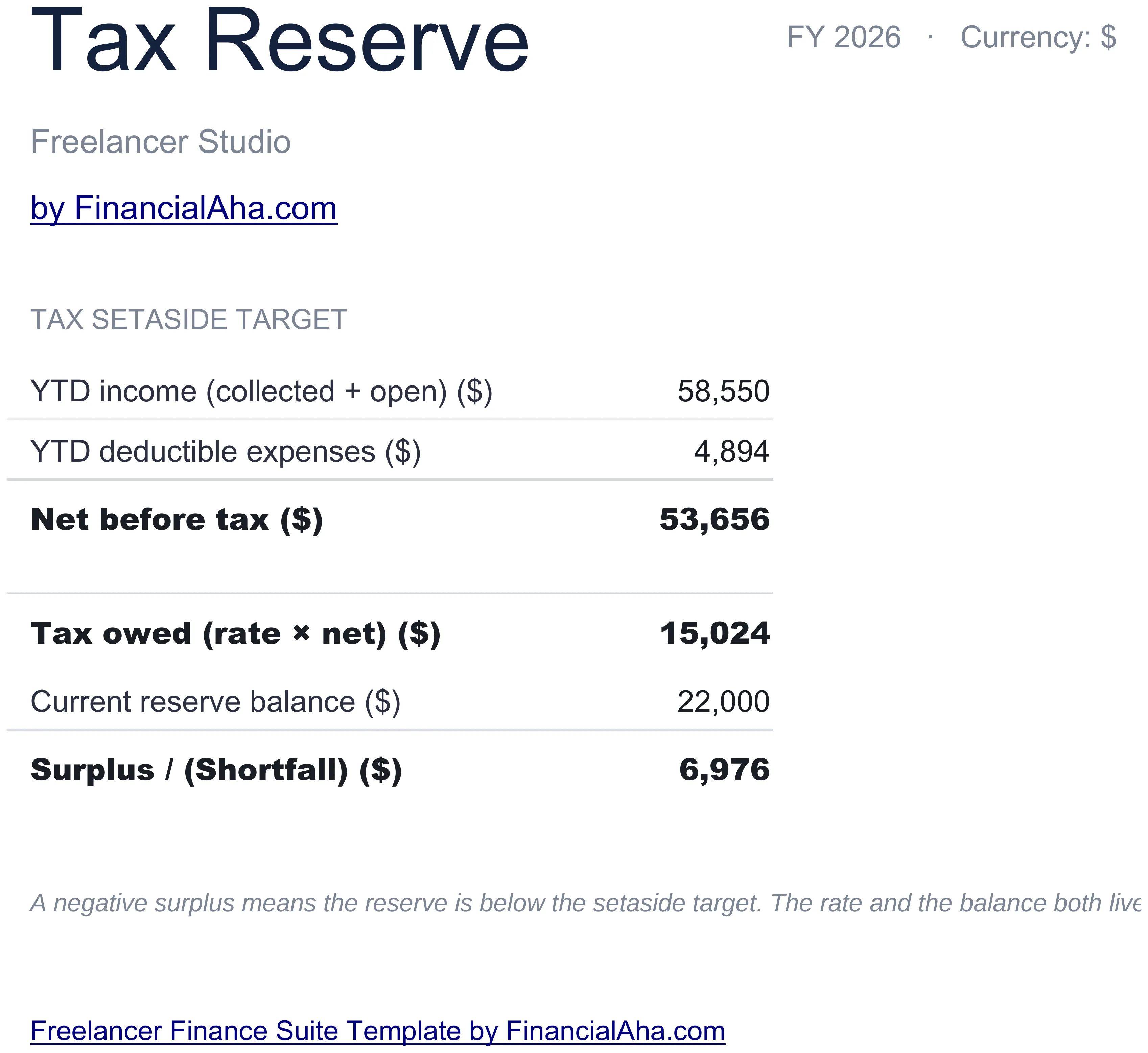 The Freelancer Finance Suite (Premium) tracks a tax reserve automatically: it estimates tax owed from year-to-date net income and compares it to what you have set aside, flagging a shortfall before a payment is due. The Annual Tax Planner covers the same ground for anyone who wants quarterly-payment tracking on its own.
Building Stability
An emergency fund matters even more with irregular income. The Consumer Financial Protection Bureau notes that the right amount depends on your situation, and many freelancers and contractors aim for 6 to 9 months of expenses rather than the 3 to 6 months often cited for salaried workers. The larger cushion reflects that a client can vanish with little warning. To put a number on your own runway, our emergency fund calculator and financial runway calculator both do the division for you.
Multiple income streams help by diversifying sources: if one client disappears, others continue. Tracking patterns over time also builds an early-warning system. Seasonal fluctuations, reliable versus unreliable clients, and the lead time between work and payment all leave a signature, and understanding your income rhythm helps you see lean periods coming before they arrive.
Related
- Freelancer Finance Suite
- Annual Tax Planner
- Monthly Budget Template
- Zero-Based Budgeting
- How to Budget with Irregular Income in Google Sheets - The same baseline method built into a four-tab sheet
- Side Hustle Income: Where to Track Extra Earnings - Folding variable side income and its taxes into the plan
- Emergency Fund Calculator
Frequently asked questions
How big should my buffer be?
One month of expenses is a common starting point. Many people build toward three, and some freelancers hold six or more so a single slow month never forces a hard choice.
What if I'm just starting freelancing?
With no history to look back on, some new freelancers plan around a conservative low-income figure until they have 12 months of real data to set a baseline from.
How do I handle annual expenses?
One approach is to divide each yearly bill by 12 and set that amount aside monthly, so an annual insurance premium or tax bill does not land as a surprise in a lean month.
What if my lowest month was an unusual outlier?
If one month was distorted by a sick leave, a client dispute, or a one-off gap, some people use the second or third lowest month as the baseline instead, so the floor reflects a normal slow month rather than a rare crisis.
Do I have to make quarterly estimated tax payments?
The IRS generally expects estimated payments when you owe $1,000 or more in tax beyond withholding. Freelancers and contractors with no employer withholding often fall into this. The estimated-tax rules are on the IRS site, and a tax professional can confirm your situation.
Can a standard budget template handle variable income?
Yes. A monthly template still works when you treat each payment as it arrives rather than assuming a fixed paycheck. You adjust the allocations for that month instead of planning against income you have not received.
Sources
- Estimated Taxes - Internal Revenue Service
- Self-Employment Tax (Social Security and Medicare Taxes) - Internal Revenue Service
- An essential guide to building an emergency fund - Consumer Financial Protection Bureau
About this article
Quarterly estimated-tax due dates and the self-employment tax rate checked against IRS guidance on estimated taxes and self-employment tax. Emergency fund ranges cross-referenced with the Consumer Financial Protection Bureau's emergency savings guidance. Last reviewed August 2026.