
Irregular income breaks a standard monthly budget because the income side is the wrong shape. The baseline method fixes it: pay your household a fixed monthly salary set from a trailing average of net income, hold the peaks and dips in a separate buffer account, and route a tax cut off every deposit before counting it as income. It fits in a Google Sheet with four tabs: income log, tax savings, buffer, and household budget.
A monthly budget that assumes a steady paycheck collapses the first time the paycheck stops being steady. For a freelance designer who earns $4,250 one month and $8,000 the next, “spend less than you earn” is not a sentence that means anything in isolation. Earn less than what? This month? The trailing three months? The annual average that doesn’t exist yet?
The CFPB’s Making Ends Meet survey found that small business owners are over 30 percentage points more likely than non-owners to report volatile income, with 16 percent saying income “varies a lot” month to month against 6 percent of non-owners (Consumer Financial Protection Bureau). The baseline method is built for that shape.
This is the Google Sheets build of the approach. For the method framed without the spreadsheet specifics, see How to Budget for Irregular Income.
Why standard monthly budgets fail with irregular income
A standard budget assumes income is roughly the same every month and treats expenses as the variable side. For salaried workers, that maps to reality. For everyone else, the assumption is reversed: expenses are fairly stable (rent, groceries, insurance), and income is the volatile side.
When the model and the reality don’t match, three failure patterns show up:
- Feast-and-famine spending. High-income months feel like found money. Low-income months feel like emergencies. The household oscillates between overspending and panic.
- Tax surprises. Quarterly estimates arrive uncovered because the cash already went somewhere else.
- No savings rhythm. Saving “what’s left” produces $0 most months and a vague guilt the rest of the time.
The baseline method addresses all three by inverting the model: income is treated as fixed (a chosen baseline), and the variability is absorbed by a buffer account that lives outside the household budget.
The baseline method: paying yourself a fixed amount
The mechanic is simple.
- All freelance or variable income lands in a holding account (often a business checking account).
- A fixed monthly “salary” transfers from the holding account to the household checking account on the same date every month.
- The household budgets against that fixed salary like any salaried household.
- Surplus in the holding account accumulates as buffer. Shortfall draws from the buffer.
The household sees a paycheck. The volatility lives upstream, in a place the household budget doesn’t touch.
Picking the baseline
The baseline is the monthly transfer amount. Common starting points:
| Approach | How to calculate | What it gives you |
|---|---|---|
| Trailing 12-month median | Median of the last 12 months of net income (after tax set-aside) | Smooths out one-off spikes and slumps; requires 12+ months of history |
| Trailing 12-month average minus safety margin | Average net income times 0.80 to 0.90 | Built-in cushion; works with shorter history if the safety margin is large enough |
| Lowest-3-of-12 average | Average of your 3 lowest months in the last year | Smallest baseline, largest buffer |
The trade-off is comfort versus margin. A baseline at 100 percent of the trailing median feels generous but leaves no cushion. A baseline at 80 percent feels tight but accumulates buffer faster.
For the worked example below, we use the trailing average minus a 15 percent safety margin.
A worked example: six months for a freelance designer
Freelance designer, working from her business checking account. Net income (after tax set-aside, see below) over six months. We’re using a 6-month window here for clarity; the real method uses a 12-month trailing window once you have that history.
| Month | Net income | Notes |
|---|---|---|
| Mar | $4,250 | Slow month; one project closed |
| Apr | $8,000 | Two projects closed plus a deposit |
| May | $3,000 | Client paid late; one invoice slipped to June |
| Jun | $7,890 | The slipped invoice plus normal load |
| Jul | $9,000 | Best month; an extra retainer started |
| Aug | $5,600 | Steady; one project plus a small ad-hoc job |
Six-month average: $6,290.
Baseline at 85 percent of average: $5,350.
The designer pays herself $5,350 on the 1st of each month, regardless of what came in.
What happens to the holding account over those six months, assuming a starting buffer of $4,200:
| Month | Net deposit | Salary out | Buffer change | Buffer balance |
|---|---|---|---|---|
| Start | 4,200 | |||
| Mar | 4,250 | 5,350 | -1,100 | 3,100 |
| Apr | 8,000 | 5,350 | +2,650 | 5,750 |
| May | 3,000 | 5,350 | -2,350 | 3,400 |
| Jun | 7,890 | 5,350 | +2,540 | 5,940 |
| Jul | 9,000 | 5,350 | +3,650 | 9,590 |
| Aug | 5,600 | 5,350 | +250 | 9,840 |
Cumulative over six months: net income $37,740, total salary $32,100, buffer change +$5,640.
The household saw $5,350 every month. The actual cash flow looked nothing like that. The buffer absorbed the difference, dipping to $3,100 in March before climbing toward $9,840 by August.
The buffer account: where it lives and how big
The buffer is the engine of the whole method. Without it, the baseline is just a wish.
Where it lives. A separate account, usually a high-yield savings account linked to the business checking. Keeping it in the same account as operating cash defeats the visibility purpose; you cannot tell at a glance whether you are dipping into reserves.
How big it should be. Common sizing ranges from one month to four months of baseline salary, depending on income variability. Highly seasonal earners (tax preparers, summer-camp operators) often hold larger buffers because the trough can last a full quarter or two.
How it fills. Whenever a high-income month puts the holding account above the baseline plus expected near-term expenses, the excess sweeps to the buffer. When the buffer is at its target size, the excess can take a different path - a quarterly distribution, an extra retirement contribution, or accelerated debt payoff.
The tax set-aside
Before any deposit reaches the “net income” column in the spreadsheet, a percent moves to a separate tax savings account. Taxes get paid first, off the top.
Common ranges sit between 25 and 35 percent of each deposit. The right percent depends on the filer’s federal bracket, state tax, self-employment tax, and any deductions or credits. A first-year freelancer with state income tax often lands at the higher end of that range; a low-income year with significant business deductions lands at the lower end. The exact number is a tax-planning question, not a budgeting one. For a worked example of how the federal estimate math runs, see the Quarterly Estimated Tax Spreadsheet.
The mechanic is automation. On every deposit:
- The chosen percent moves into the tax account.
- The remainder is what counts as “net income” everywhere downstream in the spreadsheet.
Doing this on every deposit instead of quarterly keeps the money from sitting in the operating account long enough to feel spendable.
The spreadsheet structure
Four tabs cover the whole method in Google Sheets.
Tab 1: Income log
One row per deposit.
| Date | Source | Gross | Tax % | Tax set-aside | Net |
|---|---|---|---|---|---|
| 2026-03-12 | Client A invoice | 3,500 | 30% | 1,050 | 2,450 |
| 2026-03-25 | Client B retainer | 2,200 | 30% | 660 | 1,540 |
| 2026-04-04 | Client C project | 5,000 | 30% | 1,500 | 3,500 |
Sum the Net column by month to get the monthly net income that feeds the baseline calculation.
Tab 2: Tax savings
One row per tax-savings transfer (matching the Tax set-aside column above) and one row per quarterly estimated payment going out.
| Date | Direction | Amount | Note |
|---|---|---|---|
| 2026-03-12 | In | 1,050 | Client A 30% |
| 2026-03-25 | In | 660 | Client B 30% |
| 2026-04-15 | Out | 4,800 | Q1 federal estimate |
Running balance shows whether the set-aside rate is producing enough to cover the estimates.
Tab 3: Buffer
Tracks the holding account against baseline.
| Month | Net income | Baseline salary | Net change | Buffer balance |
|---|---|---|---|---|
| Mar | 4,250 | 5,350 | -1,100 | 3,100 |
| Apr | 8,000 | 5,350 | +2,650 | 5,750 |
Tab 4: Household budget
Operates on the baseline salary as if it were a paycheck. Categories: housing, food, transportation, insurance, savings, discretionary. The household budget doesn’t need to know about the income volatility upstream. That’s the design.
Quarterly review: adjusting the baseline
The trailing window moves. Each quarter (or every month if income is changing fast), recalculate the trailing 12-month average and decide whether the baseline still fits.
Three patterns to look for:
- Buffer growing past target. The baseline may be too low for current income. Options include raising it, or treating the excess as a quarterly distribution.
- Buffer drawing down toward zero. The baseline is too high relative to current income. Lowering it before the buffer runs out is the move most people prefer to making it after.
- Buffer oscillating around target with no drift. The baseline is well-calibrated.
Updating the baseline before a crisis forces it tends to feel easier than waiting until the buffer hits empty.
Off-cycle expenses: annual insurance, quarterly tax, software renewals
The household budget covers monthly expenses. Annual or quarterly expenses (business insurance, software annual renewals, quarterly tax payments, professional dues) don’t fit cleanly in either the household budget or the buffer. Two options:
- Sinking-fund line in the household budget. Divide the annual cost by 12 and budget that amount monthly. When the bill arrives, the money is already saved.
- Separate “obligations” account, funded from the holding account. Treat large recurring obligations as upstream of the household salary entirely. This keeps the household budget cleaner but adds an account.
Either works. The mistake is having neither, in which case the annual bill becomes a quarterly buffer drain. The sinking-fund mechanics are covered in more detail in How to Build a Budget When You Have Irregular Expenses.
For the freelancer-side cash flow tracking that pairs with this method, see Freelancer Cash Flow Spreadsheet: Monthly Reconciliation in 15 Minutes.
When the baseline method breaks
Three scenarios where this structure struggles:
Extreme front-loading or back-loading. A consultant who earns 80 percent of annual income in two months of the year needs a different rhythm - the buffer would need to be enormous, or the baseline very low. A 6-month or annual smoothing window often works better than 12-month.
A truly new freelancer with under 6 months of history. There’s no trailing window to average. A reasonable starting move is to base the early baseline on a conservative estimate of guaranteed work, treating any overage as buffer until 6 to 12 months of history exist.
A genuine permanent income drop. If income has shifted down structurally (lost largest client, industry contraction), the trailing 12-month window will lag the new reality. Recalculating against the last 3 to 6 months, and rerunning the household budget against the new baseline, brings the model back in line with what’s actually happening.
Templates that fit
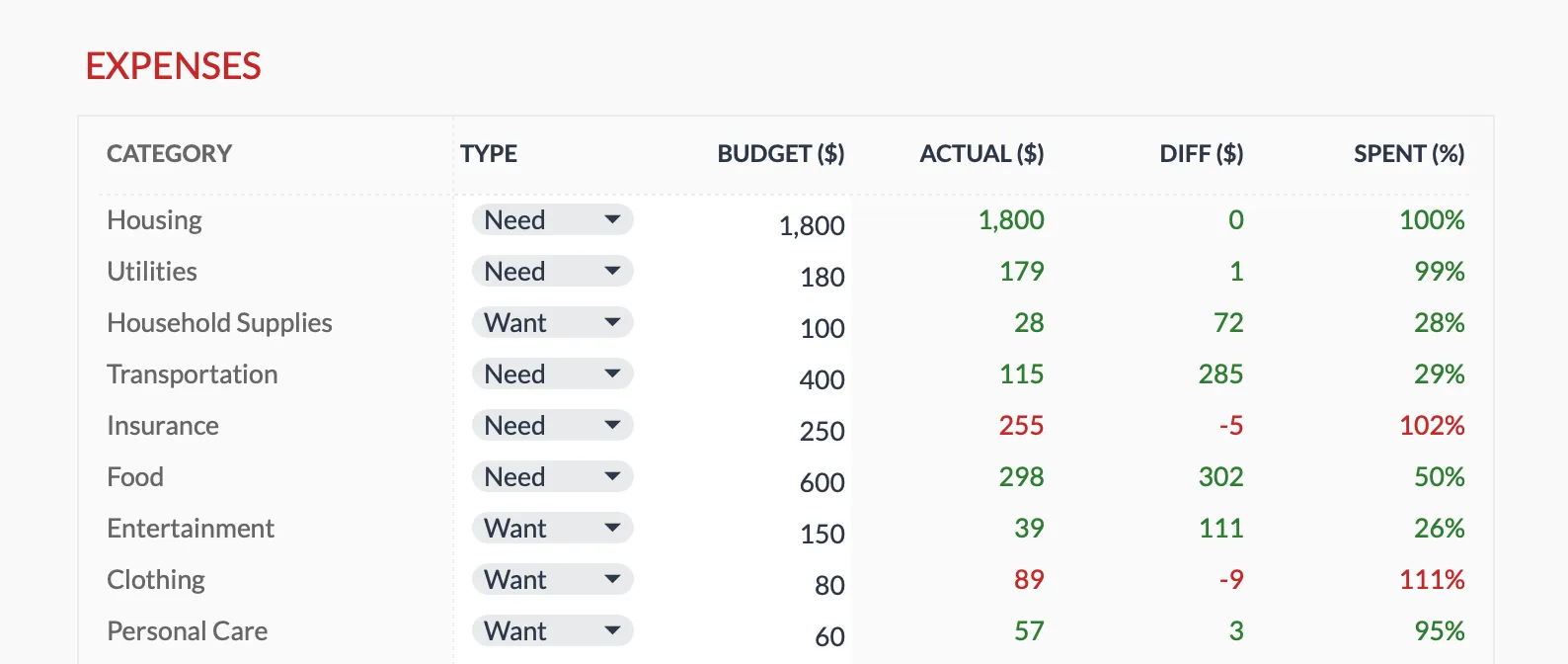 The planned-versus-actual view on the Budget Plan sheet of the Monthly Budget Template (Premium tier) is what the household-budget tab looks like once the baseline salary is entered as the planned income amount.
- “I want to plan against a steady monthly number with category targets” - The Monthly Budget Template is what you point at the household-budget tab once the baseline is set. Categories, planned versus actual, savings rate.
- “I want to see cash in, cash out, and a forward projection in one place” - The Cash Flow Forecast template handles the upstream side: cash inflows and outflows, a 12-month projection, and scenario modeling for a variable-income business.
Category names are editable on both sides. The Monthly Budget Template keeps its expense, income and savings categories on a Categories sheet, and edits there apply across the whole file. The Cash Flow Forecast renames its seven expense categories on the Settings sheet, where each one is marked Fixed or Variable, while its three income rows are fixed.
Related
- How to Budget for Irregular Income
- How to Build a Budget When You Have Irregular Expenses
- Side Hustle Income: Where to Track Extra Earnings - Logging variable side earnings by source before they hit this baseline
- Freelancer Cash Flow Spreadsheet: Monthly Reconciliation in 15 Minutes
- Quarterly Estimated Tax Spreadsheet: Safe Harbor Rule Explained
Frequently asked questions
What is the 'baseline' method?
You pay yourself a fixed monthly amount based on a trailing average, regardless of what came in that month. High-income months fill the buffer; low-income months draw from it. The household budget operates on the fixed baseline, not the variable inflow.
How do I pick the baseline number?
Common starting point is the median of your last 12 months of net income, minus a 10 to 20 percent safety margin. Adjust quarterly as the trailing window shifts.
What about taxes for self-employed people?
The method routes a percent of every deposit into a separate tax savings account before counting any of it as 'income.' Common ranges run 25 to 35 percent of net depending on bracket and state. The spreadsheet has a column for this.
When does the buffer get rebuilt?
Whenever a high-income month puts you above the trailing baseline, the excess goes back to the buffer first. If the buffer is full, the excess can become a quarterly distribution to yourself.
What happens if the buffer runs out during a long slow stretch?
The baseline has been set too high for current income, so the usual response is to lower the monthly salary before the buffer hits zero rather than after. Recalculating against the last three to six months, instead of the full trailing year, catches a genuine income drop faster.
Does this need a spreadsheet, or can a budgeting app do it?
The baseline method is an account structure plus a trailing-average calculation, so any tool that tracks a running balance can hold it. A spreadsheet makes the trailing window, the tax set-aside percentage, and the buffer math visible in one place, which is why the four-tab build below is a common way to run it.
Sources
- The Financial Security of Small Business Owners: Evidence from the Making Ends Meet Survey - Consumer Financial Protection Bureau
About this article
Income-volatility figures checked against the CFPB Making Ends Meet small-business report. Template features checked on 2026-09-10 against the shipped Monthly Budgeting Google Sheet (Summary, Budget Plan, Transactions, Goals and Categories tabs) and the shipped Cash Flow Forecast Google Sheet (Dashboard, Forecast, Actual, Scenarios and Settings tabs). Last reviewed September 2026.