
Track every side hustle payment by source, date, gross, fees, and net, ideally through a dedicated account so income and expenses stay separate. Side income is subject to self-employment tax of 15.3% plus income tax, so many people set aside 25-30% of net earnings. Quarterly estimated payments generally apply if you expect to owe $1,000 or more in tax for the year, due April 15, June 15, September 15, and January 15.
Side hustles create income and complexity. Extra money is great, but tracking freelance work, gig economy earnings, or hobby income requires different systems than a regular paycheck.
Adaptable template: The Monthly Expense Tracker can be modified to track side income by source and business expenses.
Basic Tracking Setup
For each payment received, track: date, gross amount, source/client, type of work, and fees deducted.
| Date | Client | Description | Gross | Fees | Net |
|---|---|---|---|---|---|
| 4/1 | Client A | Web design | $500 | $0 | $500 |
| 4/5 | Uber | Driving | $215 | $32 | $183 |
| 4/10 | Etsy | Sales | $180 | $27 | $153 |
Separate Your Finances
Open a dedicated checking account for side income. All payments deposit here, all business expenses come from here. This simplifies tax preparation, shows profit/loss clearly, and prevents spending business money accidentally. Transfer profits to your personal account periodically.
Tracking by Income Source
If you have several income streams, track each separately:
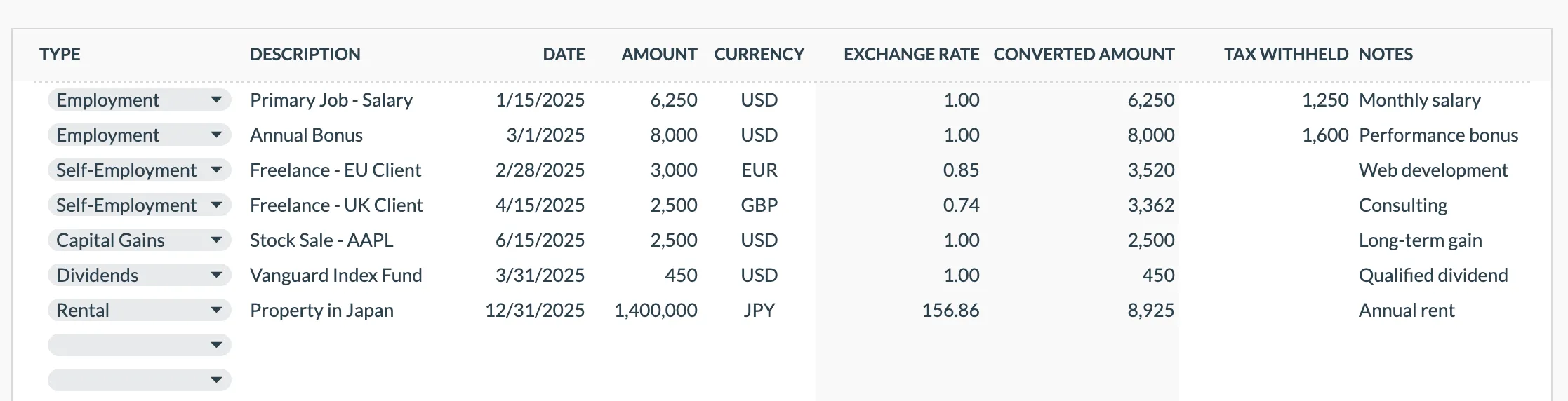 The income tab in the Premium Annual Tax Planner separates self-employment earnings from other income by type and date.
| Source | Q1 Income | % of Total |
|---|---|---|
| Freelance writing | $2,400 | 48% |
| Uber/Lyft | $1,500 | 30% |
| Etsy sales | $850 | 17% |
| Other | $250 | 5% |
| Total | $5,000 | 100% |
Real Hourly Rate
| Hustle | Income | Hours | $/Hour |
|---|---|---|---|
| Freelance writing | $2,400 | 60 | $40 |
| Uber | $1,500 | 80 | $19 |
| Etsy | $850 | 30 | $28 |
Worth knowing when deciding where to focus your time. The Side Hustle Profit Calculator does the same math on take-home terms, and Side Hustle Calculator: Your Real Profit After Taxes walks through a worked example.
Expense Tracking
Common deductions: supplies and materials, software and tools, home office (portion of rent/utilities), vehicle expenses (mileage), marketing/advertising, professional development.
| Date | Expense | Category | Amount | Hustle |
|---|---|---|---|---|
| 4/2 | Adobe subscription | Software | $55 | Freelance |
| 4/8 | Gas | Vehicle | $45 | Uber |
| 4/15 | Shipping supplies | Materials | $32 | Etsy |
Save receipts (digital works fine). They’ll matter if you’re ever audited.
Tax Preparation
Organize everything: The Annual Tax Planner Template tracks income from multiple sources, estimated quarterly payments, and deductions - helpful for anyone with side income.
Estimated Taxes
The IRS threshold for quarterly estimated payments is based on tax owed, not income earned. You generally need to make estimated payments if you expect to owe $1,000 or more in tax for the year. Many people set aside 25-30% of net income to cover it, though the actual rate depends on total income and tax bracket.
Two taxes stack on side income, which is why the set-aside runs higher than a wage earner might expect. First is self-employment tax, a flat 15.3% (12.4% for Social Security plus 2.9% for Medicare) that applies once net earnings from self-employment reach $400. On top of that sits federal income tax at your marginal rate. A W-2 job splits the 15.3% with an employer; a side hustle does not, so the full amount lands on you.
Quarterly payments due: April 15, June 15, September 15, and the following January 15.
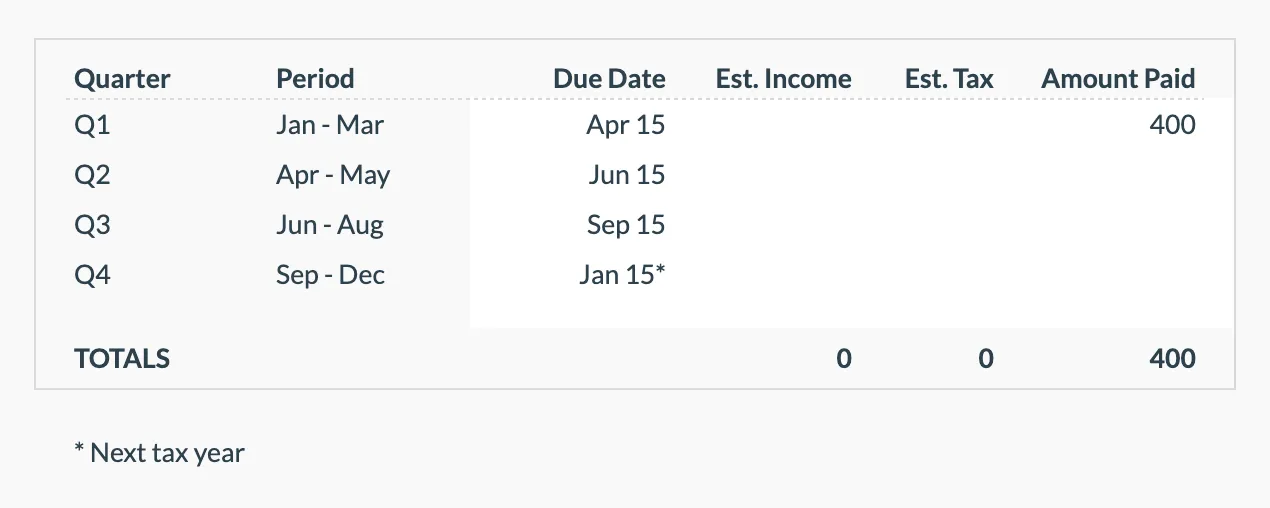 The Annual Tax Planner lays out the four estimated-tax deadlines and tracks what has been paid against each.
Tax Forms
- 1099-NEC: From clients paying $2,000 or more in a year. That threshold rose from $600 for payments made after December 31, 2025.
- 1099-K: From payment apps and marketplaces once payments exceed $20,000 in more than 200 transactions.
- No form: Doesn’t mean not taxable - track everything.
Tax Tracking Summary
| Quarter | Gross Income | Expenses | Net | Tax Set-Aside |
|---|---|---|---|---|
| Q1 | $5,000 | $700 | $4,300 | $1,290 |
| Q2 | $4,500 | $600 | $3,900 | $1,170 |
Profitability Analysis
True Profit Calculation
True Profit = Gross Income - Platform Fees - Direct Expenses - Time CostExample: Etsy Shop
| Item | Amount |
|---|---|
| Gross sales | $1,200 |
| Etsy fees | -$180 |
| Materials | -$400 |
| Shipping | -$150 |
| Net profit | $470 |
If it took 40 hours: $11.75/hour
To run your own numbers after self-employment and income tax, use the calculator below.
Integration with Personal Budget
Method 1: Include all income. Add side income to regular income in budget. Complete picture, but variable income complicates budgeting.
Method 2: Budget on main income only. Side income goes to taxes first, then savings goals, debt payoff, or fun money. Stable budget, but side income may feel invisible.
Method 3: Average side income. Use a 3-month average in your budget, kept conservative (maybe 80% of average).
Year-End Process
| Metric | Amount |
|---|---|
| Total gross income | $18,000 |
| Platform fees | -$2,200 |
| Business expenses | -$3,500 |
| Net income | $12,300 |
| Taxes paid | $3,200 |
| After-tax profit | $9,100 |
Gather for tax filing: 1099 forms received, income tracking spreadsheet, expense records with receipts, mileage log and home office calculation (if applicable).
Common Mistakes
- Not tracking cash income - cash payments are still taxable.
- Mixing personal and business - commingled funds create tax confusion.
- Forgetting expenses - every deductible expense reduces taxes.
- No tax set-aside - spending all income leads to tax bill shock.
Related
- Annual Tax Planner Template - Track quarterly payments and deductions
- Monthly Expense Tracker - Adapt for side income tracking
- Side Hustle Profit Calculator - See take-home after self-employment and income tax
- Side Hustle Calculator: Your Real Profit After Taxes - Worked example, start to finish
- How to Budget for Irregular Income - Fold variable side income into a monthly plan
Frequently asked questions
How much of my side income should go to taxes?
Side hustle income is subject to self-employment tax of 15.3% (Social Security and Medicare) once net earnings pass $400, plus federal income tax at your marginal rate. That combination is why many people set aside 25-30% of net earnings, though the actual figure depends on your total income and bracket.
Do I have to pay quarterly estimated taxes?
The IRS threshold is based on tax owed, not income earned: estimated payments generally apply if you expect to owe $1,000 or more in tax for the year. Payments are due April 15, June 15, September 15, and the following January 15.
What if a client or platform never sends me a 1099?
Income is taxable whether or not a form arrives. A 1099-NEC only shows up when a client pays $2,000 or more in a year, and a 1099-K only when a platform crosses its reporting threshold. Tracking every payment yourself covers the gap.
What if my side hustle loses money?
Track the loss the same way you track income. Losses may be deductible against other income depending on how the activity is classified, which is a question worth taking to a tax professional.
Sources
- Estimated Taxes - Internal Revenue Service
- Self-Employment Tax (Social Security and Medicare Taxes) - Internal Revenue Service
- Understanding Your Form 1099-K - Internal Revenue Service
- About Form 1099-NEC, Nonemployee Compensation - Internal Revenue Service
- Gig Economy Tax Center - Internal Revenue Service
About this article
Tax figures verified on 2026-09-10 against IRS guidance on estimated taxes, self-employment tax, and the 2026 reporting thresholds for Forms 1099-NEC and 1099-K. Template sheets, inputs and outputs checked on 2026-09-10 against the shipped Annual Tax Planner (Dashboard, Income, Deductions, Quarterly, Documents Checklist tabs) and the Monthly Expense Tracker (Summary, Transactions, Categories tabs). Screenshots come from the Annual Tax Planner. Last reviewed September 2026.