
$1,500 a month in side hustle revenue is often closer to $790 after self-employment tax (15.3% on 92.35% of net earnings), income tax at your marginal bracket, and expenses. Between taxes and costs, 30 to 45 percent of side income commonly disappears, and the real take-home hourly rate lands well below the headline freelance rate. The method: revenue minus expenses minus SE tax minus income tax on the side income.
$1,500 a month from a side hustle. Sounds like $18,000 a year in extra income. In practice, after self-employment tax, income tax, and business expenses, that $1,500 turns into about $790.
That is not a typo. Once self-employment tax, income tax at your marginal bracket, and expenses come out, a bite of 40% or more on side income is common, and most people do not see it coming until April.
The Side Hustle Calculator shows your real take-home and effective hourly rate. No signup required.
Where the Money Actually Goes
Most side hustle math looks like this: revenue minus expenses equals profit. Clean and simple. But it leaves out the largest cost: taxes.
The full equation:
Real profit = Revenue - Expenses - Self-Employment Tax - Income Tax on Side Income
That last piece is the one people underestimate. Side hustle income does not get its own tax bracket. It stacks on top of your day job income and gets taxed at whatever marginal rate you are already in. If your salary puts you in the 22% bracket, every side hustle dollar is taxed at 22% (or higher) for federal income tax, plus self-employment tax on top of that.
The Numbers Behind That $790
Here is the full breakdown for someone earning $85,000 at a day job with $1,500/month ($18,000/year) from a side hustle and $200/month in business expenses:
Starting point: $18,000 gross revenue minus $2,400 in expenses = $15,600 net self-employment income.
Self-employment tax: 15.3% on 92.35% of net income = $2,204. This covers both the employer and employee portions of Social Security and Medicare. At a regular job, the employer pays half. When you are self-employed, you pay both halves.
Federal income tax: After deducting half the SE tax ($1,102), the remaining $14,498 is taxed at the 22% marginal rate = $3,190.
State income tax: At 5%, that is another $725.
Total taxes: $6,119. Real profit: $9,481 a year, or $790 a month.
The Hourly Rate Nobody Calculates
Revenue per billable hour is one number. Take-home per total hour is a very different one - the same gap the salary converter exposes when it turns a day-job salary into a real hourly rate.
If this side hustle involves 30 hours of client work, 8 hours of admin and marketing, and 4 hours of learning per month, 42 hours in total, the math looks like this:
Apparent hourly rate (revenue / billable hours): $50/hour. Actual hourly rate (profit / total hours): $18.81/hour.
That does not make the side hustle a bad idea. But it does change the conversation from “I make $50 an hour freelancing” to “my take-home is under $19 an hour when I account for everything.” Those are different enough to affect decisions about whether to take on more clients, raise prices, or spend the time differently.
How Tax Brackets Stack
The more you earn at your day job, the harder taxes hit side income:
| Day Job Income | Side Income Tax Bracket | Approximate Total Tax on Side Income |
|---|---|---|
| $40,000 | 12% | ~30% |
| $75,000 | 22% | ~39% |
| $100,000 | 22% | ~39% |
| $150,000 | 24% | ~41% |
These use the 2026 single-filer brackets with the standard deduction, and they include self-employment tax, federal income tax, and an estimated 5% state tax. Someone in the 24% bracket keeps about $589 of every $1,000 in side hustle revenue, before expenses.
The climb does not continue indefinitely. Once wages pass the Social Security wage base of $184,500, the 12.4% Social Security half of self-employment tax stops applying to side earnings, so the combined rate flattens out instead of rising with the bracket.
Deductions Are Your Leverage
Every deductible expense reduces both income tax and self-employment tax. This is where careful tracking pays off directly.
- Direct costs: supplies, software subscriptions, platform fees, contractor payments.
- Equipment: computers, tools, cameras, either deducted fully (Section 179) or depreciated.
- Vehicle use: the IRS standard mileage rate for business driving, 72.5 cents per mile from January to June 2026 and 76 cents from July to December, or actual vehicle expenses.
- Home office: proportional share of rent or mortgage, utilities, and insurance if you have a dedicated space.
- Professional development: courses, certifications, memberships, business insurance.
The difference between tracking expenses carefully and not tracking them can easily be $2,000-$4,000 in annual tax savings on a $18,000 side hustle. That is meaningful when the total profit is under $10,000.
The Monthly Expense Tracker logs every expense on one Transactions sheet with a category, name, date and amount, and the category list on the Categories sheet is editable, so side hustle costs can sit in categories of their own. The Annual Tax Planner has a Deductions sheet that feeds a deduction tax benefit into the Dashboard’s net tax liability, plus a Quarterly sheet for logging estimated income, estimated tax and amount paid against the four due dates.
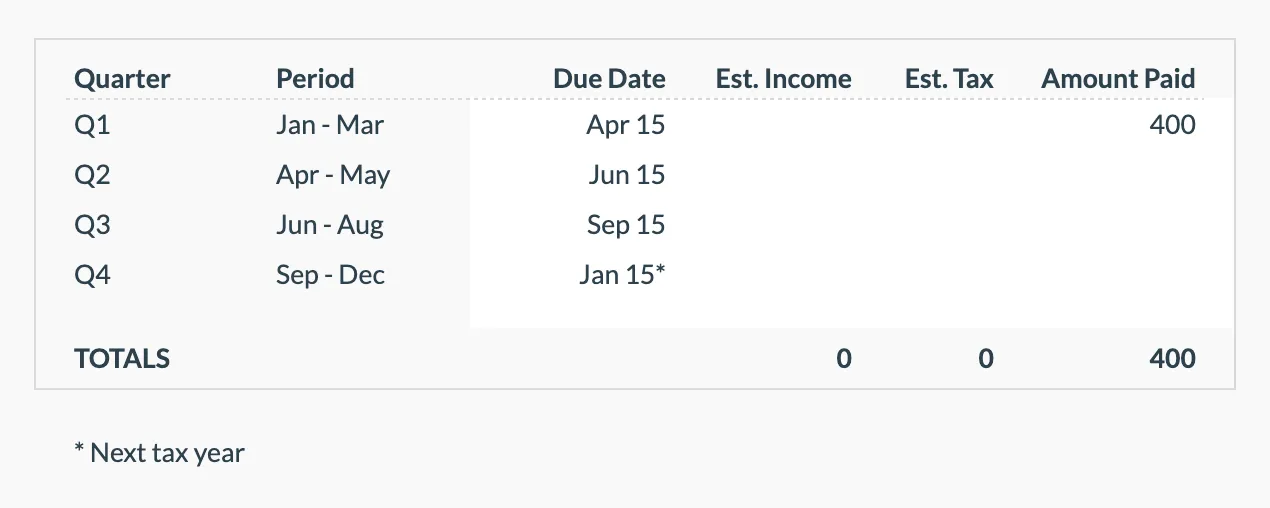
The quarterly-payment tab from the Annual Tax Planner (Premium tier): the four IRS due dates with running columns for estimated income, estimated tax, and amount paid.
Beyond the Hourly Rate
After running the real numbers, the financial picture becomes clear. But money is not the only factor worth weighing:
Scalability. Freelance services trade time for money. A digital product or course can earn revenue without proportional time. The calculator helps evaluate whether the current model works financially, but the growth trajectory matters too.
Skill building. Some side hustles develop capabilities that increase future earning potential at the main job. A web developer freelancing on the side is building a portfolio and client management skills, not just earning $19 an hour.
Sustainability. Adding 10-15 hours per week on top of a full-time job works for some people and wrecks others. If burnout kills the side hustle in six months, the annualized return is much lower than the calculator shows.
Enjoyment. This one gets dismissed as soft, but it matters. If the work is genuinely engaging, a lower effective hourly rate may still feel like a good trade. If it is drudgery, even a high rate might not compensate for the lost evenings.
The calculator handles the financial side. The rest is a personal judgment call, and it is a better judgment call when the financial piece is honest.
More on Taxes & Self-Employment
- Self-Employment Tax Calculator - The full breakdown of how SE tax works and what to set aside for quarterly payments
- Income Tax Calculator: Understanding Your Tax Bill - How side hustle income stacks on top of W-2 earnings for tax purposes
Related
Frequently asked questions
How much of my side hustle income goes to taxes?
Expect 25-40% depending on your total income and tax bracket. Self-employment tax alone takes 15.3%, and federal/state income tax adds another 10-25%.
Do I need to report side hustle income under $600?
Yes. All income is reportable regardless of amount. Payer thresholds are separate: for payments made in 2026 a payer issues a 1099-NEC or 1099-MISC at $2,000 and up, raised from $600 for earlier years. Neither figure is a reporting threshold for the earner.
What expenses can I deduct?
Any ordinary and necessary expense for the business - supplies, software, equipment, mileage, home office (if dedicated space), professional development, and marketing costs.
When does a side hustle become a business?
In the IRS's view, it's a business if you pursue it with the intention of making a profit. Most regular side income qualifies. Hobbies with no profit motive are treated differently.
Do I have to pay quarterly estimated taxes on side income?
The IRS generally expects estimated payments when you owe $1,000 or more at filing and withholding does not cover it. Some people raise the withholding on their W-2 job instead, which can cover the extra side income tax without four separate payments. Missing the quarterly deadlines can trigger an underpayment penalty even if the balance is paid in April.
Is the effective rate really 40%, or is that just for high earners?
In the $85,000 worked example the taxes alone run near 39% of net side income, and the larger cut appears once expenses are added. In the 24% federal bracket the tax share lands near 41%. The calculator runs the same breakdown on your own numbers rather than a single average.
Sources
- Self-Employment Tax (Social Security and Medicare Taxes) - Internal Revenue Service
- Standard Mileage Rates - Internal Revenue Service
- IRS Releases Tax Inflation Adjustments for Tax Year 2026 - Internal Revenue Service
- Topic No. 751, Social Security and Medicare Withholding Rates - Internal Revenue Service
- Gig Economy Tax Center - Internal Revenue Service
About this article
Self-employment tax (15.3% on 92.35% of net earnings) and the half-SE-tax deduction checked against the IRS Self-Employment Tax page The 2026 standard mileage rates, the 2026 federal brackets and standard deduction, the Social Security wage base and the 1099 payer threshold checked on 2026-09-10 against the IRS Standard Mileage Rates, tax year 2026 inflation-adjustment, Topic 751 and information-return pages Template sheets, columns and calculations checked on 2026-09-10 against the shipped Monthly Expense Tracker (Transactions, Categories) and Annual Tax Planner (Dashboard, Income, Deductions, Quarterly, Documents Checklist) Side Hustle Calculator inputs and outputs checked on 2026-09-10 against the component that powers the on-site calculator Last reviewed September 2026.