
Divide annual salary by 2,080 (52 weeks x 40 hours) for the standard hourly rate, so $60,000 works out to about $28.85/hour. The figure that matters more is your real hourly rate, salary divided by the hours you actually work: a 60-hour week can quietly cut an $80,000 job to roughly $25/hour, about what a strictly 40-hour $53,000 job pays.
A $80,000 salary sounds better than $53,000. Obviously. But what if the $80,000 job regularly demands 60-hour weeks while the $53,000 position is strictly 40 hours? Run the hourly math and they pay almost exactly the same per hour worked.
Salary numbers without context can be misleading. Converting between annual, monthly, weekly, and hourly rates, then factoring in the hours you actually work, makes compensation comparisons much more honest.
The Salary Converter Calculator handles all these conversions instantly. No signup required.
The Quick Reference Table
Standard conversions assume 52 weeks and 40 hours per week (2,080 work hours annually):
| Annual | Monthly | Biweekly | Weekly | Hourly | |--------|---------|----------|--------|--------| | $40,000 | $3,333 | $1,538 | $769 | $19.23 | | $50,000 | $4,167 | $1,923 | $962 | $24.04 | | $60,000 | $5,000 | $2,308 | $1,154 | $28.85 | | $75,000 | $6,250 | $2,885 | $1,442 | $36.06 | | $100,000 | $8,333 | $3,846 | $1,923 | $48.08 |
All gross (pre-tax). Take-home is significantly less after federal and state taxes, Social Security, Medicare, and deductions.
The Formulas
These are simple enough to do on a phone calculator:
- Annual to hourly: salary / 2,080
- Hourly to annual: rate x 2,080
- Annual to monthly: salary / 12
- Annual to biweekly: salary / 26
Adjust the 2,080 figure for non-standard schedules. Someone working 35 hours/week has 1,820 annual hours. Someone working 45 has 2,340.
Your Real Hourly Rate (The Number That Matters)
The standard conversion assumes a 40-hour week. For a lot of salaried workers, that’s fiction.
Here’s what happens to an $80,000 salary at different actual weekly hours:
| Hours/Week | Annual Hours | Effective Rate | |-----------|-------------|---------------| | 40 | 2,080 | $38.46 | | 45 | 2,340 | $34.19 | | 50 | 2,600 | $30.77 | | 55 | 2,860 | $27.97 | | 60 | 3,120 | $25.64 |
At 60 hours/week, that $80,000 salary pays $25.64/hour - roughly what a $53,000 job pays at a standard 40-hour week. The extra 20 hours each week are essentially uncompensated.
This doesn’t mean longer-hours jobs are bad - they may offer career growth, equity, or other non-monetary value. But knowing the actual hourly rate makes the tradeoff visible instead of hidden.
Comparing Job Offers Beyond the Salary Line
Salary is one number in a larger compensation picture. Benefits routinely add 20-40% on top of base pay, and the composition varies widely between employers. Bureau of Labor Statistics data on employer costs for employee compensation puts benefits at roughly 30% of total compensation on average, so wage alone leaves out close to a third of what an employer spends.
Consider two offers:
Job A: $72,000 base, 4% 401(k) match ($2,880), fully covered health insurance (~$7,200 value), 3 weeks PTO
Job B: $80,000 base, 2% 401(k) match ($1,600), employee pays $200/month for health insurance, 2 weeks PTO
| | Job A | Job B | |—|-------|-------| | Base salary | $72,000 | $80,000 | | 401(k) match | $2,880 | $1,600 | | Health insurance value | $7,200 | $4,800 | | Extra PTO value | ~$1,385 | - | | Total compensation | ~$83,465 | ~$86,400 | | Health insurance cost | $0 | -$2,400 | | Net total | ~$83,465 | ~$84,000 |
The $8,000 salary gap shrinks to about $535 when benefits are factored in. If Job B involves longer hours, the per-hour comparison could actually favor Job A.
Benefits aren’t always easy to value precisely. Health insurance is worth less if you’d be on a spouse’s plan anyway, for instance. Even so, ignoring them entirely when comparing offers leaves a lot of information on the table.
The Freelance Conversion
Going from salary to freelance rate isn’t as simple as using the same hourly number. A salaried employee gets benefits, paid time off, employer-paid taxes, and consistent work. A freelancer covers all of that themselves.
The common rule of thumb: multiply the salary-equivalent hourly rate by 1.3-1.5 to get a baseline freelance rate.
A $60,000 salary works out to $28.85/hour. As a freelancer, the equivalent rate is closer to $37-43/hour to account for:
- Self-employment tax (15.3% for Social Security and Medicare, versus the 7.65% an employee pays while the employer covers the other half)
- Health insurance premiums
- Retirement contributions with no employer match
- Non-billable time (admin, marketing, invoicing)
- Gaps between projects
Some independent consultants use a 2x multiplier to account for business expenses and the inherent instability of project-based work. The right number depends on the field, utilization rate, and overhead.
The Biweekly Budget Trap
One practical detail that catches people off guard: if you’re paid biweekly (every two weeks), your paycheck and your monthly budget don’t align neatly.
At $60,000/year paid biweekly, each paycheck is about $2,308 gross. Most months have two paychecks ($4,616). But two months per year have three paychecks ($6,924).
Budgeting based on the 2-paycheck month and treating the two extra paychecks as bonus savings opportunities is a cleaner approach than trying to average everything out. The Monthly Budget Template sets a budgeted figure for each income category and compares it against what actually came in that month, while the Annual Budget Template carries the same income categories across a 12-month plan and actual grid, so a three-paycheck month reads as actual income running ahead of plan.
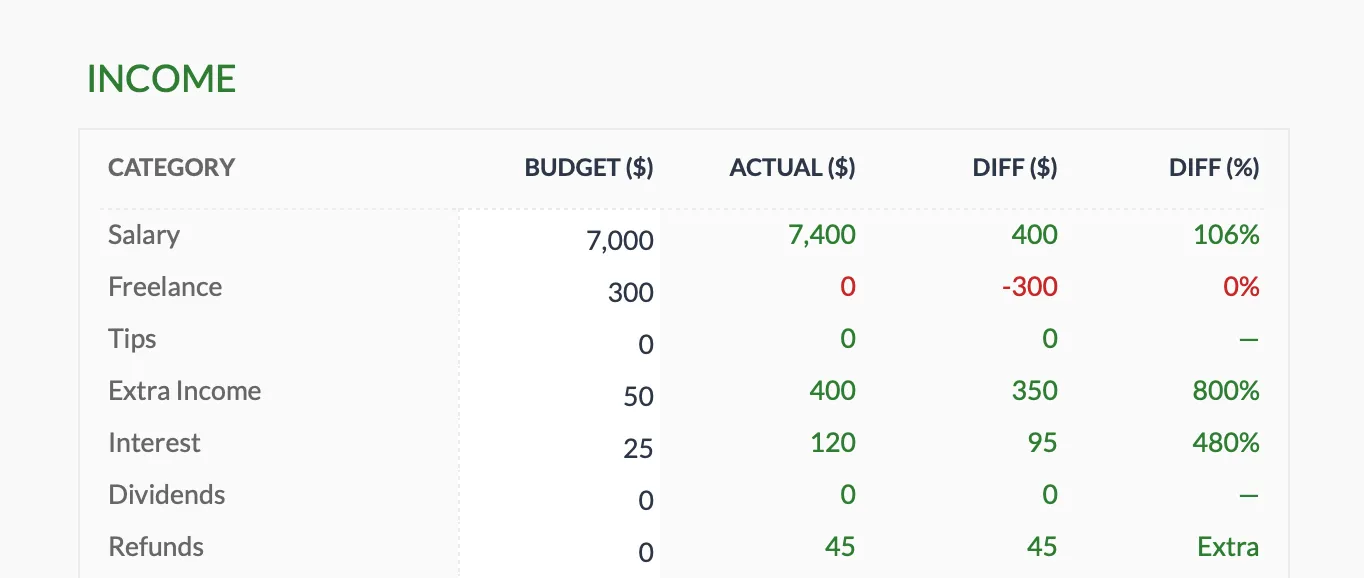
The Monthly Budget Template (Premium tier) tracks each income source against a budgeted figure, so a converted salary or a variable freelance rate lands in the same view as spending.
The Number Behind the Number
Salary is the most-discussed, most-compared number in personal finance. People negotiate it, benchmark it against peers, and use it as shorthand for financial standing. But the hourly rate, especially the real hourly rate that accounts for actual time worked, tells a more complete story about what time is worth.
Worth running the conversion at least once, with honest numbers about hours worked. The result is sometimes confirming, sometimes surprising.
More on Income & Earnings
- Paycheck Calculator: Understanding Your Take-Home Pay - See what actually lands in your account after taxes and deductions
- Income Percentile Calculator - Where your salary falls in the national income distribution
- Side Hustle Calculator: Real Profit After Taxes - What a freelance rate actually nets once taxes and expenses come out
Related
Frequently asked questions
How do I convert annual salary to hourly rate?
Divide annual salary by 2,080 (52 weeks x 40 hours). A $60,000 salary equals roughly $28.85/hour. For a more accurate picture, account for paid time off - if you work 48 weeks, divide by 1,920 instead.
How do I convert hourly to annual salary?
Multiply hourly rate by 2,080 for a standard full-time year. A $25/hour rate equals $52,000 annually. Adjust if you work more or fewer than 40 hours/week.
Should I compare jobs on salary or hourly rate?
Hourly rate (including expected hours) gives a more complete picture, especially if one job regularly requires overtime or has significantly different hour expectations.
How do benefits factor into salary comparisons?
Benefits like health insurance, 401(k) match, and paid time off can add 20-40% to total compensation. A $60,000 salary with strong benefits may be worth more than $70,000 with minimal benefits.
Does the 2,080-hour figure include paid time off?
No. 2,080 is 52 weeks times 40 hours, so it counts paid vacation and holidays as worked time. If you want the rate against hours you are actually at work, subtract your time off first: at three weeks off you work about 1,960 hours, and a $60,000 salary then works out closer to $30.61/hour.
How does overtime change a salaried worker's real hourly rate?
Most salaried roles are paid the same regardless of hours, so every extra hour lowers the effective rate rather than adding pay. An $80,000 salary is $38.46/hour at 40 hours a week but drops to about $25.64 at 60 hours. Hourly and non-exempt workers are a different case, since qualifying overtime is paid on top.
Sources
- Self-Employment Tax (Social Security and Medicare Taxes) - Internal Revenue Service
- Employer Costs for Employee Compensation - U.S. Bureau of Labor Statistics
About this article
Conversion figures use the standard 2,080-hour work year (52 weeks x 40 hours); the self-employment tax rate is checked against the IRS, and the benefits share of pay against the BLS Employer Costs for Employee Compensation release. Last reviewed September 2026.