
Gross salary and take-home pay are not the same number. Federal and state income tax, Social Security at 6.2% and Medicare at 1.45%, plus pre-tax deductions like a 401(k) and health insurance, typically leave most people with 60 to 75% of gross. On a $70,000 salary paid biweekly, that works out to roughly $1,875 per check. The calculator below runs your own figures.
There’s a moment early in most careers when the first real paycheck arrives and the number is… less than expected. Sometimes a lot less. A $70,000 salary sounds like $5,833 a month, but the actual deposit might be closer to $4,000.
Where does the rest go? That’s not a rhetorical question - it’s worth understanding, because every financial decision you make starts with what actually lands in your bank account.
The Paycheck Calculator breaks it all down for your specific situation. No signup required.
The Anatomy of a Paycheck
Let’s trace what happens to a $70,000 salary, paid biweekly (26 paychecks per year). Gross per paycheck: $2,692. The federal line below assumes a single filer taking the standard deduction.
| What Gets Taken | Per Paycheck | Per Year |
|---|---|---|
| Federal income tax | ~$205 | $5,326 |
| State tax (at 5%) | ~$120 | $3,128 |
| Social Security (6.2%) | $167 | $4,340 |
| Medicare (1.45%) | $39 | $1,015 |
| 401(k) at 6% | $162 | $4,200 |
| Health insurance | $125 | $3,250 |
| Total deductions | $818 | $21,259 |
| What you keep | $1,874 | $48,741 |
That’s about 70% of gross pay. Close to a third of the salary never reaches the checking account. The percentage shifts based on state, filing status, and how much goes to retirement - but the general pattern holds. Most people take home somewhere between 60% and 75% of their gross.
Each Deduction, Explained
Federal income tax is the biggest chunk for most people. It’s withheld based on your W-4 form and projected annual income. The withholding system tries to estimate what you’ll owe so that your annual bill comes out roughly even, using the marginal tax brackets covered in the income tax guide.
State income tax ranges from nothing (Texas, Florida, Nevada, Washington, and a few others) to over 10% (California, New York at higher incomes). Moving from a 0% state to a 5% state on a $70,000 salary costs about $3,000 a year in take-home pay. That’s real money.
Social Security takes a flat 6.2% up to $184,500 in wages (2026 cap). Your employer pays a matching 6.2%. Once you hit the cap, Social Security deductions stop for the rest of the year, which is why higher earners sometimes notice slightly bigger paychecks late in the year.
Medicare takes 1.45% of everything, no cap. Above $200,000 in wages (single filer), an additional 0.9% surtax kicks in.
Pre-tax deductions, including a 401(k), health insurance, an HSA, and an FSA, come out before income tax is calculated, which is why they’re particularly efficient. More on this below.
The Pre-Tax Trick That’s Worth Understanding
A $500/month 401(k) contribution doesn’t reduce your paycheck by $500. For someone in the 22% federal bracket with 5% state tax:
- The 401(k) gets: $500
- Federal tax saved: $500 x 22% = $110
- State tax saved: $500 x 5% = $25
- Actual paycheck reduction: $365
You “spend” $365 from your take-home pay, but $500 goes into the retirement account. That $135 gap is a tax discount, and it applies to every pre-tax deduction - health insurance premiums, HSA contributions, FSA deposits.
This math is why a pre-tax retirement contribution is one of the more efficient ways to save. Each dollar contributed costs less than a dollar.
Biweekly Pay and the Two Bonus Months
If you’re paid biweekly, you get 26 paychecks a year. Most months have two pay periods. But twice a year, a month has three paydays.
This creates an interesting budgeting opportunity. If monthly expenses are built around two paychecks, those two three-paycheck months produce an “extra” paycheck that’s already unspoken for. Some people route those straight to savings or debt. Others don’t notice because the money blends into regular spending. The biweekly budgeting method walks through assigning each bill to the paycheck that lands before its due date.
Knowing which months have three paydays, and having a plan for them, is one of the simpler ways to find money that was always there.
Semi-monthly pay (twice a month on fixed dates, 24 paychecks per year) doesn’t have this quirk. Each paycheck is slightly larger, but there are no bonus months.
Hourly Workers: A Different Starting Point
The math for hourly pay starts with: hourly rate x hours x 52 weeks / pay periods.
$25/hour at 40 hours/week = $52,000 annually, or $2,000 gross per biweekly paycheck.
Overtime makes the tax picture temporarily weird. A paycheck with 10 hours of overtime is larger, and the withholding system projects that higher amount across the entire year. The tax bite looks enormous, though it isn’t: the year-end calculation sorts it out. It can still feel discouraging in the moment.
When Your Withholding Is Off
Getting a $3,000 tax refund every April feels like a windfall. But it means you overpaid by $250 a month all year - that money was sitting with the IRS earning nothing while it could have been in your checking account or a savings account.
On the flip side, owing $2,000 at tax time means your paychecks were larger than they should have been. That might come with an underpayment penalty.
The sweet spot is somewhere close to zero: a small refund or a small balance due. The IRS has a Tax Withholding Estimator that helps dial in the right W-4 settings.
From Paycheck to Budget
Every budget lives or dies on one number: what actually arrives. Common mistakes include planning around gross salary (the aspirational number), averaging take-home when biweekly pay means some months are bigger, and forgetting that benefits enrollment changes in January can shift the paycheck amount.
One approach for biweekly pay is to budget monthly expenses around two paychecks and use three-paycheck months for goals that don’t fit the regular budget.
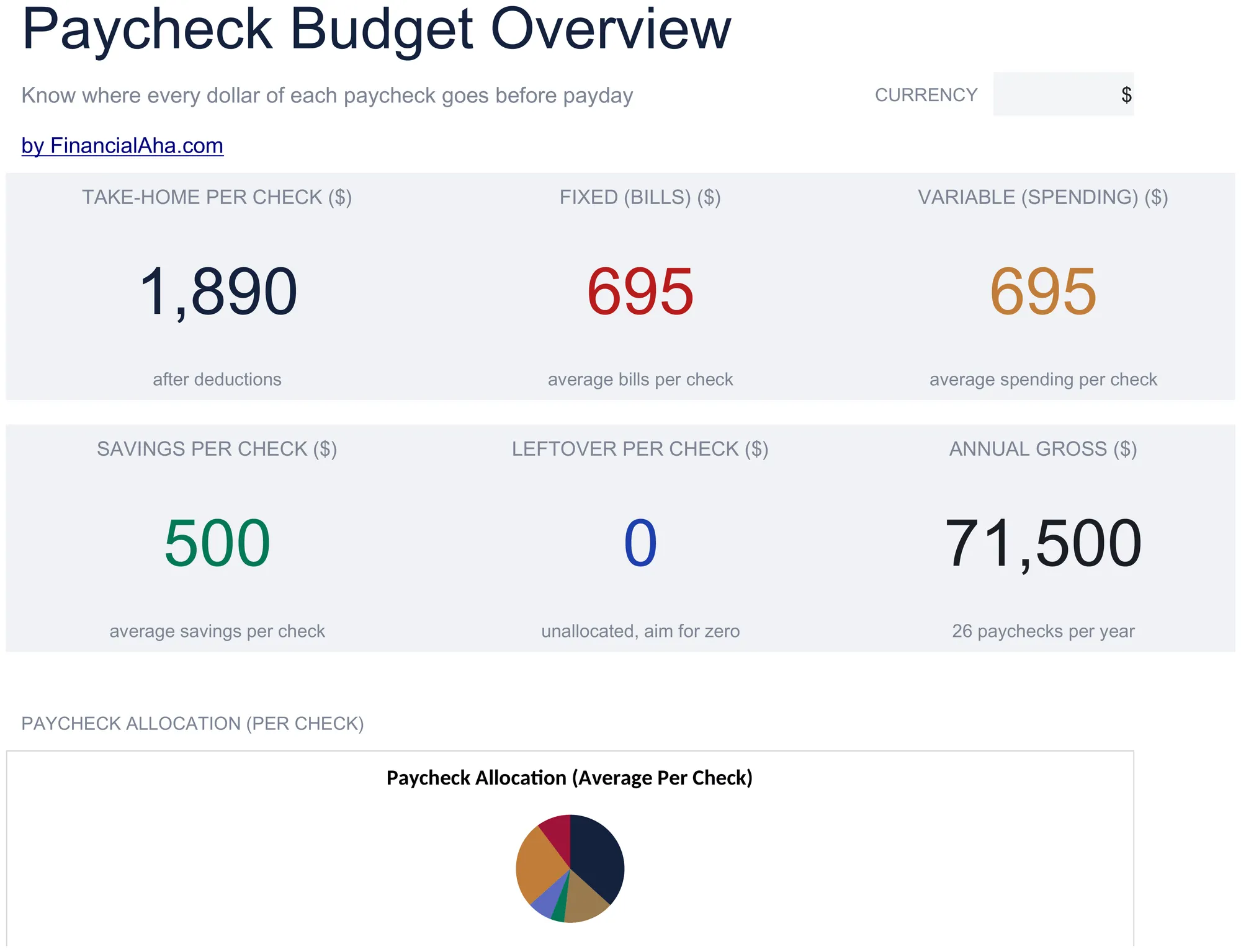 The Paycheck Budget template (Essentials tier) allocates each check by take-home amount rather than monthly salary.
The Paycheck Budget Template splits each of the month’s two checks into bills, spending and savings. The Monthly Budget Template plans a whole month with budgeted and actual columns side by side across income, expense and savings categories, and the Annual Tax Planner Template logs tax withheld against each income entry alongside quarterly payments, so April holds fewer surprises.
More Tax & Income Guides
- Income Tax Calculator: Understanding Your Tax Bill - How brackets actually work
- Salary Converter: Annual to Hourly - Turn a salary into the real hourly rate behind these paychecks
- Bi-Weekly Budgeting: Build a Budget Around Paychecks - Assign each bill to a specific check
- Tax Season Budget Prep - Get ahead of what you’ll owe
Related
Frequently asked questions
Why is my paycheck so much less than my salary suggests?
Federal income tax, state income tax, Social Security (6.2%), and Medicare (1.45%) all reduce take-home pay. Pre-tax deductions like a 401(k) and health insurance further reduce the amount before it reaches your bank account, so most people receive 60 to 75% of gross.
What's the difference between biweekly and semi-monthly pay?
Biweekly means every two weeks (26 paychecks per year). Semi-monthly means twice per month on fixed dates (24 paychecks per year). Biweekly produces two three-paycheck months a year; semi-monthly checks are slightly larger but always two per month.
Are bonuses taxed at a higher rate than regular pay?
Bonuses are not taxed at a higher rate, but they are often withheld differently. Employers commonly apply a flat 22% federal supplemental withholding rate to bonuses under $1 million, which can make the paycheck look heavily taxed. The year-end return reconciles it against your actual bracket.
Why did my take-home pay change in January?
Several things reset with the calendar year. Benefits re-enrollment can change health insurance and retirement deductions, Social Security withholding restarts if you had hit the annual wage cap, and updated tax tables take effect. Any of these can shift the net amount even when your salary is unchanged.
Sources
- Contribution and Benefit Base - Social Security Administration
- Topic no. 751, Social Security and Medicare withholding rates - Internal Revenue Service
- Tax Withholding Estimator - Internal Revenue Service
About this article
Withholding rates and thresholds checked on 2026-09-10 against IRS Topic 751: Social Security 6.2%, Medicare 1.45%, and the 0.9% Additional Medicare Tax above $200,000. The Social Security wage cap is checked against the Social Security Administration's contribution and benefit base, $184,500 for 2026. The worked paycheck example was recomputed on 2026-09-10 from the IRS 2026 rate schedule and the $16,100 single standard deduction (Rev. Proc. 2025-32). Template claims checked on 2026-09-10 against the shipped Paycheck Budget workbook (Dashboard, Paycheck Budget, How to Use tabs), the Monthly Budgeting Google Sheet (Summary, Budget Plan, Transactions tabs) and the Annual Tax Planner workbook (Dashboard, Income, Deductions, Quarterly tabs). Last reviewed September 2026.