
Biweekly pay means 26 paychecks a year, so two months carry a third check. Assign each bill to the paycheck that lands before its due date, split variable costs like groceries and gas evenly across both checks, and decide where the two extra paychecks go before they arrive.
If you’re paid biweekly, you get 26 paychecks per year - not 24. That means two months have three paychecks, and monthly budgets don’t match your actual cash flow.
Budgeting by paycheck rather than by month aligns your plan with reality. Each paycheck has its own assignment of bills and expenses, making cash flow predictable rather than stressful.
Build it in a sheet: The Paycheck Budget template starts from gross pay and deductions, then splits the month’s two checks into fixed bills, variable spending, savings, and whatever is left unallocated, with a pay frequency switch for biweekly or semi-monthly. A free version covers one month by paycheck, with budgeted and actual columns side by side.
Understanding Biweekly Pay
The math is straightforward: 52 weeks per year divided by 2 equals 26 pay periods. 26 pay periods divided by 12 months equals approximately 2.17 paychecks per month. Two months per year end up with three paychecks instead of two. It is the most common way US workers get paid: biweekly is the single most common pay frequency among private employers, covering about 43 percent of establishments, according to the U.S. Bureau of Labor Statistics.
If you’re paid every other Friday starting January 2, your three-paycheck months in 2026 are January and July. To find your own, count forward in 14-day steps from your first payday of the year: the two months where a payday lands three times are the bonus months, and they shift as the calendar moves each year.
Creating a Biweekly Budget
Start by building a pay calendar. Mark every payday on a calendar, then mark every bill due date. This visual shows which bills fall between which paychecks and reveals any problematic timing. Every figure that follows works from take-home pay per check rather than gross, since take-home is the money you can actually assign; the paycheck calculator converts an annual salary into per-check net if you only know your gross figure.
Assign bills to paychecks based on when they’re due. Bills due between the 1st and 15th come from Paycheck 1 (rent/mortgage, utilities, insurance). Bills due between the 16th and end of month come from Paycheck 2 (car payment, credit card, subscriptions).
For expenses that aren’t tied to due dates, such as groceries, gas, and entertainment, split them evenly between paychecks. If you want category targets to start from, the budget calculator splits a monthly income into spending buckets you can then halve across two checks:
| Category | Per Paycheck | |----------|--------------| | Groceries | $300 | | Gas | $75 | | Entertainment | $100 | | Personal | $50 |
This division ensures you’re not overspending early in the month and scrambling later.
Sample Biweekly Budget
Here’s what a complete biweekly budget might look like for a $2,000 paycheck:
Paycheck 1: | Category | Amount | |----------|--------| | Rent | $1,200 | | Electric | $120 | | Internet | $60 | | Groceries | $300 | | Gas | $75 | | Savings | $200 | | Remaining | $45 |
Paycheck 2: | Category | Amount | |----------|--------| | Car payment | $400 | | Car insurance | $100 | | Phone | $80 | | Groceries | $300 | | Gas | $75 | | Credit card | $200 | | Entertainment | $100 | | Savings | $200 | | Remaining | $545 |
Notice that Paycheck 1 is tighter due to housing costs, while Paycheck 2 has more flexibility. This imbalance is common and manageable with awareness.
Handling Uneven Paychecks
If one paycheck covers significantly more bills than the other, several approaches can help balance the load.
Many service providers will change your due date if you call and ask. Moving bills from one half of the month to the other balances the load between paychecks. Credit cards, utilities, and insurance companies often accommodate these requests.
Splitting large expenses like rent works well too. Set aside half from each paycheck into a holding account. When rent is due, you have the full amount ready without one paycheck bearing the entire burden.
A small buffer in checking ($500-1,000) smooths out timing differences. This cushion covers situations where a bill is due before the next paycheck arrives.
The Third Paycheck Strategy
Those two extra paychecks per year are opportunities. Since your regular budget only accounts for two paychecks monthly, the third is essentially “extra” money that doesn’t have assigned bills waiting for it.
Strategic uses for extra paychecks include emergency fund boosts, large debt principal payments, front-loading sinking funds for holidays or vacation, maxing out IRA contributions, or lump sum investments into a brokerage account. Each of these accelerates financial goals significantly. The Financial Planning Template projects assets and debt forward to an end year you set, from monthly income, expenses, growth, yield and inflation assumptions.
Treating the third paycheck as bonus spending money is tempting but tends to produce regret. Deciding in advance where it will go, before it arrives, keeps it from disappearing into everyday expenses.
Budget Calendar Approach
A visual calendar showing paydays, bill due dates, and running balance makes biweekly budgeting concrete. Here’s what February 2026 might look like:
| Date | Event | Impact | |------|-------|--------| | Feb 1 | Rent due | -$1,200 | | Feb 13 | Paycheck | +$2,000 | | Feb 15 | Electric due | -$120 | | Feb 22 | Car payment | -$400 | | Feb 27 | Paycheck | +$2,000 | | Feb 28 | Credit card | -$200 |
This view reveals timing issues before they become problems. If rent is due February 1 but the first paycheck doesn’t arrive until February 13, you’ll see the gap immediately - which is exactly where a checking buffer or a due-date change earns its keep.
Common Biweekly Budget Challenges
When bills are due before payday (mortgage due the 1st but you’re not paid until the 5th), a few options exist: build a one-week buffer in checking, request a due date change from the lender, or pay from the previous paycheck’s remaining balance.
Variable pay from overtime or commissions requires a different approach. Budgeting based on your minimum expected amount keeps the base budget sustainable. Treat extra as bonus savings rather than inflating lifestyle expectations.
Annual or quarterly bills can disrupt biweekly planning since they don’t fit the normal cadence. Sinking funds help - saving a portion each month for these irregular expenses prevents them from derailing the budget when they arrive.
Biweekly vs. Monthly Budgeting
| Aspect | Monthly Budget | Biweekly Budget | |--------|---------------|-----------------| | Timing | Doesn’t match paydays | Matches pay periods | | Cash flow | May run short late in month | Bills aligned with income | | Extra paychecks | Harder to plan | Built into system | | Complexity | Simpler setup | Slightly more complex |
Monthly budgeting works well for those paid semi-monthly (1st and 15th) or monthly. Biweekly budgeting aligns better with biweekly pay schedules. The slightly higher complexity pays off in reduced cash flow stress.
Building a Buffer
A checking account buffer prevents overdrafts when bill timing doesn’t perfectly match paydays. The peace of mind alone is worth the effort of building one.
For most people, $500-1,000 covers timing mismatches adequately. Some people keep larger buffers of one full paycheck for more security. Using one of those third paychecks to create the buffer, then maintaining it indefinitely, is one straightforward approach.
Tracking Your Biweekly Budget
After each paycheck hits, confirm deposits, pay assigned bills, allocate variable expense amounts, and transfer savings. This per-paycheck routine takes just a few minutes but keeps the system working.
At month end, review whether you stayed within each paycheck’s allocation, whether any categories ran consistently over or under, and whether adjustments are needed for next month.
Spreadsheet Setup
Instead of one monthly budget, create two columns, one for each regular paycheck:
| Category | Paycheck 1 | Paycheck 2 | Monthly Total | |----------|------------|------------|---------------| | Housing | $1,200 | $0 | $1,200 | | Utilities | $180 | $0 | $180 | | Transportation | $0 | $500 | $500 | | Groceries | $300 | $300 | $600 | | Savings | $200 | $200 | $400 | | Total | $1,880 | $1,000 | $2,880 |
This structure makes the allocation explicit and shows immediately if either paycheck is overcommitted.
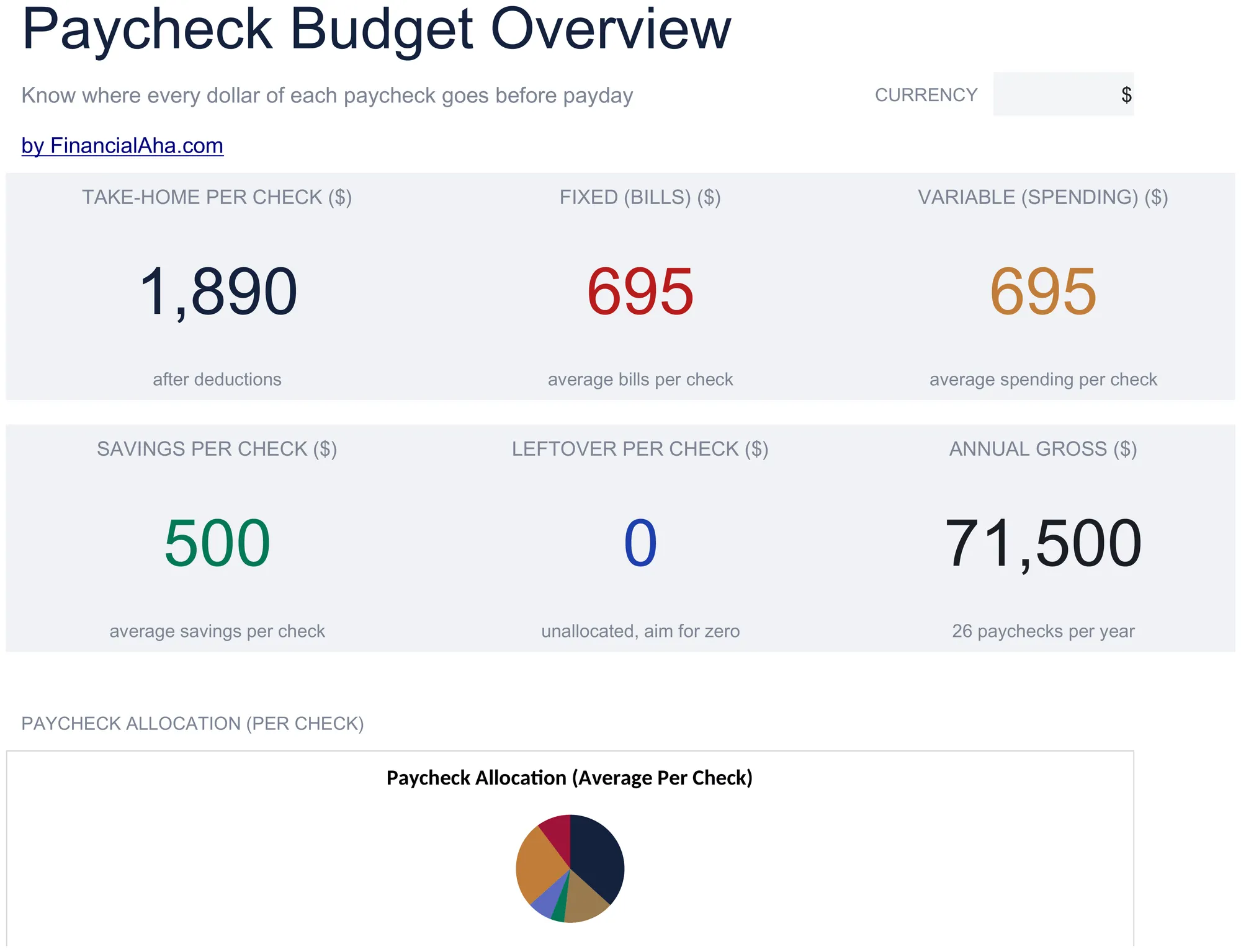 The Paycheck Budget template (Essentials tier, with a free version) breaks each of the month’s two checks into fixed bills, variable spending, savings, and what is left unallocated, and shows the per-check averages next to annual gross on the dashboard.
Related
- Paycheck Budget template - Every check split into bills, spending, and savings (free and Essentials)
- Monthly Budget Template - Track by category alongside your pay calendar
- How to Budget for Irregular Income
- Pay Yourself First Strategy
- Sinking Funds Explained
Frequently asked questions
Does biweekly budgeting work for weekly pay?
Weekly pay follows the same concept but with roughly four pay periods per month and four extra paychecks per year instead of two. The principles transfer directly - assign bills to the check that lands before their due date and split variable costs across the checks.
Should I budget based on gross or net pay?
Net (take-home) pay is what actually lands in your account, so it is the figure most biweekly budgets are built around. Gross pay includes taxes and deductions you never get to spend.
How do I know which months have three paychecks?
Count forward in 14-day steps from your first payday of the year. The two months where a payday lands three times are your three-paycheck months, and they shift each year as the calendar moves. For a schedule starting January 2, 2026, those months are January and July.
How is semi-monthly pay different from biweekly?
Semi-monthly pay (for example the 1st and 15th) has exactly 24 paychecks per year with no extras, so paydays fall on the same dates every month. Biweekly pay lands every 14 days, which produces 26 checks and the two extra months.
Sources
- Length of pay periods in the Current Employment Statistics survey - U.S. Bureau of Labor Statistics
About this article
Pay-frequency prevalence checked against the U.S. Bureau of Labor Statistics Current Employment Statistics pay-period data. 2026 three-paycheck months computed from a biweekly Friday schedule starting January 2, 2026. Paycheck Budget template claims checked on 2026-09-10 against the shipped Free workbook (Paycheck Budget, How to Use) and Essentials workbook (Dashboard, Paycheck Budget, How to Use), and the Financial Planning claim against its Projection sheet. Last reviewed September 2026.