Pay yourself first treats savings as the first bill you pay: the moment income lands, a set amount, often around 20%, transfers to savings and investments automatically, and you live on what remains. Automating the transfer on payday removes willpower from the decision, so saving happens whether or not you feel motivated that month.
Most people save whatever’s left after spending. Problem: there’s often nothing left. Expenses have a way of expanding to fill available funds, and savings become an afterthought that never quite happens. The national numbers reflect it: the US personal saving rate hovered near 3% of disposable income through mid-2026, according to the Bureau of Economic Analysis. The broader mid-2026 snapshot puts that saving rate next to credit card balances and net worth.
Pay yourself first flips this dynamic. Savings come out immediately after income arrives, before you can spend it. The sequence change seems small but creates fundamentally different outcomes over time.
Track your savings rate: The Monthly Budget Template shows how much you’re saving each month.
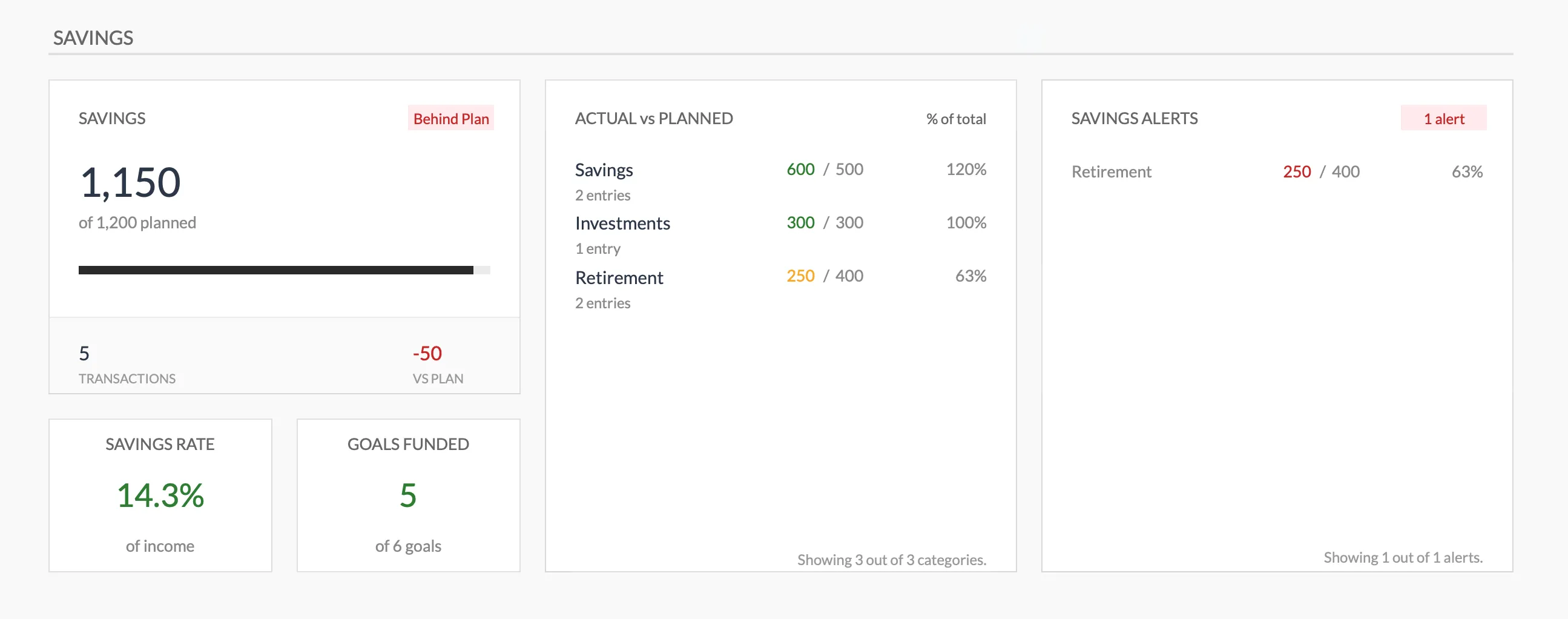 The Monthly Budget Template (Premium) tracks your savings rate and each destination against plan.
How It Works
The sequence matters fundamentally. Income arrives, then a predetermined amount transfers to savings and investments automatically. Remaining money covers bills and spending. You adjust spending to fit what’s left - not the other way around.
That last part is key. When savings come out first, you adapt to what remains rather than hoping something will be left after spending. Human nature works against saving what’s left but works fine with spending what’s available.
The 80/20 Framework
A common starting point allocates 20% to savings and investments first, with 80% covering everything else. This ratio has history behind it, but the specific percentage matters less than establishing the habit. If you prefer a more granular split, the same first-out logic works with the 50/30/20 method.
The rate you settle on has a direct, arithmetic effect on how fast money piles up. The table below shows how long it takes to bank one full year of living expenses at each savings rate, setting aside any investment growth. Each row is simply the share you spend divided by the share you save, so a 20% rate means four years of saving to cover one year of spending:
| Savings Rate | Time to Save 1 Year of Expenses | |--------------|---------------------------------| | 10% | 9 years | | 20% | 4 years | | 30% | 2.3 years | | 50% | 1 year |
Adjusting based on your situation makes sense. Even 5-10% builds the habit, and habits can grow over time. Starting somewhere sustainable beats starting aggressive and quitting.
Once the money is invested, growth shortens those timelines further. To project what a fixed monthly amount grows into over the years, run the numbers in the savings calculator:
Setting Up Automation
Determining your amount comes first. Start with what you can manage consistently, then increase by 1% every few months. Gradual increases feel less disruptive than large jumps.
Schedule transfers on payday or within 1-2 days. Before you see the full amount ideally - money that never hits your checking account never gets spent. Where the money goes depends on your goals:
| Destination | Purpose | |-------------|---------| | High-yield savings | Emergency fund | | 401(k) | Retirement | | IRA | Retirement | | Taxable brokerage | Long-term wealth | | Sinking funds | Planned expenses |
The tax-advantaged destinations carry annual caps worth knowing before you set the amount. For 2026 the IRS limits employee 401(k) contributions to $24,500 and IRA contributions to $7,500, with extra catch-up room from age 50 (IRS). Sizing a monthly transfer to land inside those caps keeps the money working steadily instead of arriving in a year-end scramble.
Implementation Options
Several methods can implement pay yourself first. Paycheck splitting through employers allows direct deposit into multiple accounts - 80% to checking, 20% to savings. Many employers offer this at no cost, and it’s the most invisible way to save. If you are paid every two weeks, assigning bills and the savings transfer to specific paychecks keeps the timing clean across the year’s 26 checks.
Automatic bank transfers work when paycheck splitting isn’t available. Set up recurring transfers on payday to designated accounts. 401(k) contributions are perhaps the most automatic of all - deductions happen before you see the money, making it genuinely invisible.
Why Automation Works
Automation removes decision fatigue. You’re not constantly choosing between saving and spending - the choice was made once when you set up the automation. Monthly willpower becomes unnecessary.
Consistency follows naturally. Savings become reliable and predictable rather than dependent on whether you “felt like it” that month. This eliminates timing excuses - without automation, postponing until “next month” becomes a recurring pattern that never ends.
When Money Is Tight
Starting small works when budgets are stretched. Even $25/paycheck builds the habit, and increasing as income grows allows the system to scale. The habit matters more than the initial amount.
Variable income requires a different approach, covered in more depth in budgeting for irregular income. One method sets a baseline for low months and manually transfers extra during high months. This balances consistency with reality.
For those living paycheck to paycheck, reducing expenses first often takes priority. Once there’s any breathing room at all, automation can lock that in and prevent lifestyle creep from absorbing the difference.
What to Do with Raises
This is where the strategy really shines. Calculate the additional monthly amount from a raise, then automate 50-100% of the increase to savings. Lifestyle stays the same while wealth grows.
This approach prevents lifestyle inflation from consuming every raise. Before the bigger paycheck becomes normal, the increase is already spoken for. Many people who build substantial savings credit this single habit more than any other.
When It Doesn’t Apply
High-interest debt often takes priority over saving. Credit card debt at 20%+ costs more than typical savings earn; the average rate on balances assessed interest ran near 22% in 2026, per the Federal Reserve. One exception: employer 401(k) match is still worth getting since it’s essentially a 100% return.
Having no emergency fund can also change priorities. Many people build at least $1,000-2,000 before aggressive investing. Without this buffer, unexpected expenses go on credit cards at high interest.
When income falls below basic expenses, increasing income or reducing expenses typically comes first. Pay yourself first assumes there’s something left to work with.
Turning the method into a number
Everything here reduces to one figure: the amount that leaves your account before you spend it. A practical starting move is to pick a percentage you can hold every month, schedule the transfer for payday, and watch the rate against plan rather than guessing. Raising it by a single point every few months lets the compounding in the calculator above do the rest, the same way small budget changes add up more than their size suggests once time is involved.
Related
Frequently asked questions
What if I need the money I automated into savings?
That's what an emergency fund is for. If you find yourself regularly pulling money back out, that can be a sign the automated amount is set higher than your cash flow supports, and a smaller, steadier transfer often holds up better.
Does pay yourself first mean savings before bills?
No. Bills and obligations come first. The phrase means savings comes before discretionary spending, not before essential expenses.
What's a good starting savings percentage?
10% is a common starting point, and even 5% is enough to build the habit. A 20% rate builds wealth faster. Many people begin with a percentage they can sustain every month and raise it over time.
Is pay yourself first the same as the 50/30/20 rule?
They overlap but are not identical. 50/30/20 splits income into needs, wants, and savings, while pay yourself first is about sequence: moving the savings portion out first, before anything else gets spent. You can run 50/30/20, or any split, on a pay-yourself-first basis by automating the savings slice on payday.
What happens if an automated transfer overdraws my checking account?
It can, if the transfer is larger than what sits in the account when it fires. Some people schedule the transfer for the day after payday and keep a small buffer in checking so a timing mismatch does not trigger an overdraft. Starting with a smaller amount while you watch how the timing lands is one way to avoid it.
Sources
- Consumer Credit - G.19 - Federal Reserve
- Personal Income and Outlays, June 2026 - U.S. Bureau of Economic Analysis
- 401(k) limit increases to $24,500 for 2026, IRA limit increases to $7,500 - Internal Revenue Service
About this article
Retirement contribution figures checked against the IRS 2026 limits announcement (401(k) $24,500, IRA $7,500). The credit card interest rate and US personal saving rate are drawn from the Federal Reserve G.19 release and the Bureau of Economic Analysis. Last reviewed August 2026.