
For the 2026 season, employers send W-2s and most 1099s by January 31, and 2025 returns plus 2025 IRA and HSA contributions are due April 15, 2026 (October 15 with an extension). Gather income forms and deduction records as they arrive, and if you expect to owe, setting money aside monthly makes the bill easier to meet.
Tax season tends to catch people unprepared, with scattered documents, missing receipts, and deadline surprises. January is when a little preparation pays off, and a New Year financial reset is a natural time to start.
Track it: The Monthly Budget Template carries a Taxes & Fees expense category, so money set aside for a tax bill sits in the plan with everything else and shows planned against actual.
Key 2026 Deadlines
Several dates matter for the 2026 tax season, and missing them can mean penalties or missed opportunities. Mark these on your calendar.
January 31 is when employers must furnish W-2s, and most 1099-NEC forms are due to recipients by the same date. By early February, most tax documents should have arrived; if something is missing, that is when to follow up. April 15, 2026 is the filing deadline for 2025 returns, and it is also the last day to make 2025 IRA or HSA contributions, a detail many people miss. October 15 is the extended filing deadline if you requested an extension.
Stay organized: The Annual Tax Planner Template tracks income, deductions, quarterly payments, and includes a document checklist - everything in one place.
Documents to Gather
Gathering documents before you sit down to file makes the process significantly faster. For income, collect W-2s from each employer, 1099-NEC forms for freelance work, 1099-DIV and 1099-INT from investment accounts, 1099-B from brokerage sales, and 1099-R if you took any retirement distributions.
For deductions, gather your 1098 for mortgage interest, property tax statements, charitable donation receipts, 1098-T for tuition, 1098-E for student loan interest, and medical expense records if they’re significant.
Personal info includes Social Security numbers for everyone in your household, bank account and routing numbers for direct deposit of refunds, and last year’s return for reference. Having everything in one place before starting prevents the frustrating hunt for missing documents.
Staying Organized
As documents arrive, check them against your records, file in a dedicated folder (physical or digital), and mark as received on a checklist. This sounds basic but prevents the panic of missing something important at filing time.
A simple tracking sheet helps. List each document you’re expecting, who sends it, when it’s due, and check it off when received. Something like: W-2 from employer, expected January 31. 1099-INT from bank, expected mid-February. 1098 from mortgage company, expected early February. When something doesn’t arrive by its expected date, you know to follow up.
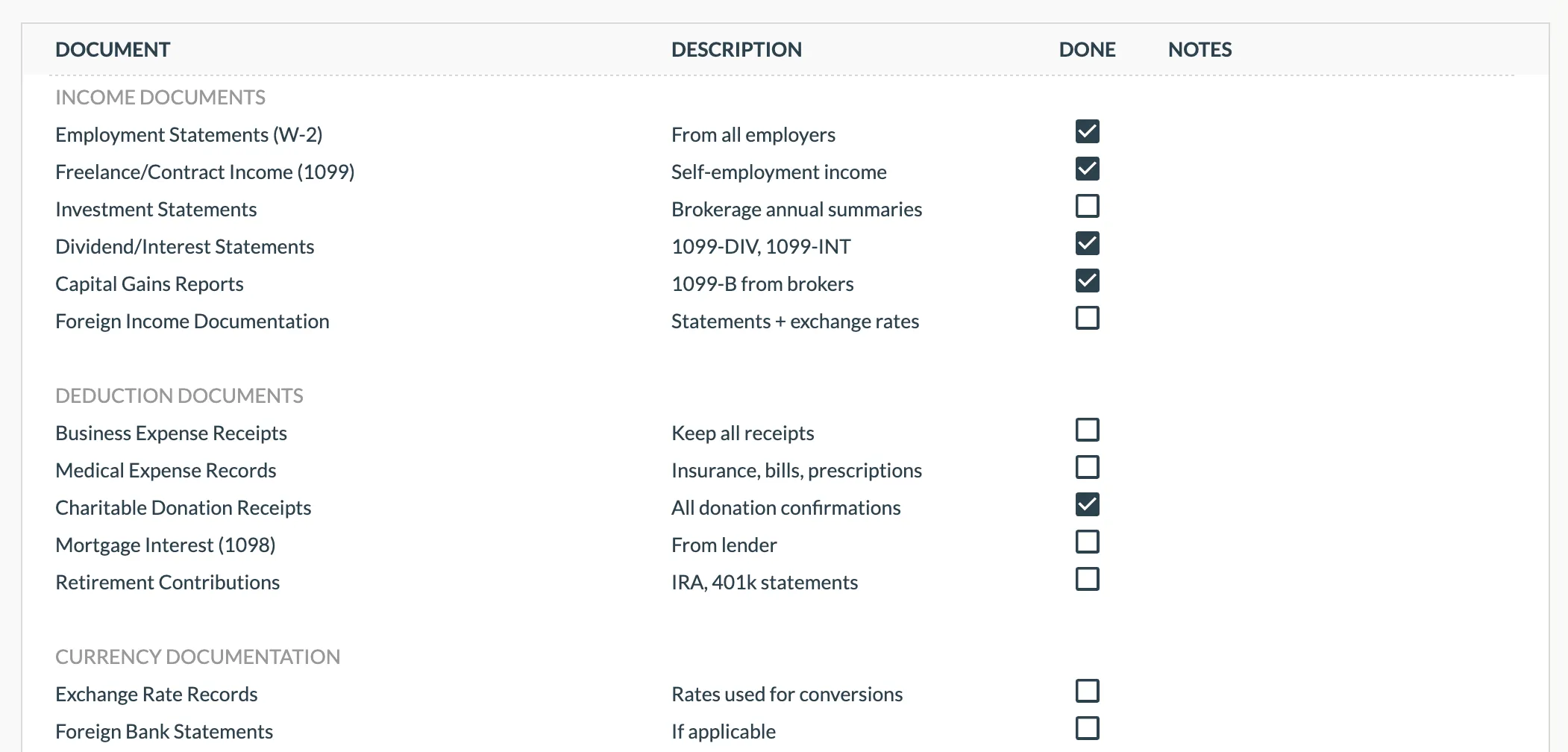
The Annual Tax Planner (Premium tier) ships with a 14-item document checklist like this, grouped into income documents, deduction documents, and currency documentation, with a Done checkbox for each.
Budgeting for Taxes
How taxes affect your budget depends on whether you’re expecting money back or need to write a check. Both scenarios benefit from planning.
Expecting a refund? It’s your money returning, not free money - though it can feel like a windfall. Common uses include filling out an emergency fund, paying off high-interest debt, or making a retirement contribution before April 15. Worth considering: waiting until the refund actually arrives rather than using refund anticipation loans, which have fees that eat into the amount.
Expecting to owe? One approach is spreading the impact. If you expect to owe $3,000, setting aside $250/month from January through December prepares you. Payment options include paying in full by April 15 (avoids interest and penalties), IRS payment plans for larger amounts, or credit card with fees if necessary.
Self-employment requires extra attention since taxes aren’t withheld automatically. Many self-employed people set aside 25-30% of income to cover income tax plus self-employment tax; the Self-Employment Tax Calculator estimates that combined figure. One approach is moving the set-aside to a separate account as income arrives, so that money is never in reach to spend. Quarterly estimated payments are due April 15, June 15, September 15, and January 15 of the following year.
Before April 15
The April 15 deadline matters for more than just filing. IRA contributions for 2025 can be made until April 15, 2026, potentially reducing 2025 taxable income. This is useful if you didn’t max out contributions during the year and have room to add more.
HSA contributions follow the same deadline for Health Savings Account holders. These are the last opportunities to reduce the prior year’s tax burden, so they’re worth considering before the deadline passes.
When to File
Filing early has advantages: a faster refund and reduced identity theft risk, since no one can file fraudulently in your name once you have already filed. Filing early works best when your situation is straightforward and documents are complete.
Waiting makes sense if documents are missing or your situation is complex enough that rushing could cause errors. Filing an extension (Form 4868 by April 15) gives an automatic six-month extension to file. Important caveat: the extension applies to filing, not payment. Any tax owed is still due April 15 regardless of the extension.
Related
- New Year Financial Reset Checklist
- Year-End Financial Review: 10 Questions to Ask Yourself
- Announcing the Annual Tax Planner Spreadsheet Template - The story behind the template and what each tab tracks
- Mid-Year Tax Checkup: 8 Things Worth Reviewing in June - The June counterpart to this January prep
- Annual Tax Planner Template
- Financial Planning Template
- Self-Employment Tax Calculator
- Monthly Budget Template
Frequently asked questions
When should I expect my W-2?
Employers must furnish W-2s by January 31, so most arrive in early February. Contact your employer if you haven't received it by mid-February.
How long to keep tax records?
At least three years, which is the IRS audit period for most returns. Keep property and home-improvement records longer, since they affect the cost basis when you sell.
What if I can't pay what I owe?
Filing on time still matters, because late filing carries its own penalty on top of the late-payment penalty. The IRS offers payment plans for those who can't pay in full.
Does a tax extension give me more time to pay?
No. Form 4868 extends the filing deadline to October 15, but any tax owed is still due April 15. Interest and penalties accrue on unpaid amounts after that date.
How much do self-employed people set aside for taxes?
There is no single rule, but many self-employed people set aside 25-30% of income to cover income tax plus self-employment tax. Quarterly estimated payments are due April 15, June 15, September 15, and January 15 of the following year.
Sources
- When to file - Internal Revenue Service
- Employment tax due dates - Internal Revenue Service
- Estimated taxes - Internal Revenue Service
- About Form 4868, Application for Automatic Extension of Time to File - Internal Revenue Service
- IRA year-end reminders - Internal Revenue Service
- Publication 969, Health Savings Accounts and Other Tax-Favored Health Plans - Internal Revenue Service
About this article
Deadlines and contribution dates checked against IRS filing and estimated-tax guidance. Annual Tax Planner tabs, inputs and outputs checked on 2026-09-10 against the shipped workbook (Dashboard, Income, Deductions, Quarterly, Documents Checklist, Exchange Rates, Instructions). Last reviewed September 2026.