
A year-end financial review means working through a short set of questions and writing down honest answers: what you earned versus spent, how much you actually saved, your biggest spending category, and the one thing you want different next year. These 10 questions turn a vague sense of how the year went into a written baseline you can measure against twelve months from now. No software needed to start - a pen and your bank statements are enough.
The end of the year makes us reflect on everything - trips taken, goals hit or missed, relationships that grew or faded. But money? Most people would rather not look.
There’s a reason for that. Reviewing your finances can feel like stepping on a scale after the holidays. But not knowing is worse. Not knowing means repeating the same patterns, wondering again where all the money went, and setting next year’s goals based on wishful thinking instead of reality.
A year-end financial review isn’t about guilt or judgment. It’s about gathering the information you need to make next year different - if you want it to be different.
Before You Start
Grab a pen and a piece of paper. This isn’t a passive read - it’s meant to produce something useful. The questions below are designed to surface things you might not have thought about clearly before. Some will be easy. Others might require you to check a bank statement or sit with an uncomfortable number.
As you go, write down your answers - or at least your best guess. By the end, you’ll have something more valuable than a finished article: a snapshot of where you actually stand, in your own handwriting, ready to inform whatever you decide to do next. That document, messy and honest and real, becomes a baseline for next year. Keep it somewhere you’ll find it in twelve months.
1. Did I Spend More Than I Earned?
This is the question that matters most, and the one people avoid longest.
Add up everything that came in this year - salary, side income, any other sources. Then add up everything that went out. If the second number is bigger than the first, write that down. No judgment here - life happens, emergencies happen, inflation happened. But you can’t change what you don’t measure.
If you’ve been tracking expenses throughout the year, you likely already have this answer. If not, your bank statements can get you close.
Write down: Total income. Total expenses. The difference.
2. How Much Did I Actually Save?
Not how much you planned to save - how much actually moved into savings and stayed there?
Compare your savings and investment account balances from January 1st against today. The difference tells the real story, not your intentions.
Some people find they saved more than they expected. Others discover their savings account became a holding tank they dipped into regularly. Both are worth knowing.
Write down: Your total saved this year.
3. What Was My Biggest Expense Category?
Not your largest single purchase - your largest category across the entire year.
For most people, housing takes the top spot. Across U.S. households, housing is the single largest spending category, about a third of all expenditures in the Bureau of Labor Statistics Consumer Expenditure Survey. That’s expected. But what comes second? Third? Food, transportation, subscriptions, shopping - the answer varies, and it’s often surprising.
Daily spending tends to feel invisible in the moment. A few dollars here, twenty there. But when you add up a full year, patterns emerge that weren’t obvious before.
Write down: Your top three spending categories, if you know them.
If You Don’t Have the Data
If you’re realizing you can’t answer the questions above with any confidence - that’s okay. You’re not behind. You’ve just discovered something important.
Not having answers isn’t failure. It’s information. It tells you that this is exactly where tracking could help. Even three months of expense data would give you more clarity than most people ever have about their money.
The remaining questions are easier to answer from memory. Keep going - and keep writing.
4. What Purchase Do I Regret Most?
Most people can answer this one immediately. It’s the thing gathering dust in a closet, the subscription that seemed like a good idea at the time, or the purchase that felt necessary in the moment but wasn’t.
This isn’t about self-criticism. It’s about noticing patterns. Do your regrets tend to be impulse purchases? Things bought on sale that you didn’t truly need? Purchases made to impress others or meet expectations?
Recognizing what triggers regret makes it easier to pause next time.
Write down: Your biggest regret purchase - and why you think it happened.
5. What Was My Best Financial Decision?
Don’t just focus on mistakes. The wins matter too.
Think about this past year: did you negotiate a raise or a better rate on something? Pay off a debt? Set up automatic transfers? Cancel subscriptions you weren’t using? Walk away from a purchase you would have regretted?
Whatever it was, it’s worth remembering. Knowing what worked makes it easier to repeat.
Write down: One or two wins from this year.
6. Did Any Subscriptions Slip Through?
Studies show that people consistently underestimate their subscription spending, often by 2-3x. These charges are designed to be forgettable - small amounts, automatic billing, no friction.
It’s worth pulling your statements and searching for recurring charges. Streaming services, apps that converted from free trials, memberships you haven’t used in months - they add up faster than most people expect.
Write down: Any subscriptions you forgot about or no longer use.
7. How Much Did I Pay in Interest and Fees?
This question can be uncomfortable, but the answer is useful.
Add up any credit card interest, loan interest, bank fees, overdraft charges, and late payment penalties from the past year. This is money that didn’t buy you anything - it simply left.
A single late fee is easy to overlook. But if the same fees keep appearing, it might point to a timing or system issue worth looking at.
Write down: Your total interest and fees paid this year.
8. Did I Make Progress on Debt?
If you carry any debt, compare your balances from January to now. Did they go down? By how much? Is your payoff timeline still on track, or has it stretched?
If your total debt increased this year, that’s useful information for thinking about next year.
Write down: How your debt changed, whether up, down, or flat, and by how much.
9. What Financial Goal Did I Completely Ignore?
Almost everyone has a goal they intended to pursue and then quietly set aside. Building an emergency fund, contributing more to retirement, paying off a specific balance, learning about investing - the specifics vary, but the pattern is common.
The useful question isn’t whether you ignored something. It’s why. Was the goal unrealistic from the start? Was there no concrete plan attached to it? Did more urgent expenses push it aside?
Understanding why a goal stalled helps you decide whether to approach it differently next year or let it go entirely.
Write down: The goal you ignored - and your honest guess at why.
10. What Do I Want Different Next Year?
This is where reflection turns into intention.
Look at everything you’ve written down. What’s one or two things you’d genuinely like to change? Not ten things - keeping the list short matters. Too many goals usually means none of them get real attention.
The more specific you can make it, the easier it becomes to follow through. “Track my spending for three months” is more actionable than “be better with money.” A clear target gives you something to measure when you sit down to do this again next year.
Write down: One or two specific things you want to be different.
What You Have Now
Look at your notes. If you’ve been writing as you went, you now have a clearer picture of this year than you did before you started.
Maybe some of it is uncomfortable. Maybe some of it is better than you expected. Either way, you now have something to work with - not vague feelings about money, but observations you can build on. This is information, not a verdict. A high number in one category or a missed goal doesn’t define you - it just tells you something about how this particular year went.
Clarity beats guessing, even when the answers aren’t what you hoped for. And unlike the vague sense that money is “tight” or “fine,” these written notes can inform specific decisions. They turn next year’s goals from wishes into something more grounded.
Making Next Year Easier
If parts of this review felt like guesswork, they don’t have to next year.
“I don’t know where my money goes.” Start with a Monthly Expense Tracker. It’s the simplest way to see what’s actually happening - just record what comes in and what goes out.
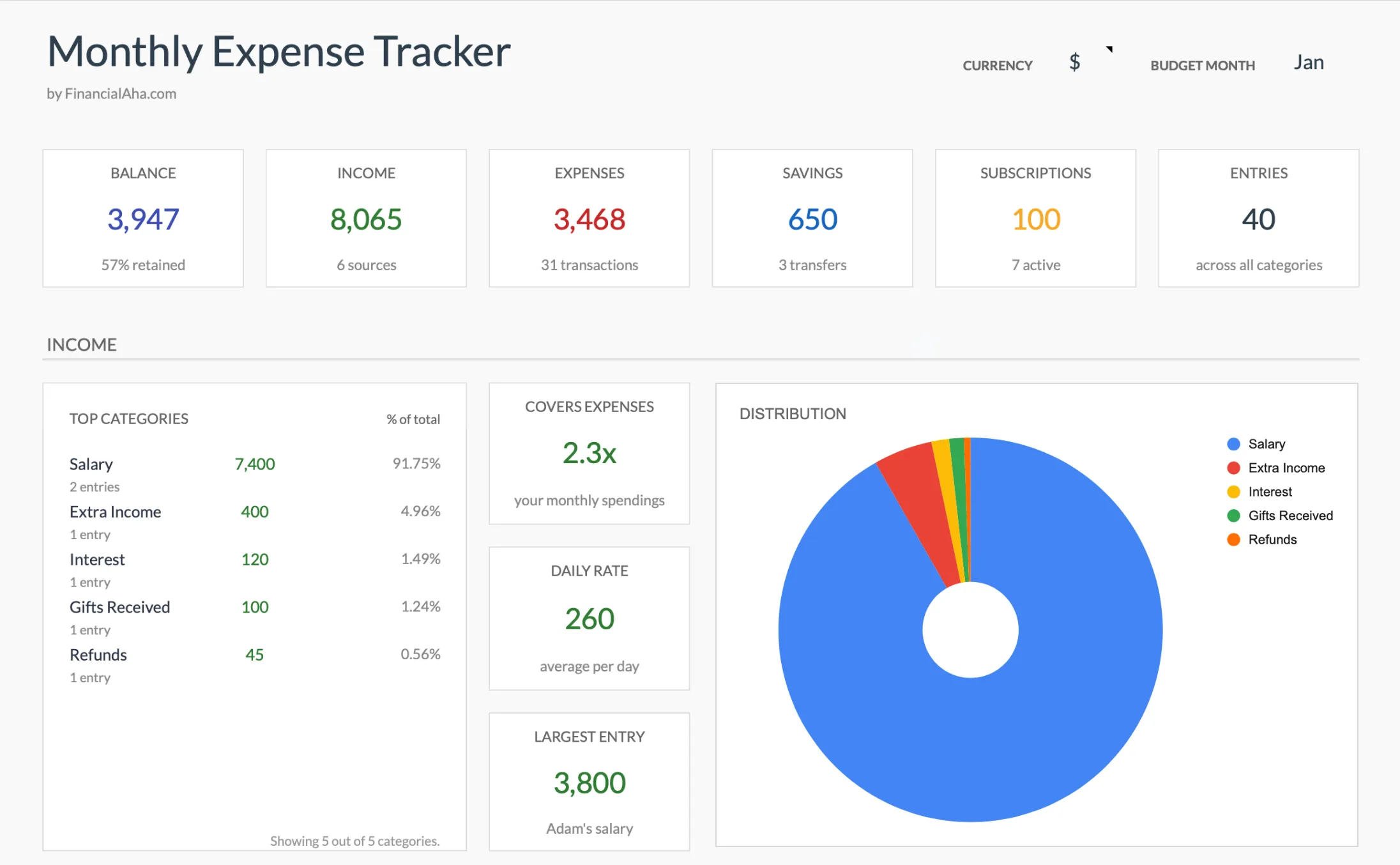
The Monthly Expense Tracker (Premium tier) rolls a month of entries into income, expenses, savings, subscriptions, and top categories - the same figures questions 1, 2, 3, and 6 ask you to find. If you’d rather build one yourself, our guide to an advanced personal finance tracker in Google Sheets walks through the formulas.
“I can see where my money goes, but not where it should go.” A Monthly Budget Template adds planning to tracking. Set targets, see how reality compares, and adjust as you go.
“I want to see the full year, not just month to month.” The Annual Budget Template gives you the year-long view - what you planned for each month versus what actually happened. It works well on its own, and even better alongside a monthly template.
You don’t need all three. Pick the one that matches where you are right now.
A year from now, when you come back to these same questions, the answers will come easier - and we hope they’ll be better than this year’s. When that happens, we’d love to hear about it.
Related
- Monthly Budget Template - adds targets to the tracking, so each month you fill in already holds the income, savings and top-category figures questions 1 to 3 ask for.
- Annual Budget Template - the year-long, planned-versus-actual view that mirrors this review month by month.
- Net Worth Tracker - captures the savings and debt movement behind questions 2 and 8 in one snapshot.
- What Is Financial Freedom and How to Get There - useful once question 10 turns your review into next year’s goals.
Frequently asked questions
When is the best time to do a year-end financial review?
Any point where the year's activity is mostly settled works - late December once most transactions have cleared, or the first days of January. Some people pair it with a quiet weekend so they can pull statements without rushing. The window matters less than actually sitting down with the numbers once.
Do I need budgeting software or a spreadsheet to do this?
No. Every question here can be answered with a pen, a piece of paper, and your bank and card statements. A tracker mainly helps with the first few questions - income versus expenses, total saved, top categories - because it adds those figures up for you. Next year those answers come faster if the data is already recorded somewhere.
Should the review include net worth, or just spending?
The 10 questions focus on cash flow and habits, but some people add a net worth snapshot - total assets minus total debts - as a single line at the top. It captures progress that spending alone misses, such as investment growth or a shrinking loan balance.
How is a year-end review different from setting New Year's resolutions?
A review looks backward at what actually happened, using real figures. Resolutions look forward at what you hope to do. Doing the review first means the goals you set rest on evidence from the past year rather than on a guess about it.
Sources
- Consumer Expenditures News Release - U.S. Bureau of Labor Statistics
About this article
Spending-category framing (housing as the largest household expense) checked against the U.S. Bureau of Labor Statistics Consumer Expenditure Survey. Template sheets, inputs and outputs checked on 2026-09-10 against the shipped Monthly Expense Tracker (Summary, Transactions), Monthly Budgeting (Summary, Budget Plan), Annual Budgeting Planner (Summary, Annual Plan) and Net Worth Tracker (Summary, Assets, Liabilities) Google Sheets. Last reviewed September 2026.