
A mid-year tax checkup is a 60-minute review run in June or July across eight areas: withholding pace, estimated payments, retirement and HSA contributions, itemize-vs-standard, capital gains, self-employment items, and life changes, all measured against 2026 figures. Run in June it leaves five to six months to act instead of facing an April surprise. The point is to surface questions for a CPA while withholding or a deferral rate can still be changed.
April is too late for most tax adjustments. By the time the return is in front of you, the year is over. December is better, but narrow - one or two paychecks left, one shot at a retirement contribution before the calendar resets.
June leaves five to six months. Withholding can still be reshaped over twelve to fourteen paychecks. A 401(k) deferral percentage can be changed in a benefits portal in under a minute. The point of a mid-year checkup is not to file taxes early. It is to notice drift while there is room to act.
The eight items below each follow the same shape: what to check, how to check it in a spreadsheet, and what patterns are worth raising with a CPA. None of this replaces a tax professional on a complex year. It is the prep work that makes that meeting shorter. The Annual Tax Planner holds the year’s income, deductions, quarterly payments and document checklist in one file. The projections below are arithmetic you run beside it.
What you need before starting
Five inputs.
| Input | What it gives you |
|---|---|
| Most recent paystub (you and spouse) | YTD federal/state withheld, 401(k) deferred, gross |
| 2025 federal return (Form 1040) | Prior-year tax liability, prior AGI |
| Brokerage and retirement statements | YTD contributions and realized gains/losses |
| HSA statement (if applicable) | YTD HSA contributions |
| Estimated tax confirmations (if self-employed) | Q1 and Q2 paid amounts |
If something is missing, run the review anyway. A blank cell is still information - it tells you which records to start keeping for the back half.
Withholding adequacy
What to check. Whether year-to-date federal withholding, run forward through December, will roughly cover the year’s projected tax liability.
How to check it in the spreadsheet. Pull federal tax withheld YTD from the latest paystub. Divide by pay periods elapsed, then multiply by total annual pay periods. Compare that projection against last year’s total federal tax from line 24 of the 1040.
Projected withholding = (YTD withheld / pay periods YTD) * pay periods in year
Gap                   = Line 24 of last year's 1040 - Projected withholding
A gap near zero means autopilot is roughly aligned. A large positive gap means projected withholding is short. A large negative gap means a refund is brewing - the IRS holds the money until April with no interest.
What to discuss with a CPA. If the gap is wide in either direction, whether the cause is structural (raise, new job, side income, dependent change) or seasonal (bonus timing, one-time event). The structural-vs-seasonal split is what determines whether a new Form W-4 is the right lever.
One caveat: changing withholding mid-year reshapes only the remaining paychecks. A W-4 submitted in July has about 13 paychecks to spread the correction across. The same correction filed in November has 4, which means a much larger per-check change. The IRS Tax Withholding Estimator handles the math and produces a completed W-4 to hand to payroll.
Estimated payments status
What to check. Whether Q1 (April 15) and Q2 (June 15) estimates were paid on time, and what Q3 (September 15) should look like.
How to check it in the spreadsheet. A row per quarter: the period it covers, the due date, estimated income and tax for that quarter, and the amount paid. Then the safe harbor reference:
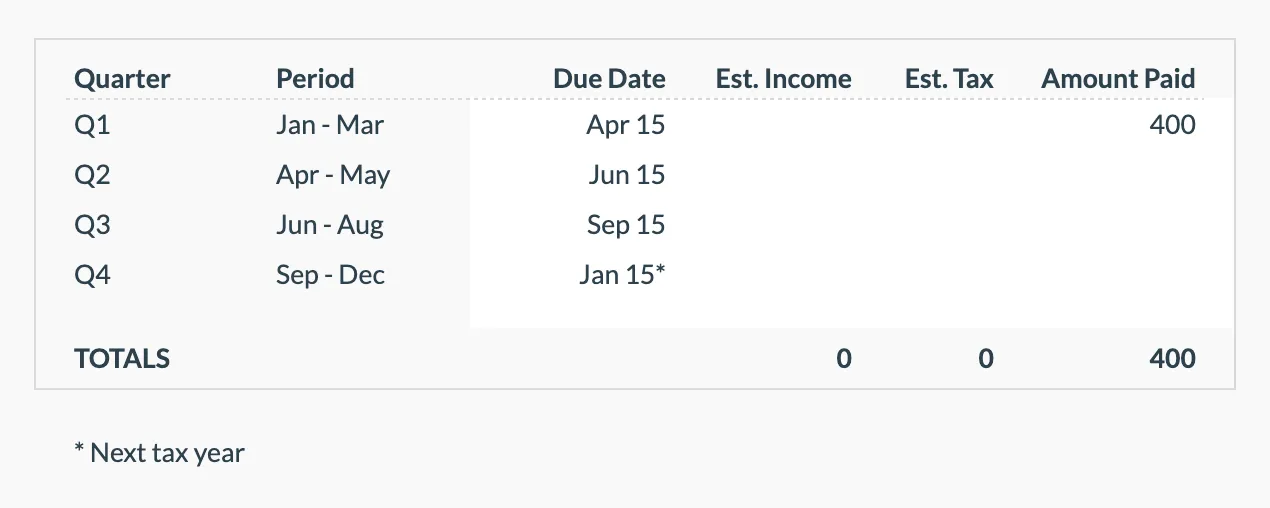 The quarterly payments tab in the Annual Tax Planner (Premium tier) tracks each estimate against its due date.
Safe harbor target = Prior year total tax / 4
                   = Prior year total tax * 1.10 / 4  (if prior AGI > $150,000)
Per IRS guidance on the underpayment penalty, estimates avoid penalty if they total at least 90 percent of current-year tax or 100 percent of prior-year tax (110 percent when prior AGI exceeded $150,000), whichever is lower.
What to discuss with a CPA. If Q1 was missed, the underpayment penalty is already accruing - a CPA can quantify it and weigh catching up in Q3 against spreading the shortfall. If income is far above or below last year, the safe harbor floor still applies, but actual-income method may save cash flow. Our walkthrough on the quarterly estimated tax spreadsheet covers both methods.
Retirement contribution pace
What to check. YTD 401(k), 403(b), 457(b), or Solo 401(k) contributions against the 2026 IRS limit of $24,500, with $8,000 catch-up at age 50+ and an $11,250 super catch-up for ages 60 through 63. Traditional and Roth IRA contributions against the 2026 limit of $7,500 ($1,100 catch-up for 50+).
How to check it in the spreadsheet.
| Account | 2026 limit | YTD contributed | Remaining | Months left |
|---|---|---|---|---|
| 401(k) elective | 24,500 | 11,800 | 12,700 | 6 |
| IRA | 7,500 | 3,500 | 4,000 | 6 (until April 2027) |
| Employer match captured | (full) | 2,950 | - | - |
Remaining divided by months left is the monthly pace needed to hit each cap. The IRA deadline is April 15 of the following year, so the runway is longer.
The Roth IRA piece needs care. The 2026 Roth IRA phase-out runs $153,000 to $168,000 MAGI single, $242,000 to $252,000 married filing jointly (per IRS 2026 limits). MAGI is not gross income; it adds back several items. If income is near the threshold, a contribution that turns into an excess in April creates paperwork - it can be recharacterized or withdrawn, but the rules have edges.
What to discuss with a CPA. Whether Traditional or Roth fits the current year given projected future bracket. Whether a backdoor Roth is on the table for those above the phase-out. Whether the employer match at the current deferral rate captures the full match - some plans true up annually, others do not.
HSA pace
What to check. YTD HSA contributions against the 2026 limit: $4,400 self-only HDHP, $8,750 family, plus a $1,000 catch-up at 55+.
How to check it in the spreadsheet.
| HSA coverage | 2026 limit | YTD contributed | Remaining |
|---|---|---|---|
| Family | 8,750 | 4,000 | 4,750 |
| Catch-up (55+) | 1,000 | 0 | 1,000 |
HSA eligibility requires HDHP enrollment for the months contributions are made. Mid-year coverage changes prorate the limit. The last-month rule allows a full-year contribution for someone HDHP-enrolled on December 1, with a testing-period requirement.
What to discuss with a CPA. Prorated limit if HDHP coverage shifted mid-year. If the HSA is used as an investment vehicle (paying current medical out of pocket, leaving HSA invested), whether medical receipts are filed for future reimbursement.
Itemize vs standard deduction projection
What to check. Whether the combined itemized deductions (state and local taxes, mortgage interest, charitable, allowable medical) will exceed the 2026 standard deduction. Per IRS Rev. Proc. 2025-32, the figures are $16,100 single, $32,200 married filing jointly, $24,150 head of household.
How to check it in the spreadsheet. A category roll-up of YTD deductible expenses, annualized:
| Category | YTD | Annualized | Cap or floor |
|---|---|---|---|
| State income tax | 4,800 | 9,600 | SALT cap $40,400 combined for 2026 (OBBBA) |
| Property tax | 2,200 | 4,400 | Combined with SALT |
| Mortgage interest | 5,400 | 10,800 | Full amount |
| Charitable cash | 2,000 | 4,000 | Within 60% AGI |
| Medical (over 7.5% AGI) | 0 | 0 | Floor not crossed |
| Total allowable | ~24,800 |
If projected itemized lands well above standard, year-end charitable timing matters. If it lands well below, logging individual receipts is mostly wasted effort. The narrow band, within $1,000 to $2,000 of standard, is where bunching comes up. The row-by-row walkthrough in our piece on the tax deduction tracker in Google Sheets covers the schema.
What to discuss with a CPA. Bunching strategy if itemized lands close to standard. Donor-advised fund timing in a year with an income spike. SALT cap interaction in a year with unusually high state taxes.
Capital gains and losses year to date
What to check. Realized short-term and long-term gains and losses, dividends, and any wash-sale flags. The mid-year snapshot is not the final number, since markets move, but the realized side is largely set.
How to check it in the spreadsheet. A few rows from the brokerage statement:
| Category | YTD | Notes |
|---|---|---|
| Realized short-term gains | 1,200 | Taxed as ordinary income |
| Realized long-term gains | 8,400 | 0/15/20% depending on bracket |
| Realized losses (any term) | -2,100 | Offset gains first |
| Net taxable capital activity | 7,500 |
Carryover losses from prior years apply at filing. If last year left an unused capital loss carryover, line 6 of last year’s Schedule D shows the amount carried into 2026.
What to discuss with a CPA. Whether realizing gains in a known low-income year (or harvesting losses in a high-income year) fits the current bracket. Wash-sale exposure if losses were taken on positions repurchased within 30 days. Giving appreciated stock instead of cash, which substitutes for cash giving and avoids the gain.
The spreadsheet shows realized activity. It does not know your view on the market, your bracket projection, or whether a large event (home sale, business sale, inheritance) is still ahead. The data is information. The decision belongs in the conversation.
Self-employment items
What to check. For freelancers, sole proprietors, single-member LLCs, and side-hustlers: home office square footage, business mileage YTD, business expenses YTD, and estimated payments paid.
How to check it in the spreadsheet. Schedule C categories with YTD totals and line references.
| Category | YTD | Schedule C line |
|---|---|---|
| Home office (simplified) | 750 | Line 30 - $5/sq ft up to 300 |
| Vehicle mileage | 4,200 | Line 9 - 72.5 c/mile Jan-Jun, 76 c/mile Jul-Dec 2026 |
| Software and subscriptions | 1,100 | Line 22 |
| Internet (business %) | 360 | Line 25 |
| Contract labor | 1,500 | Line 11 - 1099-NEC at $2,000 for 2026 |
| Business meals (50%) | 480 | Line 24b |
Mileage especially: the IRS raised the business rate mid-year, so 2026 carries two figures. Trips from January 1 through June 30 count at 72.5 cents per mile (Notice 2026-10); trips from July 1 through December 31 count at 76 cents per mile. A mid-year log needs the trip date to apply the right rate. A contemporaneous log (date, miles, purpose) holds up under audit; a year-end estimate does not.
What to discuss with a CPA. Whether actual-expense vehicle method beats standard mileage at current vehicle costs. Whether the QBI deduction applies (Form 8995) and the higher-income phase-out shape. Whether a Solo 401(k) or SEP IRA opens up retirement contribution room beyond the employee-side $24,500. Our self-employed deductions roundup for 2026 covers the 25 most common.
Life changes that affect tax position
What to check. Anything in the first half of the year that shifts withholding logic, filing status, or deduction picture.
The usual list:
| Change | Why it matters |
|---|---|
| Marriage or divorce | Filing status, withholding between spouses |
| New child | Child tax credit, dependent care FSA, W-4 update |
| Becoming self-employed | Quarterly estimates required, new deductions |
| W-2 to 1099 or reverse | Withholding stops/starts, estimates needed |
| Buying or selling a primary home | Mortgage interest, property tax, gain exclusion |
| Inheritance or large gift received | Basis questions, possible gift-tax reporting |
| Starting RMDs (age 73+) | Distribution withholding, taxable income spike |
| State of residence change | Source-state vs resident-state allocation |
How to check it in the spreadsheet. A small notes section at the top of the review tab: “What changed since January?” A two-line answer is enough.
What to discuss with a CPA. Each item is a question worth raising. Marriage mid-year often produces under-withholding because each W-4 assumed single brackets. Divorce inverts that. A new child changes the W-4 dependent count and may open dependent care benefits at the next open enrollment. The spreadsheet does not calculate these. The notes line is where they get written down.
A worked example
Tom and Priya are married filing jointly. Combined W-2 income, no side businesses. Mid-year snapshot:
| Item | Status | Notes |
|---|---|---|
| Withholding pace | $11,200 ahead of safe harbor | Last year had an RSU vest; this year is lower |
| Q1/Q2 estimates | N/A | All W-2 |
| 401(k) Tom | $9,800 of $24,500 | Pace projects $19,600 - would miss cap |
| 401(k) Priya | $12,200 of $24,500 | On pace |
| Roth IRA each | $3,750 of $7,500 | On pace |
| HSA family | $4,200 of $8,750 | Slight underpace |
| Itemized projection | $26,400 | Below $32,200 MFJ standard |
| Capital gains YTD | +$3,400 long-term | One rebalance |
| Life changes | None |
The findings list is short: Tom’s 401(k) pace would miss the cap by ~$5,000 at current deferral. HSA contributions are running slightly below the family limit. Withholding is over-correcting from last year’s RSU spike, projecting a sizable refund. Three things the review surfaced. What to do about each one is the next conversation.
The next-step list
What might change for July through December. Three to seven items, no more. Common entries from people who have run the review:
- A note to revisit the payroll 401(k) deferral percentage given the pace gap
- A reminder to revisit the W-4 if a projected refund or balance due is large and structural
- The Q3 estimated payment date (September 15) on the calendar
- A note on HSA contribution pace given the family limit
- A reference to the carryover loss for the year-end review
- A flag to pull the Roth IRA MAGI projection forward if income is near the phase-out
- A booked CPA meeting if any of the above raised questions
What does not belong: anything that depends on guessing about market returns, future income, or major life events still in the maybe column.
When the mid-year tax checkup hands off
A spreadsheet compares YTD withholding to last year’s tax. It does not know whether this year’s bracket will be higher or lower. It shows the Roth IRA contribution made so far. It does not weigh Traditional versus Roth over a thirty-year horizon. The data is what is happening. The decision of whether to adjust, when, and how aggressively belongs in the CPA conversation, ideally before October when calendars fill up.
Get the template
Three options depending on what you are starting with.
- Annual Tax Planner - Seven tabs covering the whole tax year. Income logged by type with an editable rate on each, deductions logged by category, a tax credits field feeding a net tax liability line, a four-quarter payment log with due dates, a 14-item document checklist, and an exchange rate sheet for income in other currencies. For people who want one spreadsheet for the full tax year.
- Tax Deduction Tracker - The simpler version. Fifty rows across six categories with a running year-to-date total, plus a dashboard showing the total, the top category, receipts on file, and estimated tax savings at the rate you enter. For people who mostly need the receipts organized.
- Tax Deduction Tracker Ultimate - Up to 150 deductions, Schedule A/C/E breakdown, quarterly summaries, and a tax-impact calculator. For higher-volume filers or anyone running multiple income streams.
All three open in Google Sheets and Excel, and the two deduction trackers also run in LibreOffice Calc. The data stays on your device unless you share it.
Related
- Quarterly Estimated Tax Spreadsheet: Safe Harbor Rule Explained - The full walkthrough on the safe harbor math and 2026 due dates.
- Tax Deduction Tracker in Google Sheets: Schedule A Categories, Row by Row - The deeper dive on the itemize-vs-standard question.
- Mid-Year Financial Review: A Template for Checking In - The broader six-month review that this tax checkup slots into as one of nine sections.
- Announcing the Annual Tax Planner Spreadsheet Template - What the planner that structures this review actually holds.
Frequently asked questions
Why bother with a tax review in June?
Half the year is left to act. Adjusting withholding or making an additional estimated payment in July is easier than scrambling in December and far easier than an April surprise.
Does this replace working with a CPA?
No. It is a self-checkup that surfaces questions to discuss with a CPA at year-end or in any planning conversation. Many people find that doing the review first makes the CPA meeting shorter and more productive.
What does the safe harbor rule say?
Estimated payments avoid penalty if they total either 90 percent of current year's tax or 100 percent of prior year's (110 percent if prior AGI exceeded $150,000). Working out which of the two is the lower bar is a hand calculation from last year's return and the year-to-date figures.
What life changes most often surprise people at tax time?
Marriage or divorce mid-year, a new baby, becoming self-employed, selling stock with large gains, and switching from W-2 to 1099. Each shifts withholding logic in ways that go unnoticed until April.
Which 2026 mileage rate applies if I drive for work all year?
Two rates apply. The IRS set the business rate at 72.5 cents per mile for January 1 through June 30, 2026, then raised it to 76 cents per mile for July 1 through December 31. A mileage log needs the trip date so each stretch is priced at the rate in force that day.
Is a mid-year checkup worth it if all my income is W-2?
For a single-job W-2 filer with no big changes, withholding usually tracks close to the tax owed, so the review is short. It earns its hour when a bonus, an RSU vest, a raise, a second job, or a spouse's income has shifted the picture, since combined W-4s can under-withhold without either party noticing.
Sources
- Tax Withholding Estimator - IRS
- Underpayment of Estimated Tax by Individuals Penalty - IRS
- 401(k) limit increases to $24,500 for 2026, IRA limit increases to $7,500 - IRS
- Tax inflation adjustments for tax year 2026 (Rev. Proc. 2025-32) - IRS
- 2026 business standard mileage rate (Notice 2026-10) - IRS
- Standard mileage rates - IRS
- Instructions for Forms 1099-MISC and 1099-NEC - IRS
About this article
2026 contribution limits, safe-harbor rules, standard deduction figures, and both halves of the 2026 business mileage rate checked against the linked IRS releases. The 2026 Form 1099-NEC reporting threshold and the simplified home office rate checked on 2026-09-10 against the IRS Instructions for Forms 1099-MISC and 1099-NEC and the IRS simplified home office option page. Template sheets, inputs and outputs checked on 2026-09-10 against the shipped Annual Tax Planner (Dashboard, Income, Deductions, Quarterly, Documents Checklist, Exchange Rates, Instructions), the Essentials Tax Deduction Tracker (Dashboard, Deductions, How to Use) and the Ultimate Tax Deduction Tracker (Dashboard, Deduction Log, Category Summary, Schedule Breakdown, Quarterly Summary, Tax Impact Calculator). Last reviewed September 2026.