A week-long road trip for two typically runs $1,250 to $2,400, and where the nights are spent moves that range more than anything else. Fuel is the one line you can calculate rather than estimate: divide trip miles by real-world MPG, then multiply by the price per gallon. This guide works through gas, food, lodging, activities, tolls and a 10 to 15% buffer, with sample budgets for weekend, week-long and cross-country trips.
Road trips offer adventure and flexibility, but costs can surprise you. Gas, food, lodging, and unexpected stops add up quickly. Accurate planning prevents both overspending and cutting trips short.
Planning tool: The Travel Budget Planner plans one trip at a time: bookings carrying an estimated and an actual cost, a pre-trip expense list, and a summary showing what is left to spend per day. Its category list is editable, so fuel and toll lines can be added to the ones it ships with.
Gas Cost Calculations
Fuel is the one road trip line you can calculate rather than estimate, and in the sample budgets further down it lands between 10 and 20% of the total once lodging and food are counted. A few simple calculations give you the number.
The Basic Formula
Gas Cost = (Total Miles ÷ MPG) × Gas PriceExample Calculation
- Trip distance: 1,200 miles round trip
- Vehicle MPG: 28 mpg
- Gas price: $4.16/gallon, the EIA national average for regular in the week ending 7 September 2026
1,200 ÷ 28 = 42.9 gallons
42.9 × $4.16 = $178 gas cost
Prices move week to week and by state, so that figure is the first one worth replacing with a local number.
Factors That Affect MPG
Reduce efficiency (plan for lower MPG):
- Highway speeds above 65 mph
- Air conditioning running constantly
- Full car with passengers and luggage
- Mountain driving with elevation changes
- Headwinds
Improve efficiency:
- Steady highway speeds 55-65 mph
- Properly inflated tires
- Minimal idling
- Windows up at highway speeds
Realistic MPG Adjustment
Road trip conditions rarely match test conditions. A full trunk, extra passengers, detours and constant air conditioning all chip away at the rated figure, and real-world mileage commonly comes in 10-20% below the EPA number. If your car is rated 30 mpg, planning for 26-28 mpg on a long trip leaves less room for an unpleasant surprise at the pump.
Applying a flat 15% haircut to the rated figure is one way to build that gap into the estimate. Take a 2,000 mile round trip in a car rated at 28 mpg with gas at $4.16 a gallon. The raw calculation gives 71 gallons and roughly $297. Rerun it at 23.8 mpg, which is 28 mpg less 15%, and the same trip needs 84 gallons and about $350. That $53 difference is the sort of gap that turns a tidy budget into an overrun by the third fill-up.
Route Planning Tools
Mapping Services
Start with Google Maps for distance and drive time. Then cross-check gas prices with GasBuddy to find cheap fuel stops along the route. Google Maps calculates total distance, estimates drive time, and helps find gas stations along your route. GasBuddy compares gas prices so you can plan fuel stops at cheaper stations rather than wherever happens to be convenient.
Distance Estimation
| Route Segment | Miles | Hours |
|---|---|---|
| Home to City A | 280 | 4.5 |
| City A to City B | 195 | 3 |
| City B to Destination | 125 | 2 |
| Return trip | 600 | 9.5 |
| Total | 1,200 | 19 |
Breaking down the route into segments helps with planning stops and gives more accurate time estimates than a single end-to-end calculation.
Food Budget
Food is one of the two largest lines in most road trip budgets, alongside lodging. The actual amount depends entirely on your style, with coolers and fast food on one end and sit-down meals at every stop on the other. Knowing your preferences helps you budget accurately.
Daily Food Costs
| Level | Daily Estimate | Notes |
|---|---|---|
| Budget | $25-40/person | Grocery store food, cooler, minimal dining |
| Moderate | $40-70/person | Mix of restaurants and prepared food |
| Comfortable | $70-100/person | Restaurant meals, coffee shops |
Three restaurant meals a day for a week can quietly outgrow the fuel bill, which is why the cooler does so much work here. Breakfast items and lunch supplies from a grocery store cost a fraction of restaurant prices, and covering breakfast and lunch yourself while eating out once a day tends to cut the food line roughly in half.
Cost-Saving Strategies
Bring from home:
- Snacks (saves stopping)
- Water bottles (refill instead of buying)
- Breakfast items (granola bars, fruit)
Cooler essentials:
- Sandwich supplies
- Drinks
- Fresh fruit
- Cheese and crackers
Smart restaurant choices:
- Lunch specials vs. dinner prices
- Local spots vs. chains
- Sharing large portions
Sample Food Budget (4-Day Trip, 2 People)
| Meal | Cost | Notes |
|---|---|---|
| Breakfasts | $40 | From cooler |
| Lunches | $80 | Fast casual |
| Dinners | $160 | Sit-down restaurants |
| Snacks/drinks | $40 | Gas station, grocery |
| Total | $320 | $40/person/day |
Accommodation Options
Lodging costs swing wildly depending on your choices. Camping saves money but requires gear. Hotels offer convenience at higher prices. Vacation rentals work for groups splitting costs, often providing kitchens that reduce food expenses.
Cost Comparison
| Type | Price Range | Notes |
|---|---|---|
| Public campground | $15-35/night | State and national parks, requires gear |
| Private campground | $40-70/night | Showers, hookups |
| Budget motel | $60-90/night | Basic, functional |
| Mid-range hotel | $100-150/night | Comfort, amenities |
| Upscale hotel | $150-250+/night | Full service |
| Vacation rental | $100-200/night | Kitchen, space |
Location moves these numbers as much as the category does. A motel that costs $80 in rural Oklahoma can run $180 near a national park entrance or a major city, so the same comfort level is not the same price twice on one route.
Camping sits at the bottom of the range once the gear is bought. Dispersed camping on Bureau of Land Management land is free across much of the western United States, with no hookups, no showers and no reservations. Other ways to bring lodging down include vacation rentals shared across a group, nights with friends or family along the route, and sleeping in the vehicle where local rules allow it. Each one trades some comfort for cost.
Booking Strategy
Book in advance:
- Popular destinations
- Peak travel times
- Known overnight stops
Book day-of:
- Flexible itineraries
- Off-peak travel
- Last-minute deals (Hotel Tonight, etc.)
Lodging Budget Example (3 Nights)
| Night | Location | Type | Cost |
|---|---|---|---|
| 1 | En route | Budget motel | $75 |
| 2 | Destination | Vacation rental | $150 |
| 3 | En route home | Budget motel | $75 |
| Total | $300 |
Activities and Attractions
Activity costs can run anywhere from zero to hundreds depending on what’s on your route and what interests you. A road trip through national parks costs differently than one hitting amusement parks. Planning activities ahead helps avoid budget surprises.
Budget Categories
Free:
- Scenic drives
- Public parks
- Beach days
- Hiking trails
- Walking tours
Low cost ($10-30/person):
- State parks with entry fees
- Small museums
- Historical sites
- Self-guided tours
Moderate ($30-75/person):
- Major attractions
- Guided tours
- Activities such as kayaking or rentals
Higher cost ($75+/person):
- Theme parks, often $100+ per person per day
- Premium experiences
- Guided adventures
National Park Fees
Federal parks charge by the vehicle rather than the head, so entry works differently from a museum ticket. The larger parks charge up to $35 per vehicle for a seven-day pass, which a full car splits several ways. The America the Beautiful annual pass costs $80 and covers entry to federal recreation sites for a year, so it breaks even at three park visits. Museums along the way typically run $15-30 per person.
Activities Budget Formula
Activities = (Number of paid activities) × (Average cost per person) × (Number of people)Complete Budget Template
Putting all the categories together gives you a complete picture. Building the same categories in Google Sheets turns this static table into a live estimate that recalculates as you change miles, MPG or gas price. The buffer matters because unexpected expenses happen on almost every trip, from minor car issues to spontaneous detours.
| Category | Calculation | Amount |
|---|---|---|
| Gas | 1,200 mi ÷ 27 mpg × $4.16 | $185 |
| Food | 4 days × $40/person × 2 people | $320 |
| Lodging | 3 nights × $100 average | $300 |
| Activities | 4 activities × $25 × 2 people | $200 |
| Tolls | Estimated based on route | $45 |
| Parking | City parking, attractions | $40 |
| Buffer (10%) | Unexpected expenses | $109 |
| Total | $1,199 |
Daily Budget Breakdown
Per-Day Method
Some people prefer daily spending limits instead of category budgets. This approach makes tracking simpler during the trip, since each morning starts with a known number to spend.
| Day | Gas | Food | Activity | Lodging | Daily Total |
|---|---|---|---|---|---|
| 1 | $40 | $60 | $50 | $75 | $225 |
| 2 | $20 | $80 | $100 | $150 | $350 |
| 3 | $20 | $80 | $75 | $150 | $325 |
| 4 | $40 | $60 | $0 | $0 | $100 |
| Total | $120 | $280 | $225 | $375 | $1,000 |
Hidden Costs to Plan For
Often Forgotten
Many road trippers forget to budget for these common expenses. They’re small individually but add up over a multi-day trip.
| Expense | Typical Cost |
|---|---|
| Tolls | Varies by route |
| Parking | $10-50/day in cities |
| Hotel parking | $15-35/night in cities |
| Tips | 15-20% on meals |
| Souvenirs | $20-50 per person |
| Laundry on longer trips | $5-15 per load |
| Pet care (if leaving pets) | $25-50/day |
| Car wash after trip | $15-30 |
Tolls
Tolls are the line item most often left out entirely, and on some routes they are not small. Crossing the full length of the Pennsylvania Turnpike in a passenger car costs roughly $50 or more, and the New Jersey Turnpike, the Chicago Skyway and a long list of bridge and tunnel crossings each add their own charge. Route-level toll estimators such as Tollsmart price a specific origin and destination before you leave, and adding around 10% on top covers the rate changes that arrive most years. Comparing a tolled route against the free alternative sometimes shows the toll buying back hours, and sometimes shows it buying back very little.
Vehicle Preparation
Getting your car ready before a long trip can prevent expensive problems on the road. These pre-trip costs are easy to budget in advance.
| Item | Cost |
|---|---|
| Oil change before trip | $30-75 |
| Tire check/fill | Usually free |
| Windshield washer fluid | $5 |
| Emergency kit items | $20-50 |
Tracking Expenses During Trip
Simple Tracking Method
Keep a running total on your phone. Put receipts in one place. Make quick entries after each stop rather than trying to remember everything at day’s end, an approach covered in more depth in how to track expenses while traveling. A notes app is enough for one person, while a shared spreadsheet works better when two people are both spending. Consistency matters more than the tool.
| Date | Description | Amount | Running Total |
|---|---|---|---|
| Day 1 | Gas - Shell | $42 | $42 |
| Day 1 | Lunch - diner | $28 | $70 |
| Day 1 | Hotel | $85 | $155 |
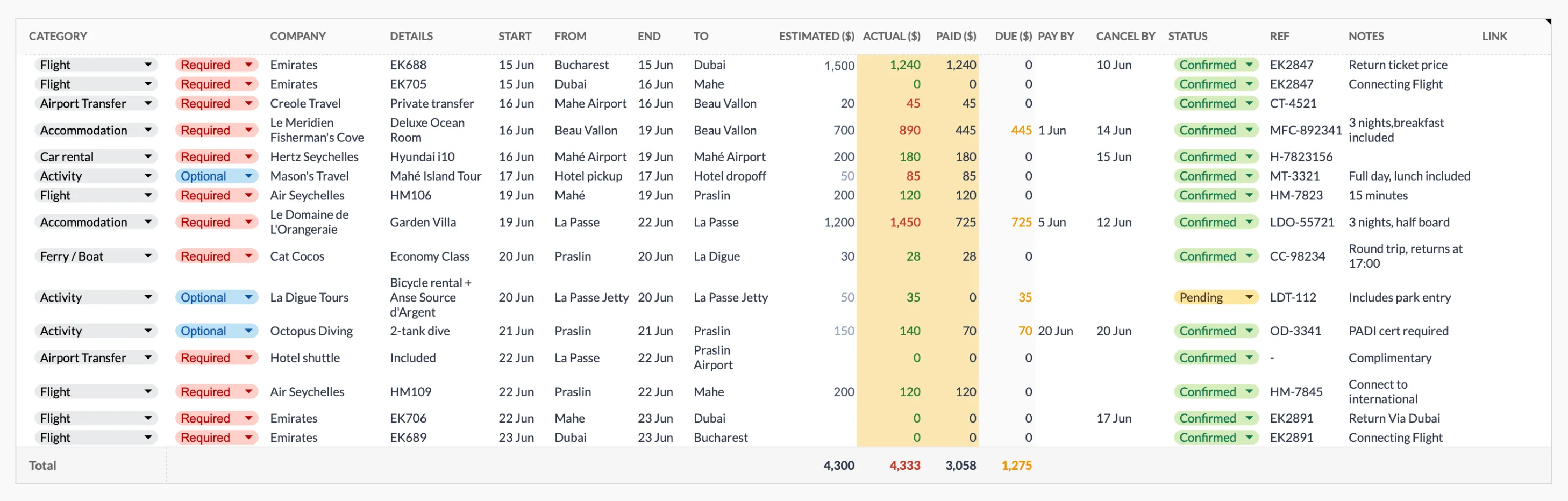
The Travel Budget Planner (Premium) covers the booked side of a trip. Each flight, hotel, car rental and activity carries an estimated cost, the actual cost once booked, what has been paid and what is still due. There is no on-trip expense log in the template, so the running daily total above lives wherever you keep it.
End of Each Day
Compare actual to budget. Running high? Adjust meals or skip an activity. Running low? Bank the difference or add something spontaneous. A quick check each night keeps the whole trip on track and prevents unpleasant surprises at the end.
After the Trip
The most useful budgeting work happens once you are home. Comparing the finished totals against the plan shows which categories were underestimated, whether that was food, tolls or the nights that ended up in hotels rather than campgrounds. Those gaps are the raw material for the next trip’s estimate, and records from two or three of your own trips usually beat any generic per-mile rule.
Different Trip Types
Weekend Getaway (2-3 Days)
Weekend getaways typically cover shorter distances (under 500 miles round trip) with 1-2 nights of lodging. Budget ranges from $300-600 for two people depending on accommodation choices and activities.
Week-Long Road Trip (5-7 Days)
Week-long trips extend to 1,000-2,000 miles with a mix of driving days and destination days. Budget typically runs $1,250-2,400 for two people, and lodging is what moves it. The two columns below cover the same week and the same 1,500 miles, split by where the nights are spent.
| Category | Mostly camping | Mostly hotels |
|---|---|---|
| Fuel (1,500 mi at 26 mpg, $4.16/gal) | $240 | $240 |
| Food | $400 | $600 |
| Lodging | $310 (5 camping, 2 motel) | $840 (7 hotel nights) |
| Activities | $100 | $250 |
| Tolls and parking | $50 | $125 |
| Buffer (15%) | $165 | $308 |
| Total | $1,265 | $2,363 |
The camping column assumes cooking most meals, a couple of paid activities and flexibility about where each night lands. The hotel column assumes mid-range rooms, a mix of restaurants and cooler food, and more paid attractions. Same route, same week, and close to twice the money.
Cross-Country Trip (2+ Weeks)
Cross-country trips involve major mileage (3,000+ miles) and multiple destinations. Budgets range from $2,000-5,000+ for two people. At this length, small daily savings compound into significant totals. If road trips are a regular part of the year rather than a one-off, an annual travel fund spreads these larger totals across months rather than one painful hit.
Saving Money on Road Trips
Small changes add up over long miles. A few dollars saved each day can mean hundreds over a week-long trip.
Gas Savings
Gas savings come from using GasBuddy to find cheapest stations, filling up before entering expensive areas (cities, tourist zones), and maintaining steady speeds, which saves fuel.
Food Savings
Food savings accumulate when you pack a cooler with groceries, eat breakfast from the hotel (if included) or your cooler, enjoy picnic lunches at scenic spots instead of restaurants, and save restaurant budget for dinners when the experience matters more.
Lodging Savings
Lodging costs drop when you use hotel rewards programs, apply AAA or other membership discounts, camp for some nights, and stay slightly outside popular areas where prices are lower but convenience remains good.
Tools for Planning
Travel Budget Planner
The Travel Budget Planner covers one trip: a Bookings sheet for reservations, a Planning sheet for pre-trip expenses and a packing list, and a Summary reporting the budget, the reserve percentage held back, what is available and how much of that is left per day. There is no fuel or mileage calculator in it, so the gas figure gets worked out with the formula above and entered as a line.
Gas Cost Calculator
To roll your own, a single-cell gas estimate reads directly from named ranges for the three inputs:
=TotalMiles/MPG*GasPriceSwapping the rated MPG for the real-world figure (rated MPG times 0.85, say) gives the more honest number to budget against.
Related
- Travel Budget Planner - Bookings, pre-trip expenses and a budget summary for one trip
- How to Track Expenses While Traveling
- Annual Travel Fund: How to Budget for Multiple Trips
- How to Plan a Trip Budget in Google Sheets
- Travel Budget Spreadsheets
Frequently asked questions
How accurate are online gas cost estimates?
Usually within 10-20% if you use realistic MPG. Online calculators often use official EPA ratings, which are optimistic. Adjusting for real-world conditions improves accuracy.
Is it worth budgeting for car trouble?
Including a buffer of 10-15% for unexpected expenses makes sense, covering minor car issues or other surprises. For older vehicles, a larger buffer provides additional peace of mind.
How do I budget for tolls?
Check toll calculator websites for your route and add a 10% buffer as toll rates change. Some routes have significantly more tolls than alternatives, so comparing is worthwhile.
What if gas prices spike during the trip?
Adjusting by eating cheaper meals or finding free activities helps absorb the difference. Having a buffer built into your budget provides flexibility for exactly these situations.
What is a reasonable daily budget for a road trip?
Budget travelers often spend $100-150 a day for a couple. Moderate comfort tends to run $200-300 a day, and families with children frequently land at $400-500 a day. Lodging choice moves the number more than anything else.
Is road tripping actually cheaper than flying?
For a solo traveler, flying is often cheaper. For families or groups the math flips, because fuel and lodging split across everyone in the car while airfare multiplies by each person.
Does an electric car change the budgeting math?
The method is the same, just in different units: divide trip miles by the car's miles per kWh, then multiply by the price per kWh. Overnight charging at home is usually far cheaper per mile than gas, while public DC fast charging on a busy travel corridor can land closer to gas cost, so where you charge matters more than the car.
Sources
- Entrance Fee Prices by Park - National Park Service
- Passes - National Park Service
- Factors That Affect Fuel Economy - fueleconomy.gov (U.S. Department of Energy / EPA)
- Toll Calculator - Pennsylvania Turnpike Commission
- Gasoline and Diesel Fuel Update - U.S. Energy Information Administration
About this article
National park entry figures (up to $35 per vehicle for a seven-day pass, $80 for the America the Beautiful annual pass) checked against the National Park Service fee and pass pages. Real-world MPG adjustments reference the U.S. Department of Energy's fueleconomy.gov guidance on factors that lower fuel economy. Gas price of $4.16 a gallon used in the worked examples is the U.S. Energy Information Administration weekly national average for regular gasoline, week ending 2026-09-07. Travel Budget Planner sheets, columns and categories checked on 2026-09-10 against the shipped Google Sheet (Summary, Bookings, Planning, Categories, Setup, Instructions, Helpers tabs). Last reviewed September 2026.