
Track travel points in a simple three-tab spreadsheet: an inventory of balances with a dollar value on each, a monthly earning log, and a redemption log. Value points conservatively, roughly 1 to 2 cents for airline miles and 0.4 to 0.8 cents for hotel points, so the running total reflects what the points are actually worth.
Travel rewards points have real value - but only if tracked. Points scattered across programs, slowly devaluing, with no clear picture of what they’re worth? That’s money slipping through the cracks.
A simple spreadsheet turns a vague sense of “I have some points somewhere” into a clear inventory with dollar values attached.
The Points Tracking Spreadsheet
This is the core of it. One table, updated monthly, that shows everything at a glance.
| Program | Balance | Est. Value/Point | Total Value | Expiration | Notes |
|---|---|---|---|---|---|
| Chase Ultimate Rewards | 85,000 | 1.5c | $1,275 | None | Transfer to Hyatt for best value |
| Delta SkyMiles | 42,000 | 1.3c | $546 | None | |
| Marriott Bonvoy | 120,000 | 0.6c | $720 | None | Need 50k for free night |
| Southwest RR | 35,000 | 1.4c | $490 | Dec 2027 | Use before expiration |
| Total | $3,031 |
The formula: Point Value = Cash Price of Redemption / Points Required. A $400 flight costing 25,000 points = 1.6 cents per point.
Typical Point Valuations
Not all points are equal. These ranges help with conservative estimates:
| Program Type | Typical Value Per Point |
|---|---|
| Airline miles | 1 - 2 cents |
| Hotel points | 0.4 - 0.8 cents |
| Flexible points (Chase UR, Amex MR) | 1.5 - 2 cents |
| Generic cash back | 1 cent (fixed) |
Use the lower end for tracking purposes. If the redemption beats your estimate, that’s a bonus.
Monthly Earning Tracker
Knowing what comes in each month helps you plan future trips. Add a tab for monthly earning:
| Month | Card Used | Category | Spend | Points Earned | Earning Rate |
|---|---|---|---|---|---|
| Mar | Chase Sapphire | Travel | $800 | 2,400 | 3x |
| Mar | Chase Sapphire | Dining | $400 | 1,200 | 3x |
| Mar | Chase Sapphire | Other | $1,300 | 1,300 | 1x |
| Mar | Amex Gold | Groceries | $600 | 2,400 | 4x |
| Mar Total | $3,100 | 7,300 |
At 7,300 points/month, that’s roughly 87,600 points/year - worth $1,300+ in travel at conservative valuations.
Annual Fee ROI Tracker
Cards with rewards often carry annual fees. A simple ROI check keeps things honest:
| Card | Annual Fee | Points Value Earned | Perks Used | Net Benefit |
|---|---|---|---|---|
| Chase Sapphire Reserve | $795 | $1,100 | $300 travel credit, $300 dining credit, lounge access | +$905 |
| Amex Gold | $325 | $720 | $120 dining credit | +$515 |
| Hotel card | $95 | $180 | Free night ($200 value) | +$285 |
Fees move, so plug in the current numbers when you build the table: as of September 2026 the Chase Sapphire Reserve carries a $795 annual fee and the Amex Gold sits at $325. If net benefit goes negative, the card isn’t earning its keep.
Integrating Points into Trip Budgets
When planning a trip, points reduce out-of-pocket costs. A simple planning table makes this clear:
| Trip Expense | Payment Method | Cash Cost |
|---|---|---|
| Flights (2 round-trip) | 50,000 points | $0 |
| Hotel (4 nights) | 80,000 points | $0 |
| Rental car | Cash | $280 |
| Food & activities | Cash | $600 |
| Total cash needed | $880 |
Without points, that trip costs $2,100+. The spreadsheet makes the savings concrete.
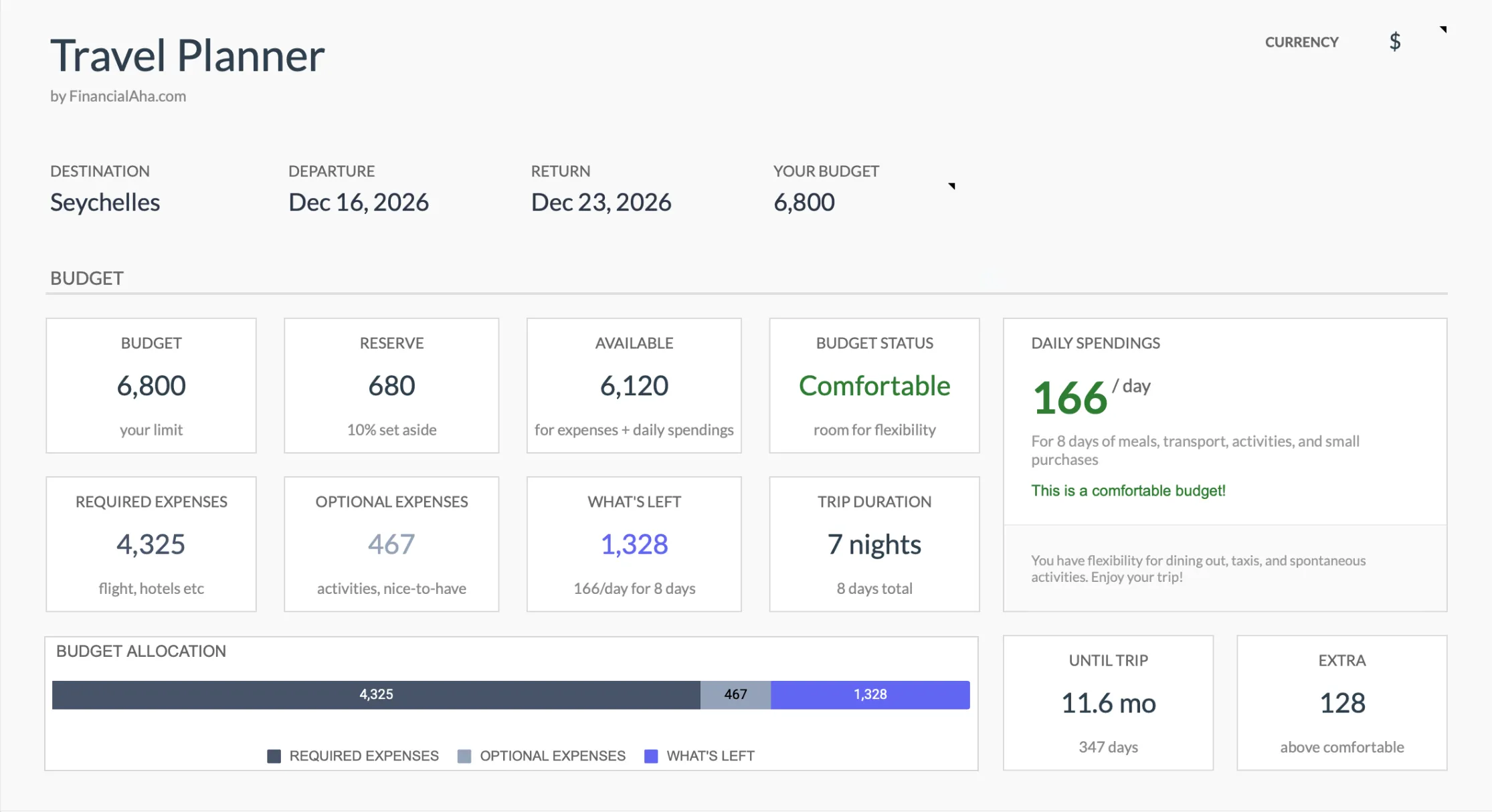
The Travel Budget Planner handles the cash side of the same trip. Its Bookings sheet logs each reservation by category, flagged Required or Optional, with the estimated cost, the actual cost, what you have paid and what is still due. A booking covered by points goes in at zero cost, and the Summary works out what is left of the budget and what that leaves to spend per day.
Redemption Log
Track actual redemptions to see if your valuations hold up over time:
| Date | Program | Points Used | Cash Value | Actual c/pt | Redemption Type |
|---|---|---|---|---|---|
| Jan | Chase UR | 40,000 | $680 | 1.7c | Hyatt transfer |
| Mar | Delta | 25,000 | $350 | 1.4c | Domestic flight |
| Jun | Marriott | 50,000 | $275 | 0.55c | Hotel night |
This log refines your valuations over time. If hotel points consistently redeem below estimate, adjust the tracking table.
Avoiding Common Pitfalls
| Pitfall | How tracking helps |
|---|---|
| Points expiring unused | Expiration column flags deadlines |
| Hoarding for “someday” | Monthly value check shows devaluation risk |
| Overspending to earn points | Earning tracker separates organic spend from chasing |
| Paying fees on underperforming cards | Annual ROI table catches negative-value cards |
Setting Up Your Tracker
A Google Sheet with three tabs covers everything:
- Points Inventory - Current balances, valuations, expirations
- Monthly Earning - What’s coming in and from where
- Redemption Log - What you’ve used and the value received
Update the inventory monthly. Log redemptions as they happen. Review the annual fee ROI once per year. If you want a head start on the trip-budgeting side, the roundup of free travel budget spreadsheets is a useful jumping-off point.
The tracking itself takes about 15 minutes per month. The clarity it provides is worth far more.
Related
- Travel Budget Planner - Bookings, payments and a daily allowance for one trip
- Annual Travel Fund: Budgeting for Multiple Trips
- International Travel: Managing Currency Exchange
- Track Subscriptions and Recurring Expenses
Frequently asked questions
Should I save points for big trips?
Points lose value over time through program devaluations, so hoarding indefinitely has costs. A good redemption today often beats a theoretical perfect redemption years from now.
Are travel cards worth the annual fees?
Calculate your expected earning and redemption value, then compare to the annual fee. Most active travelers easily justify fees, but occasional travelers might do better with no-fee options.
How do I value points I haven't redeemed yet?
Use conservative estimates: 1 to 1.2 cents for airline miles and 0.5 to 0.6 cents for hotel points. Actual value depends on your eventual redemption.
Should I include points in my net worth?
If you include them, use conservative valuation and note they're illiquid. Many people track them separately rather than including them in their primary net worth figure.
What happens to my points if I cancel a card?
It depends on the program. Points earned in a bank's flexible currency, like Chase Ultimate Rewards or Amex Membership Rewards, generally disappear if you close the card holding them, while co-branded airline and hotel miles usually live in the loyalty account and survive card closure. The Notes column is a good place to record which is which before you cancel anything.
Are travel points taxable?
Points earned from spending on a card are generally treated as a rebate rather than income, so they usually are not taxed. Points or bonuses received without any spending requirement can be different. Tax situations vary, so a tax professional is the right source for your specifics.
Sources
- Chase Sapphire Reserve - JPMorgan Chase
- American Express Gold Card - American Express
About this article
Annual fee and credit figures in the card ROI example were checked against the Chase and American Express product pages on 2026-09-10: Chase Sapphire Reserve $795 with a $300 travel credit and a $300 dining credit, American Express Gold $325 with a $120 dining credit. Travel Budget Planner sheets, inputs and outputs checked on 2026-09-10 against the shipped Google Sheet (Summary, Bookings, Planning, Categories, Setup, Instructions). It tracks cash for one trip and has no points, miles or redemption fields. Point valuations use conservative per-point ranges; actual redemption value depends on the program and award. Last reviewed September 2026.