
Total up every trip you have planned, add a 10-20% buffer for spontaneous travel, then divide by 12 to find the monthly amount to set aside. A $5,500 year of trips becomes about $6,325 with buffer, or roughly $527 a month. One dedicated fund can cover every trip, allocated by trip, by percentage, or by season.
Planning multiple trips per year (weekend getaways, summer vacation, holiday travel) means saving year-round rather than scrambling before each trip.
Planning tools: Track savings with the Monthly Budget Template and plan individual trips with the Travel Budget Planner.
Calculating Your Annual Travel Budget
Step 1: List All Planned Travel
| Trip | Timing | Estimated Cost |
|---|---|---|
| Weekend getaway | February | $400 |
| Spring break | April | $1,200 |
| Summer vacation | July | $2,500 |
| Fall long weekend | October | $600 |
| Holiday travel | December | $800 |
| Total | $5,500 |
Step 2: Add Buffer for Spontaneous Travel
Add 10-20% for unplanned trips or opportunities:
$5,500 × 1.15 = $6,325 annual travel budgetStep 3: Calculate Monthly Savings
$6,325 ÷ 12 = $527/monthThis monthly number clarifies whether the plan is realistic or needs adjustment.
To test your own numbers, the Savings Calculator projects what a starting balance plus a monthly contribution grows to over a set number of years, so you can try a monthly amount and see where the fund lands:
Allocation Strategies
Percentage-Based
| Trip Type | Percentage | Amount ($6,000 total) |
|---|---|---|
| Main vacation | 45% | $2,700 |
| Holiday travel | 20% | $1,200 |
| Weekend trips | 25% | $1,500 |
| Spontaneous | 10% | $600 |
Trip-Based
Allocate specific amounts per known trip, plus buffer for unknowns.
Season-Based
Higher allocation for peak travel seasons (summer, holidays), lower for off-peak.
Managing the Fund
Set up automatic monthly transfers to a dedicated travel savings account on payday. Direct bonuses, tax refunds, or travel rewards points to the same fund. Points reduce cash needed ($2,000 trip - $400 in points = $1,600 from savings).
Keep travel money in its own high-yield savings account. Track allocation by trip:
| Trip | Allocated | Spent | Remaining |
|---|---|---|---|
| Spring break | $1,200 | $0 | $1,200 |
| Summer vacation | $2,500 | $800 deposit | $1,700 |
| Buffer | $600 | $0 | $600 |
Unused funds from one trip can roll to the next or stay as buffer. This is the sinking fund approach applied to travel: saving steadily for a known future expense so the cash is ready when the trip arrives.
When Trips Overlap
Priority System
Decide in advance which trips take priority if you can’t afford all:
- Family obligations (weddings, milestone events)
- Main vacation
- Holiday travel
- Weekend getaways
Sometimes the math doesn’t add up for everything. Shorter main vacation to fund more weekend trips. Skip one weekend to upgrade the big one. Push a trip to next year. These are normal trade-offs, and easier when you’ve thought about priorities in advance.
Adjusting Mid-Year
Check in quarterly. Are you on track for savings? Have trip costs changed? New trips added or cancelled?
If a trip costs less than expected, reallocate to upcoming trips, additional travel, or next year’s fund. If spending exceeds plan, reduce remaining trip budgets or cut a planned trip.
Travel Fund vs. Emergency Fund
Keep them separate. Travel fund is for planned spending - not emergencies. If you have no emergency fund, worth considering that before dedicated travel savings.
Sample Annual Travel Plans
Family of Four - $8,000 Annual Budget
| Trip | Timing | Budget | Notes |
|---|---|---|---|
| Spring weekend | March | $600 | Driving distance |
| Summer vacation | June | $4,000 | Beach rental, 1 week |
| Fall camping | September | $400 | State park |
| Thanksgiving | November | $1,500 | Flights to family |
| Buffer | - | $1,500 | Flexibility |
Monthly savings needed: $667
Couple - $5,000 Annual Budget
| Trip | Timing | Budget | Notes |
|---|---|---|---|
| Weekend getaways (4) | Quarterly | $1,600 | $400 each |
| Main vacation | August | $2,400 | International |
| Buffer | - | $1,000 | Spontaneous |
Monthly savings needed: $417
Tools for Planning
The Travel Budget Planner helps plan individual trips with detailed expense categories. Track travel as a category in your Annual Budget Template to see travel spending in context of overall finances.
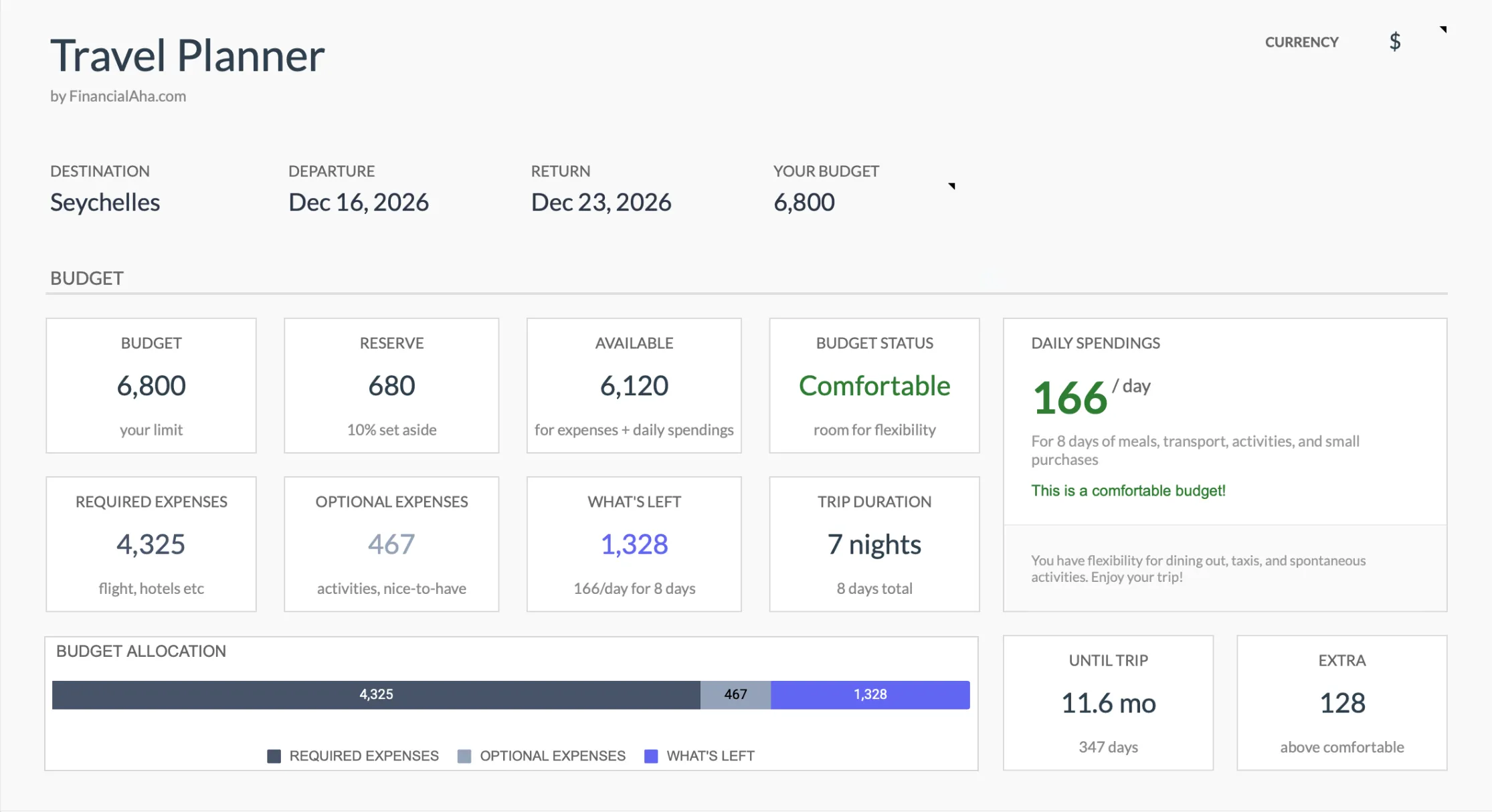
The Travel Budget Planner (Premium tier) summarises one trip at a glance: the budget, a reserve percentage set aside, what is left to spend per day, and the days until departure.
If you would rather start without spending anything, our roundup of free travel budget spreadsheets covers the no-cost options.
Related
- Travel Budget Planner - Plan individual trips
- Annual Budget Template - See travel in yearly context
- Vacation Savings Calculator - Work out the monthly amount for one trip
- Road Trip Budget Guide: Miles, Gas, and Stops - Budget a driving trip within the annual plan
- Sinking Funds Explained - The savings method behind a travel fund
- Best Free Travel Budget Spreadsheets - No-cost starting points
Frequently asked questions
How much should I budget for travel annually?
There's no universal answer - it depends on income, priorities, and lifestyle. Track current spending first, then decide if you want to spend more or less.
Should I save for all trips at once or separately?
Either works. One fund is simpler; separate savings per trip gives more control. Choose based on your preference.
What if I can't save enough for planned trips?
Either reduce trip costs (budget accommodations, shorter trips) or reduce number of trips. Worth considering how to make trips work within what you can save rather than borrowing.
Should travel points count toward my travel budget?
Yes - track their value and factor into trip planning. Points reduce cash needed but represent real value you've earned.
Where should an annual travel fund be kept?
Many people keep it in a separate high-yield savings account so it stays distinct from everyday spending and earns interest while it sits. Keeping it apart from the emergency fund also stops planned trips from eating into money set aside for surprises.
How do I budget when a trip's cost is still unknown?
Estimate from past trips or a quick price check on flights and lodging, then lean on the 10-20% buffer to absorb the gap. As real quotes come in, update the trip's line and reallocate any difference during a quarterly check-in.
About this article
Every sample figure in this guide (trip totals, buffer percentages, and monthly-savings amounts) is a worked example; each total and per-month number can be re-derived from the arithmetic shown. Last reviewed September 2026.