For most trips, ATMs in local currency and a card with no foreign transaction fees beat airport counters and exchange offices, where the spread runs far wider. Declining dynamic currency conversion, budgeting in your home currency with a 3-5% buffer for rate swings, and carrying a couple of days of cash as backup keep costs predictable.
International travel budgets have an extra layer of complexity: currency exchange. Fluctuating rates, hidden fees, and tracking expenses in unfamiliar denominations can turn a well-planned budget into confusion.
Plan your trip: The Travel Budget Planner tracks all bookings and payments in one place - enter costs in your home currency after converting.
Here’s how to manage currency exchange effectively.
Understanding Exchange Rates
Exchange rates tell you how much foreign currency you get for your home currency. Understanding a few key concepts helps you make better decisions about when and how to exchange money.
Example:
- EUR/USD rate: 1.08
- $1 USD = €0.93 EUR
- $100 USD = €93 EUR
Mid-Market vs. Retail Rate
The mid-market rate is the “real” rate - what banks charge each other. Use XE.com or Google for current mid-market rates as your reference point. The retail rate is what you actually get, which is always worse than mid-market. The difference is the exchange provider’s profit.
Typical spreads vary widely: banks and ATMs typically offer 1-3% worse than mid-market, exchange offices average 3-7% worse, and airports and hotels are often 7-15% worse. Knowing these ranges helps you evaluate whether you’re getting a reasonable deal.
Pre-Trip Planning
Budget in Home Currency
Plan your budget in your home currency first, then convert to estimate local spending. This keeps your planning grounded in familiar numbers while giving you a sense of what things will cost locally.
| Category | USD Budget | EUR Equivalent (at 1.08) |
|---|---|---|
| Accommodation | $800 | €740 |
| Food | $400 | €370 |
| Transportation | $200 | €185 |
| Activities | $300 | €278 |
| Total | $1,700 | €1,573 |
Build In Rate Fluctuation
Exchange rates change daily. Budget for 3-5% rate movement:
Budgeted Amount × 1.05 = Rate-Protected BudgetKnow Your Destination’s Costs
Research typical costs in local currency before you go. Knowing that coffee runs €3-5, lunch €12-20, dinner €25-50, and metro tickets €2-3 helps you mentally budget as you spend. Our budget travel Europe daily costs guide breaks down realistic ranges by city, which prevents sticker shock and helps you recognize when prices seem unusually high.
Getting Cash
Best Options
ATMs in local currency usually offer the best rate. Bank ATMs tend to beat independent ones, larger withdrawals reduce the number of fee events, and declining “conversion” offers (explained below) keeps the rate on your card. Some banks offer competitive rates for account holders if you order currency 3-5 days before travel. Credit cards work well for purchases if you have one with no foreign transaction fees.
What to Avoid
Airport exchanges offer the worst rates and high fees - only use if absolutely necessary. Hotel exchanges are convenient but expensive. Street exchanges are risky and often scam-prone.
Dynamic Currency Conversion (DCC)
When paying abroad, merchants sometimes offer to charge you in your home currency instead of local currency. For example: “Would you like to pay €50 or $58 USD?” This sounds convenient, but it’s almost always a bad deal.
Why Declining Usually Costs Less
The merchant’s rate is markedly worse, often 3-8% above your card’s rate. Choosing local currency lets your card handle the conversion instead, which is typically the cheaper rate.
How to Decline
At ATMs, select “continue without conversion” or “local currency.” For card payments, tell the merchant “local currency, please.” Declining is routine, and it keeps the conversion on your card’s rate rather than the terminal’s.
Credit vs. Debit vs. Cash
Credit Cards (Best for Purchases)
Credit cards typically offer the best exchange rates, plus purchase protection and rewards. The key is having a card with no foreign transaction fees. The downside is that cards aren’t accepted everywhere, and some countries are more cash-dependent. Look for cards with no foreign transaction fees, reasonable annual fees, and widely accepted networks (Visa/Mastercard).
Debit Cards (Best for ATM Withdrawals)
Debit cards give direct access to your money and work for ATM withdrawals. Watch out for foreign transaction fees (check your bank) and double ATM fees from both your bank and the local ATM. Debit cards also offer less fraud protection than credit cards. Some banks reimburse ATM fees and waive foreign transaction fees on debit - worth researching before travel.
Cash
Cash works everywhere and serves as backup when cards don’t work. It also makes budgeting easier through the physical limit of what’s in your wallet. The downsides are exchange fees, risk of theft or loss, and no fraud protection if stolen.
Managing Multiple Currencies
Multi-Country Trips
When visiting multiple currency zones, you have two main approaches. Getting each currency means exchanging as needed - you’ll have local cash but also leftover currency. A card-primary strategy uses cards as much as possible with small cash withdrawals in each country. The euro zone offers an advantage here: 21 of the 27 EU countries share one currency, which makes multi-country Europe trips simpler.
Tracking Expenses in Foreign Currency
Method 1: Track in Local, Convert Later
Log all expenses in local currency and convert totals at the end of the trip. This is easier in the moment, but budget comparison is harder until you convert.
Method 2: Convert at Entry
Convert each expense to home currency immediately using the formula: Home Currency = Local Amount times Current Exchange Rate. This gives real-time budget awareness but requires looking up rates.
Method 3: Use Conversion Apps
Apps like XE Currency convert on the fly, combining convenience with accuracy.
Tracking Template
| Date | Item | Local | Rate | USD |
|---|---|---|---|---|
| Mar 15 | Lunch | €18 | 1.08 | $19.44 |
| Mar 15 | Metro | €2.50 | 1.08 | $2.70 |
| Mar 15 | Museum | €15 | 1.08 | $16.20 |
Handling Leftover Currency
Before Leaving
Spend down cash on your last day, use it for airport purchases (overpriced but at least uses the currency), or keep a small amount for future trips to the same region.
At Home
Options for leftover currency include bank exchange (usually poor rates for small amounts), currency exchange services, saving for a future trip, or donating to charity (some accept foreign currency). Estimating cash needs conservatively avoids the problem: leaning on a card for the final purchases leaves less foreign currency to deal with once you’re home.
Fee-Saving Strategies
Credit Card Selection
Look for cards with no foreign transaction fees, good exchange rates, and no annual fee (or worthwhile benefits that justify the fee).
Bank Selection
Consider accounts that offer no foreign ATM fees, ATM fee reimbursement, and no foreign transaction fees on debit. These features can save significant money over a trip.
Withdrawal Strategy
Fewer, larger withdrawals beat many small ones. Five withdrawals of $50 means fees on each; one withdrawal of $250 means one fee event. Worth noting: notifying your bank about travel dates and destinations can help avoid unexpected card blocks.
Country-Specific Tips
Cash-Heavy Countries
Japan, Germany, and Austria are more cash-dependent - carry more cash than you might expect. Card-friendly countries like Scandinavia, UK, and Netherlands accept cards almost everywhere.
Tipping Cultures
US travelers often over-tip abroad. Many countries don’t expect US-style tips, so research destination norms before you go. This affects your budget and helps you avoid awkward situations.
Budget Adjustment During Trip
Daily Rate Check
Glance at exchange rates daily during your trip. If your currency strengthens, you have more buying power. If it weakens, tighten spending accordingly.
The 50% Checkpoint
Halfway through your trip, count remaining cash, review card spending, compare to budget, and adjust plans for remaining days. This mid-trip review prevents end-of-trip surprises.
Tools for Currency Management
Travel Budget Planner
The Travel Budget Planner tracks flights, accommodation, car rental, transfers and activities across 13 expense categories, each booking carrying an estimated cost beside the actual, the amount paid and the amount still due. Alongside that sit a budget dashboard showing what’s left per day, a payment schedule built from pay-by dates, and a Planning sheet holding pre-trip expenses and a packing checklist. It works in a single currency: convert each cost to your home currency once, enter it, and the dashboard does the rest.
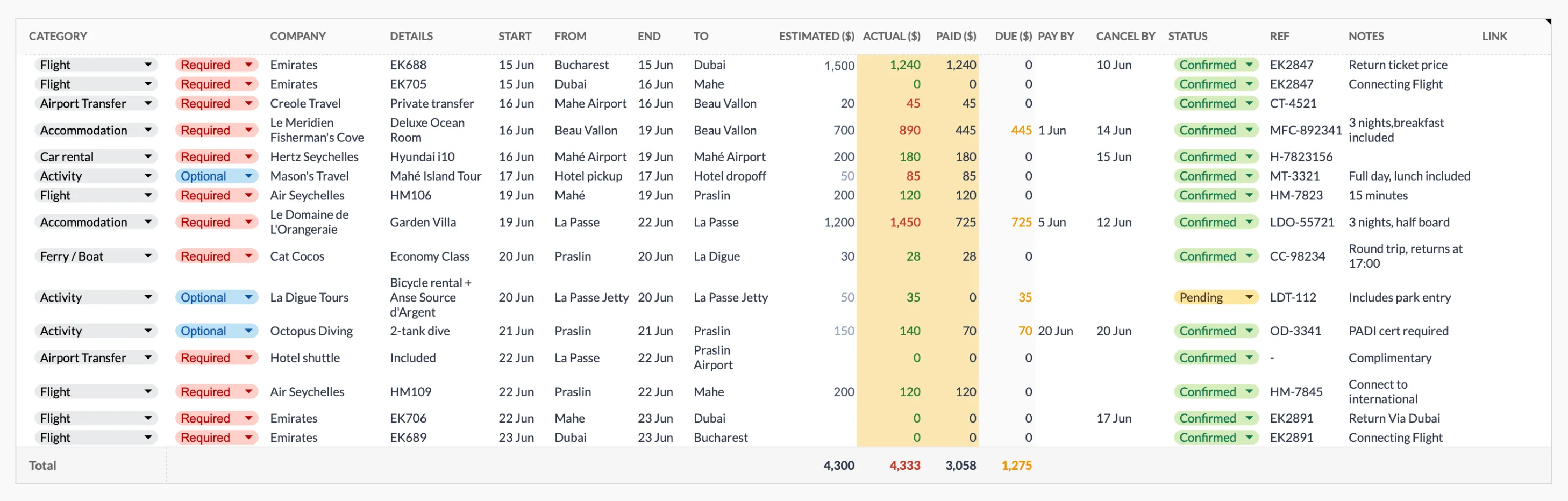 The Travel Budget Planner (Premium tier) logs estimated against actual, paid and due amounts for every booking. Convert each foreign cost to your home currency before entering it.
Google Sheets Formula
In a sheet you build yourself, the GOOGLEFINANCE function auto-converts currency: =GOOGLEFINANCE(“CURRENCY:EURUSD”). This returns the current EUR to USD rate for live calculations. The Travel Budget Planner does not use it, since that template works in one currency.
Related
- International Travel Budget: Currency, Fees, and Real Costs - The complete international trip budget guide
- Travel Budget Planner - Estimated vs actual costs across 13 expense categories
- How to Track Expenses While Traveling
- Budget Travel Europe: Daily Costs
- Vacation Savings Calculator: Plan the Trip Fund
Frequently asked questions
Is it worth exchanging money before traveling?
Some cash is useful for arrival. Most exchange can happen via ATM abroad at better rates. Getting a small amount before departure provides peace of mind.
How much cash do I need to carry?
Generally, 2-3 days of expenses in cash works well, with the rest on cards. Cash-heavy countries need more; card-friendly countries need less.
Are travel money cards worth it?
Prepaid travel cards lock in exchange rates but often have fees. For most travelers, a no-fee credit card plus debit ATM access is simpler and often cheaper.
What if my card is declined abroad?
Have backup: a second card from a different network and some emergency cash. Notifying your bank before travel prevents most blocks.
Do multi-currency cards like Wise or Revolut save money abroad?
Multi-currency accounts and cards convert at or near the mid-market rate, which can beat a typical bank spread. Fees and weekend surcharges vary by provider and plan, so the terms are worth checking. Many travelers use one alongside a no-fee card rather than as a full replacement.
Sources
- The euro: Countries using the euro - European Union
About this article
Euro-area membership count verified against the European Union's official 'countries using the euro' page (21 of 27 EU countries) Template sheets, inputs and outputs checked on 2026-09-10 against the shipped Travel Budget Planner Google Sheet (Summary, Bookings, Planning, Categories, Setup, Instructions tabs), including the 13 expense categories and the single-currency note in the Instructions tab Last reviewed September 2026.