A practical guide to budget travel costs in Europe - with daily expense estimates by country and tips for stretching your travel budget further.
The price gap across Europe is staggering. A day in Zurich can cost what an entire week costs in Bucharest. That’s not an exaggeration - it’s the simple reality of a continent where a dozen different economies sit side by side, connected by cheap flights and train lines. Understanding where your money goes furthest, and why, is the difference between a trip that stretches three weeks and one that runs dry after ten days.
Planning tool: The Travel Budget Planner takes one trip budget, adds up your bookings and pre-trip costs, and shows what is left to spend per day.
How European Travel Costs Actually Work
Before diving into country-by-country numbers, it helps to understand what drives the variation. The biggest factor is simply cost of living - wages, rent, and grocery prices in Scandinavia and Switzerland are multiples of what they are in the Balkans, and tourism prices follow suit. But within each country, the spread between a major city and a smaller town can be dramatic too. Paris costs 30-40% more than Lyon. Dubrovnik - thanks to Game of Thrones tourism and cruise ship crowds - costs nearly double what you’d pay in Zagreb.
Accommodation takes the largest bite of any travel budget, typically 35-45% of daily spending. Food comes next, then activities and transport. This means the single most impactful decision you make isn’t which restaurant to eat at or which museum to visit - it’s where you sleep. A hostel dorm at $15 per night versus a hotel at $90 per night isn’t just a comfort difference; it reshapes what the entire trip costs.
It also helps to know what a day at each level actually buys, because the labels mean different things to different travelers. A budget day covers a hostel dorm or a cheap hotel bed, two inexpensive meals, one sit-down meal, local public transit, and one free or low-cost activity. A moderate day swaps that for a three-star hotel or a decent apartment, two proper restaurant meals, one paid attraction, and the occasional taxi. Every line in that list scales with the country, which is why the same budget day costs around $35 in Bucharest and closer to $180 in Zurich.
The time of year matters almost as much as the country. High season (June through August) inflates accommodation prices by 30-50% across the board, and popular destinations book out entirely. Shoulder season - April through May and September through October - often delivers the best combination of reasonable prices, decent weather, and manageable crowds. Low season saves the most money, but some attractions operate on reduced schedules and northern destinations can be genuinely cold.
The size of that seasonal swing varies by destination more than most people expect. Coastal Croatia in August runs roughly 50% above what the same rooms cost in May or October. Italy in shoulder season tends to come in 20-30% below peak summer. Iceland is the extreme case, where summer pricing can sit around 70% above winter, which is enough to move a whole trip from one budget tier to another.
The Expensive North and West
Switzerland is in a category of its own. Budget travelers realistically spend $120-180 per day, and moderate travelers land in the $200-300 range. Even hostels charge premium prices, and a simple restaurant lunch can run $25-30. The scenery is extraordinary, but the cost is real. Some travelers handle this by transiting through Switzerland quickly or packing food from neighboring countries where groceries cost a fraction of the price.
The Nordic countries - Norway, Sweden, Denmark - follow a similar pattern at $100-150 per day for budget travelers and $180-250 for moderate ones. Groceries become essential here. Eating every meal at restaurants in Stockholm or Copenhagen will drain a budget fast, but the same cities have excellent supermarkets where you can assemble a perfectly good meal for a quarter of the restaurant price. Iceland pushes even higher at $130-180 daily on a budget, and camping becomes a genuine strategy rather than just an adventure choice.
France, Germany, the UK, and the Benelux countries occupy the mid-range tier, though with significant internal variation. France on a budget runs $70-100 per day, but that average masks a wide gap between Paris and the countryside. A week in Provence or Brittany costs noticeably less than a week in the capital, and the experience is arguably richer. Germany is one of Western Europe’s better values at $60-90 per day on a budget - beer is cheap, public transit is excellent, and the country has an extensive network of affordable accommodation. The UK runs higher at $80-120 per day, with London acting as a significant outlier that can blow through daily budgets before lunch. Austria, Ireland, the Netherlands and Belgium sit in the same band, with budget days landing between $90 and $105 and moderate days between $170 and $190.
Italy and Spain straddle the line between Western European prices and Southern European value. Italy on a budget runs $70-100 per day, with Venice and Milan at the expensive end and the south - Naples, Puglia, Sicily - offering considerably more for less. Spain delivers some of Europe’s best value for food quality, with budget days running $60-90. The tapas culture in particular means you can eat remarkably well without ever sitting down at an expensive restaurant.
The East: Where Budgets Breathe
Eastern Europe is where budget travel feels genuinely comfortable rather than like a constant exercise in restraint. Poland runs $35-55 per day on a budget, with excellent food, clean hostels, and efficient public transport. Krakow and Warsaw both offer remarkable value, and even in peak season, prices stay reasonable by Western standards.
The Czech Republic comes in slightly higher at $45-65 per day, mostly because Prague’s popularity has pushed accommodation prices up. But even in Prague, a beer still costs what a coffee costs in London, and food remains impressively affordable. Step outside Prague to cities like Brno or Cesky Krumlov and prices drop further still.
Hungary sits alongside Poland as one of Europe’s best value destinations. Budapest at $35-55 per day offers thermal baths, stunning architecture, and a food scene that would cost three times as much in Paris. The ruin bars of the Jewish Quarter deliver an atmosphere you can’t buy at any price - and the drinks cost a fraction of what they would in Western Europe.
Romania and Bulgaria represent the floor of European travel costs at $30-50 per day on a budget. These aren’t compromise destinations either - the Transylvanian countryside, Bucharest’s unexpected energy, Sofia’s growing food scene, and the Black Sea coast all offer genuine travel experiences at prices that make Western Europeans do a double take.
Croatia is the exception in the region, with Dubrovnik in particular approaching Western European prices at $50-75 per day on a budget. The Dalmatian coast is worth the premium for many travelers, but heading inland to Zagreb or the Plitvice Lakes brings costs back in line with the broader Eastern European range.
The Baltic states - Estonia, Latvia, Lithuania - land around $45-65 per day on a budget. Tallinn is the priciest of the three capitals, but all offer a distinctive blend of medieval old towns, strong coffee culture, and prices that feel generous after Western Europe.
Southern Europe: The Middle Ground
Portugal has become one of Europe’s most popular budget destinations, and for good reason. At $50-75 per day, Lisbon and Porto deliver world-class food, striking architecture, and a pace of life that rewards slow travel. The Algarve varies sharply by season - summer beach prices versus quiet off-season rates - so timing matters here more than in most places.
Greece on a budget runs $50-80 per day on the mainland and higher on the islands. The island premium is real but varies enormously - Santorini and Mykonos charge near-Western European prices, while less famous islands like Naxos or Milos offer the same sparkling water and whitewashed charm at a fraction of the cost. Mainland Greece, particularly outside Athens, remains one of Southern Europe’s better values.
Turkey - for visitors who include it in their European itinerary - offers exceptional value at $35-55 per day. Istanbul runs slightly higher than the rest of the country, but even there, the quality-to-price ratio on food and accommodation is remarkable. The bazaars, the Bosphorus, and the depth of history available for the price of a modest hotel room make it one of the continent’s most compelling budget destinations.
Daily Costs at a Glance
Every figure above, collected in one place for a single traveler. None of these numbers include flights to Europe.
| Country or region | Budget ($/day) | Moderate ($/day) |
|---|---|---|
| Romania, Bulgaria | 30-50 | 80-100 |
| Poland | 35-55 | 90-110 |
| Hungary | 35-55 | 90-110 |
| Turkey | 35-55 | 90-110 |
| Czech Republic | 45-65 | 110-130 |
| Baltics (Estonia, Latvia, Lithuania) | 45-65 | 110-130 |
| Croatia | 50-75 | 110-140 |
| Portugal | 50-75 | 110-140 |
| Greece | 50-80 | 120-150 |
| Spain | 60-90 | 130-160 |
| Germany | 60-90 | 150-180 |
| Italy | 70-100 | 140-180 |
| France | 70-100 | 150-210 |
| UK | 80-120 | 160-220 |
| Austria, Ireland, Netherlands, Belgium | 90-105 | 170-190 |
| Norway, Sweden, Denmark | 100-150 | 180-250 |
| Iceland | 130-180 | 250-320 |
| Switzerland | 120-180 | 200-300 |
The moderate column assumes a three-star hotel or a good apartment, two restaurant meals a day, and a paid attraction. Across Eastern and Southern Europe it lands at roughly double a budget day; in the expensive north the gap narrows to about 1.7 times, because the budget tier is already carrying high fixed prices. City-level costs move around inside these national ranges, and Numbeo’s crowdsourced cost-of-living data is one way to sanity-check a specific city before locking a number into a plan.
Couples come out ahead of these figures, but less than people expect. Sharing one room saves 25-30% on accommodation and almost nothing on food, transit, or activities, so per-person daily cost for two people travelling together tends to land near 85% of the solo number.
The Accommodation Decision
How you sleep shapes everything else about your budget. Hostel dorms at $15-30 per night (varying by country) are the foundation of shoestring travel, but they come with trade-offs in privacy and sleep quality that not everyone tolerates well. Private rooms in hostels often split the difference - $30-60 per night gets you a door that locks, usually with access to a communal kitchen, at prices well below hotels.
Airbnb and apartment rentals become more economical for stays of three nights or longer, especially for couples or small groups who can split the cost. A two-bedroom apartment in Lisbon or Budapest for $60-80 per night, divided among three or four people, can undercut even hostel prices while adding a kitchen - which cuts food costs significantly.
Hotels start making sense at the moderate budget level, and the gap between boutique hotels in Eastern Europe ($40-70) and chain hotels in Western Europe ($120-200) is another reason geographic strategy matters so much. Within a single city the spread is just as wide: a four-star room in Rome runs around $250 a night, a good three-star around $130, a plain budget hotel around $80, and a private hostel room around $50. Same city, five times the price, and no other single decision moves a trip total that far.
One line quietly disappears from most plans, and that is the travel day. A flight landing at 9pm in Rome still costs a full hotel night, and so does an early departure at the far end of the trip. Counting nights rather than sightseeing days keeps that from surfacing as a surprise later.
Getting Around
Transportation within Europe has become remarkably affordable thanks to budget airlines and bus networks. Flixbus connects hundreds of European cities at prices that sometimes seem like typos - $10 for a four-hour intercity trip is common. Trains are faster and more comfortable, but prices vary wildly depending on when you book. A Paris-to-Amsterdam ticket bought two months ahead might cost $30; the same ticket the day before might cost $120.
Rail passes - the Eurail pass being the most common - are worth calculating carefully rather than assuming they save money. For travelers moving between cities every two or three days, a pass often makes sense. For those spending a week in each location with just a few train rides total, point-to-point tickets purchased early tend to be cheaper. Within cities, public transit is almost always the right move, and multi-day passes can reduce per-ride costs significantly.
Flights get underestimated twice over. Getting to Europe from the US typically costs $600-1,400 per person round trip depending on season and route, and none of the daily figures on this page include it. Once you have landed, low-cost carriers like Ryanair, EasyJet and Wizz Air move you between countries for $30-120 a segment, though the headline fare rarely covers a checked bag or a convenient airport. Rome2Rio is useful for pricing those in-between days, since it puts train, bus and flight options for the same route side by side.
Each additional country adds one of those moves, which is why two weeks across four countries costs more per day than the same two weeks in one or two. Three inter-city flights at around $110 each add $330 per person before anyone has seen anything, and every one of them consumes a half-day that would otherwise have been a cheap day.
A Two-Week Trip, Costed Out
Ranges are useful for choosing a destination. A single number is what you actually save toward. Here is a moderate-tier fortnight for two people in October, split between Italy and Croatia: five nights in Rome, three in Florence, three in Split, and three in Dubrovnik.
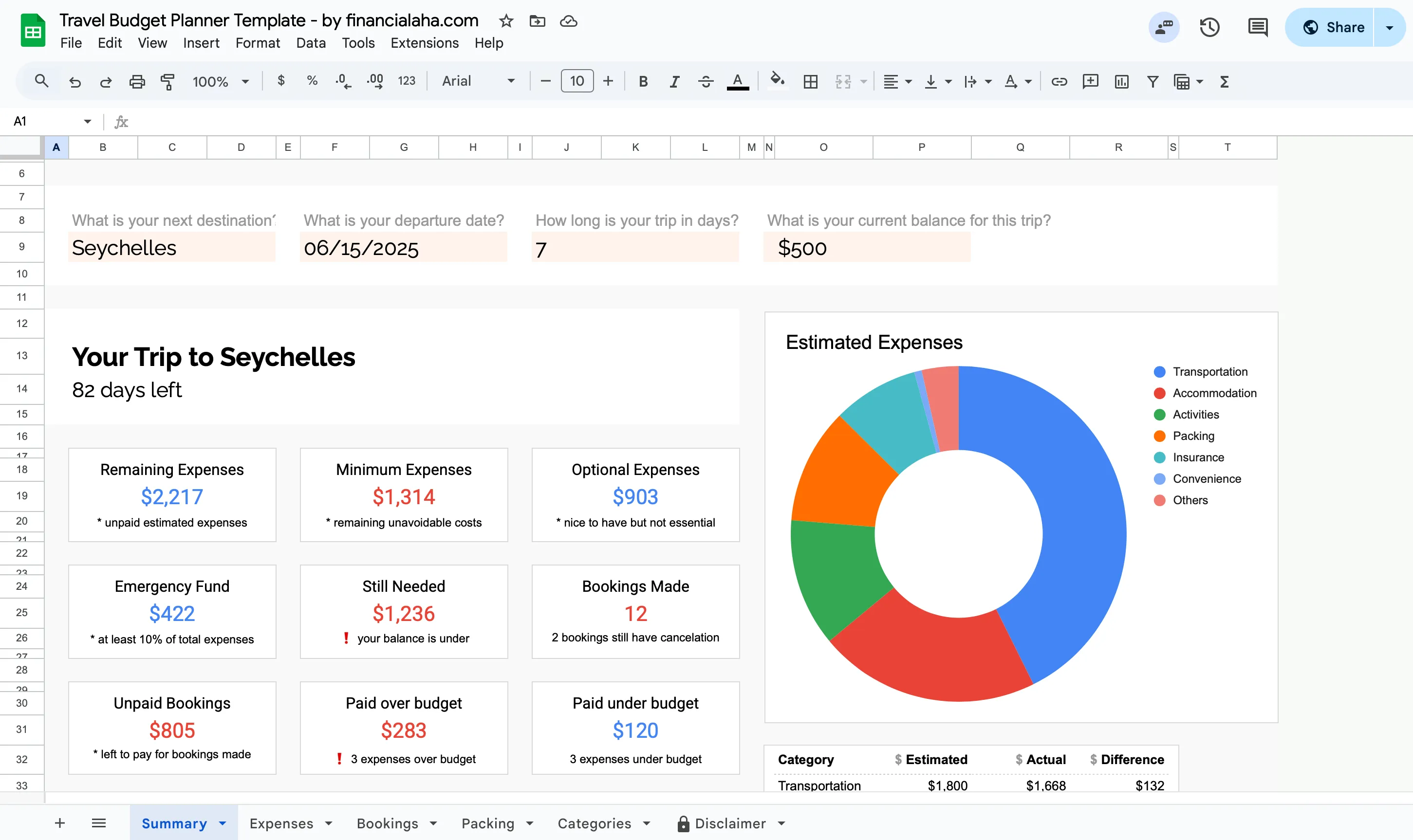
The Premium Travel Budget Planner records an estimated and an actual cost for every booking and pre-trip expense, then breaks the total down by category on the Summary tab.
At the moderate rates above, Italy runs about $165 a day solo and Croatia about $130. Applying the 85% couple factor gives $140 a day per person in Italy and $110 in Croatia. Dubrovnik sits at the top of the Croatian band and Split below it, so the average holds across the six nights on the coast.
| Stop | Nights | Per person per day | Per person total |
|---|---|---|---|
| Rome | 5 | 140 | 700 |
| Florence | 3 | 140 | 420 |
| Split | 3 | 110 | 330 |
| Dubrovnik | 3 | 110 | 330 |
| In-country subtotal | 14 | 1,780 |
Then the costs that arrive as lump sums and get split between two people.
| Item | Per couple | Per person |
|---|---|---|
| Round-trip flights from the US East Coast | 1,800 | 900 |
| Train, Rome to Florence | 80 | 40 |
| Flight, Florence to Split | 220 | 110 |
| Bus, Split to Dubrovnik | 30 | 15 |
| Travel insurance | 200 | 100 |
| Transport and extras subtotal | 1,165 |
The trip comes to $2,945 per person, or $5,890 for the couple. Daily spending is only about 60% of that. Flights, the three inter-city moves and insurance make up the rest, and that is exactly the part missing whenever a two-week Europe trip gets estimated off daily costs alone.
Two of those lines fall out of a first draft more often than any others. Travel insurance at roughly $100 per person for a fortnight is small enough to forget and large enough to notice. The inter-city moves get filed mentally as travel rather than as spending, even though they cost more here than a week of restaurant meals. Tipping runs the other way: it is lighter across Europe than in the US, and in several countries a service or cover charge already sits on the bill, so that line usually comes in below what American travelers set aside for it.
Putting It All Together
The most powerful budget lever in European travel isn’t finding the cheapest hostel or the least expensive restaurant - it’s geographic strategy. A three-week trip that spends one week in Western Europe and two weeks in Eastern or Southern Europe costs roughly the same as two weeks spent entirely in the west. Mixing expensive and affordable countries lets you experience more of the continent without blowing through your savings. The mechanics of splitting one pot across several currencies and price levels are worth mapping out in advance, which is the whole point of a proper international travel budget.
A realistic two-week budget trip through Western Europe - combining accommodation, food, transit, and activities - runs roughly $1,600 before flights. The same two weeks in Eastern Europe costs closer to $980. These aren’t shoestring, eat-nothing-but-bread numbers. They assume private hostel rooms, a mix of cooking and eating out, public transit, and entry to paid attractions.
For a month-long trip, the range is wide: $2,500-4,000 focused on Eastern Europe, $4,000-6,000 mixing regions, and $6,000-10,000 centered on Western Europe and Scandinavia.
Tracking spending while traveling prevents budget creep. A few minutes each evening logging the day’s expenses catches overspending before it’s too late to adjust, and a free travel budget spreadsheet is enough to get started if a full planner feels like more than the trip needs. The halfway check is particularly useful - if you’ve spent more than 50% of your budget halfway through the trip, it’s time to shift toward cheaper meals, free activities, or a less expensive next destination.
The Travel Budget Planner holds one trip at a time: destination, dates, a single currency, and every booking and pre-trip expense, with a countdown to departure and a running total of what the trip costs. Having a clear number to save toward, rather than a vague sense of “enough,” tends to make the pre-trip saving phase more effective. To turn that target into a monthly amount, the vacation savings calculator walkthrough shows how the timeline math works.
Related
Frequently asked questions
How much for a month in Europe?
Budget: $2,500-4,000 (Eastern Europe focus). Moderate: $4,000-6,000 (mixed countries). Comfortable: $6,000-10,000 (Western Europe focus).
Is Western Europe worth the extra cost?
Different experience, not better or worse. Western Europe offers iconic attractions; Eastern Europe offers value and authenticity.
Should I buy a rail pass?
Worth calculating point-to-point tickets first. Passes often aren't cheaper unless you're moving between cities frequently.
How far in advance should I book?
Flights: 2-3 months ahead. Accommodation: 1-2 months (longer for peak season). Trains: 2-4 weeks for best prices.
Do these daily costs include flights?
No. Every figure on this page covers costs once you are in Europe. Round-trip flights from the US typically run $600 to $1,400 per person depending on season and route, and they sit as a separate line in any trip budget. Flights between European cities on low-cost carriers usually run $30 to $120 per segment.
Does the Schengen 90-day limit affect a long trip?
For most non-EU travelers, yes. The rule allows 90 days inside the Schengen Area within any rolling 180-day window. Croatia, Romania and Bulgaria are now inside Schengen, so they no longer reset anything. The UK, Ireland, Turkey and most of the Western Balkans sit outside it, which is why longer itineraries often route through them.
How much cheaper is Europe for a couple?
Couples save roughly 25 to 30 percent on accommodation by sharing one room, but little on food, transit or activities. Per-person daily cost for a couple usually lands around 85 percent of the solo figure.
Is it cheaper to book everything ahead or leave room to improvise?
The big fixed costs reward booking early. Long-haul flights, high-speed trains and peak-season rooms all climb as the date approaches. Day-to-day spending on food, local transit and activities barely moves whether you plan it or not, so many travelers lock the expensive lines in advance and leave the daily budget flexible.
Sources
- Schengen Area - European Commission
About this article
Schengen Area membership and the 90/180-day short-stay rule checked against the European Commission's official Schengen page. Daily cost ranges cross-checked against Numbeo's crowdsourced cost-of-living index for representative cities in each country. Travel Budget Planner sheets, inputs and outputs checked on 2026-09-10 against the shipped Google Sheet (Summary, Bookings, Planning, Categories, Setup tabs). Last reviewed September 2026.