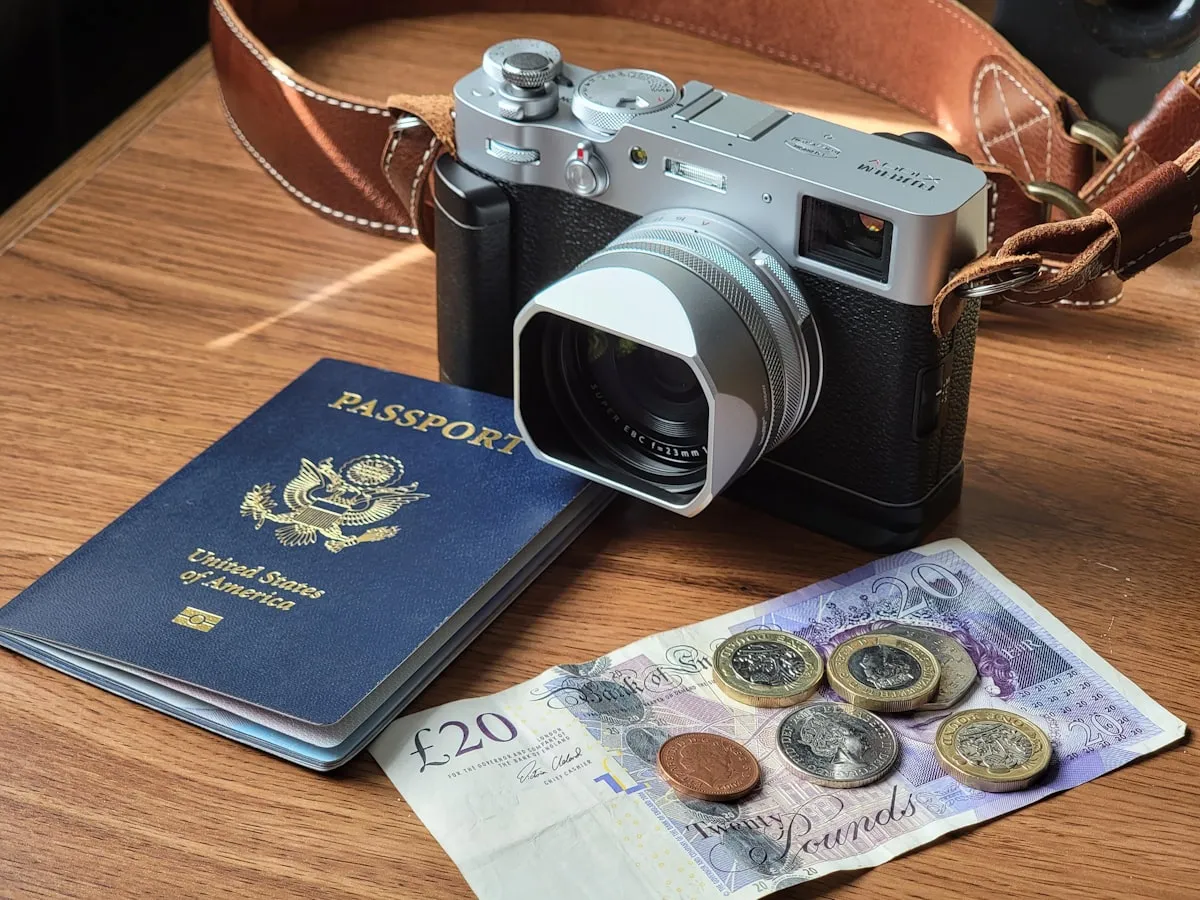
International travel adds costs a domestic trip never sees: currency exchange margins that run from about 1% at an ATM to 8-15% at an airport kiosk, foreign transaction fees of 1-3% per card purchase, and stacked ATM charges. The method is to research current local prices, convert at today's rate, then add a fee line of roughly 3% and a 10-15% buffer. A moderate 10-day Portugal trip for two lands near $4,700, with about $555 of that in fees and buffer alone.
Domestic travel budgets are straightforward. International adds layers - currency exchange losses, foreign transaction fees, ATM charges, costs that vary wildly from what guidebooks estimate. Understanding these costs before leaving helps avoid expensive surprises.
The Hidden Cost of Currency Exchange
The exchange rate on Google isn’t the rate you’ll get. Every service builds in a margin between the mid-market rate (what currencies actually trade at) and the rate offered to consumers. These margins vary dramatically.
Banks typically add 2-4% above mid-market rate. Airport exchange kiosks take 8-15% - the convenience comes at a steep price. Hotel exchanges fall somewhere in between at 5-10%. ATMs abroad usually offer the best rates at 1-3% above mid-market.
On $1,000 exchanged, an airport kiosk might cost $100+ more than using an ATM abroad. Over a two-week trip with significant spending, these differences compound.
Where to exchange, roughly from best to worst: ATMs abroad using a no-fee debit card offer the best rates for most travelers. Your bank before travel typically offers fair rates without the pressure of needing cash immediately. Local banks abroad sometimes offer competitive rates. Exchange bureaus vary widely - worth checking the rate before committing. Hotels are a last resort with poor rates but sometimes necessary. Airports offer the worst rates and are worth avoiding except for minimal amounts needed immediately upon arrival.
Foreign Transaction Fees
Most credit and debit cards charge 1-3% on every foreign currency transaction. Under the CFPB’s finance-charge rules, a foreign transaction fee is any charge for buying in a foreign currency, buying from a foreign merchant, or spending outside the country, so it can apply even to purchases from foreign companies made while you’re home.
On a $3,000 trip with 3% foreign transaction fees, that’s $90 in fees - money that could have been spent on the trip itself.
Cards without foreign transaction fees exist. Chase Sapphire, Capital One Venture, and many airline cards waive these fees. For frequent international travelers, these cards are worth considering - the fee savings over a single trip can offset annual card costs.
Dynamic Currency Conversion Trap
When paying abroad, merchants sometimes offer to charge in USD instead of local currency. This is called dynamic currency conversion, and it’s worth declining.
The merchant sets the conversion rate, and it’s typically 3-7% worse than what your credit card would charge. Choosing local currency when the terminal asks gets you your credit card’s conversion rate, which almost always beats the merchant’s.
ATM Fees Abroad
ATM withdrawals abroad can incur multiple fees from different sources: your bank’s foreign ATM fee ($2-5), the ATM operator’s fee, foreign transaction percentages, and sometimes poor exchange rates built into the transaction.
Several approaches minimize these costs. Use partner ATMs: Bank of America’s Global ATM Alliance, for example, waives its own $5 ATM fee and the operator access fee at partner banks in several countries. Withdraw larger amounts to reduce the number of transactions if flat fees apply. Use no-fee cards like Charles Schwab’s Investor Checking, whose debit card reimburses ATM fees worldwide, though not the dynamic currency conversion markup. One common tip: declining the ATM’s offer to convert currency and withdrawing in local currency tends to result in a better exchange rate, since your bank’s rate is typically more favorable than the ATM operator’s markup.
Real Costs vs. Guidebook Estimates
Guidebooks are often outdated by the time you read them. Several factors cause estimates to diverge from reality.
Inflation affects international costs just like domestic ones. A 2023 guidebook underestimates 2026 costs by 10-20% in most destinations. Post-pandemic tourism pricing has accelerated this in many popular areas.
Tourist pricing creates pockets of higher costs. Popular areas charge more than local neighborhoods. Eating at restaurants near major attractions costs significantly more than places a few blocks away where locals eat.
Your travel style matters. Budget guides assume budget travel - hostels, street food, public transit. If you prefer private rooms over dorm beds, restaurants over cooking, or taxis over buses, adjust estimates upward accordingly.
Seasonality swings costs dramatically. High season typically costs 20-50% more than shoulder or low season for accommodation especially. Flight prices vary similarly.
Building Your Budget
Creating an accurate international travel budget requires research, conversion, and adding layers for fees and uncertainty.
Research current costs using travel forums and recent blog posts. These sources provide more current pricing than printed guidebooks. Look for posts from the past 6-12 months for relevant numbers. For a step-by-step build in a blank sheet, see how to plan a trip budget in Google Sheets.
Convert to your currency using the current rate, then add 5-10% buffer for exchange losses and rate fluctuations between now and your trip.
Add fee categories that international travel specifically requires.
| Item | Notes |
|---|---|
| Flights | Usually paid in dollars |
| Accommodation | Local currency |
| Food, activities, transport | Local currency |
| Exchange fees | 2-3% of total |
| ATM fees | Estimate based on withdrawals |
| Buffer | 10-15% of total |
If you’d rather not build the layout from scratch, the Travel Budget Planner sets up pre-trip expenses, booking tracking with estimated, actual, paid and due amounts, and a daily spending allowance for whatever is left once those are covered, all in Google Sheets. It keeps a reserve line for the buffer, set as a percentage of the budget on the Setup sheet and starting at 10%. It works in a single currency: you set the symbol in the Summary header, and the instructions cover converting foreign amounts to your home currency as you enter them.
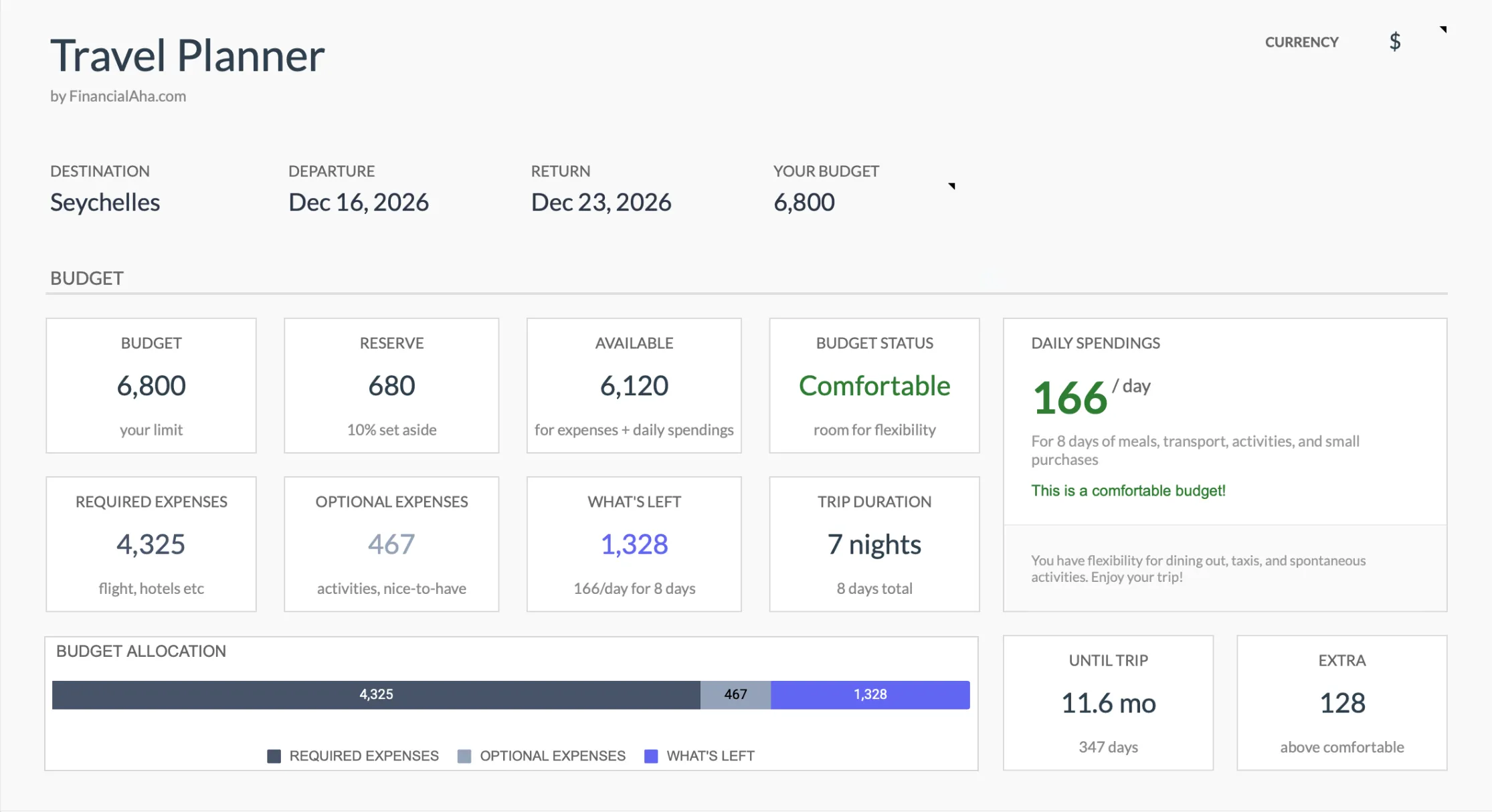 The Travel Budget Planner (Premium tier): a budget limit, a 10% reserve set aside, a daily spending allowance for the days of the trip, and a currency symbol field in the top corner that labels every money column.
Sample Budget: 10 Days in Portugal (2 people)
Here’s what a moderate international trip budget might look like in practice. Portugal represents a mid-range European destination.
| Category | USD |
|---|---|
| Flights | $1,200 |
| Hotels (9 nights) | $1,485 |
| Food | $770 |
| Local transport | $165 |
| Activities | $330 |
| Miscellaneous | $220 |
| Exchange/fees (3%) | $125 |
| Buffer (10%) | $430 |
| Total | $4,725 |
Note that exchange fees and buffer add $555 to the base costs. These are real expenses that many travelers underbudget.
Related
- Travel Budget Planner - Pre-trip expenses, booking tracking, and a daily spending allowance in Google Sheets
- How to Plan a Trip Budget in Google Sheets - Build the layout yourself, step by step
- Best Free Travel Budget Spreadsheets - Free options for single-trip planning
- How to Save for a Vacation Using a Spreadsheet - Set the savings target before the trip
Frequently asked questions
Does it make sense to buy foreign currency before leaving?
Worth getting $100-200 equivalent for immediate expenses upon arrival. ATMs abroad usually offer better rates for larger amounts.
How much cash is appropriate to carry?
Enough for a few days of expenses plus an emergency reserve. This varies by destination - some countries are heavily cash-based while others accept cards everywhere.
What happens if a card is declined abroad?
Notify your bank of travel plans before leaving. Carry a backup card from a different issuer and know your PINs for all cards.
How much should I set aside just for fees on top of the trip cost?
A common approach is a line of about 3% for exchange and card fees plus a 10-15% buffer for rate swings and underestimates. On a $4,000 trip that works out to roughly $520-720 combined, separate from the actual flights, hotels, and food.
Is a card with no foreign transaction fee worth an annual fee?
It depends on how often you travel. On a single $3,000 trip, a 3% fee is about $90, so one or two international trips a year can offset a modest annual fee. Occasional travelers sometimes find a no-annual-fee card that also waives foreign fees covers the same ground.
Sources
- § 1026.4 Finance charge (foreign transaction fees and currency conversion) - Consumer Financial Protection Bureau
- Schwab Bank Investor Checking - unlimited ATM fee rebates worldwide - Charles Schwab
- International partner ATMs (Global ATM Alliance) - Bank of America
About this article
Foreign transaction fee and currency conversion mechanics checked against the CFPB's Regulation Z finance-charge rules No-fee ATM claims verified against the current Charles Schwab and Bank of America account pages Travel Budget Planner sheets, reserve setting and currency handling checked on 2026-09-10 against the shipped Travel Budget Planner Google Sheet (Summary, Bookings, Planning, Categories, Setup, Instructions tabs) Last reviewed September 2026.