
You can retire the year your invested balance reaches roughly 25 times your target annual spending. Four inputs settle it: current age, current balance, annual savings, and target spending, projected forward at about 7 percent real growth. The free Simple Retirement Calculator checks a retirement age you pick in Google Sheets with no signup, and the worked examples below trace the math at ages 30, 45, and 55.
The “when can I retire” question feels intimidating because most calculators ask for 25 inputs. The honest version of the calculation needs four. This post walks through both the simple version and the longer version, with three worked examples at different ages.
The four inputs that matter most
If you can answer these four questions, you can produce a retirement age estimate within 2 years of the more sophisticated versions.
- Current age.
- Current invested balance. Sum across all accounts (401k, IRAs, taxable brokerage, etc.).
- Annual savings. What you add to invested accounts each year (your contributions plus employer match).
- Target retirement spending. What you’d want to spend per year in retirement, in today’s dollars.
That’s it. Everything else (Social Security, pension, healthcare, taxes) refines the answer; the four-input model gets you the headline number.
The simple formula
Retirement balance needed = Target spending x 25
Current shortfall = Retirement balance needed - Current balance
Years to close shortfall = Years where (Annual savings + previous balance compounded) reaches target
In plain English: figure out your target portfolio (25x annual spending, the flip side of the 4 percent withdrawal rule), then project forward year by year adding savings and compounding the balance until you hit the target. The year you hit it is the year you can retire.
Math behind the projection (per year):
End balance year n = (Beginning balance year n + Annual savings) x (1 + Real return rate)7 percent real return is the common assumption. Lower (5 percent) for conservative; higher (8 percent) is optimistic.
A worked example: age 30
Anjali is 30. Currently has $80,000 invested. Saves $25,000/year (her contributions plus employer match). Target retirement spending: $55,000/year.
Target portfolio (25x): $55,000 x 25 = $1,375,000
Current shortfall: $1,375,000 - $80,000 = $1,295,000
Year-by-year projection at 7 percent real return:
| Age | Beginning balance | Savings | End balance |
|---|---|---|---|
| 30 | 80,000 | 25,000 | 112,350 |
| 35 | 266,000 | 25,000 | 311,000 |
| 40 | 527,000 | 25,000 | 591,000 |
| 45 | 893,000 | 25,000 | 982,000 |
| 49 | 1,289,000 | 25,000 | 1,406,000 |
| ~50 | 1,375,000 hit |
Anjali crosses her $1,375,000 target between age 49 and 50. At 7 percent real return, she could retire around 50.
A worked example: age 45
Marcus is 45. Currently has $320,000 invested. Saves $35,000/year. Target retirement spending: $70,000/year.
Target portfolio (25x): $70,000 x 25 = $1,750,000
Current shortfall: $1,750,000 - $320,000 = $1,430,000
Year-by-year projection at 7 percent real return:
| Age | Beginning balance | Savings | End balance |
|---|---|---|---|
| 45 | 320,000 | 35,000 | 380,000 |
| 50 | 664,000 | 35,000 | 748,000 |
| 55 | 1,147,000 | 35,000 | 1,265,000 |
| 59 | 1,670,000 | 35,000 | 1,824,000 |
| ~60 | 1,750,000 hit |
Marcus crosses his $1,750,000 target around age 59 to 60. At 7 percent real, he could retire then.
A worked example: age 55
Linda is 55. Currently has $710,000 invested. Saves $20,000/year (smaller because retirement is closer). Target retirement spending: $60,000/year.
Target portfolio (25x): $60,000 x 25 = $1,500,000
Current shortfall: $1,500,000 - $710,000 = $790,000
Year-by-year projection at 6 percent real return (Linda is more conservative; closer to retirement, less time to recover from down markets):
| Age | Beginning balance | Savings | End balance |
|---|---|---|---|
| 55 | 710,000 | 20,000 | 773,800 |
| 60 | 1,070,000 | 20,000 | 1,155,000 |
| 64 | 1,443,000 | 20,000 | 1,551,000 |
| ~65 | 1,500,000 hit |
Linda crosses her $1,500,000 target around age 64 to 65. With Social Security joining at 67, the two-year gap from 65 to 67 is the planning question; the portfolio supports it, but with less margin than a younger retiree would have.
What the simple version misses
Honest limitations.
Social Security and pensions. Adding $20K to $30K of inflation-adjusted income at 67 (or whenever you claim) materially changes the picture. The simple model treats portfolio withdrawal as the only income source.
Healthcare bridge. US retirees under 65 pay for healthcare without Medicare. ACA marketplace plans cost $500 to $2,000+ a month depending on income, age, and state. The simple model rolls this into “target spending” but it’s worth modeling explicitly if you’re early-retiring.
Tax efficiency in withdrawal. Drawing from taxable, tax-deferred, and Roth in different orders affects how long the portfolio lasts. Neither the simple model nor our retirement projection template splits a portfolio by account type; the projection template treats savings as one combined balance and asks for return assumptions already net of tax.
Sequence-of-returns risk. A bad first decade is much worse than a bad last decade. Deterministic models smooth this away. Monte Carlo (in tools like ProjectionLab) captures it.
One-time events. Inheritances, home sales, college costs, healthcare events. Add or subtract from the projected balance in the year they happen.
For an order-of-magnitude answer, the simple model is fine. For a real plan, layer in Social Security at minimum.
Adding Social Security to the simple model
Two changes:
- Estimate your Social Security benefit at full retirement age (67). The Social Security Administration provides this on your statement at ssa.gov/myaccount, and its Retirement Benefits planner explains how the amount is set. Roughly $2,000 to $3,500 per month for most middle-income workers, more for higher earners.
- Subtract that annual benefit from your target retirement spending starting at the claim year.
Example for Marcus (above): Social Security estimated $2,400/month at 67 = $28,800/year. From 67 onward, his portfolio only needs to cover $70,000 - $28,800 = $41,200/year. The portfolio drawdown rate effectively drops, extending sustainability.
In the projection, this means his $1,750,000 target at 25x is conservative; the realistic target accounting for Social Security is closer to $1,200,000. He could retire 2 to 3 years earlier than the simple model suggests. For a walkthrough of how the benefit itself is estimated, see estimating your Social Security benefits.
Where the calculator lives
Run the numbers here without leaving the page. Enter your current age and retirement age, current balance, monthly contribution, expected return, inflation, target income and expected Social Security, and it returns the projected balance at retirement, that balance in today’s dollars, and any gap between the income it supports and your target:
If you would rather keep a copy you can edit and re-run over the years, the free Simple Retirement Calculator spreadsheet runs a similar projection in Google Sheets. No signup, no email gate. It asks for your current age, a retirement age goal, life expectancy, current savings, monthly contributions, expected rate of return, estimated retirement expenses, extra retirement income and an inflation adjustment. The output is your value of savings at retirement, the monthly withdrawal needed, how many years the savings last, and whether the plan is flagged sustainable.
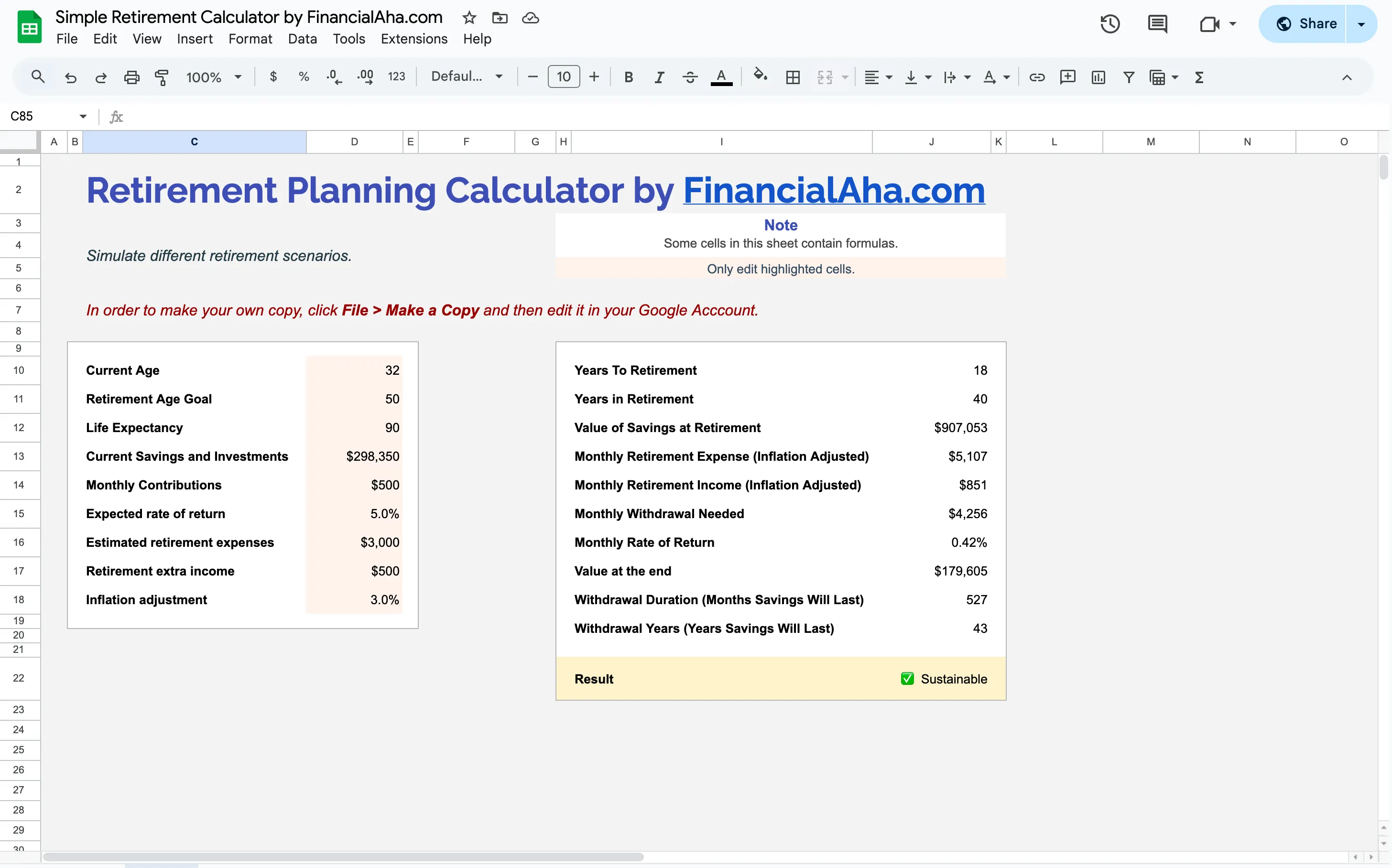 The free Simple Retirement Calculator, a single Google Sheets tab: the inputs on the left drive the projected balance at retirement and the sustainability check on the right.
For a fuller plan with a year-by-year withdrawal phase, see the paid Retirement Financial Planning Projections template ($39). It runs from your current age to life expectancy on one combined savings balance, adds pension income with its own start age, and shows the bridge years between retiring and that pension starting.
Sensitivity to the four inputs
How much each input moves the answer.
Current age: Each year you start later moves retirement age by roughly 0.7 to 1 year (you have less compounding time). Massive lever for late starters; not in your control going forward.
Current balance: Each $50,000 of additional starting balance moves retirement age earlier by roughly 1 year for someone in their 30s, 0.7 years for someone in their 40s.
Annual savings: Each additional $5,000 saved per year moves retirement age earlier by roughly 0.5 to 1 year. The biggest variable in your control.
Target spending: Each $5,000 reduction in target spending moves retirement age earlier by 1 to 1.5 years. The other big lever.
The two levers in your control (savings rate and target spending) move the answer most. Most people focus on increasing income; reducing target spending is just as effective and often easier.
Which tool fits your next step
Start with the estimate, then decide how much detail you need:
- Simple Retirement Calculator - one Google Sheets tab that projects your balance to a retirement age you set and flags whether the plan is sustainable. Free, no signup. Good enough for the headline number and quick what-ifs.
- Retirement Financial Planning Projections ($39) - year-by-year accumulation and withdrawal projection from your current age to life expectancy, with configurable inflation and net return assumptions, pension income, and conservative, base case and optimistic scenarios side by side. This is the one to reach for once the four-input estimate says you are close and the withdrawal phase starts to matter. It sits in the retirement library that 1,000+ customers across 65+ countries already use.
Related
Frequently asked questions
Is 7 percent real return realistic?
For a stock-heavy long-term portfolio, yes. The historical US stock market average is roughly 10 percent nominal, 7 percent after inflation. For a 60/40 portfolio, 5 to 6 percent real is more accurate. For bond-heavy allocations, 2 to 3 percent real.
Should I use today's spending or expected retirement spending?
Expected retirement spending in today's dollars. Most retirees spend 70 to 90 percent of their pre-retirement spending (work-related costs disappear; healthcare may rise). If you spend $80K now, plan for $60K to $70K in retirement.
What if I don't know my Social Security benefit?
Default to $20K to $30K per year for someone with a typical W-2 earning history. Or check your statement at ssa.gov. The amount varies based on lifetime earnings; the SSA calculation is precise.
Does the calculator handle early retirement (FIRE)?
Yes. Same math applies. The trick is that your portfolio has to bridge from FIRE age to traditional retirement age (when Social Security and Medicare kick in). Some early retirees use Roth conversion ladders to access tax-deferred funds before 59.5. See the [FIRE calculator](@route:templates.product:retirement:fire-financial-freedom-calculator) for the FIRE-specific version.
What if my situation changes?
Re-run. Calculators are cheap; running the numbers again with new inputs takes 60 seconds. Annual updates are sufficient for most people; semi-annually if you're within 5 years of retirement.
Does the projection account for inflation?
It can, as long as you stay consistent. The worked examples use a real (inflation-adjusted) return of 6 to 7 percent and target spending in today's dollars, so the output age already accounts for rising prices. If you switch to a nominal return like 10 percent, you also have to grow your target spending each year, or the answer comes out too optimistic.
How accurate is a four-input estimate?
For an order-of-magnitude answer it lands within about 2 years of a 25-input planner, because the four levers (age, balance, savings, spending) drive most of the result. It gets less reliable the closer you are to retirement, where Social Security timing, the healthcare bridge before 65, and withdrawal sequencing start to matter more than the headline number.
Sources
- my Social Security - Social Security Administration
- Retirement Benefits - Social Security Administration
About this article
Product names, tiers, and the $39 price were checked against the site's product data. Template sheets, inputs and outputs were checked on 2026-09-10 against the shipped Simple Retirement Planning Calculator (Data tab) and Retirement Financial Planning Projections (Summary, Inputs, Projections, Helpers and Instructions tabs) Google Sheets, and the embedded calculator against its component on the site. Social Security estimates reference the Social Security Administration's my Social Security account and Retirement Benefits pages. Last reviewed September 2026.