
Lean FIRE targets a $625,000 to $1M portfolio (retiring on $25,000 to $40,000 a year), Regular FIRE $1M to $2M ($40,000 to $80,000), and Fat FIRE $2.5M plus ($100,000 plus), each using the 4 percent rule (25x annual spending). Coast FIRE means having enough invested today that compounding alone reaches your target by traditional retirement age; Barista FIRE covers part of spending with part-time income. A free spreadsheet and on-page calculator run your own numbers.
The FIRE community has invented a lot of variations on the basic financial independence idea. Most of them fall into one of five categories. This post defines each, gives you the numbers behind each, and clarifies which one you’re actually pursuing if you’ve been reading the forums and getting confused.
The five flavors
| Type | Annual spending | Portfolio target (25x) | Lifestyle |
|---|---|---|---|
| Lean FIRE | $25,000 to $40,000 | $625,000 to $1,000,000 | Frugal; lower-cost-of-living area; modest |
| Regular FIRE | $40,000 to $80,000 | $1,000,000 to $2,000,000 | Median US household lifestyle |
| Fat FIRE | $100,000 plus | $2,500,000 plus | Comfortable to luxurious |
| Coast FIRE | Variable | Smaller current balance, no more saving | Coast on existing investments |
| Barista FIRE | Variable | Smaller portfolio plus part-time income | Hybrid retirement |
The 4 percent rule (multiply annual spending by 25 for portfolio target) is the math behind the first three; that multiplier is the whole of the FIRE number calculation. The last two are different framings.
Lean FIRE
Retiring on minimal expenses, typically $25,000 to $40,000 a year for a single person or $40,000 to $60,000 for a couple. Often involves geographic arbitrage (moving to a low-cost area or country), housing optimization (paid-off home or cheap rental), and cooking-everything-from-scratch frugality.
Portfolio target: $625,000 to $1,000,000.
Realistic for whom: People genuinely happy on a low-budget lifestyle, often single, often in their late 30s or 40s after aggressive saving in their 20s and 30s. Less realistic for families with kids, healthcare needs, or aspirations beyond modest.
Risk: Lean FIRE has the smallest margin for error. A surprise medical expense, inflation that outruns expectations, or a long market downturn can break the plan. Most lean FIRE retirees keep some flexibility (part-time work, side projects, adjustable spending) precisely because the margin is thin.
Worked example: A 42 year old single person with a paid-off small house in a low-cost area, $30,000 in annual spending, $750,000 portfolio. At 4 percent withdrawal that’s $30,000 a year. Tight but workable, especially with Social Security expected to add $20,000 to $25,000 starting at 67.
Regular FIRE
The default. Retiring on annual spending in the $40,000 to $80,000 range, which approximates middle-class American lifestyle in most non-coastal markets.
Portfolio target: $1,000,000 to $2,000,000.
Realistic for whom: Most people who hear “FIRE” and think it sounds appealing. Real median US household income was $80,610 in 2023, the most recent Census figure, and many households can match that lifestyle in retirement on a $50,000 to $60,000 spend (because retirement removes work-related costs and savings line items).
Risk: Moderate. The 4 percent rule has held up historically for 30-year periods; for retirees in their 50s expecting 40 plus years, the rule may need to flex to 3.5 percent for the same security. Manageable.
Worked example: A 50 year old couple, $60,000 annual spending, $1,500,000 portfolio. 4 percent withdrawal funds the spending exactly. With Social Security joining at 67, the portfolio drawdown rate effectively drops to closer to 2 percent, leaving plenty of margin.
Fat FIRE
Retiring on $100,000 plus a year. Comfortable to luxurious lifestyle. International travel, larger home, hobbies that cost real money, dining out regularly.
Portfolio target: $2,500,000 plus, often $4,000,000 to $5,000,000 for a couple wanting full optionality.
Realistic for whom: High earners who saved aggressively, dual high-income couples, business owners with successful exits, or inheritors who maintained discipline. The math requires either income that supports massive saving or a windfall.
Risk: Low. The portfolio is large enough to absorb sequence-of-returns risk and to maintain lifestyle through downturns. The bigger risk is overshooting and dying with a portfolio too large to fully enjoy, which is a different kind of problem.
Worked example: A 55 year old couple, $120,000 annual spending, $3,500,000 portfolio. 4 percent withdrawal is $140,000, comfortably above their target. Plus Social Security, the plan is reliable to multiple bad scenarios.
Coast FIRE
A different kind of FIRE. Coast FIRE means you have enough invested today that compounding alone, with no further contributions, will grow your portfolio to your retirement target by your traditional retirement age.
Portfolio target: Variable. Depends on age, target, and return assumption. For a 35 year old targeting $1.5M at 65 with 7 percent real return, Coast FIRE is around $200,000 today.
The point: Coast FIRE doesn’t mean stopping work; it means stopping retirement saving. You still need income to cover current expenses, but the future is funded.
Realistic for whom: Younger savers (20s, 30s) who got an early start. The earlier you hit Coast, the smaller the number, because compounding has more years to work.
Worked example: A 30 year old with $141,000 invested, targeting $1.5M at 65 at 7 percent real return. The math: $1.5M / (1.07)^35 = $140,500. They’re right at Coast. From here on, they could redirect their retirement contributions to other goals (taxable investing, real estate, business) and still hit retirement on schedule.
The on-site Coast FIRE Calculator runs this present-value math for your own age, target, and return. For the formula worked through in full, see Coast FIRE Calculator Explained.
Barista FIRE
Partial retirement. You leave full-time work but keep some part-time income, often specifically chosen for healthcare benefits (the original “barista” framing was someone working at Starbucks for the health insurance).
Portfolio target: Smaller than full FIRE because part-time income covers part of expenses. If part-time income covers $30,000 of a $60,000 lifestyle, you only need to fund the other $30,000 from the portfolio. Target becomes $750,000 instead of $1.5M.
Realistic for whom: People who want flexibility more than full retirement, or who haven’t quite hit FIRE numbers but are close. Also for early retirees in their 40s and 50s who want healthcare access without ACA marketplace navigation.
Worked example: A 48 year old with $850,000 portfolio, taking a part-time job that pays $35,000 a year with health insurance. Annual spending is $65,000. Portfolio covers $30,000 (under 4 percent), part-time job covers the rest. Plan works without depleting the portfolio at all in early retirement years.
A side-by-side at the same age
Same person, age 35, targeting retirement at 65. Different FIRE flavors, different requirements.
| Flavor | Annual spending in retirement | Portfolio at 65 needed | Required savings rate from age 35 to 65 (assuming current $50K saved) |
|---|---|---|---|
| Lean FIRE | $32,000 | $800,000 | 14 percent |
| Regular FIRE | $60,000 | $1,500,000 | 22 percent |
| Fat FIRE | $120,000 | $3,000,000 | 38 percent |
| Coast FIRE | $60,000 | $197,000 today, then 0 | Until they hit $197K, then 0 percent |
| Barista FIRE | $60,000 ($30K portfolio + $30K work) | $750,000 | 14 percent |
These are illustrative; actual numbers depend on income, geography, and current balance. The relative ordering is the point: Fat FIRE is roughly twice the savings rate of Regular, Lean is about a third less, Barista is comparable to Lean if you commit to the part-time work, and Coast is the easiest to “achieve” today but hardest to commit to long-term (because you have to keep working until traditional retirement, just without saving for it).
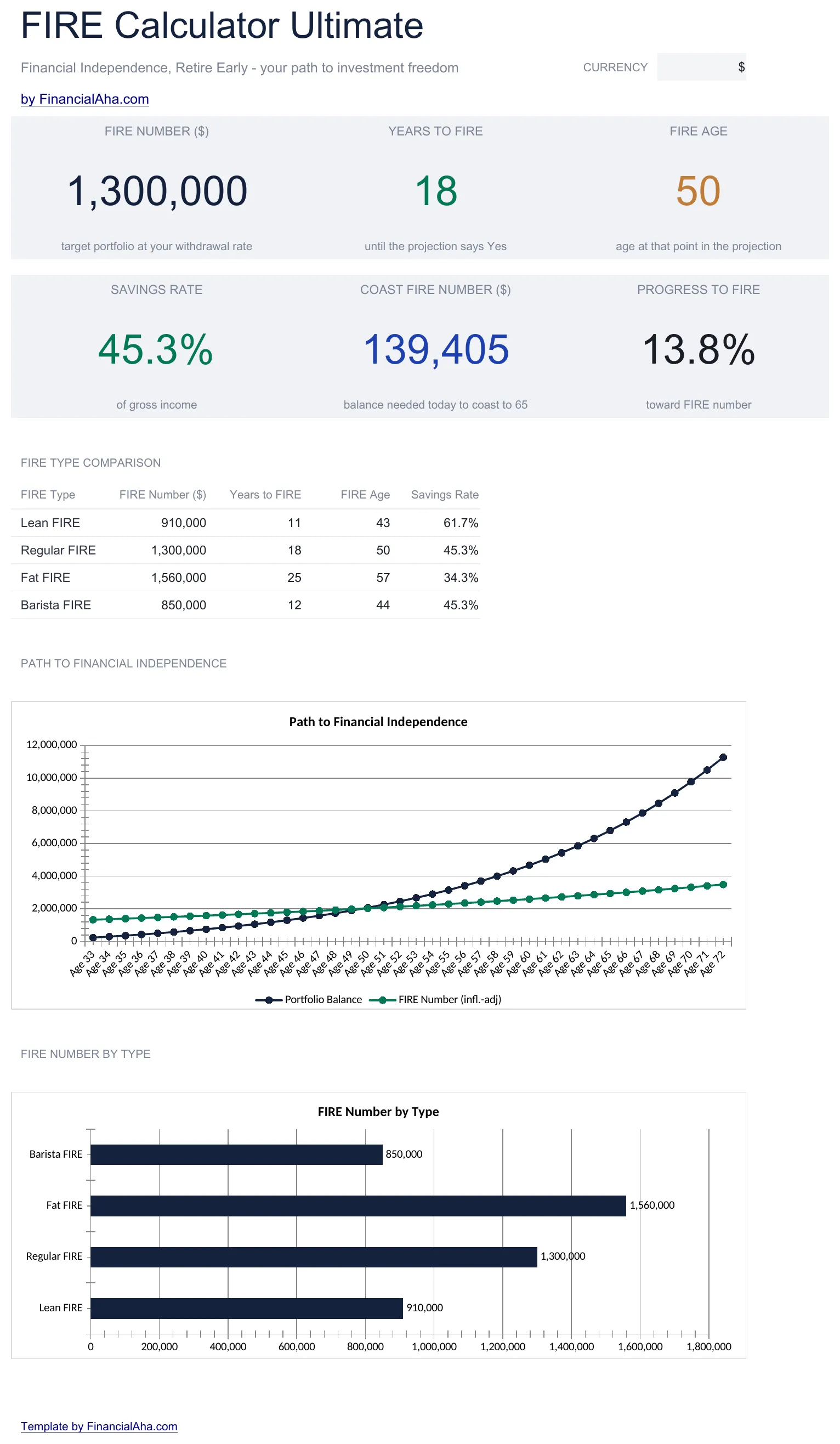
The FIRE Calculator Ultimate ($29) runs its own side-by-side (Lean, Regular, Fat and Barista) from your inputs, with a Coast FIRE number and a year-by-year path chart.
Which one are you actually pursuing?
A few diagnostic questions.
Do you want to stop working entirely, or just stop needing the income? First: regular FIRE or Fat FIRE. Second: Coast FIRE or Barista FIRE.
Are you comfortable on a frugal lifestyle indefinitely? Yes: Lean FIRE is on the table. No: skip it.
Is healthcare a binding constraint? If yes, Barista FIRE solves it cleanly (employer coverage); regular FIRE requires ACA navigation or other paths.
How early do you want to retire? 40s requires Lean or aggressive saving toward Regular. 50s opens up Regular FIRE for more people. 60s is the standard age and any flavor works.
What’s your current savings rate? Under 15 percent and you’re tracking traditional retirement. 15 to 25 percent puts Coast or Lean in reach. 25 to 50 percent is regular FIRE territory. 50 percent plus is Fat FIRE.
Where the calculator helps
The free FIRE Financial Freedom Calculator is a single Google Sheets tab with a Starting Data panel: monthly savings, monthly expenses, current savings, savings yearly return, inflation and current age. It outputs:
- A Financial Freedom Year and a Financial Freedom Age
- A Projected Data table listing yearly expenses, yearly return, yearly savings and year-end savings for every year
- A chart plotting yearly expenses against yearly return, where the crossover marks the freedom year
It does not print a FIRE number or label the flavors. What it does show is how the crossover moves: drop the monthly expenses figure toward a leaner lifestyle or raise it toward a fatter one, leave every other input alone, and the Financial Freedom Age moves with it.
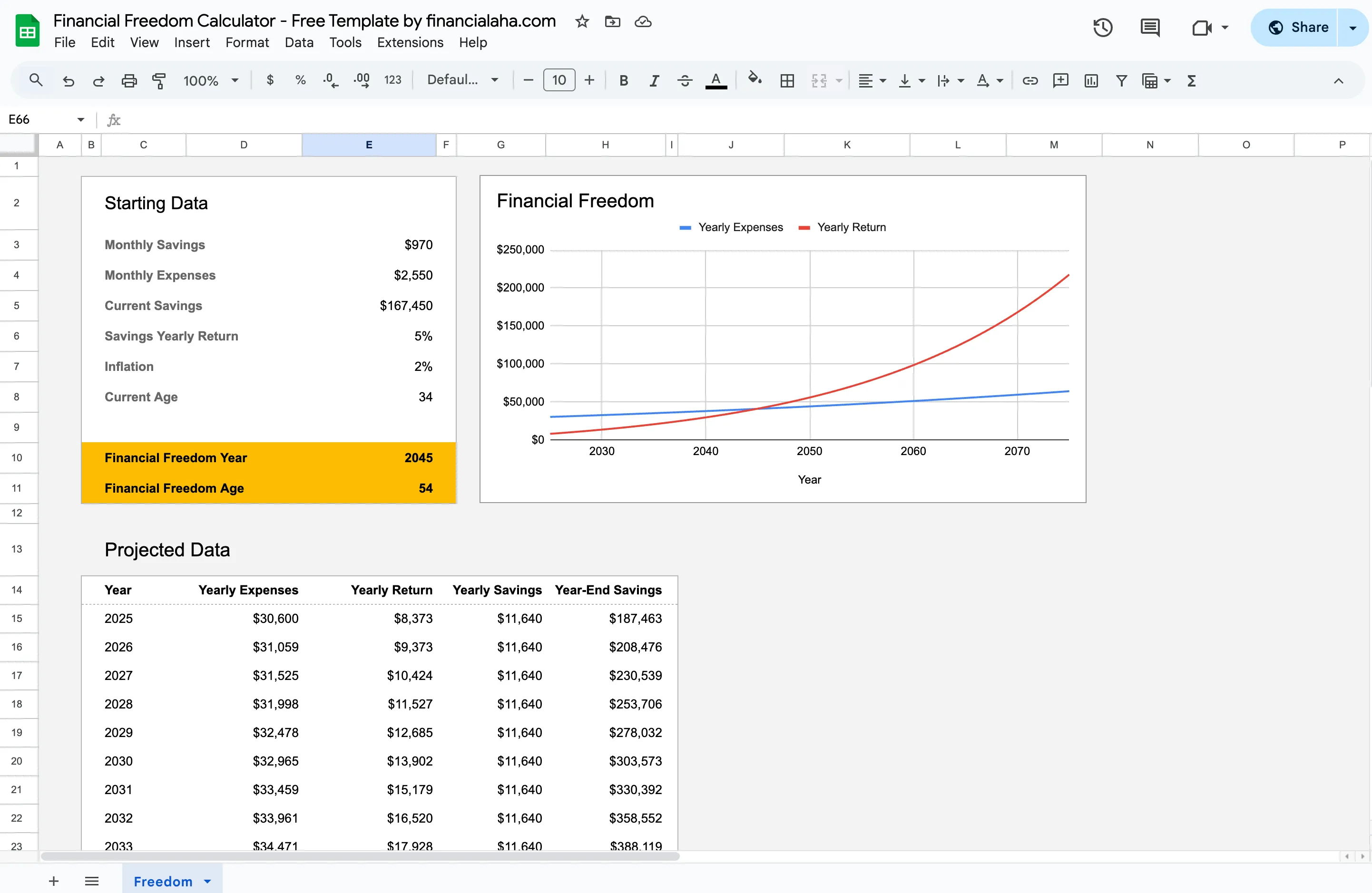
The free FIRE Financial Freedom Calculator template returns your financial-freedom age and a year-by-year projection. Google Sheets, no signup.
If you would rather not open a spreadsheet, the on-page calculator below returns a savings rate, a FIRE number, years to FIRE and a FIRE date from your income, expenses, current savings, expected return, inflation and withdrawal rate:
For the drawdown side of the plan, the paid Retirement Financial Planning Projections template starts from one combined savings balance, your annual retirement expenses and a pension start age, then projects income against expenses year by year to your life expectancy.
Which template runs your FIRE plan
Pick the one that matches how far you want to take the planning:
- FIRE Financial Freedom Calculator covers the starting point: the year and age your savings reach financial freedom, plus a year-by-year projection table. Free, Google Sheets, no signup.
- FIRE Calculator Ultimate ($29) compares Lean, Regular, Fat and Barista FIRE side by side, each with its FIRE number, years to FIRE, FIRE age and required savings rate, and adds a Coast FIRE number and a path chart.
- Retirement Financial Planning Projections goes further into the drawdown: a year-by-year projection from your retirement age to your life expectancy, a bridge period covering the years before pension income starts, conservative, base and optimistic scenarios, and a set of what-if tests.
Not sure which flavor you are pursuing yet? Run your own numbers in the calculator above, then read Coast FIRE Calculator Explained for the worked present-value math behind the Coast column.
Related
Frequently asked questions
Is the 4 percent rule still valid in 2026?
For 30-year retirements, yes; the historical research that produced the rule (Trinity Study and updates) holds up across most market scenarios. For longer retirements (40 plus years for early retirees), 3.25 to 3.5 percent is more conservative and probably more honest.
What's the difference between FIRE and traditional retirement?
FIRE is retirement at any age your math supports. Traditional retirement happens around 62 to 67 when Social Security and pension benefits start. The math is the same; the timing and reliance on different income sources differs.
Can I FIRE with kids?
Yes, but the spending target is higher. Kids cost real money (housing, food, education), and the safety margin needs to be larger because you can't easily reduce spending on dependents. Most FIRE-with-kids stories use the Regular or Fat FIRE versions.
What if my returns are worse than 7 percent real?
Run the numbers with 5 percent real instead. Your portfolio target stays the same but the years to reach it grow. A 1 percent change in real return moves the timeline by roughly 5 to 7 years for someone starting in their 30s.
Should I aim for Coast FIRE first, then keep going?
Common path. Coast FIRE buys you optionality (you could stop saving for retirement); deciding whether to stop or to push through to Regular FIRE is then a quality-of-life conversation, not a math one.
What's the difference between Coast FIRE and Barista FIRE?
Coast FIRE is about your future being funded: enough is invested today that compounding alone reaches your target by traditional retirement age, so you can stop retirement saving while still working full time. Barista FIRE is about your present: a smaller portfolio plus ongoing part-time income (often chosen for its health insurance) covers current spending. Coast solves the saving question; Barista solves the income and benefits question.
Sources
- Income in the United States: 2023 (P60-282) - U.S. Census Bureau
About this article
Portfolio targets derived from the 4 percent rule (25x annual spending); Coast FIRE figures computed from the present-value formula target / (1 + real return)^years. Median household income checked against U.S. Census Bureau data (P60-282). Template sheets, inputs and outputs checked on 2026-09-10 against the shipped FIRE Financial Freedom Calculator Google Sheet (Freedom tab), the FIRE Calculator Ultimate workbook (Dashboard, Assumptions, FIRE Projection, FIRE Types, Coast FIRE, Withdrawal Strategy, How to Use tabs) and the Retirement Financial Planning Projections Google Sheet (Summary, Inputs, Projections, Helpers, Instructions tabs). Last reviewed September 2026.