
The 4 percent rule lets you withdraw 4 percent of your starting balance in year one, then raise that dollar amount by inflation each year, with roughly a 95 percent historical chance a 60/40 portfolio lasts 30 years. A retirement withdrawal calculator spreadsheet implements it as a year-by-year balance projection with a rate cell you can change. Our Retirement Financial Planning Projections template ($39, Google Sheets) takes the other route: each year it withdraws whatever expenses need beyond pension and other income, then reports that withdrawal rate with an under-4-percent safety check.
The 4 percent rule is the most-cited number in retirement planning. It’s also widely misunderstood. This post covers what the rule actually says, how to implement it in a spreadsheet, when to use a different rate, and how to model dynamic (variable) withdrawals if a static 4 percent feels too rigid.
What the 4 percent rule actually says
Three precise claims, often summarized incorrectly.
- Withdraw 4 percent of your starting balance in year 1. If you retire with $1,000,000, the year 1 withdrawal is $40,000.
- Adjust the dollar amount for inflation in subsequent years. Year 2 withdrawal is $40,000 times (1 + inflation). Year 3 is year 2 times (1 + inflation). And so on.
- High probability the portfolio lasts 30 years. Based on the Trinity Study and follow-on research, around 95 percent of historical 30-year periods would have supported this withdrawal pattern from a 60/40 stock/bond portfolio.
What the rule doesn’t say:
- It doesn’t say withdraw 4 percent of the current balance each year. The 4 percent applies once to determine the starting amount.
- It doesn’t guarantee the portfolio survives. It’s a probability statement, not a certainty.
- It doesn’t account for fees. If you pay 1 percent in fund fees and another 1 percent in advisor fees, the safe rate drops meaningfully.
- It doesn’t apply to retirements longer than 30 years. For 40 plus year horizons (early retirees), 3.25 to 3.5 percent is more honest.
The formula in a spreadsheet
Three columns plus a starting balance.
Column A: Year (1, 2, 3, …) Column B: Beginning balance (B2 = starting portfolio; B3 = D2; B4 = D3; etc.) Column C: Withdrawal
- C2 = StartingBalance * 0.04 (year 1)
- C3 = C2 * (1 + Inflation) (year 2 and beyond) Column D: Ending balance = (B - C) * (1 + Return)
Year by year, drag down for 30 rows. The Ending balance column should stay positive at year 30.
In Google Sheets:
| Year | Beginning | Withdrawal | Ending |
|---|---|---|---|
| 1 | 1,000,000 | 40,000 | 1,028,000 |
| 2 | 1,028,000 | 41,200 | 1,055,008 |
| 3 | 1,055,008 | 42,436 | 1,081,331 |
| … |
Assuming 7 percent nominal return and 3 percent inflation, the table walks year by year. By year 30, the portfolio at these assumptions is around $2,200,000 in nominal dollars (about $900,000 in today’s dollars after inflation). The 4 percent rule survives this scenario.
Of course, returns aren’t constant. If years 1 to 5 produce negative real returns, the picture changes dramatically. This is sequence-of-returns risk; the deterministic spreadsheet doesn’t capture it.
Configurable rate
The “4 percent” is approximate. Different planning horizons and risk tolerances suggest different rates.
| Horizon | Common SWR |
|---|---|
| 20 years | 5.0 to 5.5 percent |
| 30 years | 4.0 percent (the classic rule) |
| 40 years | 3.25 to 3.5 percent |
| 50 years | 3.0 percent |
| 60+ years | Below 3 percent (effectively perpetual) |
The spreadsheet should let you set the rate as an input cell. Type 0.04 for the classic rule; type 0.035 for a conservative 40-year approach.
Our Retirement Financial Planning Projections template works the other way around. There is no withdrawal-rate input. Each year it withdraws the gap between inflation-adjusted expenses and pension plus other income, then reports that gap as a percentage of the portfolio. A safety check on the Summary flags whether the rate stays under 4 percent, so the rule becomes a test the plan passes or fails rather than a dial you set.
Dynamic vs static spending
The classic 4 percent rule assumes constant inflation-adjusted spending year after year. Two reasonable variations.
Variable percentage withdrawal (VPW). Each year, withdraw a percentage of the current balance, increasing slightly with age. Years with high returns produce higher withdrawals; bad years produce lower. The portfolio is more volatile but never runs out by definition.
Guardrails (Guyton-Klinger). Start at 4.5 to 5 percent. If the portfolio drops 20 percent below target, cut the withdrawal by 10 percent. If it rises 20 percent above target, increase by 10 percent. Catches sequence-of-returns risk without requiring full annual flexibility.
Both produce higher average withdrawals than the static 4 percent rule because they accept volatility. Both require more spending discipline than retirees often have.
Both are easy to add to the calculator above. For VPW, replace the withdrawal formula with a percentage of the beginning balance. For guardrails, wrap it in an IF that compares the current balance with the year 1 target. Our template does not offer either as a switch. Its withdrawals follow expenses, so a spending cut is modeled by lowering the annual expenses input, and the 12 what-if cards on the Summary already show the effect of 10 percent lower expenses, 10 percent higher expenses and a 20 percent market drop without touching a formula.
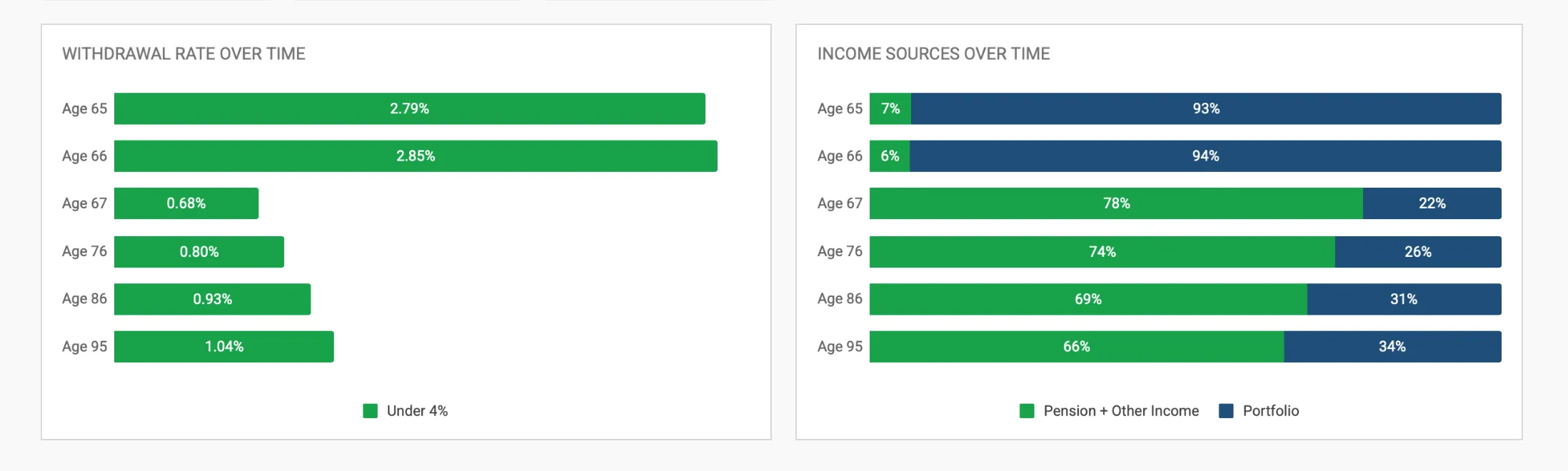
Withdrawal-rate and income-source charts from the Retirement Financial Planning Projections template (Premium tier). The withdrawal rate stays under 4 percent across the plan while pension and other income cover a growing share as the portfolio drawdown eases.
A worked example
Marcus retires at 65 with $1,400,000. Wants to spend $56,000 in year 1 (about 4 percent of starting balance, in today’s dollars).
Static 4 percent:
Year 1: $56,000 withdrawal. Portfolio: $1,400,000 starting, withdraw $56,000, grow remainder at 7 percent. End year 1 balance: $1,438,080.
Year 2: $57,680 withdrawal (3 percent inflation adjustment). End year 2 balance: $1,476,948.
Year 30: Withdrawal is $135,800 (in nominal dollars). End balance: $1,950,000 (nominal) or about $800,000 in today’s dollars.
The plan survives. With margin to spare in this base case.
Stress test: 5 percent real return instead of 4 percent (7 percent nominal minus 3 percent inflation).
Year 30 end balance drops to about $1,100,000 nominal, or about $450,000 today’s dollars. Still positive. Still works.
Stress test: 4 percent real return.
Year 30 end balance drops to about $640,000 nominal, or about $260,000 today’s dollars. Tight. Plan still holds.
Stress test: 3 percent real return.
Year 30 end balance is approximately $300,000 nominal, or $120,000 today’s dollars. Below comfort margin. The rule starts breaking down.
The exercise is more useful than the base case answer. A plan that survives 4 percent real and gets tight at 3 percent real is “reliable to most scenarios” rather than “guaranteed.”
Sequence-of-returns risk
The single biggest gap in deterministic withdrawal calculators. The calculator above assumes a smooth return rate. Real markets aren’t smooth.
If your first 5 retirement years produce negative real returns (a common pattern in market drawdowns), withdrawing a fixed inflation-adjusted dollar amount means selling more shares at lower prices. The portfolio recovers from a smaller base. The plan can fail even if the long-run average return is fine.
The 4 percent rule already accounts for this in its 95 percent historical success rate. But “5 percent of historical sequences would have failed” means roughly 1 in 20 retirees following the rule strictly would have run out. Not zero risk.
Approaches people use to soften it:
- A cash buffer of 1 to 3 years of spending, so stocks don’t have to be sold during a drawdown.
- Trimming withdrawals about 10 percent in the years after a major drawdown (an informal guardrail).
- Delaying Social Security, which raises the benefit through delayed retirement credits and provides a larger inflation-adjusted floor late in life.
- A slightly lower starting rate, such as 3.5 percent, to build margin.
A spreadsheet can model the cash-buffer approach with a separate cash column that gets drawn first in down years, but it can’t model probability without Monte Carlo. The template’s closest tool is its market-crash what-if, which applies a 20 percent drop to the portfolio and reports whether the plan still lasts. For full Monte Carlo retirement modeling, ProjectionLab is the dominant tool; see our ProjectionLab Alternative post for the comparison.
Where the calculator lives
The Retirement Financial Planning Projections template ($39, Google Sheets) runs the drawdown for you, expenses first rather than rate first. Everything is entered on one Inputs tab:
- Current age, target retirement age, life expectancy, and the age your state pension starts
- Inflation rate, applied to all expenses
- Net return before retirement and net return in retirement, after taxes and fees
- Annual pension increase
- Total current savings, all retirement accounts combined, and annual savings until retirement
- Monthly pension income, plus other income such as rental or part-time work
- Total annual expenses in year 1 of retirement
Output: projected value at retirement, a year-by-year table of portfolio, income, expenses, the amount drawn from the portfolio and the withdrawal rate, a conservative, base and optimistic comparison, the legacy balance at life expectancy, and 12 what-if scenarios such as retiring a year later, a 50 percent pension cut or a 20 percent market crash.
To sketch a projection before downloading anything, the free retirement calculator runs starting balance, monthly contribution, return, inflation and desired retirement income in the browser:
If you’d rather build it yourself, the structure above is the entire formula. About 60 minutes from blank sheet to working calculator.
Where to go from here
Pick the level of detail your plan needs:
- Retirement Financial Planning Projections ($39) - Accumulation and expense-driven drawdown projection from your current age to life expectancy, three scenarios, 12 what-ifs, and the withdrawal-rate and income-source charts above. Google Sheets.
- Retirement Planning Bundle ($59) - Retirement Projections plus Net Worth plus Annual Tax Planner, for the tax-and-net-worth picture around the withdrawal plan.
- Retirement Calculator Ultimate ($29) - Accumulation and withdrawal projection with inflation-adjusted draws, a Social Security offset, and a 3-scenario return comparison.
If the base case survives 4 percent real return but gets tight at 3 percent, the worked example above shows where your own margin sits before you commit to a rate.
Related
Frequently asked questions
Is 4 percent still the right rate in 2026?
Recent research from Morningstar's State of Retirement Income series and Wade Pfau's Retirement Researcher suggests 3.5 to 4 percent for 30-year horizons in the current return environment, leaning toward 3.5 percent for portfolios heavy in fixed income. The original Trinity Study at 4 percent assumed higher historical bond yields than current.
What if I'm planning a 50-year retirement?
3 percent is the common conservative target. The longer the horizon, the more sequence-of-returns risk dominates and the lower the safe rate. Some FIRE researchers use 3.25 percent for 50 plus year retirements.
Should the withdrawal rate include Social Security?
No. Social Security covers a portion of your spending; the withdrawal rate applies to the gap your portfolio needs to cover. If your spending is $80,000 and Social Security covers $30,000, your portfolio needs to cover $50,000, and the withdrawal rate applies to that $50,000 against your portfolio balance.
What if I want to leave an inheritance?
Lower your withdrawal rate. Or use a "perpetual" model where the withdrawal is the real return rate (typically 3 to 4 percent), which preserves the inflation-adjusted balance indefinitely.
Does the spreadsheet handle Roth conversions?
No. Neither the calculator built here nor the Retirement Financial Planning Projections template models Roth conversions. The template takes one combined savings balance and net, after-tax return assumptions, so tax-bracket management in early retirement sits outside it. See the [Annual Tax Planner](@route:templates.product:personal-finance:annual-tax-planner) for the tax-side analysis.
Is the 4 percent figure before or after taxes and fees?
It's a gross withdrawal from the portfolio, before income tax on the distribution and before fund or advisor fees. Fees come straight off the safe rate: paying 1 percent in fund costs and 1 percent in advisory fees means the sustainable withdrawal is closer to 2.5 to 3 percent than 4. Neither spreadsheet has a separate fee cell. In the calculator above, lower the return input by your total fee percentage. The Retirement Financial Planning Projections template asks for net returns after taxes and fees for the same reason.
How is a withdrawal calculator different from a Monte Carlo simulation?
A spreadsheet projection uses one fixed return each year, so it answers "what happens at this average return" but can't show the odds. Monte Carlo runs thousands of randomized return sequences and reports a success percentage. The spreadsheet is where sequence-of-returns risk is invisible, which is why stress-testing several fixed return assumptions is the practical substitute.
Sources
- The State of Retirement Income - Morningstar
- Safe Withdrawal Rates - Retirement Researcher (Wade Pfau)
- Delayed Retirement Credits - Social Security Administration
About this article
Template inputs, drawdown logic, safety checks and what-if scenarios checked on 2026-09-10 against the shipped Retirement Financial Planning Projections Google Sheet (Inputs, Projections, Summary and Instructions tabs) Social Security delay figures reference the Social Security Administration Last reviewed September 2026.