
Five financial independence spreadsheets stand out in 2026: Mad Fientist's free Excel sheet (deep but dated), community Bogleheads and Reddit workbooks (free, uneven quality), ProjectionLab ($129/yr SaaS with Monte Carlo), Aspire Budgeting (free, budgeting-first), and our Financial Planning Spreadsheet ($29 one-time, net worth, cash flow and a long-run assets and debt projection in Google Sheets). A spreadsheet you own wins when you want to track progress month over month; pick on what you weight most, projection depth, support, or cost.
In this article
- The five options compared on FI projection capability, methodology depth, support, and cost
- What FI tracking actually requires vs. what’s nice-to-have
- A side-by-side feature matrix
- Which option fits which user
- A worked example: same person, different tools
- Common shortcomings across the field
- How to migrate between them
A serious FI tracker has to do one thing well: project how many years of work you have left at your current saving rate, and update that projection live as your savings rate or balance changes. Everything else (charts, asset allocation, withdrawal modeling) is helpful but secondary. This post compares the five most-used options against that core requirement and the surrounding nice-to-haves.
What FI tracking requires
Three calculations, in order of priority.
1. Years to FI.
Years to FI = log((FI Number * r + Spending) / (Current * r + Spending)) / log(1 + r)Where r is real return, Current is current invested balance, Spending is annual spending (which doubles as the FI target divisor at 25x), and FI Number is 25 times annual spending. If that formula looks intimidating, it’s because the math behind FI is annuity math, not simple compounding.
Most spreadsheets simplify by either using a closed-form approximation or running a year-by-year iteration in a column. Both work; the iteration version is easier to read.
2. Savings rate.
Savings rate = (Total annual savings) / (Take-home income)Or some people use gross income; either is fine as long as you’re consistent. Most FI math is more sensitive to savings rate than to absolute spending; a 50 percent savings rate produces FI in around 17 years regardless of whether you earn $50K or $500K.
3. Current FI ratio.
FI ratio = (Current invested balance) / (FI Number)How far you are. 0.4 means you’re 40 percent of the way to your FI number.
These three numbers are the dashboard. Everything else is supporting detail.
The five options compared
Option 1: Mad Fientist’s FI Spreadsheet (free, Excel-first)
The original. Mad Fientist’s FI Laboratory included a free downloadable spreadsheet that became the template for the genre.
What it does well
- Deep methodology. Calculates years to FI, projected balance, and net worth over time with serious math.
- Includes scenarios (different savings rates, different return assumptions).
- Free.
- Citation rich; mentioned in dozens of FI blogs.
Limitations
- Excel-first. Conversion to Sheets breaks some formulas.
- Last updated several years ago; methodology is solid but UX is dated.
- Single methodology baked in (specific savings rate framing).
- No support; community discussion happens on the FI forums.
- Doesn’t integrate budget tracking.
Best for people who want the original FI spreadsheet methodology and don’t mind Excel.
Option 2: Bogleheads/Reddit FI workbook (free, community)
Several user-built workbooks circulate on r/financialindependence and the Bogleheads forum. The most-cited is a multi-tab workbook that combines net worth tracking, savings rate calculation, and FI projection.
What it does well
- Built by deeply engaged FI practitioners.
- Often handles edge cases (multiple account types, employer match, taxable vs tax-deferred withdrawal sequence).
- Free, with active forum discussion.
Limitations
- Quality varies by author.
- No central support; updates depend on the original creator’s time.
- Often heavily personalized to the creator’s situation; requires customization.
- Documentation lives in forum threads, which can be hard to search.
Best for spreadsheet-comfortable users who enjoy customizing and want a community-vetted starting point.
Option 3: ProjectionLab (SaaS, $129/yr)
Not a spreadsheet, but the most-cited alternative for serious FI planning. The Premium plan runs $129 a year, with a free Basic tier for a first look.
What it does well
- Best-in-class UX for retirement and FI projection.
- Monte Carlo simulation, Sankey diagrams, scenario branching.
- International tax modeling beyond the US.
- Active development, regular feature updates.
Limitations
- Not a spreadsheet. Closed math; you can’t audit the formulas.
- Recurring subscription, with no one-time or lifetime option.
- Data syncs to the cloud; not strictly offline.
- No spreadsheet export if you want to leave.
Best for users who value Monte Carlo and visual scenarios, are comfortable with the cost, and don’t care about formula transparency. See ProjectionLab Alternative for the full comparison.
Option 4: Aspire Budgeting (free, donation-funded)
Aspire is a Google Sheets envelope budgeting template. It includes basic FI math but the focus is monthly budgeting.
What it does well
- Free, privacy-clean, donation-funded.
- Strong envelope/zero-based methodology.
- Active Reddit community (r/aspirebudgeting).
Limitations
- FI projection is light; main focus is monthly budgeting.
- Steep onboarding curve.
- Single methodology (envelope) may not fit all users.
- No formal support or update SLA.
Best for users primarily focused on monthly budgeting with FI as a secondary interest. See Aspire Budgeting Alternative for the budget comparison.
Option 5: FinancialAha Financial Planning Spreadsheet ($29 one-time)
Our entry. Puts net worth, assets, debts, monthly cash flow, goals and a long-run projection in a single workbook.
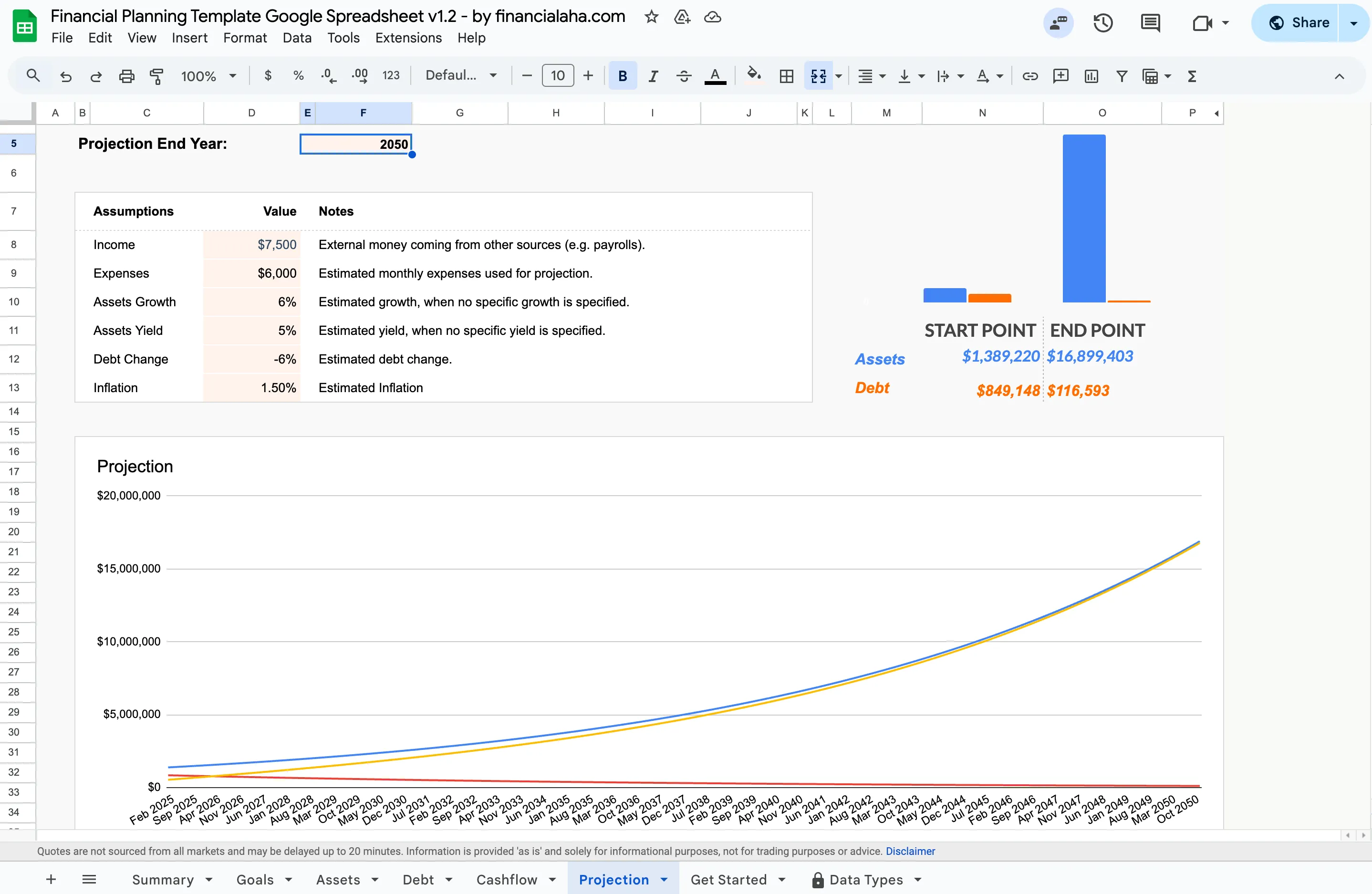
The Projection sheet in the Financial Planning Spreadsheet (Premium tier): set the end year and the six assumptions, and the long-run curve plus the start and end point figures for assets and debt update with them.
What it does well
- Google Sheets native, and it runs on a phone or tablet through the Sheets app.
- One-time cost.
- Sold with the Net Worth Tracker and Annual Tax Planner in the Personal Finance Bundle, though each is a standalone file rather than a linked system.
- Updates are free for the life of the purchase, with email instructions when a new version ships.
- Questions go through the site contact form, answered in 24 to 48 hours.
- Country-agnostic; there is no tax logic in the workbook to localise.
Limitations
- No years-to-FI, savings rate or FI ratio cell. The Projection sheet returns the assets and debt path to the end year you set, and you read the crossing point off it yourself.
- Deterministic projection only; no Monte Carlo. (For Monte Carlo, pair with ProjectionLab as a one-time stress test.)
- Newer than Mad Fientist’s; less established in the FI community.
- $29 vs free options.
Best for people who want maintained software, budgeting and net worth in the same file as the projection, and a one-time cost.
Side-by-side feature matrix
| Feature | Mad Fientist | Bogleheads | ProjectionLab | Aspire | FinancialAha |
|---|---|---|---|---|---|
| Years to FI | Yes | Yes | Yes | Light | No |
| Savings rate | Yes | Yes | Yes | Yes | No |
| Current FI ratio | Yes | Yes | Yes | Light | No |
| Year-by-year balance | Yes | Yes | Yes | No | Yes |
| Withdrawal phase | Light | Yes | Yes | No | No |
| Monte Carlo | No | No | Yes | No | No |
| Sankey diagram | No | No | Yes | No | No |
| Multi-country tax | No | No | Yes | No | Country-agnostic |
| Budget integration | No | Sometimes | Light | Yes | Yes |
| Net worth integration | Yes | Yes | Yes | Light | Yes |
| Mobile-friendly | No | Varies | Yes | Limited | Yes |
| Cost | Free | Free | $129/yr | Free | $29 once |
| Support | None | Forums | Contact form | ||
| Updates | Stale | Per author | Active | Per maintainer | Active |
| Format | Excel | Mixed | SaaS | Sheets | Sheets |
The FinancialAha column is the Financial Planning Spreadsheet, which tracks the balances and projects them forward without naming an FI date. The years-to-FI, savings rate and FI number figures come from the free FIRE calculator embedded further down, which is a separate tool.
A worked example: same person, five tools
Marcus is 32, $180K invested, $35K annual spending, $90K take-home, saves $35K/year. He runs his FI scenario through each tool.
Mad Fientist’s spreadsheet: Plug current balance, savings rate, and target. Output: years to FI = 12.4 at 7 percent real return.
Bogleheads workbook: Same inputs. Output: 12.5 years. Slight variance from rounding and assumed return formulas.
ProjectionLab: Same inputs plus Monte Carlo. Output: median 12.3 years, 90th percentile 9.5 years (good market), 10th percentile 16.8 years (bad market).
Aspire: Aspire’s FI section gives the savings rate (39 percent take-home, 30 percent of gross with employer match) and roughly translates to a 14 to 17 year horizon based on the standard savings-rate-to-years table. Less precise than the dedicated tools.
FinancialAha Financial Planning: Marcus lists his holdings on the Assets sheet and his balances on the Debt sheet, sets monthly income, monthly expenses, assets growth and inflation on the Projection sheet, then sets the projection end year. The output is the assets and debt curve running to that year rather than a years-to-FI number, so he reads off the point where the balance passes his target. Changing the growth assumption redraws the curve.
The deterministic answers cluster at 12.4 years across the tools that return a single number. ProjectionLab adds the confidence band (9.5 to 16.8 years range), which is genuinely useful additional information.
Before committing to any tool, it helps to see your own deterministic number. Our free FIRE calculator runs the same years-to-FI math in the browser:
When the answer is something other than a spreadsheet
You want Monte Carlo. ProjectionLab. The deterministic median answer from any of the spreadsheets is good for general planning; Monte Carlo is good when you want to know the probability your plan survives.
You want professional advice. A fee-only fiduciary advisor at $250 to $500 an hour for a one-time engagement. They’ll use their own software and produce a multi-page plan. For people with complex situations (business interests, estate considerations, multi-country exposure), this is often worth more than any spreadsheet.
You’re okay with rough math. A simple FIRE calculator on a phone takes 60 seconds. Engaging Data, WalletBurst, FinancialAha’s free FIRE calculator. For an initial sanity check, free calc beats spreadsheet.
The spreadsheets are right when you want to track the same numbers month over month, see the trend, and update your plan as your situation changes. For one-time math, simpler tools win.
Common shortcomings across the field
A few things that no one in this category does well.
Healthcare cost modeling for early retirees. US healthcare between FIRE age and Medicare eligibility (65) is the single biggest variable in early retirement plans. Most tools (including most of the five above) assume employer-comparable coverage continues, which it doesn’t.
Roth conversion ladder modeling. A common FIRE tactic is converting tax-deferred to Roth in low-income early-retirement years. Few spreadsheets handle this elegantly; ProjectionLab does it best, and most others ignore it. A dedicated Annual Tax Planner tracks the income, deductions, and quarterly payments that surround those conversions, though it does not model the ladder itself.
Sequence-of-returns risk visualization. A bad first decade in retirement is much worse than a bad last decade. Deterministic projections smooth this away; only Monte Carlo captures it. Pair a spreadsheet with ProjectionLab one-time runs for stress testing if this matters.
Income from non-portfolio sources in retirement. Part-time work, rental income, royalties, business interests. Most tools assume your retirement income is portfolio withdrawals plus Social Security. Reality is messier.
Migration paths
If you’re already using one and curious about another, the moves are mostly painless.
Mad Fientist or Bogleheads to FinancialAha: Open the FinancialAha Financial Planning Spreadsheet. Balances go on the Assets sheet by type, loans and cards on the Debt sheet, and the monthly income, expense, growth and inflation assumptions on the Projection sheet. Then compare the projected balance in the year your old sheet called FI against what that sheet showed.
Aspire to FinancialAha: the FinancialAha Cashflow sheet holds one row a month rather than a transaction log, so an Aspire CSV export needs totalling by month first. Enter the monthly spending and income figures there, then fill in the Projection assumptions once.
ProjectionLab to FinancialAha: Export the ProjectionLab plan as JSON. Current balances go on the Assets and Debt sheets, and the return, inflation, income and expense assumptions on the Projection sheet. There is no retirement age field, so set the projection end year to the year you were planning to.
FinancialAha to anything: Your data lives in the file. Copy values out as CSV; paste into the new tool.
Recommendation by user type
Someone just starting FI: Free options first. Mad Fientist’s spreadsheet or our free FIRE calculator is enough to get a number.
Someone tracking FI seriously over years: Pay for a maintained tool. Either FinancialAha Financial Planning ($29 once) or ProjectionLab if Monte Carlo matters ($129/yr).
Someone who wants budgeting plus a long-run projection in one place: FinancialAha Financial Planning ($29) or build out from Aspire (free) with patience.
Someone with a complex US tax situation: ProjectionLab plus a fee-only advisor consultation. The combination handles edge cases that no single tool does well.
Someone outside the US: FinancialAha (country-agnostic) or build from a Bogleheads workbook with localized tax rules.
Where to go next
If you want a free number first, run yours through the FIRE calculator embedded above, then compare it against the worked example to sanity-check your assumptions. When you are ready to track FI month over month rather than compute it once, these are the FinancialAha files that fit:
- Financial Planning Spreadsheet ($29 once): net worth, assets, debts, monthly cash flow, goals and a long-run projection in one file.
- Retirement Financial Planning Projections ($39 once): multi-decade accumulation and withdrawal projection with configurable assumptions.
- Personal Finance Bundle ($59): Financial Planning plus Net Worth plus Annual Tax Planner, cheaper than buying the three separately.
Related
Frequently asked questions
Do I need a spreadsheet to track FI, or is a calculator enough?
A calculator is fine for one-time math. A spreadsheet is the right tool when you want to track progress month over month and update the projection as your situation changes. Both have a place.
Is the Mad Fientist spreadsheet still maintained?
Not actively. The methodology is sound and the math doesn't change much, but UX and edge cases haven't been updated in years. It's a historic artifact at this point; useful, but pick a more current tool if you're starting fresh.
Should I use ProjectionLab if I'm 5 years from FIRE?
The Monte Carlo confidence interval becomes more useful close to retirement because sequence-of-returns risk is most damaging in the first 5 to 10 years of withdrawal. ProjectionLab Premium runs $129 a year, so some people subscribe for the planning years and cancel once they have retired.
Can I use multiple tools at once?
Yes, and many people do. A common pattern: track day-to-day in a spreadsheet, run periodic Monte Carlo stress tests in ProjectionLab, get a fee-only advisor opinion every few years. The spreadsheet is the constant; the others are check-ins.
What's the most common mistake in FI projections?
Overestimating expected return. 7 percent real (after inflation) is the commonly cited long-run US stock market average; people often plug in 10 percent (which is the nominal average, before inflation) and get a fantasy projection. A base case in the 5 to 7 percent real range keeps the projection grounded.
Is the $29 FinancialAha spreadsheet worth it over the free Mad Fientist sheet?
It depends on what you value. The Mad Fientist sheet is free and the FI math is sound, but it is Excel-first and has not been updated in years. The FinancialAha Financial Planning Spreadsheet is a maintained Google Sheets file that puts net worth, assets, debts, monthly cash flow and a long-run projection in one workbook for a one-time $29. It does not output a years-to-FI figure of its own; you set the projection end year and read the balance path from there. If a current, integrated, mobile-friendly tool matters, that is what the price buys.
Does the FinancialAha Financial Planning Spreadsheet work in Excel?
It is built for Google Sheets. The formulas and charts are set up for Sheets rather than Excel, so it opens and runs in a browser with a free Google account. If you want an Excel-native FI sheet, the Mad Fientist download is the closer fit.
Sources
- ProjectionLab Pricing - ProjectionLab
- Financial Independence Spreadsheet - Mad Fientist
- Aspire Budgeting - Aspire Budget
About this article
ProjectionLab and Aspire pricing and features checked against the vendors' own sites FinancialAha sheet names, inputs, outputs and prices checked on 2026-09-10 against the shipped Financial Planning Google Sheet (Summary, Goals, Assets, Debt, Cashflow, Projection, Get Started, Data Types tabs), the Retirement Financial Planning Projections sheet, the free FIRE / Financial Freedom Calculator sheet and the Annual Tax Planner FI formulas (years to FI, savings rate, FI ratio) worked through against the standard 25x / 4 percent framing Last reviewed September 2026.