
Avalanche (highest rate first) always costs the least total interest; snowball (smallest balance first) tends to help more people finish. In a worked four-debt example ($18,500 owed, $200 a month extra), both orderings clear the debt in about 28 months, avalanche for roughly $2,460 in interest and snowball for roughly $2,600, a gap of about $130. The calculator below runs one balance against your own minimum and extra payment.
Here’s something that doesn’t get talked about enough in the snowball vs. avalanche debate: for a lot of people, the difference between the two methods is shockingly small. We’re talking a few hundred dollars and maybe a month or two. The real question isn’t which method is mathematically superior - it’s which one you’ll actually stick with until the last payment clears.
The Debt Payoff Calculator takes one balance with its rate, minimum payment and any extra amount, then returns the payoff time, total interest, total paid and the interest saved against paying the minimum alone. For several debts ordered two ways, the Credit Card Payoff Calculator takes each balance, APR and minimum and reports avalanche and snowball side by side. Neither needs a signup.
The Two Methods, Briefly
Both approaches work the same way mechanically. You make minimum payments on everything, then throw all extra money at one specific debt. When that debt is gone, its payment rolls into the next target. The snowball effect, payments getting larger as debts disappear, is the same either way.
The only difference is targeting:
- Avalanche targets the highest interest rate first
- Snowball targets the smallest balance first
That’s it. Same total monthly payment, same rollover mechanism, different attack order.
Running the Numbers on a Real Scenario
| Debt | Balance | APR | Minimum | |------|---------|-----|---------| | Credit Card A | $3,200 | 22% | $80 | | Credit Card B | $1,800 | 18% | $45 | | Personal Loan | $5,500 | 12% | $150 | | Car Loan | $8,000 | 6% | $280 |
Total owed: $18,500. Combined monthly payment: $755.
With avalanche (attacking 22% card first): Debt-free in roughly 28 months. Total interest: about $2,460.
With snowball (attacking $1,800 card first): Debt-free in roughly 28 months. Total interest: about $2,600.
The avalanche saves about $130 in interest, and in this scenario both orderings finish the same month. Snowball produces the first payoff win five months earlier, in month 8 rather than month 13, because Credit Card B disappears fast, which feels good when you’re staring at four different balances.
When the Gap Gets Bigger (and When It Doesn’t)
That $130 difference isn’t universal. It depends almost entirely on the interest rate spread across your debts.
Wide rate spread, large high-rate balance: If your biggest debt also carries the highest rate, avalanche pulls ahead significantly. Think $15,000 at 24% alongside smaller debts at 6-8%. Avalanche could save $1,000+ here.
Similar rates across all debts: When everything is within a few percentage points of each other, the methods produce nearly identical results. At that point, pick whichever ordering makes you more likely to keep going.
Small high-rate balance, large low-rate balance: In this case, both methods might start at the same place - the high-rate debt might also be the smallest. Lucky break.
The only way to know what the difference looks like for your specific situation is to plug in your actual numbers. General rules only go so far. The calculator below works on a single balance: enter what you owe, the rate, the minimum payment and any extra amount, and it returns the payoff time, total interest, total paid and the interest that extra payment saves.
The Psychology Question
Research published in the Harvard Business Review found that people who focused on paying off their smallest balances first, the snowball approach, were more likely to eliminate all their debt, despite paying more in total interest. The quick wins from knocking out small balances created momentum that kept people going. Earlier work summarized by Northwestern’s Kellogg School of Management reached a similar conclusion about the motivating power of small victories.
This is worth sitting with for a moment. The mathematically optimal strategy that gets abandoned in month four saves less money than the “suboptimal” strategy that gets followed through to the end.
Avalanche tends to work for people who are motivated by efficiency, who find satisfaction in watching interest charges shrink, and who don’t need external validation to maintain a long-term plan.
Snowball tends to work for people who’ve tried and abandoned payoff plans before, who need visible progress to stay motivated, and who have at least one small balance that can be wiped out quickly.
Some people start with snowball to build the habit, then switch to avalanche once they’ve proven they can stick with it. That hybrid approach isn’t mathematically pure, but it works in practice.
What Actually Speeds Things Up
The snowball vs. avalanche debate gets a lot of attention, but the single biggest factor in payoff speed is how much extra money goes toward debt each month. An extra $100/month matters far more than which debt you target first.
Round up payments. Paying $50 instead of $47 barely registers in a monthly budget, but it compounds over dozens of payments.
Direct windfalls to debt. Tax refunds, bonuses, cash gifts, rebates - these one-time amounts can knock months off a payoff timeline. A single $2,000 tax refund applied to the scenario above would eliminate Credit Card B instantly.
Negotiate interest rates. A phone call to a credit card issuer asking for a rate reduction sometimes works, sometimes doesn’t. When it does, even a 2-3% reduction changes the total interest calculation meaningfully.
Look at the spending side. The Monthly Budget Template helps identify where extra money for debt payments might be hiding. Sometimes it’s a subscription that’s been running on autopilot for months. Sometimes it’s a spending category that’s larger than expected.
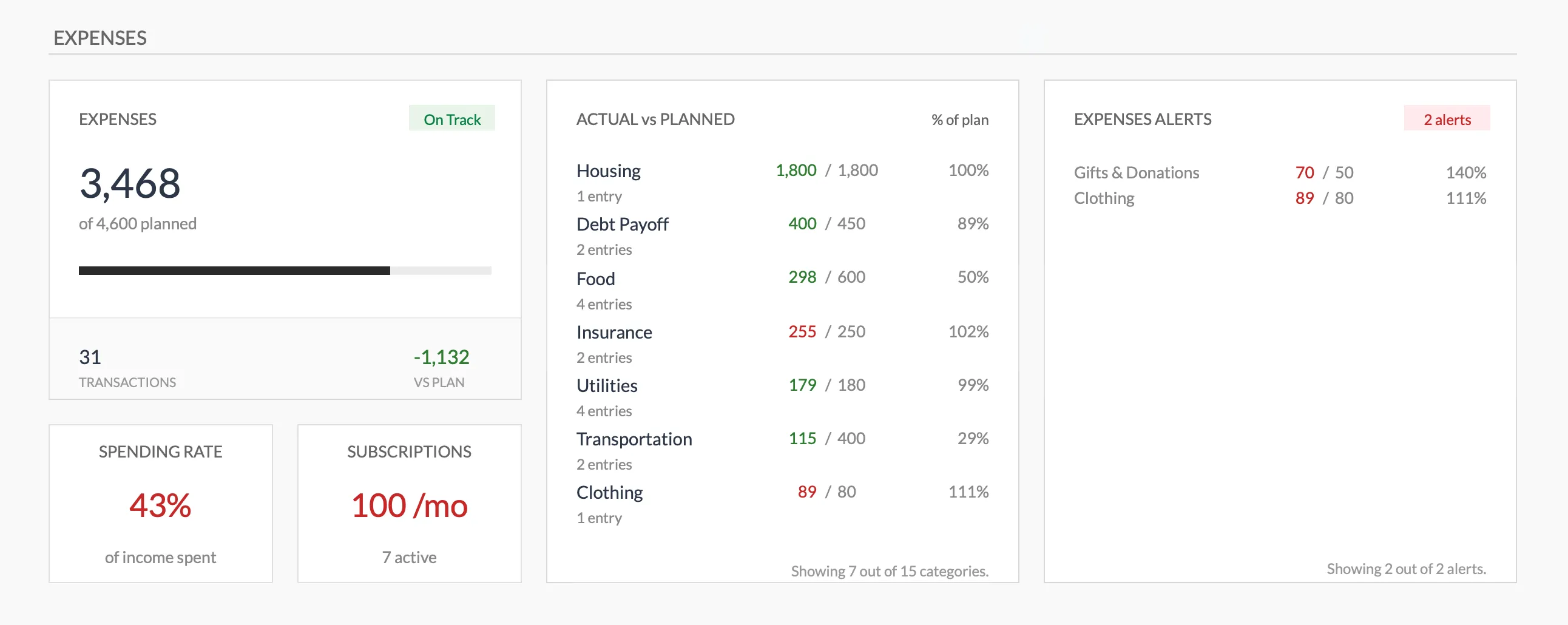
The Monthly Budget Template (Premium tier) carries a dedicated Debt Payoff category and a subscriptions count, so the money you might redirect toward a debt shows up next to what you already spend.
The Manual Math (For the Curious)
To build a payoff timeline by hand:
- List every debt with its balance, rate, and minimum payment
- Add up all minimums, then figure out how much extra you can pay on top
- Apply the extra to your target debt
- Use the spreadsheet formula
=NPER(APR/12, -MonthlyPayment, Balance)to find how many months until that debt hits zero - When it’s gone, roll its entire payment into the next target
- Repeat
This gets tedious with more than two or three debts because each payoff changes the payment cascade. That cascade is what the Credit Card Payoff Calculator runs for you across every balance you enter, in both orderings, which is easier than building the model from scratch. If you’d rather keep the whole plan in one file, the free debt payoff spreadsheets roundup walks through options that handle the cascade for you.
Why the First Month Is the Hardest
Whichever method you pick, the hardest month is the first one. Not because the math is hard, but because sending extra money toward debt instead of spending it requires a shift in how you think about that money. It stops being available. That’s uncomfortable.
By month three or four, it’s just what you do. The payment goes out, the balance drops, and the next month you do it again. The method matters less than the consistency.
More on Debt Payoff
- Debt Payoff Spreadsheets That Actually Help - Spreadsheet roundup
- Credit Card Payoff Calculator - Focused on credit card debt
- Debt Snowball vs. Debt Avalanche - The strategy comparison in depth
- Debt Snowball Spreadsheet - The snowball ordering worked through one Excel file
- Debt Consolidation Calculator Spreadsheet - When restructuring beats attacking the debts one by one
Related
Frequently asked questions
Which method saves more money?
Avalanche (highest interest first) always saves more in total interest. The difference depends on the spread between your interest rates: wider spreads mean bigger savings.
Can I switch methods partway through?
Yes. Some people start with snowball for momentum, then switch to avalanche once the habit is established. Any consistent approach beats no approach.
What about debt consolidation?
Consolidation can simplify payments and reduce interest for those who qualify for a lower rate. Running the numbers both ways, with and without consolidation, shows the difference in total cost.
What about 0% promotional rates?
A promotional balance sits at the end of an avalanche list because its current rate is lowest. Worth noting when the promo period ends: if the rate jumps to 20% or more, that future cost changes the picture.
How do I find extra money for debt payments?
Common sources include reducing discretionary spending, cancelling unused subscriptions, tax refunds, work bonuses, and side income. Even small additional amounts move the payoff date noticeably.
Sources
- Research: The Best Strategy for Paying Off Credit Card Debt - Harvard Business Review
- The 'Snowball' Approach to Paying Off Debt - Kellogg School of Management, Northwestern University
About this article
Payoff months, total interest and first-payoff months in the worked example recomputed on 2026-09-10 with standard fixed-payment amortization at the stated balances, APRs and minimums, with freed payments rolling into the next target Calculator inputs and outputs checked on 2026-09-10 against the shipped Debt Payoff and Credit Card Payoff calculator components Monthly Budget Template claims checked on 2026-09-10 against the shipped Monthly Budgeting Google Sheet (Summary, Budget Plan, Transactions, Categories tabs) Snowball-momentum findings checked against Harvard Business Review research on credit card debt payoff and the Kellogg School of Management summary Last reviewed September 2026.