
Avalanche always saves more interest; snowball helps more people actually finish. In a typical three-debt example ($3,000, $8,000 and $15,000 balances with $300 a month extra), avalanche saves about $435 and one month, while research on 6,000 borrowers found snowball users were more likely to become debt-free. Pick avalanche for the math, snowball for momentum.
The avalanche method saves more money. The snowball method helps more people actually finish. That’s the trade-off.
The Two Methods
Snowball: Pay off smallest balance first, regardless of interest rate. Quick wins build momentum.
Avalanche: Pay off highest interest rate first, regardless of balance. Mathematically optimal.
With both: Pay minimums on everything, put all extra money toward the target debt. When one is paid off, roll that payment to the next one.
The mechanics are identical - the only difference is which debt you attack first. That single decision shapes the entire payoff experience.
The Math
Avalanche always saves more in interest. That’s just how math works - killing high-interest debt first reduces total interest across all debts.
But how much more?
A LendingTree analysis of real debt profiles found the gap in total interest ranged from $0 all the way to $1,292, depending on the mix of balances and rates. The most realistic scenario? Only about $29 apart.
The actual savings depend on:
- Interest rate spread - Bigger differences between rates = more avalanche savings
- Balance distribution - Many small debts = more snowball wins
- Extra payment amount - Larger extra payments reduce the difference regardless
For typical consumer debt, the interest difference is often $200-500 total.
The Psychology
Here’s where it gets interesting.
Kellogg School of Management researchers analyzed 6,000 people who were paying down credit card debt. Those who prioritized small balances (snowball) were more likely to eliminate all their debt than those who prioritized high-interest accounts.
Harvard Business Review research reached the same conclusion. Snowball users were more likely to actually complete their debt payoff.
Why? Quick wins matter. Each eliminated debt provides:
- Proof the plan is working
- One fewer payment to track
- Momentum to continue
Separate research on borrowers found that concentrating extra money on one debt at a time cleared balances roughly 15% faster than spreading the same amount thinly across every debt. The snowball taps into that same focus, even though the method itself pays slightly more interest than the avalanche.
When to Use Each
Choose snowball if:
- You’ve tried to pay off debt before and stopped
- You have many small debts
- Motivation is your challenge
- Interest rates across debts are similar
Choose avalanche if:
- You’re disciplined and committed
- One or two debts have significantly higher rates than others
- You won’t get discouraged by a longer first payoff
- The math matters to you psychologically
Hybrid approach: Pay off that tiny $300 balance first (snowball for momentum), then switch to avalanche for the rest.
Neither choice is wrong. The real risk is spending months debating methods instead of making payments.
Real Example
Your debts:
- Credit Card: $3,000 at 21% APR
- Personal Loan: $8,000 at 10% APR
- Student Loan: $15,000 at 5% APR
Extra payment: $300/month beyond minimums
| Method | Time to Payoff | Total Interest | |--------|----------------|----------------| | Snowball | 24 months | $2,847 | | Avalanche | 23 months | $2,412 | | Difference | 1 month | $435 |
Avalanche saves $435 over two years. Meaningful, but not life-changing for most people. The question becomes whether that savings is worth potentially slower psychological progress early on.
Run the Numbers on Your Own Debts
Those figures shift the moment your balances and rates change. The calculator below works one debt at a time. Enter the balance, the rate, the minimum payment and whatever extra you can put toward it, and it returns the payoff time, the total interest, the total paid, and how much interest the extra payment removes compared with paying the minimum alone:
For the two orderings compared across every debt at once, the Debt Payoff Calculator spreadsheet ($19, Essentials tier) takes up to eight debts with their balances, rates and minimum payments plus one extra payment applied across the set, then runs smallest balance first and highest rate first in parallel on one dashboard.
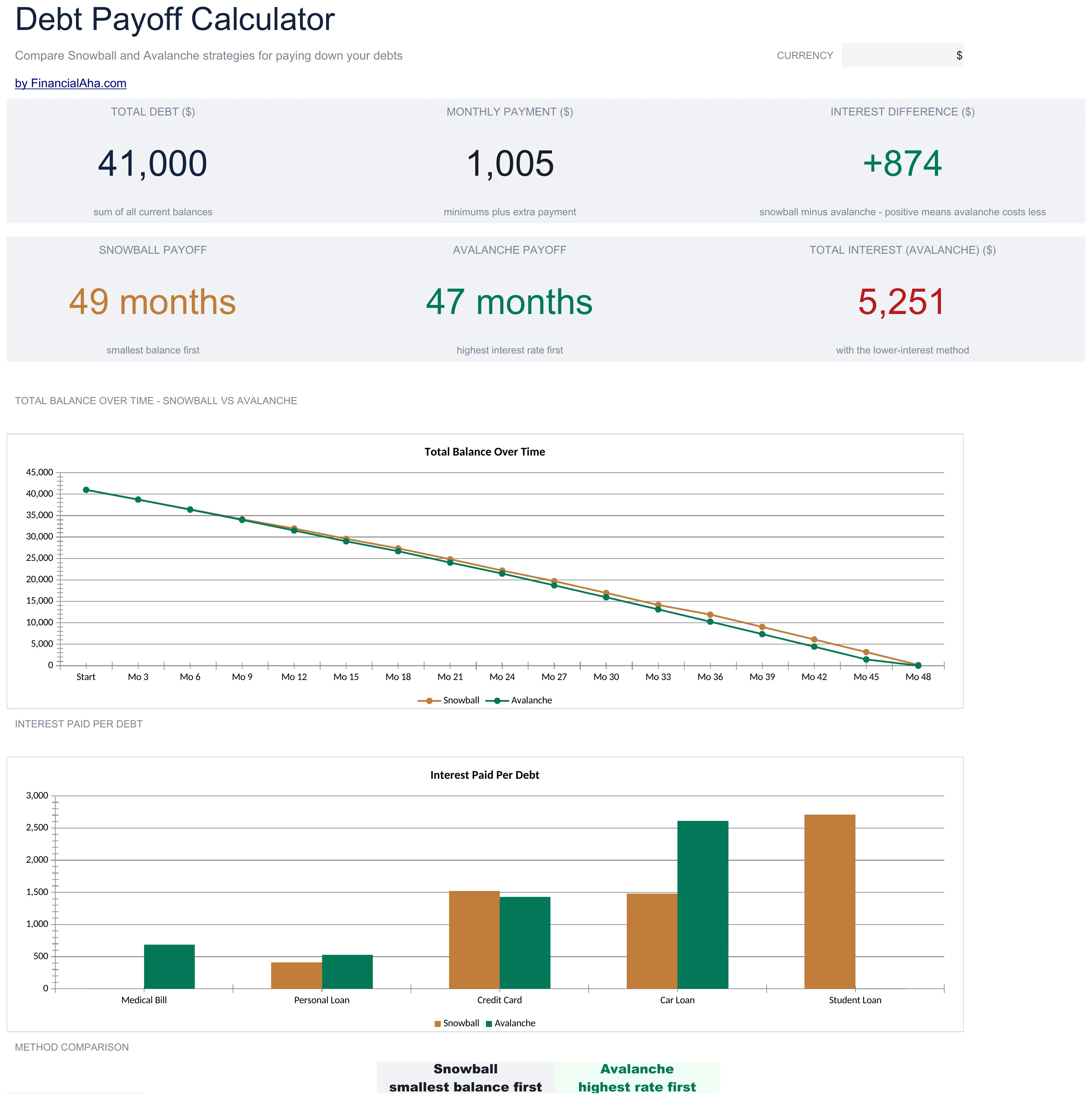 The Debt Payoff Calculator spreadsheet (Essentials tier) reports both payoff timelines and the interest difference from your own balances and rates.
Related
- Debt Payoff Calculator: Snowball vs Avalanche Compared - Hands-on calculator walkthrough with worked examples
- Debt Snowball Spreadsheet - The snowball payoff order built out in one Excel file
- Debt Payoff Calculator - Run the numbers for your debts
- Credit Card Payoff Calculator
- Debt Payoff Spreadsheets That Actually Help
- Debt Payoff Calculator spreadsheet - Snowball vs avalanche across up to eight debts in one Excel or Google Sheets file ($19, Essentials)
- Monthly Budget Template - A budget makes room for the extra payment both methods rely on
Frequently asked questions
What if two debts have the same interest rate?
With equal rates, clearing the smaller balance first eliminates a payment sooner without changing total interest, so it is the common tie-breaker.
Should I include my mortgage?
Most people don't. Mortgage rates tend to be lower, and the balance is large enough to delay progress on smaller debts.
What about 0% promotional rates?
Mathematically, they go at the end of the avalanche list. But watch when the promo ends - if it jumps to 24%, factor in that future rate.
Can I switch methods mid-payoff?
Yes. Many people start with snowball for momentum, then switch to avalanche once the habit is established.
What if I can barely make minimums?
Neither method gains much traction without extra payment. Increasing income or cutting expenses becomes the priority. Even $50/month extra makes a noticeable difference.
Sources
- The 'Snowball' Approach to Paying Off Debt - Kellogg School of Management, Northwestern University
- Research: The Best Strategy for Paying Off Credit Card Debt - Harvard Business Review
About this article
Payoff months and total interest in the worked example recomputed with a standard fixed-payment amortization at the stated balances and APRs Psychology findings checked against the Kellogg School of Management summary and Harvard Business Review research on credit card debt payoff Product claims checked on 2026-09-10 against the shipped Essentials Debt Payoff Calculator workbook (Dashboard, Debt Setup, Payoff Schedule, How to Use tabs) and the on-site Debt Payoff Calculator component Last reviewed September 2026.