
Enter each card's balance, APR, and minimum payment, plus any extra you can add on top, to see how many months until the balance reaches zero and the total interest you will pay. The pattern is steep. A $5,000 balance at 20% APR takes 109 months and $5,840 in interest at a $100 minimum, but only 33 months and $1,522 at $200 a month. Doubling the payment roughly triples the speed, because most of an early minimum payment is interest rather than principal.
Credit card debt creates a simple question: how long until it’s gone?
Enter each card’s balance, interest rate, and minimum payment in the Credit Card Payoff Calculator, add whatever extra you can put toward the debt, and it returns the months to a zero balance. No signup.
Three Numbers You Need
Any payoff calculation rests on three numbers. Current balance is what you owe today, taken from your most recent statement. Interest rate (APR) is your annual percentage rate, also on your statement, where it might be called “Purchase APR”. Monthly payment is what you’ll pay each month going forward.
The calculator below takes those three for each card, using the card’s minimum as the payment field, plus one extra monthly amount applied on top of the minimums. It opens with three cards and the Add Card button adds more. It then reports the months to a zero balance, the total interest, and the total paid under both the avalanche and snowball orders, with a chart of the combined balance falling month by month. Small changes in payment amount can make dramatic differences in both.
Why Minimum Payments Barely Work
On a $5,000 balance at 20% APR, a $100 minimum payment sends about $83 to interest while only about $17 actually reduces the balance. At that pace it takes 109 months, more than nine years, and over $5,800 in interest. You would pay more in interest than the original debt. For context, the average APR on credit card balances that carry interest was 22.15% in mid-2026 according to the Federal Reserve, so the 20% used here is on the conservative side.
Credit card companies set minimums low for a reason - they make more money the longer you take. The minimum is designed to keep you paying, not to get you out of debt efficiently.
Sample Calculations
These tables show how payment amounts affect payoff timeline and total interest.
$5,000 balance at 20% APR:
| Payment | Months | Interest | Total Paid |
|---|---|---|---|
| $100 (min) | 109 | $5,840 | $10,840 |
| $150 | 50 | $2,359 | $7,359 |
| $200 | 33 | $1,522 | $6,522 |
| $300 | 20 | $907 | $5,907 |
| $400 | 15 | $654 | $5,654 |
Doubling the payment from $100 to $200 saves about $4,300 in interest and cuts more than six years off the timeline. The relationship isn’t linear, so small increases have outsized impact.
$10,000 balance at 22% APR:
| Payment | Months | Interest | Total Paid |
|---|---|---|---|
| $200 (min) | 137 | $17,356 | $27,356 |
| $300 | 52 | $5,596 | $15,596 |
| $400 | 34 | $3,500 | $13,500 |
| $500 | 26 | $2,571 | $12,571 |
At $200 a month the minimum barely clears the roughly $183 in monthly interest, which is why the balance drags on for more than eleven years. Moving to $300 more than halves the payoff time, from 137 months to 52. Even $100 extra monthly saves thousands, and the math rewards any additional payment.
Quick Estimation
For rough planning, payment-to-balance ratios give estimates. For a 5-year payoff, aim for about 2.5% of balance monthly. For 3 years, about 4%. For 2 years, about 5%. For 1 year, about 9%.
On $5,000 that means: 5-year equals roughly $125/month, 3-year equals roughly $200/month, 1-year equals roughly $450/month. Use the calculator for exact figures with your specific rate.
The Math Behind It
Understanding the underlying calculation helps explain why minimum payments are so ineffective. Monthly interest charge equals Balance times (APR divided by 12). On $5,000 at 20% APR: $5,000 times (0.20 divided by 12) equals $83.33 monthly interest.
Any payment below $83.33 means the balance grows. The minimum payment barely exceeds this threshold, which is why progress feels invisible. For Google Sheets or Excel users, the formula =NPER(APR/12, -MonthlyPayment, Balance) calculates payoff months. Example: =NPER(0.20/12, -200, 5000) returns about 32.6, meaning the last payment falls in month 33.
Payoff Strategies
Three main approaches exist for paying down credit card debt. Avalanche (interest-first) pays minimums on all cards while directing extra money to the highest APR card. When that’s paid, move to the next highest. Mathematically optimal - saves the most money.
Snowball (balance-first) pays minimums on all cards while directing extra money to the smallest balance. Roll that payment to the next smallest. Produces faster wins and more motivation. May cost slightly more in interest, but the psychological boost helps some people stick with the plan. Our debt snowball vs. avalanche comparison walks through which pattern tends to fit which situation.
Balance transfer moves debt to a 0% promotional card. Pay aggressively during the promo period, which commonly runs 12 to 21 months, and note what happens when that introductory rate ends. Watch for transfer fees of 3 to 5% of the amount moved, per the CFPB. This route only pays off if the balance clears before the promo period closes.
Building Your Payoff Plan
Start by calculating your current payoff date using minimum payments - this is the baseline to improve. Then set a target debt-free date that’s motivating but realistic. Raise the extra payment in the calculator until the timeline lands near that date. Review your budget for extra money to redirect to debt. And critically: stop using the card. No payoff plan works while adding debt.
Finding extra money often starts with quick wins: subscriptions you forgot about, eating out reduction, entertainment spending cuts, shopping pauses. Bigger impact comes from side income dedicated to debt, tax refunds applied to balances, bonus or windfall payments, and temporary lifestyle reduction. Even $50 extra per month makes a meaningful difference on the timeline, and nudging the payment up by about 1% of income at a time is a low-pain way to build toward it.
If you want the payoff schedule saved rather than recomputed each visit, the Credit Card Payoff template ($19, Essentials tier) runs one card through minimum, fixed, and custom payments side by side and charts all three balances month by month.
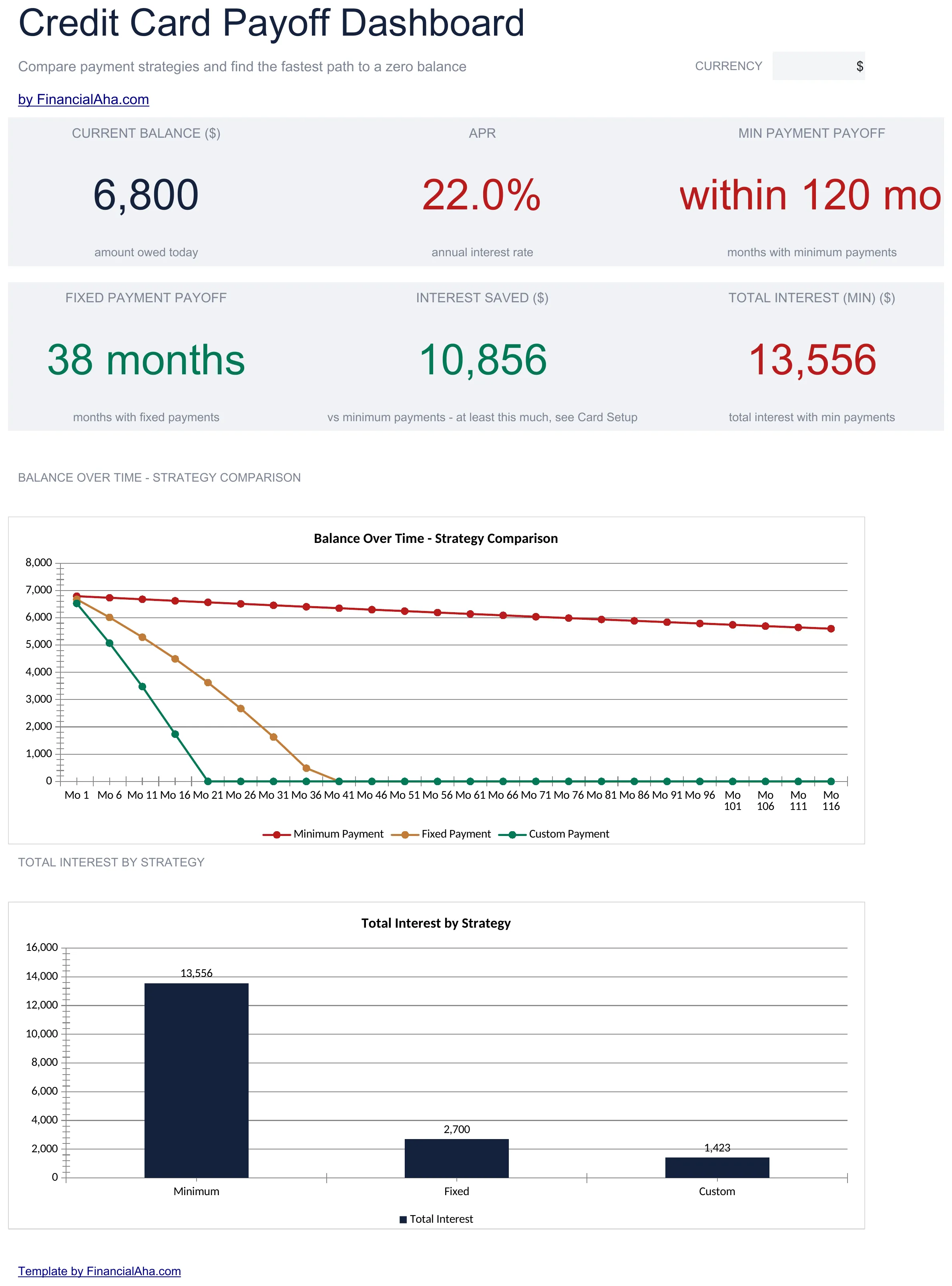 The Credit Card Payoff template (Essentials tier) covers a single card, with a balance-over-time chart for the three payment strategies and a total-interest-by-strategy chart alongside a month-by-month payoff schedule.
Habits That Make the Plan Stick
Calculators show the math. Behavior determines reality. Stop digging - no payoff plan works while adding new debt. Put the card away or freeze it literally in a block of ice.
Automate by setting up automatic payment above the minimum. Remove the monthly decision. Build a $1,000 buffer to keep “emergencies” from going back on the card. Track progress because watching the balance drop keeps you motivated. Update your tracker monthly.
Multiple Cards Strategy
If you have multiple cards, start by listing them with balance, APR, and minimum payment. This creates clarity about the full picture.
| Card | Balance | APR | Minimum |
|---|---|---|---|
| Store Card | $1,200 | 26% | $35 |
| Visa | $4,500 | 19% | $90 |
| Mastercard | $2,800 | 22% | $56 |
Avalanche order prioritizes by interest rate: Store Card (26%), Mastercard (22%), Visa (19%). Snowball order prioritizes by balance: Store Card ($1,200), Mastercard ($2,800), Visa ($4,500). In this example, both methods start with the Store Card. Pay minimums on all cards while attacking one at a time with extra payments.
The fastest way to make any of this concrete is to run your own numbers: drop each card’s balance, APR, and minimum into the Credit Card Payoff Calculator, then nudge the extra monthly payment up by $50 and watch the months to zero and the interest total move. That single comparison is usually enough to decide what the payment should be.
Related
- Credit Card Payoff Calculator
- Credit Card Payoff template ($19, Essentials)
- Debt Snowball vs. Debt Avalanche
- Debt Consolidation Calculator Spreadsheet - When a personal loan or balance transfer actually beats paying the cards directly
- Best Free Debt Payoff Spreadsheets
- Monthly Budgeting template
Frequently asked questions
How accurate are payoff calculators?
Very accurate for a fixed monthly payment on a fixed APR. They drift when you keep charging the card, when a variable APR moves, or when you pay a different amount each month. Re-run the numbers after any of those changes.
Why doesn't the calculator match my statement's payoff estimate?
Card statements model the required minimum, which shrinks as the balance falls, so the payoff stretches out for years. The calculator here holds your payment steady at whatever you enter, so its debt-free date usually arrives much sooner.
Does the payoff estimate assume I stop using the card?
Yes. Every figure assumes no new charges. Adding purchases while paying down resets the math, which is why a payoff plan and continued spending on the same card work against each other.
Should I close cards after paying them off?
Closing a card can affect your credit utilization ratio and the average age of your accounts, both of which feed a credit score. Some people keep paid-off cards open with a zero balance unless an annual fee makes closing worthwhile.
What if I can only afford close to the minimum?
Even $10 to $20 above the minimum shortens the timeline more than the small amount suggests, because the extra goes entirely to principal. Some cardholders also ask the issuer about a lower rate; the calculator shows what any rate change does to the payoff date.
What about debt consolidation loans?
A fixed-rate loan below your card APR can lower total interest, but only if the total repaid over the loan's full term is actually less. A lower monthly payment stretched over more months can cost more overall.
Sources
- Consumer Credit - G.19 (credit card interest rates) - Federal Reserve
- What is a balance transfer fee? - Consumer Financial Protection Bureau
- How long can I keep a low rate on a balance transfer or other introductory rate? - Consumer Financial Protection Bureau
About this article
Payoff months and total interest recomputed with a standard fixed-payment amortization at the stated balance and APR APR benchmark checked against the Federal Reserve G.19 release; balance transfer fee range against the CFPB Calculator inputs, outputs and chart checked on 2026-09-10 against the shipped Credit Card Payoff Calculator component (per-card balance, APR and minimum payment, one extra monthly payment, avalanche vs snowball results, balance-over-time chart) Credit Card Payoff template claims checked on 2026-09-10 against the shipped Essentials workbook (Dashboard, Card Setup, Payoff Schedule, How to Use tabs) Last reviewed September 2026.