
Raising your monthly debt payment by just 1% of income, roughly $30 to $50, can cut years off payoff and save thousands in interest. The method is a ratchet: add one small change, let it settle for a few weeks, then add another. On a $15,000 card at 18% APR, an extra $42 a month cuts payoff from 94 months to 73 and saves about $3,300 in interest.
Increasing your debt payment by just 1% of your income, roughly $30 to $50 extra per month, can cut years off your payoff timeline without requiring a lifestyle overhaul.
See the impact: The Debt Payoff Calculator shows how small extra payments affect your payoff date.
The 1% Rule Explained
The concept is straightforward: make a change equal to about 1% of your income or budget, then maintain it. Once that change feels normal, add another 1% change. Keep going. Over time, these small adjustments compound into significant financial progress without requiring dramatic lifestyle overhauls.
The approach works because changes small enough to stick beat ambitious changes that don’t last. Adjusting gradually rather than shocking your system lets each change become routine before adding the next. Momentum builds over time as the compound effect kicks in - not just on your debt balance, but on your habits and confidence that small actions matter.
Applying 1% to Debt Payoff
Consider someone earning $50,000 annually, where 1% equals $500 per year or about $42 monthly extra toward debt. On a $15,000 credit card balance at 18% APR with $300 fixed payments, the impact is substantial. Holding that $300 flat means 94 months to payoff with about $12,934 in total interest. Adding just $42 monthly (the 1% increment) cuts payoff to 73 months and saves about $3,300 in interest. (The 18% rate here is conservative: the Federal Reserve reports the average rate on card accounts assessed interest above 22%, so higher-rate balances gain even more from each extra dollar.)
| Payment | Payoff Time | Total Interest |
|---|---|---|
| $300/month | 94 months | $12,934 |
| $342/month (+1%) | 73 months | $9,639 |
| $384/month (+2%) | 60 months | $7,742 |
| $426/month (+3%) | 51 months | $6,493 |
Each subsequent 1% increment, going from 1% to 2%, then 2% to 3%, saves roughly $1,200 to $1,900 in additional interest. The compounding nature of interest means every extra dollar toward principal prevents future interest charges, making small additions more powerful than they initially appear.
Plug your own balance, rate, and payment into the calculator below to see how a small monthly bump moves your payoff date and total interest.
Finding Your 1%
Start by calculating your number. Take your monthly after-tax income and find 1% - that’s your target for each incremental change. Someone earning $3,000 monthly looks for $30, while $5,000 monthly income means a $50 target. This specific number makes an abstract concept concrete and searchable.
| Monthly Income | 1% Amount |
|---|---|
| $3,000 | $30 |
| $4,000 | $40 |
| $5,000 | $50 |
| $6,000 | $60 |
Small reductions across multiple categories often prove easier than large cuts in one area. Packing lunch one more day per week saves around $40 monthly. Dropping an unused subscription frees up $15. Reducing grocery spending by 5% might yield $25. Lowering the thermostat by 2 degrees or canceling one streaming service each contribute $15. Any combination reaching your 1% target works.
The Ratchet Method
The ratchet method applies the 1% rule systematically. First, identify your first 1% reduction and redirect that money to debt. Let it run for 2-4 weeks until it feels normal - not painful, just different. Then spot another 1% opportunity and add that to your debt payment. Repeat the cycle indefinitely.
An example progression might unfold like this. Month 1 brings a cancelled unused gym membership adding $30. Month 2, reducing dining out by one meal contributes $25. Month 3, swapping to LED bulbs lowers the electric bill by $15. Month 4, negotiating the phone bill saves $20. By the fourth month, debt payments have increased by $90 monthly without any feeling of lifestyle collapse - each individual change was small enough to absorb.
1% Rule for Raises and Windfalls
Income increases offer natural opportunities for the 1% approach. When a 3% raise arrives, redirecting 1-2% to debt payoff before lifestyle adjusts can accelerate progress significantly. On a $60,000 salary, a 3% raise means $1,800 annually or $150 monthly. Capturing just $50 of that for debt, one-third of the raise, accelerates payoff without any sense of sacrifice since the money was never part of normal spending.
Windfalls present similar opportunities. Tax refunds, bonuses, gift money, and side income all arrive outside regular budget expectations. Putting at least 50% of unexpected money toward debt accelerates payoff without affecting daily life. The remaining 50% can fund something enjoyable, making the split feel balanced rather than punitive.
Making 1% Changes Stick
Changes you won’t notice daily tend to stick better than dramatic cuts. Automatic increases to debt payments happen without daily decisions. Reductions in categories you don’t track closely, like slightly lower thermostat settings, disappear into routine. Substitutions rather than eliminations often feel less like sacrifice.
Worth giving each change 3-4 weeks to feel normal before adding another. Rushing to stack multiple changes often leads to burnout and abandoning everything. Patience with each individual change enables sustainable long-term progress. Watching your debt balance decrease helps maintain motivation during this gradual process - the Net Worth Tracker shows liabilities decreasing over time.
Compounding Effect Over Time
The cumulative impact over time is substantial. In year one, making four 1% changes redirects 4% of income to debt - on a $50,000 income, that’s $167 monthly extra. Year two brings four more changes for 8% total, meaning $333 monthly extra toward debt. The progression continues as long as opportunities exist.
Starting with $15,000 credit card debt at 18%, the math is striking. A flat $300 payment takes 94 months, nearly 8 years. After year one changes adding $167 monthly, payoff drops to about 45 months, roughly 3.8 years. With year two changes adding $333 total, payoff reaches about 30 months, around 2.5 years. Small changes cut payoff time by more than half.
| Scenario | Payoff Time |
|---|---|
| Flat $300 payment | 94 months (7.8 years) |
| Year 1 changes (+$167) | 45 months (3.8 years) |
| Year 2 changes (+$333) | 30 months (2.5 years) |
Common 1% Opportunities
A subscription audit often reveals easy wins. The average household pays $200 or more monthly in subscriptions, so finding $20-40 to cut typically takes just a few minutes of review. Services forgotten, rarely used, or easily replaced with free alternatives make obvious targets.
Food budget tweaks offer multiple paths to savings. One more home-cooked meal per week saves $30-50 monthly. Switching to store brands on staples cuts $20-40. Reducing food waste through better planning and storage might save another $30-50. Transportation savings come from better route planning ($10-20 monthly in gas) and maintenance keeping your car running efficiently ($10-20). Utility reductions through LED bulbs ($5-15), smart thermostat optimization ($10-20), and water conservation ($5-10) add up quietly.
When 1% Isn’t Enough
High-interest debt sometimes requires more aggressive approaches. If paying only minimums while interest accumulates rapidly, the 1% method alone may feel inadequate. Worth considering temporarily cutting deeper at 20-30%, adding income sources, or exploring balance transfer options to lower the interest rate. Our roundup of free debt payoff spreadsheets covers tools that model these scenarios side by side.
If minimum payments barely cover interest charges, the situation feels especially frustrating - but even small extra amounts make a significant difference. The 1% approach can still work as a starting point. Beginning with something, even if not optimal, beats waiting for a perfect plan that never materializes.
Combining with Debt Strategies
The 1% rule complements other debt payoff strategies. With the debt avalanche approach, applying 1% increases to the highest interest debt first maximizes interest savings. Each bit of extra payment goes to the debt costing you most, accelerating overall progress. Our debt snowball vs. debt avalanche comparison walks through which ordering tends to fit which situation.
With the debt snowball approach, applying extra payments to the smallest balance provides faster psychological wins. When that debt clears, roll the freed payment plus accumulated 1% increases to the next debt. This is exactly what the Debt Snowball template automates: the extra amount lands on the smallest balance first, then cascades to the next debt when one is paid off.
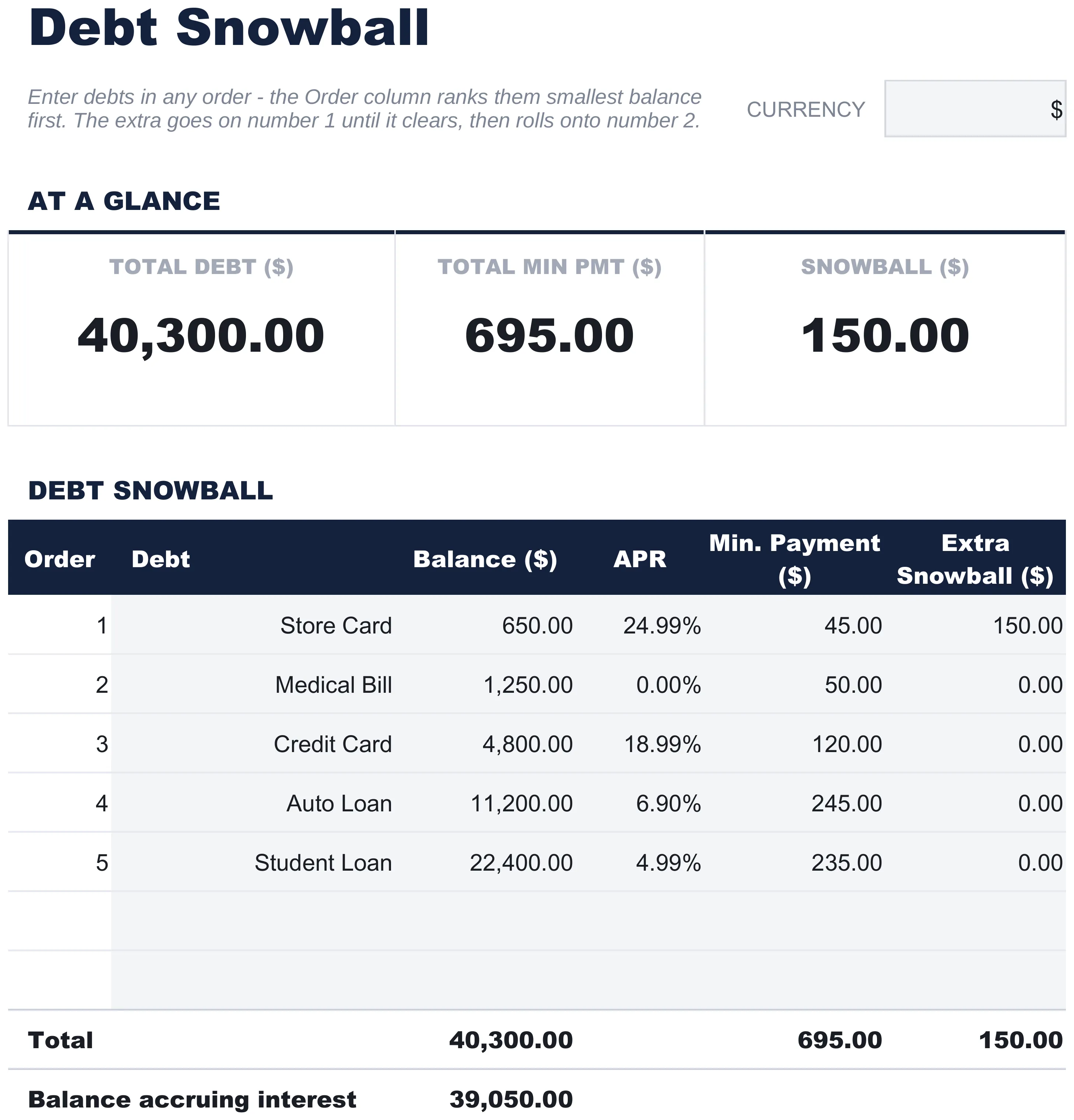
The free Debt Snowball template ranks debts smallest balance first and keeps the extra payment in its own column. The $19 Essentials version adds a Debt Setup sheet with a single extra-payment input and a month-by-month Snowball Schedule that moves the extra onto the next debt as each one clears.
After consolidating multiple debts into one loan, the 1% rule applies to the single combined payment. Lower interest rates after consolidation mean more of each extra dollar goes to principal rather than interest.
Building Momentum
Momentum builds in phases. During the first 3 months, focus on finding low-pain 1% reductions. No need to optimize everything at once - just start. Months 4-6, as earlier changes feel normal, add another 1-2 small adjustments. Small increments maintain the sustainable pace.
Months 7-12 often reveal larger opportunities. Renegotiating bills, finding better deals on insurance or services, and small income additions become visible once you’re actively looking. Beyond year one, changes stick as permanent budget adjustments. When debt is finally paid, the same gradual approach works for building savings and investments.
After Debt Payoff
When debt is eliminated, redirecting the payment amount rather than letting it disappear into general spending preserves hard-won progress. The monthly amount that was going to debt can fund emergency savings, retirement contributions, or other financial goals. Lifestyle inflation absorbs freed-up money remarkably quickly if not directed intentionally.
The same 1% approach works for building wealth after debt. Gradual increases to savings rate that don’t shock your lifestyle accumulate over time. The habits developed during debt payoff, finding small efficiencies, automating contributions, and celebrating incremental progress, transfer directly to the wealth-building phase. The Financial Planning Template projects assets and debt forward to a chosen end year from income, expense and growth assumptions, and tracks the result against the targets on its Goals tab, including an average monthly savings goal.
Related
- Debt Payoff Calculator - See how an extra 1% moves your payoff date and interest
- Debt Snowball Template - Ranks debts smallest-first and rolls extra payments forward
- Debt Snowball vs. Debt Avalanche - Which payoff order fits your situation
- Free Debt Payoff Spreadsheets - Tools that model payoff scenarios side by side
- Monthly Budget Template - Find the extra money to redirect toward debt
- Financial Planning Template - Long-term projections once debt is cleared
The 1% rule turns debt payoff from an overwhelming project into a series of small, manageable steps. Each change is minor in isolation, but the cumulative effect adds up. A practical next move: open the Debt Payoff Calculator, enter your real balance and rate, then add your 1% to the monthly payment and watch the payoff date shift.
Frequently asked questions
What if I can't find even 1%?
Starting with 0.5% is an option. Any amount matters, and reviewing spending for true essentials versus habits may reveal easier adjustments than expected.
How long should I wait between changes?
3-4 weeks minimum provides time for each change to feel normal. If a change creates ongoing stress rather than settling into routine, it may be too aggressive.
Does 1% really make a difference?
Yes - especially with high-interest debt where every extra dollar prevents future interest charges. The math shows years saved and thousands in interest avoided from seemingly small additions.
What if I have multiple debts?
The approach still works. Applying extra payments to one debt at a time, either the highest interest or the smallest balance, concentrates impact rather than spreading thin across multiple accounts.
Is the 1% based on gross or take-home income?
Either can work, but take-home (after-tax) income keeps the number tied to money you actually control. On $5,000 gross, 1% is $50; on $3,900 take-home, it is $39. Picking one and staying consistent matters more than which you choose.
Does the 1% rule work with irregular income?
It can, though the target shifts month to month. Some people base the 1% on their lowest recent month so the extra payment stays affordable in lean stretches, then add windfall amounts on top in stronger months.
Sources
- Consumer Credit - G.19: Terms of Credit, Credit Card Interest Rates - Federal Reserve
About this article
Payoff timelines are standard fixed-payment amortization at the stated balance, APR, and monthly payment Credit card interest rates checked against the Federal Reserve's G.19 Consumer Credit release Template sheets, inputs and outputs checked on 2026-09-10 against the shipped Essentials Debt Snowball workbook (Dashboard, Debt Setup, Snowball Schedule), the Premium Net Worth Tracker (Summary, Liabilities) and the Premium Financial Planning sheet (Goals, Projection) Last reviewed September 2026.