
On a $25,000 auto loan at 7% over 5 years, an extra $50 a month clears the balance about 6 months early and saves roughly $520 in interest; $100 a month saves near $940. The earlier in the term you add the payment, the more you save, because that is when the largest share of each payment goes to interest.
An extra $50 a month on a typical $25,000 auto loan at 7% saves over $500 in interest and clears the balance about six months early, and the savings grow the earlier in the term you start. The 7% used throughout this guide is close to the national average: the Federal Reserve’s G.19 release put the average 60-month new car loan at commercial banks at 7.14% in June 2026.
Run the extra payment: The Debt Payoff Calculator takes a balance, a rate and a minimum payment, then returns the payoff time, the total interest and the interest an extra monthly payment saves.
Understanding Auto Loan Amortization
Like mortgages, auto loans amortize, meaning each payment covers both interest and principal, but the ratio changes dramatically over time. Early in your loan, a significant chunk of each payment goes to interest. By the end, almost all of it goes to principal. This structure is why extra payments early in the loan term save far more interest than extra payments later. The loan amortization guide walks through the mechanics in more detail.
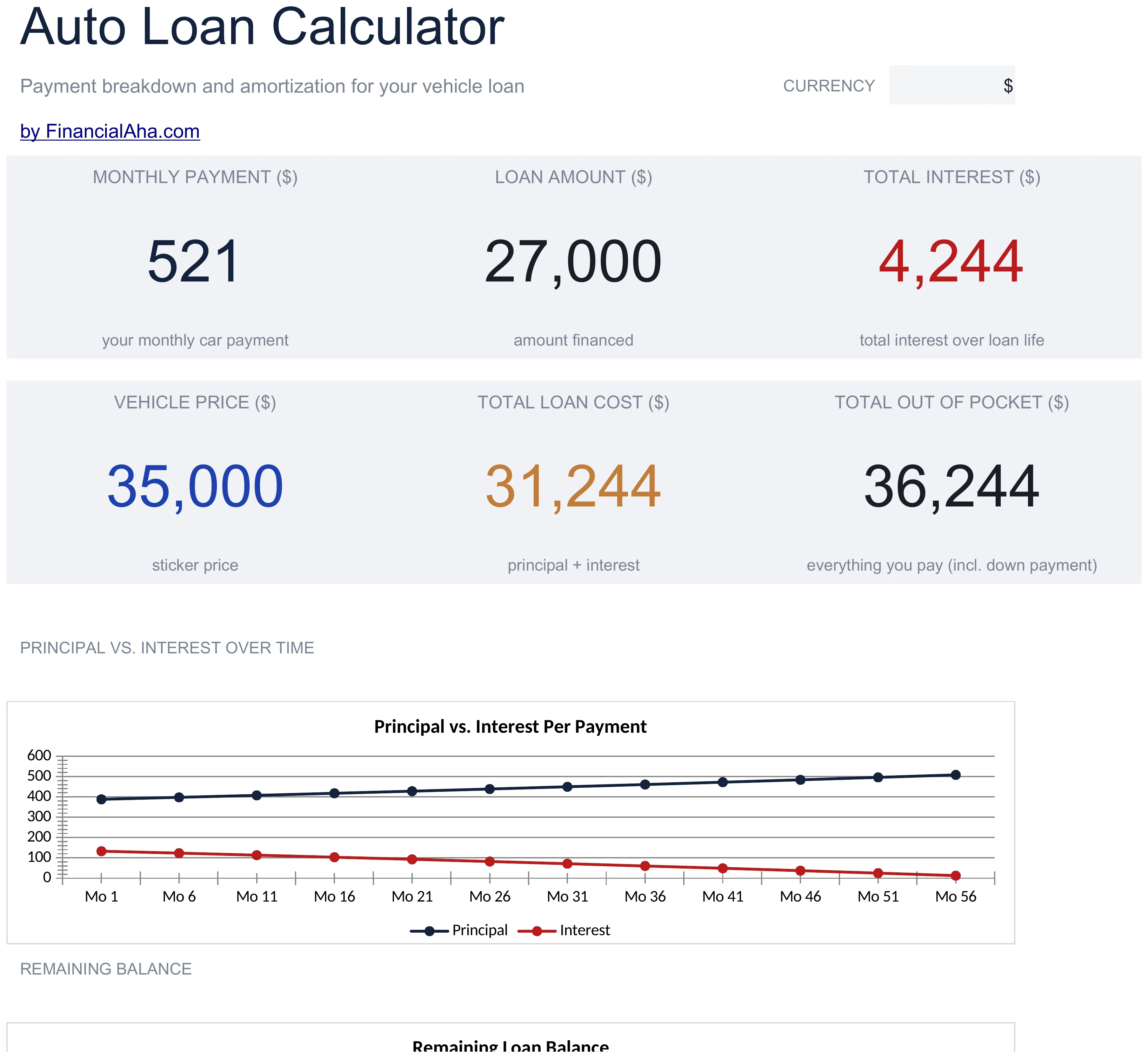
The Auto Loan Calculator (Essentials tier) plots the principal and interest split at intervals across the term, and its Amortization Schedule sheet carries a row for every payment, so the front-loaded interest is visible at a glance.
Understanding this shift helps explain why that $50 extra each month has such outsized impact. When you make an extra payment, you’re reducing the principal balance that future interest gets calculated on. The earlier you do this, the more months of interest savings you accumulate.
Example: $25,000 Loan at 7% for 60 Months
Payment 1:
- Total payment: $495
- Interest: $146 (29%)
- Principal: $349 (71%)
Payment 30 (Halfway):
- Total payment: $495
- Interest: $82 (17%)
- Principal: $413 (83%)
Payment 60 (Final):
- Total payment: $495
- Interest: $3 (1%)
- Principal: $492 (99%)
Early extra payments eliminate future interest that would have accrued on that principal. By the final payment, there’s almost no interest left to save - the battle is essentially won or lost in the first half of the loan.
Basic Auto Loan Calculations
Calculating your auto loan payments in a spreadsheet gives you control over scenario planning. You can quickly see how different loan terms, interest rates, or extra payments affect your total cost. To run the numbers without building anything, the Auto Loan Calculator below returns the monthly payment, the amount financed, the total interest and the total cost, with sales tax, down payment and trade-in equity broken out:
To build it yourself, here are the key formulas you’ll need.
Monthly Payment Formula (Google Sheets)
=PMT(rate/12, months, -principal)Example: $25,000 at 7% for 60 months:
=PMT(0.07/12, 60, -25000)Result: $495.03/month
Total Interest Calculation
=(Monthly_Payment × Total_Months) - Original_Principal($495.03 × 60) - $25,000 = $4,702 total interest
Extra Payment Scenarios
The real power of understanding auto loan math comes from running different scenarios. Small changes in monthly payment can translate to significant savings in total interest and months of payments. Here’s how different extra payment strategies stack up on a $25,000 loan at 7% over 60 months.
$50 Extra Monthly
$25,000 loan at 7%, 60 months
| Metric | Standard | +$50/month |
|---|---|---|
| Monthly payment | $495 | $545 |
| Payoff time | 60 months | 54 months |
| Total interest | $4,702 | $4,179 |
| Interest saved | - | $523 |
$50 a month saves over $500 and shaves off six months. For many households that is an achievable stretch, roughly the cost of eating out a few fewer times a month.
$100 Extra Monthly
| Metric | Standard | +$100/month |
|---|---|---|
| Monthly payment | $495 | $595 |
| Payoff time | 60 months | 49 months |
| Total interest | $4,702 | $3,763 |
| Interest saved | - | $939 |
$100 a month saves over $900 and 11 months. Doubling the extra payment nearly doubles both the interest saved and the months shaved off, because each dollar of principal you retire early stops accruing interest for the rest of the term.
Biweekly Payments
Pay half your monthly payment every two weeks (26 half-payments = 13 full payments/year).
| Metric | Standard | Biweekly |
|---|---|---|
| Payoff time | 60 months | 55 months |
| Total interest | $4,702 | $4,262 |
| Interest saved | - | $440 |
Biweekly payments work because there are 52 weeks in a year, so you end up making 26 half-payments - the equivalent of 13 full monthly payments instead of 12. It’s a relatively painless way to make one extra payment per year.
Lump Sum Payment Impact
Sometimes you come into extra money - a tax refund, a bonus, a gift. Applying these windfalls to your auto loan principal can accelerate payoff significantly, but timing matters.
A single $1,000 extra principal payment saves different amounts depending on when you make it:
| Timing | Interest Saved |
|---|---|
| Month 6 | ~$360 |
| Month 24 | ~$225 |
| Month 48 | ~$70 |
Earlier lump sums save more because they prevent interest from accruing over more months. A $1,000 payment in month 6 prevents interest from accruing on that $1,000 for the remaining 54 months. The same payment in month 48 only prevents 12 months of interest.
If you receive a $3,000 tax refund in Year 1 of a 5-year loan and apply it to principal, you could save roughly $900 to $1,150 in interest at a 7% rate, depending on how early in the year you apply it. That interest is avoided for certain, which is what makes an early lump sum hard to match elsewhere.
Auto Loan Payoff Calculator Spreadsheet
Building your own payoff calculator in a spreadsheet takes about 15 minutes and gives you a tool you can use for any loan. You’ll need input cells for the key variables and formulas that calculate your results.
Input Section
- Original loan amount
- Interest rate
- Original term (months)
- Current balance
- Months remaining
- Extra monthly payment
- Lump sum amount
Output Section
- New payoff date
- Months saved
- Interest saved
- Total savings
Key Formulas
Months to payoff with extra payments:
=NPER(Rate/12, -(StandardPayment + ExtraMonthly), CurrentBalance)Interest saved:
=StandardTotalInterest - AcceleratedTotalInterestBefore Paying Extra: Check These First
Before aggressively paying down your auto loan, it’s worth stepping back and looking at your complete financial picture. Paying extra on a car loan feels good, but it’s not always the optimal use of those dollars.
Check your loan agreement for prepayment penalties first. Most modern auto loans don’t have them, but some do charge fees for early payoff, and the CFPB notes that a few states restrict them while others allow them. If there’s a penalty, it belongs in your calculation, because it can wipe out the interest savings entirely.
Then there’s your emergency fund. Paying extra on a 7% car loan while carrying no emergency savings adds risk: a car repair or medical bill could push you into new high-interest debt, which cancels out the point of paying down the loan. Credit cards at 20%+ cost far more than a 7% car loan, so higher-rate debt clears more interest per dollar, as the credit card payoff numbers show. And an employer 401(k) match is an instant 100% return on the matched portion, a return that paying off even a high-interest loan can’t match mathematically.
When Early Payoff Makes Sense
Not everyone is in the same position, and early payoff makes more sense in some situations than others. Here’s how to think about whether accelerating your auto loan payments fits your situation.
Good Candidates for Extra Payments
- High interest rate (8%+)
- Emergency fund is solid
- No higher-interest debt
- Getting employer 401(k) match
- Loan is near the beginning (more interest to save)
Maybe Wait If
- Low interest rate (under 5%)
- No emergency fund
- Credit card debt exists
- Not maximizing retirement match
In these situations, the extra money often does more good elsewhere. A 4% car loan isn’t urgent when you’re carrying 20% credit card debt or missing out on employer match.
Payoff vs. Trade-In
Trading in an underwater car, one where you owe more than it’s worth, often rolls negative equity into the next loan. This perpetuates the debt cycle and can leave you even more underwater on the replacement vehicle. It’s a trap that keeps some people in continuous car debt.
If you’re considering trading in, calculate your current payoff amount and get a trade-in value estimate. If you’re underwater, paying down to break even first avoids rolling negative equity into the next loan. Keeping the current car longer, paying it down, and waiting until you have equity is one way to sidestep the trap entirely.
After Payoff: What to Do with the Payment
Once your car is paid off, you have a choice about that monthly payment. One common outcome is that it quietly disappears into general spending with nothing to show for it. The freed-up cash flow is an opportunity to accelerate other financial goals instead.
One approach is to continue “paying” yourself the car payment into savings. When you need the next car, you’ll have a substantial down payment or can pay cash entirely. This breaks the cycle of always having a car payment.
Alternatively, redirect to other priorities:
- Boost emergency fund
- Pay extra on mortgage
- Increase retirement contributions
- Fund other savings goals
What matters is making a deliberate choice rather than letting lifestyle inflation absorb the difference. Giving the freed-up payment a named line in a Monthly Budget Template is one way to keep it from vanishing.
Insurance Considerations
While you’re paying off the loan, lenders typically require comprehensive and collision coverage. Once the car is paid off, you can choose your coverage level - and this often presents an opportunity to reduce costs.
With a paid-off vehicle, you may be able to raise your deductible, reduce or drop collision coverage on older vehicles, and drop gap insurance (which is no longer relevant once you have equity). These changes can meaningfully reduce insurance costs. However, the right choice depends on your car’s current value, your ability to replace it if totaled, and your overall financial situation.
Early auto loan payoff saves interest and frees up cash flow sooner, though whether it fits depends on your full picture: the interest rate, your emergency savings, other debts, and any employer retirement match. Run your own numbers through the Auto Loan Calculator to see the monthly payment and total interest at stake, then check what an extra payment does to a balance in the Debt Payoff Calculator.
Related
- Debt Payoff Calculator - Payoff time and interest saved on a balance
- Loan Payment Calculator: Understanding Amortization - How each payment splits between interest and principal
- Debt Snowball vs. Debt Avalanche - Two ways to sequence extra payments
- Credit Card Payoff Calculator - Where higher-rate debt usually comes first
- Emergency Fund Calculator - The buffer to weigh before paying extra
Frequently asked questions
Should I pay off my car or invest the extra?
Investing might win mathematically if your loan rate is below 5-6%, but guaranteed debt elimination has a psychological value that pure math doesn't capture. It comes down to how you weigh a certain return against a possible one.
Does early payoff affect my credit?
Paying off an installment loan can temporarily lower a credit score because it thins out your credit mix. The dip is usually small and short-lived, and it doesn't undo the interest you saved.
What if I'm underwater on my loan?
Being underwater means you owe more than the car is worth. Extra payments still help by building equity faster, but they won't immediately erase negative equity, so the gap closes gradually rather than all at once.
How do I make sure extra payments go to principal?
Extra money only saves interest if it reduces principal. Many lenders let you mark a payment 'apply to principal'; without that flag, some apply it to the next scheduled payment instead, which pushes your due date out but doesn't cut interest.
Do biweekly payments actually work on an auto loan?
Only if the lender applies each half-payment when it arrives rather than holding it until the full amount is due. Some servicers hold biweekly payments, which removes the benefit. It's worth confirming before setting one up, and a manual 13th payment each year has the same effect.
Is refinancing better than paying extra?
They solve different problems. Refinancing lowers the rate on the whole balance; extra payments shrink the balance the rate applies to. On a high-rate loan with good credit, refinancing can save more, and the two can be combined.
Sources
- Consumer Credit - G.19 (Terms of Credit, new car loans at commercial banks) - Federal Reserve
- What should I do if I want to pay off my auto loan early? - Consumer Financial Protection Bureau
About this article
Payment, payoff, and interest-saved figures were recalculated from a standard amortization schedule for a $25,000 loan at 7% over 60 months. The 7% example rate was checked against the Federal Reserve's G.19 Consumer Credit release for 60-month new car loans. Calculator inputs and outputs checked on 2026-09-10 against the shipped Auto Loan Calculator and Debt Payoff Calculator components, and the screenshot caption against the Essentials Auto Loan Calculator workbook (Dashboard, Auto Loan Setup, Amortization Schedule, How to Use). Last reviewed September 2026.